Estring 7.5 micrograms every 24 hours vaginal delivery system
Spain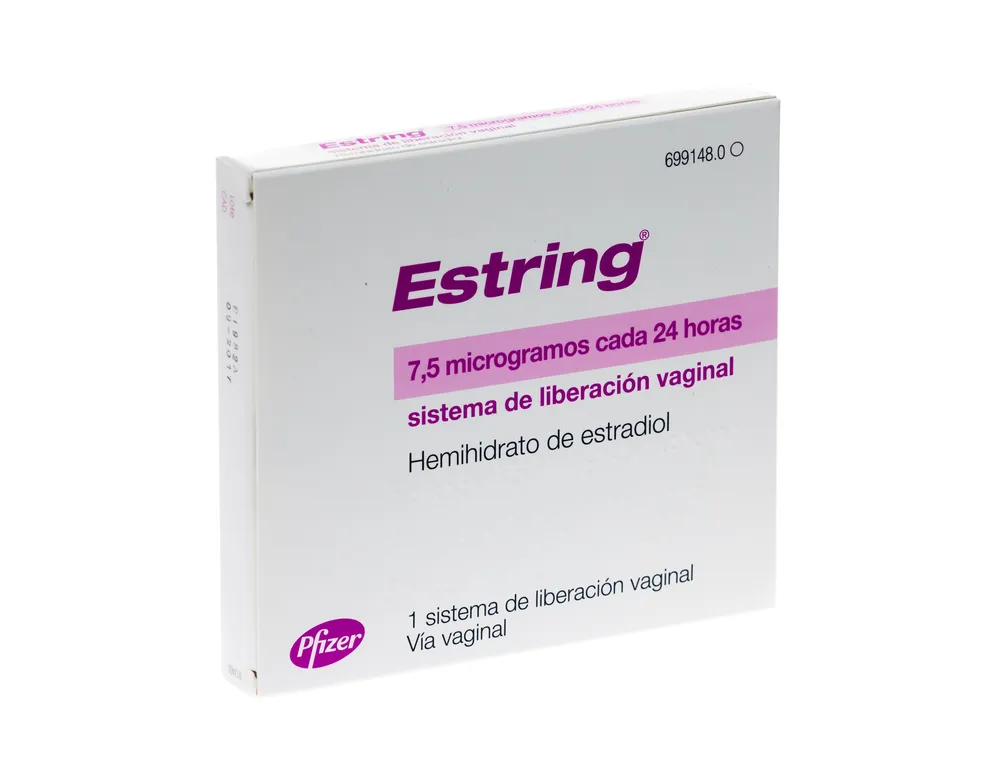
Table of Contents
Package Leaflet: Information for the User
Introduction
Package leaflet: information for the patient
Estring 7.5 micrograms per 24 hours vaginal ring system
Estradiol hemihydrate
Read the entire leaflet carefully before you start using this medicine, because it contains important information for you.
- Keep this leaflet, as you may need to read it again.
- If you have any questions, ask your doctor or pharmacist.
- This medicine has been prescribed for you only; do not give it to others, even if they have the same symptoms as you, because it could harm them.
- If you experience any adverse effects, talk to your doctor or pharmacist, even if they are not listed in this leaflet. See section 4.
Leaflet Contents
- What Estring is and what it is used for.
- What you need to know before using Estring.
- How to use Estring.
- Possible side effects.
- How to store Estring.
- Contents of the pack and other information.
1. What Estring is and what it is used for
Estring is a vaginal ring containing the active substance estradiol hemihydrate, which is a naturally occurring form of the main female sex hormone, estrogen.
As women approach menopause, their ovaries produce decreasing amounts of estrogen. Low estrogen levels can cause symptoms such as vaginal dryness, inflammation, or itching, which in turn may lead to sores or painful sexual intercourse, and an increased tendency toward vaginal or urinary tract infections.
Estring is part of hormone replacement therapy (HRT) that acts locally in the vagina to maintain adequate estrogen concentration, thereby relieving these symptoms in postmenopausal women. It does not treat other menopausal symptoms such as hot flushes and sweating. Inform your doctor if you also experience these problems.
2. What you need to know before using Estring
Medical review
Estring may not be suitable for all women. Before starting to use Estring, your doctor should ask you about your personal and family medical history. Your doctor may decide to examine your breasts and/or abdomen, and may perform an internal examination, but only if these examinations are necessary for you or if you have any specific concerns.
Once you have started hormone replacement therapy (HRT), it is recommended that you visit your doctor for regular check-ups (at least once a year). During these check-ups, your doctor will discuss with you the benefits and risks of continuing HRT.
Make sure to:
- attend regular breast screening and cervical smear tests;
- regularly examine your breasts to detect any changes, such as skin dimpling, changes in the nipple, or any lump that you can see or feel.
Do not use Estring if you have any of the following conditions:
- if you are allergic to estradiol or to drugs similar to hormone replacement therapy, or to any of the other components of this medicine (listed in section 6);
- hereditary blood disorder (porphyria);
- estrogen-sensitive cancer, e.g., endometrial cancer (cancer of the uterus), or if such cancer is suspected;
- history or current presence of a "thrombus" (blood clot traveling through the bloodstream and blocking blood vessels in the leg or elsewhere in the body; also known as "deep vein thrombosis" [DVT]);
- if you have or have had breast cancer, or if it is suspected;
- vaginal bleeding that you have not reported to your doctor;
- history or current presence of liver disease, where liver function tests remain abnormal;
- excessive growth of the tissue lining the uterus (untreated endometrial hyperplasia);
- history or current presence of blocked arteries that could lead to cardiovascular disease, such as angina pectoris or myocardial infarction;
- blood coagulation disorder (thrombophilia, such as protein C, protein S or antithrombin deficiency).
If any of the above conditions develops for the first time while using Estring, stop using it immediately (remove the ring if possible) and consult your doctor immediately.
Warnings and precautions
Consult your doctor or pharmacist before starting to use Estring.
Your doctor will assess your health status and explain in detail the benefits and risks of hormone replacement therapy before prescribing Estring. Inform your doctor if you currently suffer from or have previously had any of the following conditions, to help determine whether treatment with Estring is suitable for you:
- pelvic organ prolapse (weakening of the structures supporting internal organs) or if you have ever had surgery for prolapse;
- long-term treatment with steroids or adrenal gland problems; for example, a condition called Cushing's disease (in which you may experience thinning or reddening of the skin);
- vaginal discomfort, bleeding, or pain in the vagina, including irritation or discharge, which may be caused by ulcers or infection;
- if you have a short and narrow vagina, due to previous surgery or a condition known as vaginal atrophy;
- fluid retention due to kidney or heart problems;
- high levels of triglycerides (a type of fat) in the blood;
- liver disorders (including liver tumors);
- diabetes;
- family history of cancer (particularly breast cancer);
- risk factors for venous blood clots (venous thromboembolism or deep vein thrombosis); see section 2 below for more information on the risks of using Estring;
- high blood pressure;
- migraine or severe headache;
- uterine fibroids (growths in the uterine walls);
- seizures (epilepsy);
- gallstones;
- autoimmune disease, systemic lupus erythematosus (SLE);
- history of endometrial hyperplasia (an increase in the number of cells in the tissue lining the uterus);
- endometriosis (endometrial tissue found outside the uterus);
- hearing problems due to ear scarring (otosclerosis);
- asthma;
- hereditary or acquired angioedema.
If any of the above conditions worsens or recurs while using Estring, you should remove the Estring ring and consult your doctor immediately.
Stop using Estring (remove the ring if possible) and consult your doctor immediately
If you experience any of the following symptoms while using HRT, remove the Estring vaginal ring and consult your doctor immediately. If you experience difficulty or pain when trying to remove the vaginal ring, do not continue and consult your doctor:
- if you develop any of the conditions listed in the section do not use Estring
- if you develop yellowing of the skin or whites of the eyes (jaundice). These may be signs of liver disease;
- if you develop swelling of the face, tongue and/or throat and/or difficulty swallowing or hives along with difficulty breathing, which are indicative of angioedema;
- if you experience a significant increase in blood pressure (symptoms may include headache, fatigue, dizziness);
- if you experience headaches similar to migraines that occur for the first time;
- if you become pregnant;
- if you notice signs of a blood clot such as:
- painful swelling and redness in the legs
- sudden chest pain
- difficulty breathing
For more information, see: Blood clots in a vein (thrombosis)
Note: Estring is not a contraceptive. If less than 12 months have passed since your last menstrual period or if you are under 50 years of age, you may still need to use an additional contraceptive method to prevent pregnancy. Speak with your doctor for advice.
HRT and cancer
Excessive thickening of the uterine lining (endometrial hyperplasia) and cancer of the uterine lining (endometrial cancer)
Long-term use of estrogen-only HRT tablets may increase the risk of developing cancer in the lining of the womb (endometrium).
It is uncertain whether a similar risk exists with Estring with repeated or long-term use (more than one year). However, it has been shown that Estring has very low systemic absorption into the bloodstream, so it is not necessary to add a progestogen.
If you experience bleeding or spotting, it is usually not a cause for concern, but you should schedule an appointment with your doctor without delay. It could be a sign that your endometrium has thickened.
The following risks apply to HRT medications that circulate in the bloodstream. However, Estring is intended for local vaginal treatment and systemic absorption is very low. It is less likely that the conditions listed below will worsen or reappear during treatment with Estring, but you should consult your doctor if you are concerned.
Breast cancer
Evidence suggests that using Estring does not increase the risk of breast cancer in women with no history of breast cancer. It is unknown whether Estring can be used safely in women who have previously had breast cancer.
- Regularly examine your breasts. Consult your doctor if you notice any changes such as:
- skin dimpling
- changes in the nipple
- any lump that you can see or feel
In addition, participation in early detection screening programs with mammograms is recommended when advised.
Ovarian cancer
Ovarian cancer is rare, much rarer than breast cancer. The use of estrogen-only HRT has been associated with a slightly increased risk of ovarian cancer.
The risk of ovarian cancer varies with age. For example, in women aged 50 to 54 years who do not take HRT, approximately 2 out of 2000 women will be diagnosed with ovarian cancer over a 5-year period. For women who have been taking HRT for 5 years, there will be approximately 3 cases per 2000 users (i.e., about 1 additional case).
Effects of HRT on the heart and circulation
Blood clots in a vein (thrombosis)
The risk of venous blood clots is approximately 1.3 to 3 times higher in users of HRT than in non-users, especially during the first year of treatment.
Blood clots can be serious, and if they travel to the lungs, they can cause chest pain, difficulty breathing, fainting, or even death. This condition is known as pulmonary embolism (PE).
Deep vein thrombosis (DVT) and PE are examples of a condition called venous thromboembolism (VTE).
You are more likely to develop a blood clot in a vein as you age or if any of the following apply to you. Inform your doctor if any of these situations apply to you:
- If you have cancer
- If you are severely overweight
- If you have ever had a blood clot
- If a close family member has had blood clots
- If you have had one or more miscarriages
- If you have a blood clotting disorder requiring treatment with a medication such as warfarin or acenocoumarol
- If you spend prolonged periods in bed due to major surgery, injury, or illness
- If you have a rare condition called systemic lupus erythematosus
If any of these situations apply to you, consult your doctor to determine whether you should use hormone replacement therapy.
For women aged 50 to 60 years who do not take hormone replacement therapy: on average, over a 5-year period, 4–7 out of 1,000 would be expected to develop a blood clot in a vein.
For women aged 50 to 60 years who are taking estrogen-only hormone replacement therapy over a 5-year period, the figure would be 5–8 cases per 1,000 (i.e., one additional case).
If you experience:
- painful swelling in the leg;
- sudden chest pain;
- difficulty breathing.
Consult a doctor as soon as possible and do not continue using hormone replacement therapy until your doctor advises you that it is safe to do so. These may be signs of a blood clot.
If you are scheduled for surgery, ensure your doctor is informed. You may need to stop using hormone replacement therapy approximately 4 to 6 weeks before the operation to reduce the risk of developing a blood clot. Your doctor will advise you when you can resume HRT.
Heart disease
For women treated only with estrogen therapy, there is no increased risk of developing heart disease
Stroke
The risk of stroke is about 1.5 times higher in users of hormone replacement therapy than in non-users. The number of additional stroke cases due to HRT use increases with age. Other factors that may increase the risk of stroke include:
- aging;
- high blood pressure;
- smoking;
- excessive alcohol consumption;
- irregular heart rhythm.
If you are concerned about any of these factors or if you have had a stroke in the past, consult your doctor to determine whether you should use hormone replacement therapy.
For women aged 50 to 60 years who do not take hormone replacement therapy: on average, over a five-year period, 8 out of 1,000 would be expected to have a stroke.
For women aged 50 to 60 years who are taking hormone replacement therapy, the figure would be 11 out of 1,000 over a five-year period (i.e., 3 additional cases).
- If you experience: unexplained, migraine-type headaches, with or without visual disturbances.
Consult a doctor as soon as possible and do not continue using hormone replacement therapy until your doctor advises you that it is safe to do so. These headaches may be an early warning sign of a stroke.
Other information
Hormone replacement therapy does not prevent memory loss. In a study of women who started using combined HRT or estrogen-only therapy after age 65, a small increase in the risk of dementia was observed.
Women with hypertriglyceridemia may experience large increases in plasma triglycerides, which can lead to inflammation of the pancreas (pancreatitis). Symptoms of pancreatitis may include abdominal pain, abdominal swelling, fever, and nausea or vomiting.
Blood tests
If you are scheduled for blood tests (e.g., to check for elevated triglycerides, a type of fat in the blood), inform your doctor that you are using Estring, as these tests may be affected by the use of the vaginal delivery system.
Use of other medicines
Inform your doctor or pharmacist if you are using or have recently used any other medicines, including those obtained without a prescription.
Specifically, inform your doctor if you are taking:
- anticonvulsants used to treat epilepsy, such as phenobarbital, phenytoin, or carbamazepine;
- antimicrobials such as rifampicin or rifabutin;
- medications used to treat HIV infection, such as ritonavir, nelfinavir, nevirapine, or efavirenz;
- herbal preparations containing St. John's wort (Hypericum perforatum).
It is recommended to remove the ring if you are constipated or if you are using vaginal preparations.
Pregnancy and breastfeeding
Estring must not be used during pregnancy. If you become pregnant while using Estring, you must stop using Estring immediately (remove the ring if possible) and inform your doctor that you are pregnant. Estring must not be used during breastfeeding.
Consult your doctor or pharmacist before taking any medicine while breastfeeding.
Driving and using machines
No special precautions are required; you may drive or use machines as long as you feel well.
3. How to use Estring
Follow exactly the instructions for administering this medicine as given by your doctor. If in doubt, consult your doctor or pharmacist again. Follow exactly the instructions for administering the medicine contained in this leaflet. You must wash your hands thoroughly before inserting the Estring vaginal ring system.
To insert the Estring vaginal ring system into the vagina
- Relax and find a comfortable position.
- Stand with one foot on a chair or lie on your back with your knees bent upwards.
- With one hand, separate the skin folds around the vagina.
- With the other hand, gently press the ring to make it oval-shaped.
- Push the ring into the vagina as far as possible, moving it up and down until it reaches the vaginal vault.
- Finally, wash your hands.
If the ring falls out, rinse it with lukewarm (not hot) water and then reinsert it.
While using the Estring vaginal ring system
At first, you may be aware of the presence of the ring, but this sensation will disappear. It may take several weeks before the ring exerts its full effect. As the ring begins to work, you may notice an increase in vaginal lubrication (moisture); this is normal and should resemble what you experienced before menopause.
Most women and their partners have found it acceptable to leave the ring in place during sexual intercourse. If you or your partner feel discomfort or find the presence of the ring unacceptable, it may be removed. The ring may move further into the vagina and become noticeable when straining during bowel movements. If this occurs, the ring can be gently pushed back to its original position with a finger.
If you know you are constipated or need to strain during bowel movements, you should remove the ring first.
To remove the Estring vaginal ring system from the vagina
- Relax and find a comfortable position.
- Stand with one foot on a chair or lie on your back with your knees bent upwards.
- With one hand, separate the skin folds around the vagina.
- With the other hand, hook your finger around the ring.
- Gently pull the ring downward and forward.
- Finally, wash your hands.
How long to use the vaginal ring system (ring)
Each ring should be worn continuously for three months, after which it should be replaced with a new ring, if appropriate. The maximum recommended duration of continuous treatment is two years. Your doctor will aim to prescribe the lowest effective dose possible, and hormone replacement therapy should continue only as long as the benefits of relieving severe symptoms outweigh the risks.
Regular examinations while using the Estring vaginal ring system
You are advised to have regular screening tests as part of the national breast and cervical cancer screening programs. Your doctor can provide you with more detailed information about these tests. You are also advised to inform your doctor as soon as possible of any changes in your breasts.
If you stop using the vaginal ring system (ring)
Your symptoms may return after approximately three weeks.
Use in children
The use of the Estring vaginal ring system is not recommended in children.
If you have any further questions about the use of this medicine, ask your doctor or pharmacist.
4. Possible adverse effects
Like all medicines, this medicine can cause adverse effects, although not everyone experiences them.
The following conditions occur more frequently in women using systemic HRT medicines than in women who do not use them. These risks are lower with treatments administered vaginally, such as Estring:
- ovarian cancer
- blood clots in the legs or lungs (venous thromboembolism)
- stroke
- probable memory loss if HRT is started at age 65 or older
For more information about these adverse effects, see section 2.
If you develop any of the conditions mentioned in section “Do not use Estring” or experience any of the following adverse effects, remove the Estring vaginal ring system and consult your doctor immediately. If you experience difficulty or pain when trying to remove the vaginal ring, stop and consult your doctor:
- symptoms of an allergic reaction, which may include skin rash, hives, or skin itching. This occurs frequently (may affect up to 1 in 100 people using Estring)
- persistent or severe vaginal discomfort, ulceration, or swelling after insertion of the ring. This occurs rarely (may affect up to 1 in 1000 people using Estring)
Rare cases have been reported in which the vaginal ring adhered to the vaginal wall, making removal difficult. Some women have required surgery to remove the vaginal ring.
Frequent adverse effects may affect up to 1 in 10 people using the Estring vaginal delivery system:
- urinary tract infection
- infection and itching inside and around the vagina
- discomfort or pain in the stomach area (abdomen)
- persistent sensation of the ring in the vagina or pressure on the bladder or rectum (retrograde passage)
- pain when urinating
- generalized itching
- increased sweating
The symptoms listed above occur more frequently in untreated postmenopausal women.
Other adverse effects reported during patient treatment with other forms of estrogen therapy include:
Very common adverse effects, affecting 1 in 10 people:
- depression
- hair loss
- joint pain
- leg cramps
- unusual or unexpected intermenstrual bleeding or spotting
- vaginal discharge, breast pain, breast tenderness, breast swelling, nipple discharge
- changes in weight (increase or decrease)
- changes in triglyceride levels (fatty particles in the blood)
Common adverse effects, affecting 1 in 100 people:
- blood clots in the legs or lungs (stop using Estring (remove the ring if possible) and consult your doctor immediately)
- vaginal inflammation
- vaginal candidiasis (yeast infection)
- changes in sexual interest (increased or decreased libido)
- mood changes
- anxiety
- headache or migraine
- dizziness
- difficulty wearing contact lenses
- nausea, feeling of abdominal bloating, abdominal pain
- gallbladder disease
- skin discoloration, especially on the face or body, known as chloasma (melasma)
- increased hair growth
- skin rash
- itching
- changes in menstrual flow
- changes in vaginal discharge
- visible swelling of the face or ankles
The following adverse effects have been reported with the use of other HRT medicines:
Frequency not known (frequency cannot be estimated from available data):
- memory loss
- painful red nodules on the skin (erythema nodosum)
- rash with target-like redness or sores (erythema multiforme)
Reporting of adverse effects
If you experience any adverse effect, talk to your doctor or pharmacist, even if it is a possible adverse effect not listed in this leaflet. You can also report them directly via the Spanish Pharmacovigilance System for Human Medicines: www.notificaram.es. By reporting adverse effects, you can help provide more information on the safety of this medicine.
5. Storage of Estring
Do not store above 25 °C.
Keep this medicine out of the sight and reach of children.
Do not use this medicine after the expiry date stated on the packaging and also on the aluminium foil pouch, following CAD or EXP. The expiry date refers to the last day of the month indicated.
Do not use the vaginal delivery system Estring if it is discoloured, deformed, or if it does not have a smooth surface.
Used vaginal delivery systems (rings) still contain some of the active hormonal component. The used ring should be placed inside the original pouch or in a plastic bag; then, it must be sealed and safely discarded, out of the sight and reach of children.
Medicines must not be disposed of via wastewater drains or household waste. Return unused medicines and their packaging to the SIGRE collection point at your pharmacy. If you are unsure, please ask your pharmacist how to dispose of medicines and packaging you no longer need. This will help protect the environment.
6. Contents of the pack and other information
Composition of Estring
- The active substance in Estring is 2 mg of estradiol hemihydrate, equivalent to 1.94 mg of estradiol.
Each ring releases an average amount of estradiol of 7.5 micrograms per 24 hours, over a period of 90 days.
- The other components are: silicone fluid, barium sulfate, silicone elastomer Q7-4735A, silicone elastomer Q7-4735B.
Appearance of Estring and contents of the pack
Estring vaginal release system is a slightly opaque ring made of silicone elastomer, with a whitish core containing a reservoir of the active substance, estradiol hemihydrate.
Estring is individually packed in a rectangular, heat-sealed, sturdy pouch consisting, from outside to inside, of: polyester/aluminum foil/low-density polyethylene. Each pouch is provided with a tear notch on one side and is contained within a cardboard carton.
Marketing Authorization Holder and Manufacturer
Marketing Authorization Holder
Pfizer, S.L.
Avda. de Europa 20-B,
Parque Empresarial La Moraleja
28108 Alcobendas (Madrid)
Manufacturer
Sever Pharma Solutions AB,
Agneslundsvägen, 27,
SE-212 15 Malmö - Sweden.
This medicinal product is authorized in the European Economic Area member states and in the United Kingdom (Northern Ireland) under the following names:
Spain, France, Italy, Slovenia, United Kingdom (Northern Ireland) | Estring |
Date of the most recent review of this leaflet: 06/2022
Detailed and up-to-date information on this medicinal product is available on the website of the Spanish Agency for Medicines and Health Products (AEMPS) http://www.aemps.gob.es/