Esomeprazole Tecnigen 20 mg gastro-resistant tablets EFG
Spain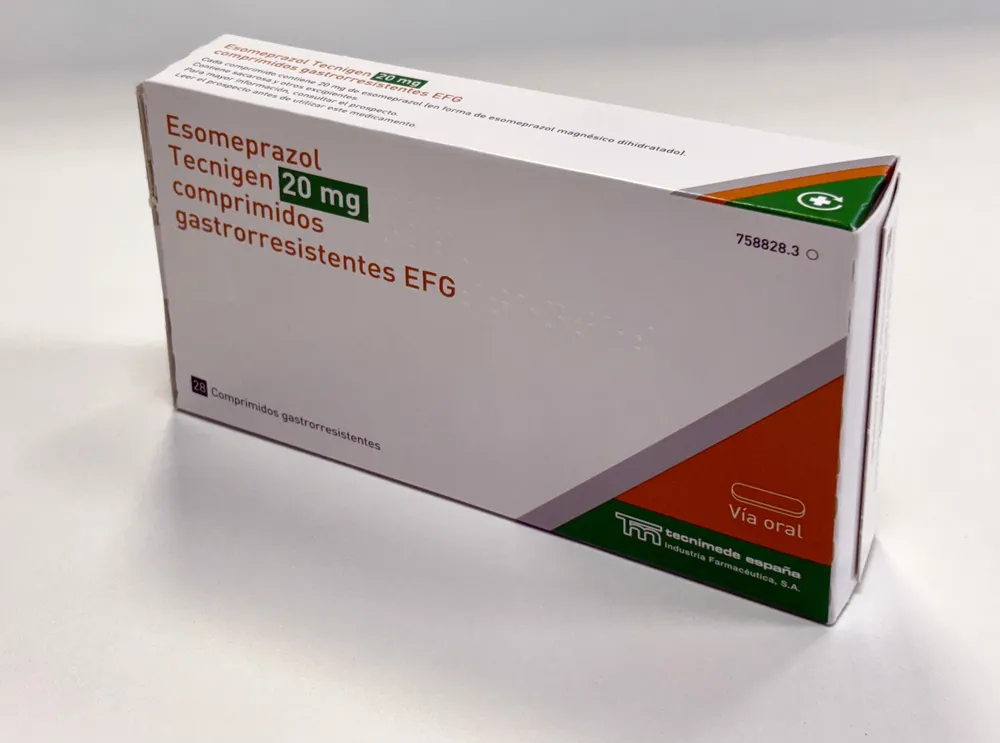
Table of Contents
- Patient Information Leaflet
- Introduction
- 1. What Esomeprazol Tecnigen is and what it is used for
- 2. What you need to know before starting to take Esomeprazol Tecnigen
- 3. How to take Esomeprazol Tecnigen
- 4. Possible adverse effects
- 5. Storage of Esomeprazol Tecnigen
- 6. Contents of the pack and other information
Patient Information Leaflet
Introduction
Package leaflet: Information for the patient
Esomeprazol Tecnigen 20 mg gastro-resistant tablets EFG
Read the entire leaflet carefully before you start taking this medicine, because it contains important information for you.
- Keep this leaflet as you may need to read it again.
- If you have any questions, ask your doctor or pharmacist.
- This medicine has been prescribed for you only, and you should not give it to other people, even if they have the same symptoms as you, because it may harm them.
- If you experience any adverse effects, consult your doctor or pharmacist, even if they are adverse effects not listed in this leaflet. See section 4.
Leaflet contents
- What Esomeprazol Tecnigen is and what it is used for
- What you need to know before taking Esomeprazol Tecnigen
- How to take Esomeprazol Tecnigen
- Possible adverse effects
- How to store Esomeprazol Tecnigen
- Contents of the pack and other information
1. What Esomeprazol Tecnigen is and what it is used for
Esomeprazol Tecnigen contains a medicine called esomeprazole, which belongs to a group of medicines known as "proton pump inhibitors". These work by reducing the amount of acid produced by the stomach.
Esomeprazole is used to treat the following conditions:
Adults
- Gastroesophageal reflux disease (GERD). This occurs when stomach acid moves up into the oesophagus (the tube connecting the throat to the stomach), causing pain, inflammation, and heartburn.
- Ulcers in the stomach or upper part of the intestine (duodenum) that are infected with a bacterium called Helicobacter pylori. If you have this condition, your doctor will likely also prescribe antibiotics to treat the infection and allow the ulcer to heal.
- Gastric ulcers caused by medicines called NSAIDs (non-steroidal anti-inflammatory drugs). Esomeprazole may also be used to prevent the formation of ulcers if you are taking NSAIDs.
- Excessive stomach acidity caused by a tumour in the pancreas (Zollinger-Ellison syndrome).
- Continuation treatment to prevent re-bleeding from peptic ulcer previously treated with intravenous esomeprazole.
Adolescents aged 12 years and older
- Gastroesophageal reflux disease (GERD). This occurs when stomach acid moves up into the oesophagus (the tube connecting the throat to the stomach), causing pain, inflammation, and heartburn.
- Ulcers in the stomach or upper part of the intestine (duodenum) that are infected with a bacterium called Helicobacter pylori. If you have this condition, your doctor will likely also prescribe antibiotics to treat the infection and allow the ulcer to heal.
2. What you need to know before starting to take Esomeprazol Tecnigen
Do not take Esomeprazol Tecnigen
- if you are allergic to esomeprazole or to any of the other ingredients of this medicine (listed in section 6).
- if you are allergic to other medicines in the group of proton pump inhibitors (e.g. pantoprazole, lansoprazole, rabeprazole, omeprazole).
- if you are taking a medicine containing nelfinavir (used in the treatment of HIV infection).
- if you have ever developed a severe skin rash, skin peeling, blistering, or mouth ulcers after taking esomeprazole or other related medicines.
If any of these situations apply to you, do not take esomeprazole. If you are unsure, consult your doctor or pharmacist before taking esomeprazole.
Warnings and precautions
Consult your doctor or pharmacist before starting to take esomeprazole
- If you have severe liver problems.
- If you have severe kidney problems.
- If you have ever had a skin reaction after treatment with a medicine similar to esomeprazole used to reduce stomach acid.
- If you are scheduled to have a specific blood test (Chromogranin A).
Severe skin reactions including Stevens-Johnson syndrome, toxic epidermal necrolysis, drug reaction with eosinophilia and systemic symptoms (DRESS), have been reported in association with esomeprazole treatment. Stop taking esomeprazole and seek immediate medical attention if you notice any symptoms related to these severe skin reactions described in section 4.
Esomeprazole may mask symptoms of other diseases. Therefore, if you experience any of the following events before or while taking esomeprazole, contact your doctor immediately:
- You lose weight significantly without reason and have difficulty swallowing.
- You experience stomach pain or indigestion.
- You begin vomiting food or blood.
- Your stools appear black (blood-stained).
If you have been prescribed esomeprazole only when you have symptoms, you should contact your doctor if your symptoms persist or change.
Taking a proton pump inhibitor such as esomeprazole, particularly for more than one year, may slightly increase the risk of fracture of the hip, wrist, or spine. Inform your doctor if you have osteoporosis or if you are taking corticosteroids (which may increase the risk of osteoporosis).
Skin rashes and skin symptoms
If you develop a skin rash, especially in areas of skin exposed to sunlight, consult your doctor as soon as possible, as it may be necessary to discontinue treatment with esomeprazole. Remember to mention any other symptoms you may notice, such as joint pain.
Severe skin rashes have occurred in patients taking esomeprazole (see also section 4). The rash may include mouth, throat, nose, genital ulcers, and conjunctivitis (red, swollen eyes). These severe skin rashes usually appear after flu-like symptoms such as fever, headache, and body aches. The rash may cover large areas of the body with blistering and skin peeling.
If at any time during treatment (even after several weeks) you develop a rash or any of these skin symptoms, stop taking this medicine and contact your doctor immediately.
Children under 12 years
This medicine should not be used in children under 12 years of age. There are more appropriate dosage forms available (consult your doctor or pharmacist if you need further information).
Use of Esomeprazol Tecnigen with other medicines
Inform your doctor or pharmacist if you are taking, have recently taken, or might need to take any other medicines. This includes medicines obtained without a prescription. This is because esomeprazole may affect how some medicines work, and some medicines may influence the effect of esomeprazole.
Do not take esomeprazole tablets if you are taking a medicine containing nelfinavir (used to treat HIV infection).
Inform your doctor if you are taking any of the following medicines:
- Atazanavir (used to treat HIV infection).
- Clopidogrel (used to prevent blood clots).
- Ketoconazole, itraconazole, or voriconazole (for fungal infections).
- Erlotinib (used in cancer treatment).
- Citalopram, imipramine, clomipramine (for treatment of depression).
- Diazepam (used to treat anxiety, as a muscle relaxant, or for epilepsy).
- Phenytoin (for epilepsy). If you are taking phenytoin, your doctor will need to monitor when you start or stop taking esomeprazole.
- Medicines used to thin the blood such as warfarin. Your doctor may need to monitor when you start or stop taking esomeprazole.
- Cilostazol (used to treat intermittent claudication – leg pain when walking caused by insufficient blood flow).
- Cisapride (used for indigestion and heartburn).
- Digoxin (used for heart problems).
- Methotrexate (a chemotherapeutic agent used at high doses in cancer treatment) – if you are taking high doses of methotrexate, your doctor may temporarily discontinue your esomeprazole treatment.
- Tacrolimus (organ transplant).
- Rifampicin (used to treat tuberculosis).
- St John’s wort (Hypericum perforatum) (used to treat depression).
If your doctor has prescribed the antibiotics amoxicillin and clarithromycin in addition to esomeprazole to treat ulcers caused by Helicobacter pylori, it is very important that you inform your doctor if you are taking any other medicines.
Taking Esomeprazol with food and drinks
You may take the tablets with food or on an empty stomach.
Pregnancy, breastfeeding, and fertility
If you are pregnant or breastfeeding, think you may be pregnant, or are planning to become pregnant, consult your doctor or pharmacist before using this medicine. Your doctor will decide whether you can take esomeprazole during this time.
It is unknown whether esomeprazole passes into breast milk. Therefore, esomeprazole should not be taken during breastfeeding.
Driving and using machines
Esomeprazole is unlikely to affect your ability to drive or use tools or machines. However, adverse effects such as dizziness or blurred vision may occur rarely or very rarely (see section 4). You should not drive or operate machinery if you experience any of these effects.
Esomeprazol Tecnigen contains sucrose
This medicine contains sugar spheres that contain sucrose, a type of sugar. If your doctor has told you that you have an intolerance to certain sugars, consult with him before taking this medicine.
Esomeprazol Tecnigen contains sodium
This medicine contains less than 23 mg of sodium (1 mmol) per gastro-resistant tablet; this is essentially “sodium-free”.
3. How to take Esomeprazol Tecnigen
Follow exactly the instructions for use of this medicine given by your doctor or pharmacist. If in doubt, consult your doctor or pharmacist again.
- If you take this medicine for a long period of time, your doctor will need to monitor you (especially if you take it for more than one year).
- If your doctor has instructed you to take this medicine only when you experience symptoms, inform your doctor if the symptoms change.
How much to take
- Your doctor will have told you how many tablets to take and when to take them. This will depend on your condition, age, and liver function.
- The recommended doses are indicated below:
Use in adults from 18 years of age
For the treatment of heartburn caused by gastroesophageal reflux disease (GERD):
- If your doctor has determined that your esophagus is slightly affected, the recommended dose is one 40 mg esomeprazole gastro-resistant tablet once daily for 4 weeks. Your doctor may instruct you to continue the same dose for another 4 weeks if your esophagus has not yet healed. Once the esophagus has healed, the recommended dose is one 20 mg esomeprazole gastro-resistant tablet once daily.
- If your esophagus is not affected, the recommended dose is one 20 mg esomeprazole gastro-resistant tablet once daily. Once your condition is under control, your doctor may instruct you to take the medicine only when you experience symptoms, up to a maximum of one 20 mg esomeprazole gastro-resistant tablet per day.
- If you have severe liver problems, your doctor may prescribe a lower dose.
For the treatment of ulcers caused by Helicobacter pylori infection and to prevent their recurrence:
- The recommended dose is one 20 mg esomeprazole gastro-resistant tablet twice daily for one week.
- Your doctor will also prescribe antibiotics such as, for example, amoxicillin and clarithromycin.
For the treatment of gastric ulcers caused by NSAIDs (non-steroidal anti-inflammatory drugs):
- The recommended dose is one 20 mg esomeprazole gastro-resistant tablet once daily for 4 to 8 weeks.
To prevent gastric ulcers if you are taking NSAIDs (non-steroidal anti-inflammatory drugs):
- The recommended dose is one 20 mg esomeprazole gastro-resistant tablet once daily.
For the treatment of excessive stomach acid caused by a pancreatic tumor (Zollinger-Ellison syndrome):
- The recommended dose is 40 mg of esomeprazole twice daily.
- Your doctor will adjust the dose according to your needs and will also decide for how long you should take this medicine. The maximum dose is 80 mg twice daily.
Continuation treatment for prevention of rebleeding from peptic ulcer induced with intravenous esomeprazole:
- The recommended dose is one 40 mg esomeprazole tablet once daily for 4 weeks.
Use in adolescents from 12 years of age
For the treatment of heartburn caused by gastroesophageal reflux disease (GERD):
- If your doctor has determined that your esophagus is slightly affected, the recommended dose is one 40 mg esomeprazole gastro-resistant tablet daily for 4 weeks. Your doctor may instruct you to continue the same dose for another 4 weeks if your esophagus has not yet healed.
- Once the esophagus has healed, the recommended dose is one 20 mg esomeprazole gastro-resistant tablet once daily.
- If your esophagus is not affected, the recommended dose is one 20 mg esomeprazole gastro-resistant tablet once daily.
- If you have severe liver problems, your doctor may prescribe a lower dose.
For the treatment of ulcers caused by Helicobacter pylori infection and to prevent their recurrence:
- The recommended dose is one 20 mg esomeprazole gastro-resistant tablet twice daily for one week.
- Your doctor will also prescribe antibiotics such as, for example, amoxicillin and clarithromycin.
How to take this medicine
- You may take the tablets at any time of day.
- You may take the tablets with food or on an empty stomach.
- Swallow the tablets whole with a glass of water. Do not chew or crush the tablets. This is because the tablets contain coated granules that prevent the medicine from being destroyed by stomach acid. It is important not to damage the granules.
What to do if you have difficulty swallowing
If you have difficulty swallowing the tablets:
- Place the tablets in a glass of non-carbonated water. Do not use other liquids.
- Stir until the tablets disintegrate (the solution will not be clear). You may drink the mixture immediately or within 30 minutes. Always stir well just before drinking.
- To ensure you have taken all the medicine, rinse the glass thoroughly with half a glass of water and drink it. The solid particles contain the medicine – do not chew or crush the granules.
If you cannot swallow at all, the tablets may be dispersed in water and administered through a syringe. They can then be delivered directly into the stomach via a tube (gastric tube).
Use in children under 12 years of age
Esomeprazol Tecnigen gastro-resistant tablets are not recommended for children under 12 years of age. Other authorized pharmaceutical forms of esomeprazole are available for children aged 1–12 years in sachets (consult your doctor or pharmacist if you need further information).
Elderly patients
Dose adjustment is not necessary in elderly patients.
If you take more esomeprazole than you should
If you take more esomeprazole than your doctor has prescribed, consult your doctor or pharmacist immediately.
In case of overdose or accidental ingestion, contact the Toxicology Information Service. Telephone 91 5620420, indicating the medicine and the amount ingested.
If you forget to take esomeprazole
If you forget to take a dose, take it as soon as you remember. However, if it is almost time for your next dose, do not take the missed dose.
Do not take a double dose (two doses at once) to make up for a forgotten dose.
If you have any further questions about the use of this medicine, ask your doctor or pharmacist.
4. Possible adverse effects
Like all medicines, this medicine can cause adverse effects, although not everyone experiences them.
If you notice any of the following serious adverse effects, stop taking esomeprazole and contact a doctor immediately:
- Yellowing of the skin, dark urine, and tiredness, which may be symptoms of liver problems.
These effects are rare and may affect up to 1 in 1,000 people.
- Sudden difficulty breathing, swelling of the lips, tongue, throat, or entire body, skin rash, fainting, or difficulty swallowing (severe allergic reaction).
These effects are rare and may affect up to 1 in 1,000 people.
- Sudden appearance of a severe skin rash or redness of the skin with blistering or peeling, even after several weeks of treatment. Large blisters and bleeding of the lips, eyes, mouth, nose, and genitals may also occur. Skin rashes may progress to serious and widespread skin damage (peeling of the epidermis and superficial mucous membranes), potentially leading to life-threatening consequences. This could be "erythema multiforme", "Stevens-Johnson syndrome", "toxic epidermal necrolysis", or "drug reaction with eosinophilia and systemic symptoms (DRESS)".
These effects are very rare and may affect up to 1 in 10,000 people.
- Widespread rash, high body temperature, and enlarged lymph nodes (DRESS syndrome or drug hypersensitivity syndrome), which is very rarely observed.
Other adverse effects include:
Common (may affect up to 1 in 10 people)
- Headache.
- Stomach or intestinal effects: stomach pain, constipation, diarrhoea, gas (flatulence).
- Nausea or vomiting.
- Benign polyps in the stomach.
Uncommon (may affect up to 1 in 100 people)
- Swelling of feet and ankles.
- Sleep disturbance (insomnia).
- Dizziness, tingling or numbness, drowsiness.
- Sensation of vertigo.
- Dry mouth.
- Abnormal blood tests indicating liver function.
- Skin rash, hives, skin itching.
- Fracture of hip, wrist, or spine (if esomeprazole is used at high doses and for a prolonged period).
Rare (may affect up to 1 in 1,000 people)
- Blood disorders such as decreased number of white blood cells or platelets. This may cause weakness, bruising, or increased risk of infections.
- Low sodium levels in blood. This may cause weakness, vomiting, and cramps.
- Restlessness, confusion, or depression.
- Taste disturbances.
- Eye disorders such as blurred vision.
- Sudden sensation of breathlessness or difficulty breathing (bronchospasm).
- Inflammation inside the mouth.
- A fungal infection known as "candidiasis" which may affect the oesophagus.
- Liver problems including jaundice, which may cause yellowing of the skin, dark urine, and tiredness.
- Hair loss (alopecia).
- Sunlight-induced dermatitis.
- Joint pain (arthralgia) or muscle pain (myalgia).
- General feeling of malaise and lack of energy.
- Increased sweating.
Very rare (may affect up to 1 in 10,000 people)
- Changes in blood cell counts, including agranulocytosis (decreased number of white blood cells).
- Aggression.
- Seeing, feeling, or hearing things that are not real (hallucinations).
- Liver disorders that may lead to liver failure or brain inflammation.
- Sudden onset of severe skin rash, blistering, or skin peeling. These symptoms may be accompanied by high fever and joint pain. (Erythema multiforme, Stevens-Johnson syndrome, toxic epidermal necrolysis, drug reaction with eosinophilia and systemic symptoms).
- Muscle weakness.
- Severe kidney disorders.
- Breast enlargement in men.
Frequency not known (frequency cannot be estimated from available data)
- If you are being treated with esomeprazole for more than three months, your blood magnesium levels may decrease. Low magnesium levels may present as fatigue, involuntary muscle contractions, disorientation, seizures, dizziness, or increased heart rate. If you experience any of these symptoms, inform your doctor immediately. Low magnesium levels may also lead to reduced levels of potassium or calcium in the blood. Your doctor may decide to perform periodic tests to monitor your magnesium levels.
- Inflammation of the intestine (which may lead to diarrhoea).
- Skin rash, possibly with joint pain.
In very rare cases, esomeprazole may affect white blood cells, causing immune deficiency. If you develop an infection with symptoms such as fever accompanied by a severe deterioration in general condition, or fever with signs of a local infection such as neck, throat, or mouth pain, or difficulty urinating, you should consult your doctor as soon as possible to rule out a reduced white blood cell count (agranulocytosis) through a blood test. It is important that, in this case, you inform your doctor about your medication.
Reporting of adverse effects
If you experience any type of adverse effect, talk to your doctor or pharmacist, even if it is a possible adverse effect not listed in this leaflet. You can also report them directly via the Spanish Pharmacovigilance System for Human Medicines: https://www.notificaRAM.es. By reporting adverse effects, you can help provide more information on the safety of this medicine.
5. Storage of Esomeprazol Tecnigen
Keep this medicine out of the sight and reach of children.
Do not store above 30°C.
Do not use this medicine after the expiry date stated on the packaging after EXP. The expiry date refers to the last day of the month indicated.
Keep this medicine in its original packaging to protect it from moisture.
Medicines must not be disposed of via wastewater or household waste. Dispose of empty containers and unused medicines at a SIGRE collection point at your pharmacy. If you are unsure, ask your pharmacist how to dispose of containers and unused medicines. This will help protect the environment.
6. Contents of the pack and other information
Composition of Esomeprazol Tecnigen
The active substance is esomeprazole. Each gastro-resistant tablet contains 20 mg of esomeprazole (as esomeprazole magnesium dihydrate).
The other components (excipients) are:
Pellets: methacrylic acid and ethyl acrylate copolymer (1:1), dispersion at 30% (containing polysorbate 80 and sodium lauryl sulfate), talc, triethyl citrate, hypromellose, sugar spheres (sucrose and corn starch), magnesium stearate, hydroxypropylcellulose, glycerol monostearate 40-55, polysorbate 80.
Tablet core: microcrystalline cellulose, povidone, macrogol, crospovidone, sodium stearyl fumarate.
Coating material: hypromellose, titanium dioxide (E171), macrogol, red iron oxide (E172), yellow iron oxide (E172).
Appearance of the product and pack contents
Esomeprazol Tecnigen 20 mg are gastro-resistant tablets, light pink in colour, 6.55 x 13.6 mm, elliptical and biconvex in shape.
They are presented in blister packs (Al/Al) containing 28 or 56 tablets.
Marketing Authorization Holder and Manufacturer
Marketing Authorization Holder:
Tecnimede España Industria Farmacéutica, S.A.
Avda. de Bruselas, 13, 3º D.
Edificio América. Polígono Arroyo de la Vega,
28108 Alcobendas (Madrid)
Spain
Manufacturer:
Balkanpharma Dupnitsa AD
3 Samokovsko Shosse Str.
Dupnitsa 2600
Bulgaria
Date of the latest revision of this leaflet: February 2025
Detailed information on this medicinal product is available on the website of the Spanish Agency of Medicines and Health Products (AEMPS) http://www.aemps.gob.es/
This information is intended for healthcare professionals only:
Administration via gastric tube:
-
Place the tablet into an appropriate syringe and fill the syringe with approximately 25 ml of water and approximately 5 ml of air. For some tubes, a dispersion in 50 ml of water is required to prevent the pellets from blocking the tube.
-
Immediately shake the syringe for about 2 minutes to disperse the tablet.
-
Hold the syringe with the tip facing upwards and check that the tip is not blocked.
-
Connect the syringe to the tube while maintaining the previous position.
-
Shake the syringe and position it with the tip facing downwards. Immediately inject 5–10 ml into the tube. After injection, invert the syringe, shake it (the syringe must be kept with the tip facing upwards to prevent blockage of the tip).
-
Reposition the syringe with the tip facing downwards and immediately inject another 5–10 ml into the tube. Repeat this procedure until the syringe is empty.
-
Fill the syringe with 25 ml of water and 5 ml of air and repeat step 5 if necessary to flush any remaining residue from the syringe. For some tubes, 50 ml of water may be required.