Erwinase 10,000 IU powder for injection and for infusion
Spain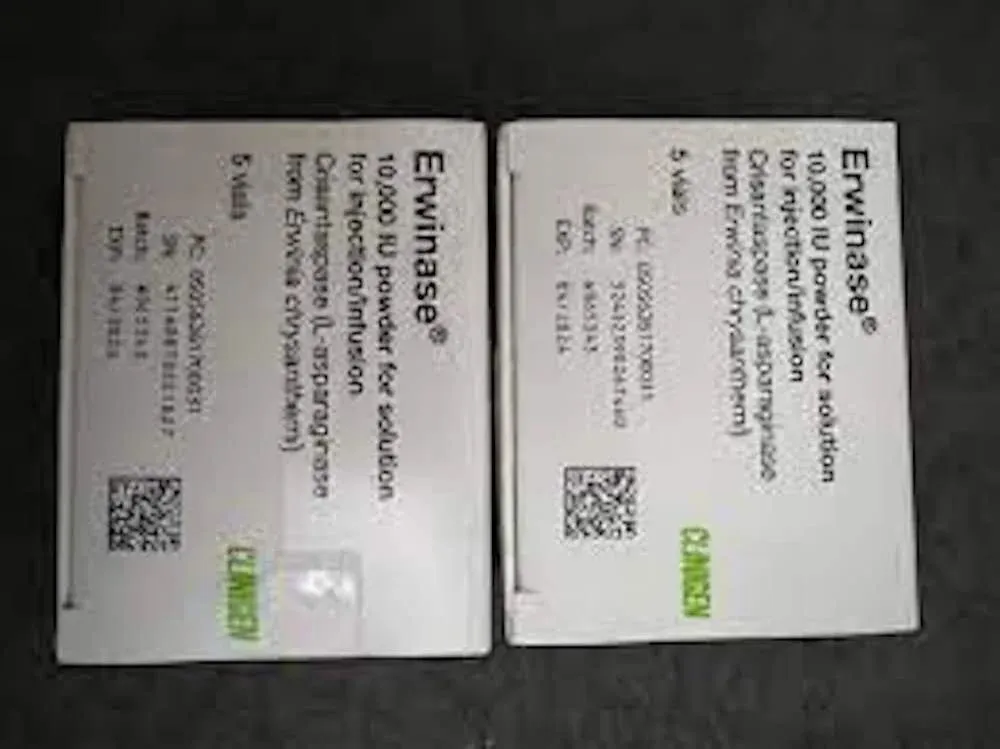
Table of Contents
Package leaflet: Information for the user
Introduction
Package leaflet: information for the patient
Erwinase 10000U powder for solution for injection and for infusion.
Crystalline asparaginase (L-asparaginase from Erwinia chrysanthemi)
Read the entire leaflet carefully before you start using this medicine, because it contains important information for you.
- Keep this leaflet, as you may need to read it again.
- If you have any questions, consult your doctor, pharmacist, or nurse.
- If you experience any adverse reactions, consult your doctor, pharmacist, or nurse, even if they are not listed in this leaflet. See section 4.
Contents of the leaflet
-
What Erwinase is and what it is used for
-
What you need to know before using Erwinase
-
How to use Erwinase
-
Possible side effects
-
How to store Erwinase
-
Contents of the pack and other information
1. What Erwinase is and what it is used for
How Erwinase works
This medicine is a cancer treatment for blood cells and belongs to a group of medicines known as "antineoplastics and immunomodulators". It works by reducing the level of asparagine (an amino acid) in your body. Asparagine is a substance that cancer cells need in order to survive.
What Erwinase is used for
This medicine is used mainly in children for the treatment of white blood cell cancer (acute lymphoblastic leukaemia), in patients who have experienced an allergic reaction to other similar medicines.
This medicine is used in combination with other treatments.
2. What you need to know before starting Erwinase
Do not take Erwinase:
- If you have had a severe allergic reaction (hypersensitivity) to the active substance (crisantaspase) or if you are allergic to any of the other components of this medicine. You can find these substances in section 6.
- You have severe liver impairment.
- You have or have had severe pancreas problems (acute pancreatitis) caused by a medicine containing L-asparaginase.
- You have pancreatitis (inflammation of the pancreas) unrelated to L-asparaginase.
Warnings and precautions
Talk to your doctor, pharmacist, or nurse before starting this medicine.
- This medicine should only be used by doctors experienced in this type of treatment.
- Severe, potentially life-threatening allergic reactions have been reported. If you experience a reaction to treatment, the hospital will need special medicines and equipment to treat you.
- Your body may become sensitive to the active substance after repeated treatment.
- If you experience abdominal pain, it may be a symptom of pancreatitis (inflammation of the pancreas), and you must inform your doctor immediately. Pancreatitis can be fatal.
- You may have too much sugar in your blood (hyperglycaemia) during treatment. This can be treated with insulin administration.
- During treatment, your body may be less able to prevent serious bleeding. If you experience serious bleeding, treatment will be stopped. Your doctor will decide whether and when treatment can be restarted.
- Use of this medicine may cause or worsen reduced liver function. Your doctor will consider stopping treatment in case of a severe reaction. Treatment may be resumed under strict monitoring, but only once sufficient recovery has occurred.
- If you or a healthcare professional spills this medicine on your skin or eyes, that area must be washed thoroughly with plenty of water for 15 minutes.
- Neurological disorders (disorders of the nervous system) with fatal outcomes have been reported. Posterior reversible encephalopathy syndrome (characterized by headache, confusion, seizures, and vision loss) may require treatment with medicines to lower blood pressure and, in the case of seizures, antiepileptic medicines.
- The destruction of cancer cells leads to elevated levels of uric acid (a waste product) in the blood. This may reduce kidney function.
- Weakening of the immune system has been observed during treatment with this medicine. This may make you more susceptible to infection.
Blood and urine tests
During treatment, your doctor will perform regular blood and urine tests to monitor for possible adverse effects, such as:
- Allergic reactions
- Whether the pancreas, kidneys, and liver are functioning properly
- Whether you have sufficient blood cells
For traceability purposes, healthcare professionals will record the product name and batch number of each dose of Erwinase you receive.
Other medicines and Erwinase
- Since Erwinase may affect liver function and levels of enzymes and proteins in the blood, it may alter the effectiveness of medicines that are sensitive to these changes.
- If Erwinase is used with other chemotherapy drugs (medicines for treating cancer), it may increase the activity or damage caused by these drugs. This is particularly relevant for the following chemotherapy agents: methotrexate, cytarabine, vincristine, imatinib, and prednisone (a corticosteroid).
- Allopurinol, a medicine used for gout (a painful rheumatic inflammation), may sometimes be given to protect the kidneys.
Erwinase must not be mixed with other medicines before administration.
Tell your doctor or pharmacist if you are taking, have recently taken, or might need to take any other medicines.
Pregnancy and breastfeeding
If you are pregnant or breastfeeding, think you may be pregnant, or plan to become pregnant, consult your doctor or pharmacist before using this medicine.
- If you are pregnant, you should not use this medicine unless absolutely necessary. Inform your doctor immediately if you are pregnant, become pregnant during treatment with this medicine, or plan to become pregnant in the near future.
- You must not breastfeed during treatment with this medicine.
Fertility and family planning
A negative effect on male fertility cannot be ruled out.
If applicable, both men and women should use contraception before, during, and for some time after treatment with Erwinase.
Driving and using machines
When driving or operating machinery, you should take into account reduced reaction time, nausea, and vomiting.
Erwinase contains sodium
This medicine contains less than 1 mmol (23 mg) of sodium per dose, which is essentially "sodium-free".
3. How to use Erwinase
Dosage
Your doctor will calculate your body surface area in square meters (m²) and use this to determine the dose you should receive.
Normally, your doctor will treat you with 25,000 U of Erwinase per square meter.
The amount you receive may be adjusted depending on the level of asparaginase (the active substance in this medicine) in your blood, which may be monitored during treatment.
Method of administration
This medicine will be administered in one of the following ways:
-
Into a vein by infusion (intravenous route).
-
Into a muscle by injection (intramuscular route).
This medicine must be administered by your doctor or nurse as an injection or infusion. Before injection or infusion, the powder is precisely dissolved (in saline solution).
Treatment is usually given continuously. If treatment needs to be interrupted, it may be restarted at a reduced dose.
Duration of treatment
You will receive an injection three times a week for two weeks. This may change, depending on results from future clinical studies.
If you have been given more Erwinase than you should have
If you think you have been given more Erwinase than you should have, contact your doctor or another healthcare professional immediately.
In case of overdose or accidental ingestion, contact your doctor or pharmacist immediately or call the Toxicology Information Service at: 91 562 04 20, indicating the medicine and the amount ingested.
If you did not receive this medicine
If you think you have missed a dose, contact your doctor or another healthcare professional immediately.
If you have any further questions about the use of this medicine, ask your doctor, pharmacist, or nurse.
4. Possible adverse effects
Like all medicines, this medicine can cause adverse effects, although not everyone will experience them.
The adverse effects listed below have been observed when this medicine was administered together with other cancer treatments.
This medicine will be administered under strict medical supervision, and your doctor may prescribe additional medicines to treat these adverse effects. Most adverse effects will disappear once treatment with this medicine is stopped.
Seek immediate medical advice if you experience any of the following adverse effects:
- Blue-colored lips, arms, or legs (possible symptom of hypoxia: very low oxygen in the blood), skin redness or inflammation, increased or decreased blood pressure, swelling of the face, lips and/or throat, shortness of breath, increased heart rate, gasping breathing, difficulty swallowing, runny nose, rash, chills, skin flushing, difficulty breathing, vomiting, malaise (weakness), or pale skin. Repeated treatment increases the risk of reaction. Redness, pain, swelling, bruising, or hardening at the injection site.
- Symptoms may include: coma, encephalopathy (brain disease), seeing, hearing, or feeling things that are not real (hallucinations), muscle weakness, decreased level of consciousness, confusion, dizziness, drowsiness, fatigue, restlessness, difficulty speaking, often as a consequence of other adverse effects.
- This medicine may increase the risk of blood clots, which can block important blood vessels in the brain, lungs, or legs (symptoms of blood clots in the arms or legs may sometimes be accompanied by swelling). If you experience chest pain spreading to the arms, neck, jaw, back, or stomach, sweating, and shortness of breath, these may be symptoms of a heart attack (myocardial infarction).
- Bleeding more easily and bruising, even without injury.
- If you have symptoms of severe inflammation of the pancreas (pancreatitis), such as severe abdominal pain with nausea and diarrhea, treatment must be stopped and should not be restarted later.
- High blood sugar levels (hyperglycemia);
- Changes in liver function (shown by blood tests)
The following is a list of other adverse effects observed with this medicine, ordered by frequency:
Contact your doctor immediately if you experience any of the following adverse effects:
Very common (affects more than 1 in 10 people)
- Systemic infection or septic shock (shock due to infection, especially potentially life-threatening shock) and other infections
- Reduced blood cells (especially platelets, white and red blood cells). Some may result from decreased bone marrow activity.
- Increased levels of fats, bilirubin (a waste substance produced in the blood when red blood cells stop functioning), and certain digestive enzymes in the blood (your doctor will monitor this)
- Weight loss
- Body pain, especially muscle and joint pain
- Nausea
Common (affects less than 1 in 10 people)
- Diarrhea
- Mucositis (inflammation of the digestive tract)
- Stomach aches or discomfort
- Fever
- Fatigue
- Headaches
Uncommon (affects less than 1 in 100 people)
- Diabetes complications (high blood sugar levels)
- Increased blood ammonia levels
- Seizures
- Fatty liver
- Reduced kidney function
Rare (affects less than 1 in 1,000 people)
- Reversible posterior leukoencephalopathy syndrome (a condition characterized by headache, confusion, seizures, and vision loss)
- Liver failure
Very rare (affects less than 1 in 10,000 people)
- A painful joint disorder known as reactive arthritis
Frequency not known (cannot be estimated from available data)
- Loss of appetite (anorexia)
- Inflammation of the salivary glands at the back of the throat
- Reduced levels of albumin (a protein) in the blood, leading to fluid retention
- Blistering and peeling of the skin (toxic epidermal necrolysis)
- Muscle pain
- Kidney disorders with abnormal urine test results (high protein levels)
In general, adverse effects are reversible (they disappear once you stop taking the medicine).
Other adverse effects in children and young adults
Adverse effects affecting the liver, pancreas, and blood clotting are more common in adults than in children and young adults.
Reporting of adverse effects
If you experience any type of adverse effect, talk to your doctor, pharmacist, or nurse, even if they are possible adverse effects not listed in this leaflet. You may also report them directly via the national reporting system: Spanish Pharmacovigilance System for Human Medicines (Sistema Español de Farmacovigilancia de Medicamentos de Uso Humano): www.notificaRAM.es.
By reporting adverse effects, you can help provide more information on the safety of this medicine.
5. Storage of this medicine
Keep this medicine out of the sight and reach of children.
The hospital will store this medicine in a refrigerator (between 2 °C and 8 °C). Do not use after the expiry date stated on the container after “EXP”. This indicates the month and year. The expiry date refers to the last day of the stated month.
6. Contents of the pack and other information
Composition of this medicine
- The active substance of this medicine is crisantaspase (L-asparaginase from Erwinia chrysanthemi).
- Each vial contains 10,000 U (units) of crisantaspase.
- The other components are sodium chloride, glucose monohydrate, sodium hydroxide, acetic acid.
Appearance of Erwinase and contents of the pack
Erwinase is a white powder contained in a small glass vial.
Each pack contains 5 small glass vials.
Marketing Authorization Holder
Porton Biopharma Limited
MC2, Penrose Wharf Business Centre,
Penrose Quay, Cork,
T23 XN53
Ireland
Email: [email protected]
Manufacturer
Almac Pharma Services Limited
Seagoe Industrial Estate
Portadown, Craigavon
BT63 5UA
United Kingdom (Northern Ireland)
This medicine has been authorized in the EEA member states under the following names:
Austria, Belgium, Finland, France, Germany, Ireland, Netherlands, Poland, Portugal: Erwinase
Date of the most recent review of this summary: March 2022
Detailed information on this medicine is available on the website of the Spanish Agency of Medicines and Health Products (AEMPS) (http://www.aemps.gob.es/)
SEPARATE HERE AND PROVIDE INSTRUCTIONS TO THE PATIENT
This information is intended for healthcare professionals only:
The contents of each vial must be reconstituted with 1 ml or 2 ml of sodium chloride solution (0.9%) for injection.
Slowly add the sodium chloride solution (0.9%) for injection down the inner wall of the vial; do not add it directly onto or into the powder. Dissolve the contents by gently swirling or rotating the vial while holding it in an upright position. Avoid contact between the solution and the stopper. Avoid excessive foaming due to vigorous shaking.
The resulting solution should be clear and free from visible particles. If excessive shaking causes visible foaming, fine filamentous or crystalline particles of protein aggregates may be observed. If visible particles or protein aggregates are present, the reconstituted solution must be discarded.
The reconstituted injectable solution should be administered within 15 minutes after reconstitution. If more than 15 minutes must elapse between reconstitution and administration, the solution should be withdrawn under aseptic conditions using a sterile glass or polypropylene syringe. The syringe containing the reconstituted solution should then be stored below 25°C and used within 4 hours.
For intravenous infusion, it is recommended to further dilute the reconstituted Erwinase solution in 100 ml of sodium chloride solution (0.9%). To facilitate preparation, the reconstituted Erwinase solution may be transferred directly into a pre-filled bag containing 100 ml of sodium chloride solution (0.9%) for infusion.
The diluted infusion solution should be used immediately after preparation. If not used immediately, the infusion solution may be stored in a polyvinyl chloride (PVC) infusion bag. The infusion bag should be stored below 25°C and used within 4 hours.
From a microbiological standpoint, the reconstituted injectable solution should be used immediately unless the reconstitution process eliminates the risk of microbial contamination. If not used immediately, the user is responsible for the storage time and conditions.
Erwinase is a non-cytotoxic medicine and does not require the special precautions usually needed for handling cytotoxic drugs. However, during preparation or administration of Erwinase, it should be noted that it may be sensitizing.
Inhalation of the powder or solution should be avoided. In case of contact with skin or mucous membranes, especially eyes, rinse thoroughly with water for at least 15 minutes.
Disposal of unused medicine and all materials that have come into contact with it must be carried out in accordance with local regulations.
In the absence of compatibility studies, this medicine must not be mixed with other medicinal products. Therefore, other intravenous drugs must not be infused through the same intravenous line used for administering Erwinase.