Erivedge 150 mg hard capsules
Spain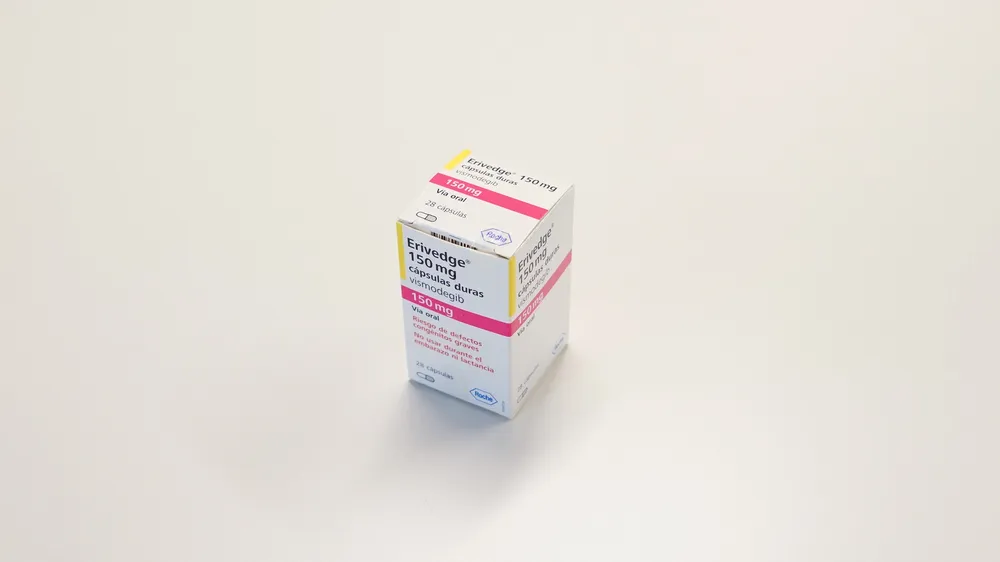
Table of Contents
Package Leaflet: Information for the User
Introduction
Package leaflet: information for the patient
Erivedge 150 mg hard capsules
vismodegib
Erivedge can cause severe birth defects. It may result in the death of the baby before birth or shortly after birth. You must not become pregnant while taking this medicine. You must follow the contraceptive advice described in this leaflet.
Read all of this leaflet carefully before you start taking this medicine, because it contains important information for you.
- Keep this leaflet, as you may need to read it again.
- If you have any questions, ask your doctor or pharmacist.
- This medicine has been prescribed for you only, and you should not give it to other people, even if they have the same symptoms as you, because it may harm them.
- If you experience any adverse effects, consult your doctor or pharmacist, even if they are effects not listed in this leaflet. See section 4.
Contents of the leaflet
- What Erivedge is and what it is used for
- What you need to know before taking Erivedge
- How to take Erivedge
- Possible side effects
- How to store Erivedge
- Contents of the pack and other information
1. What Erivedge is and what it is used for
What Erivedge is
Erivedge is a cancer treatment medicine that contains the active substance vismodegib.
What Erivedge is used for
Erivedge is used to treat adults with a type of skin cancer known as advanced basal cell carcinoma. It is used when the cancer:
- Has spread to other parts of the body (called “metastatic” basal cell carcinoma)
- Has spread to nearby areas (called “locally advanced” basal cell carcinoma) and your doctor decides that you are not a candidate for treatment with surgery or radiation
How Erivedge works
Basal cell carcinoma develops when the DNA of normal skin cells is damaged and the body cannot repair it. This damage can alter the way certain proteins function within these cells, causing the damaged cells to become cancerous and begin to grow and divide uncontrollably. Erivedge is a cancer treatment medicine that works by inhibiting one of the key proteins involved in basal cell carcinoma. This may reduce or stop the growth of cancer cells, or may kill them. As a result, your skin cancer may shrink.
2. What you need to know before starting to take Erivedge
Read the specific instructions your doctor has given you, especially regarding the effects of Erivedge on the fetus.
Carefully read and follow the instructions in the patient leaflet provided by your doctor.
Do not take Erivedge
- if you are allergic to vismodegib or to any of the other ingredients of this medicine (listed in section 6).
- if you are pregnant, think you might be pregnant, or are planning to become pregnant during treatment or within 24 months after receiving the last dose of this medicine. This is because Erivedge may harm or cause death to the fetus.
- if you are breastfeeding or plan to breastfeed during treatment or within 24 months after receiving the last dose of this medicine. This is because it is unknown whether Erivedge passes into breast milk and could harm your baby.
- if you can become pregnant and cannot or do not wish to follow the necessary pregnancy prevention measures outlined in the Erivedge Pregnancy Prevention Program.
- if you are taking St. John’s wort (Hypericum perforatum): a herbal medicine used for depression (see "Taking Erivedge with other medicines").
Further information on the above points can be found in the sections “Pregnancy”, “Breastfeeding”, “Fertility”, and “Contraceptive methods in men and women”.
Do not take this medicine if any of the above apply to you. If you have any doubts, consult your doctor or pharmacist before taking Erivedge.
Warnings and precautions
Consult your doctor or pharmacist before starting to take Erivedge if you have any questions about the information in this section:
- You must not donate blood at any time during treatment or within 24 months after receiving the last dose of this medicine.
- If you are a man, you must not donate semen at any time during treatment or for 2 months after the last dose.
- Serious skin reactions have been reported with Erivedge treatment. If you notice any of the symptoms described in section 4, stop taking Erivedge and contact your doctor immediately.
- Never give this medicine to anyone else. You must return any unused capsules at the end of your treatment. Ask your doctor or pharmacist where to return them.
Children and adolescents
Use of Erivedge is not recommended in children and adolescents under 18 years of age. This is because it is unknown whether it is safe or effective in this age group. Erivedge may impair bone growth and cause early onset of puberty (before age 8 in girls or age 9 in boys). This may occur even after stopping treatment with Erivedge. Animal studies with this medicine have shown problems with tooth and bone development.
Other medicines and Erivedge
Inform your doctor or pharmacist if you are taking, have recently taken, or might need to take any other medicines. This also includes medicines without a prescription, vitamins, and herbal remedies.
Some medicines may affect how Erivedge works, or increase the likelihood of side effects. Erivedge may also affect how other medicines work.
In particular, inform your doctor if you are taking any of the following medicines:
- rifampicin, used for bacterial infections
- carbamazepine, phenytoin, used for epilepsy
- ezetimibe and statins, such as atorvastatin, fluvastatin, pravastatin, rosuvastatin, simvastatin, used for high cholesterol
- bosentan, glibenclamide, repaglinide, valsartan
- topotecan, used for certain types of cancer
- sulfasalazine, used for certain inflammatory conditions, and especially
- St. John’s wort (Hypericum perforatum), a herbal medicine used for depression, as you must not use it together with Erivedge
Pregnancy
Do not take Erivedge if you are pregnant, think you might be pregnant, or plan to become pregnant during treatment or within 24 months after receiving the last dose of this medicine.
You must stop treatment and inform your doctor immediately if: you miss a menstrual period, have abnormal menstrual bleeding, or suspect you are pregnant. If you become pregnant during treatment with Erivedge, you must stop treatment and inform your doctor immediately.
Erivedge may cause severe birth defects. It may also cause fetal death. Your doctor will give you specific instructions (the Erivedge Pregnancy Prevention Program), especially regarding the effects of Erivedge on unborn babies.
Breastfeeding
You must not breastfeed during treatment or within 24 months after receiving the last dose of this medicine. It is unknown whether Erivedge passes into breast milk and could harm your baby.
Fertility
Erivedge may affect a woman’s ability to have children. Some women who have taken Erivedge have stopped having menstrual periods. If this happens to you, it is unknown whether menstruation will return. Talk to your doctor if you plan to have children in the future.
Contraceptive methods: for women and men
For women taking Erivedge
Before starting treatment, consult your doctor if you can become pregnant. Even if you have stopped having menstrual periods, it is important to consult your doctor about any risk of pregnancy.
If you can become pregnant:
- you must take precautions to avoid pregnancy while taking Erivedge
- use 2 forms of contraception: one highly effective method and one barrier method (please see examples below)
- you must continue contraceptive measures for 24 months after receiving the last dose, because Erivedge may remain in your body for up to 24 months after the last dose
Recommended contraceptive methods: Consult your doctor about the two best contraceptive methods for you.
Use a highly effective method such as:
- contraceptive injection
- intrauterine device (IUD)
- surgical sterilization
You must also use a barrier method such as:
- condom (preferably with spermicide)
- diaphragm (preferably with spermicide)
Your doctor will ensure you have a pregnancy test:
- within 7 days before starting treatment, to confirm you are not pregnant
- every month during treatment
You must inform your doctor immediately during treatment or within 24 months after your last dose if:
- you think, for any reason, that your contraceptive method has failed
- you have missed a menstrual period
- you stop using contraception
- you need to change your contraceptive method
For men taking Erivedge
Erivedge may pass into semen. Always use a condom (preferably with spermicide), even after vasectomy, when having sex with a woman. Do this during treatment and for 2 months after receiving the last dose of this medicine.
You must not donate semen at any time during treatment or within 2 months after receiving the last dose of this medicine.
Driving and use of machines
Erivedge is unlikely to affect your ability to drive or use tools or machines. Consult your doctor if you are unsure.
Erivedge contains lactose and sodium
The Erivedge capsule contains a type of sugar called lactose. If your doctor has told you that you have an intolerance to certain sugars, consult them before taking this medicine.
This medicine contains less than 23 mg of sodium (1 mmol) per capsule; this is essentially “sodium-free”.
3. How to take Erivedge
Follow exactly the administration instructions for Erivedge given by your doctor. If you are unsure, consult your doctor or pharmacist again.
Taking this medicine
The recommended dose is one capsule per day.
- Swallow the capsule whole with a glass of water.
- Do not crush, open, or chew the capsule, to avoid unintentional exposure to the capsule contents.
- Erivedge may be taken with or without food.
If you take more Erivedge than you should
If you take more Erivedge than you should, consult your doctor.
If you forget to take Erivedge
Do not take a double dose to make up for a missed dose; instead, continue with the next scheduled dose.
If you stop taking Erivedge
Do not stop treatment with this medicine without first consulting your doctor, as this could make your treatment less effective.
If you have any further questions about the use of this medicine, ask your doctor or pharmacist.
4. Possible adverse effects
Like all medicines, this medicine can cause adverse effects, although not everyone will experience them.
Erivedge can cause severe birth defects. It may also lead to the death of your baby before or shortly after birth. You must not become pregnant while taking this medicine (see section 2 “Do not take Erivedge” and “Pregnancy”, “Breast-feeding”, and “Fertility”).
Other adverse effects are listed below by severity and frequency
If any of the following adverse effects become severe, inform your doctor or pharmacist.
Very common (may affect more than 1 in 10 people):
- loss of menstrual periods in women of childbearing age
- loss of appetite and weight loss
- feeling tired
- muscle spasms
- diarrhoea
- hair loss (alopecia)
- a change in taste or complete loss of taste
- constipation
- vomiting or feeling sick (nausea)
- stomach discomfort or indigestion
- joint pain
- general pain or pain in arms, legs
- itching
Common (may affect up to 1 in 10 people):
- pain in chest, back or side
- lack of energy or weakness (asthenia)
- loss of body water (dehydration)
- muscle, tendon, ligament or bone pain
- stomach ache
- loss of taste
- abnormal hair growth
- loss of eyelashes (madarosis)
- changes in blood tests, including increased liver function tests or increased levels of creatine phosphokinase (a protein mainly found in muscle)
Frequency not known
- Interruption of bone growth (premature fusion of epiphyses)
- Early puberty (precocious puberty)
- Liver injury
- Serious skin reactions:
- round reddish spots or circular patches on the trunk, often with central blisters, peeling of the skin, ulcers in the mouth, throat, nose, genitals and eyes. Skin reactions are often preceded by fever and flu-like symptoms (Stevens-Johnson syndrome, toxic epidermal necrolysis).
- widespread rash, fever, and swollen lymph nodes (DRESS syndrome or drug hypersensitivity syndrome)
- widespread scaly red rash with lumps under the skin and blisters accompanied by fever at the start of treatment (acute generalized exanthematous pustulosis).
Reporting of adverse effects
If you experience any adverse effect, talk to your doctor, pharmacist or nurse, even if it is a possible adverse effect not listed in this leaflet. You can also report them directly through the national reporting system included in Appendix V. By reporting adverse effects, you can help provide more information on the safety of this medicine.
5. Storage of Erivedge
- Keep this medicine out of the sight and reach of children.
- Do not use this medicine after the expiry date which is stated on the bottle and the outer packaging following EXP. The expiry date refers to the last day of the month indicated.
- Do not store above 30 °C.
- Keep the bottle tightly closed to protect it from moisture.
- Medicines must not be disposed of via wastewater or household waste.
- When your treatment ends, return any unused capsules. These measures will prevent misuse and help protect the environment. Ask your doctor or pharmacist where to return the medicine.
6. Contents of the pack and other information
Composition of Erivedge
-
The active substance is vismodegib. Each hard capsule contains 150 mg of vismodegib.
-
The other components are:
-
Capsule contents: microcrystalline cellulose, lactose monohydrate, sodium lauryl sulfate, povidone (K29/32), sodium starch glycolate (Type A), talc, and magnesium stearate (see section 2 regarding sodium or lactose)
-
Capsule shell: iron oxide red (E172), iron oxide black (E172), titanium dioxide, and gelatin
-
Printing ink: shellac and iron oxide black (E172)
Appearance of Erivedge and contents of the pack
The capsules have an opaque pink body with the imprint “150 mg” and a grey cap with the imprint “VISMO” in black edible ink. The available packs are bottles with a child-resistant screw cap containing 28 capsules. Each package contains one bottle.
Marketing Authorization Holder
Roche Registration GmbH
Emil-Barell-Strasse 1
79639 Grenzach-Wyhlen
Germany
Manufacturer
Roche Pharma AG
Emil‑Barell‑Strasse 1
D‑79639 Grenzach‑Wyhlen
Germany
You can request further information about this medicinal product by contacting the local representative of the Marketing Authorization Holder:
Belgium/Belgium/Belgium, Luxembourg/Luxembourg N.V. Roche S.A. Belgium/Belgium/Belgium Tel/Tel: +32 (0) 2 525 82 11 | Latvia Roche Latvija SIA Tel: +371 - 6 7039831 |
| Lithuania UAB “Roche Lietuva” Tel: +370 5 2546799 |
Czech Republic Roche s. r. o. Tel: +420 - 2 20382111 | Hungary Roche (Hungary) Kft. Tel: +36 1 279 4500 |
Denmark Roche Pharmaceutical A/S Tlf: +45 - 36 39 99 99 | Netherlands Roche Nederland B.V. Tel: +31 (0) 348 438000 |
Germany Roche Pharma AG Tel: +49 (0) 7624 140 | Norway Roche Norge AS Tlf: +47 - 22 78 90 00 |
Estonia Roche Eesti OÜ Tel: +372 - 6 177 380 | Austria Roche Austria GmbH Tel: +43 (0) 1 27739 |
Greece Cyprus Roche (Hellas) A.E. Greece Tel: +30 210 61 66 100 | Poland Roche Polska Sp. z o.o. Tel: +48 - 22 345 18 88 |
Spain Roche Farma S.A. Tel: +34 - 91 324 81 00 | Portugal Roche Farmacêutica Química, Lda Tel: +351 - 21 425 70 00 |
France Roche Tél: +33 (0) 1 47 61 40 00 | Romania Roche România S.R.L. Tel: +40 21 206 47 01 |
Croatia Roche d.o.o. Tel: +385 1 4722 333 | Slovenia Roche farmacevtska družba d.o.o. Tel: +386 - 1 360 26 00 |
Ireland, Malta Roche Products (Ireland) Ltd. Ireland/Ireland Tel: +353 (0) 1 469 0700 | Slovak Republic Roche Slovensko, s.r.o. Tel: +421 - 2 52638201 |
Iceland Roche Pharmaceutical A/S c/o Icepharma hf Tel: +354 540 8000 | Finland/Finland Roche Oy Puh/Tel: +358 (0) 10 554 500 |
Italy Roche S.p.A. Tel: +39 - 039 2471 | Sweden Roche AB Tel: +46 (0) 8 726 1200 |
Date of the most recent review of this leaflet:
Other sources of information
Detailed information on this medicine is available on the website of the European Medicines Agency: http://www.ema.europa.eu.
This leaflet can be found on the European Medicines Agency's website in all languages of the European Union/European Economic Area.
As part of the Erivedge Pregnancy Prevention Programme, all patients will receive a patient brochure.
Please consult this document for more information.