Eribulin Baxter 0.44 mg/ml solution for injection EFG
Spain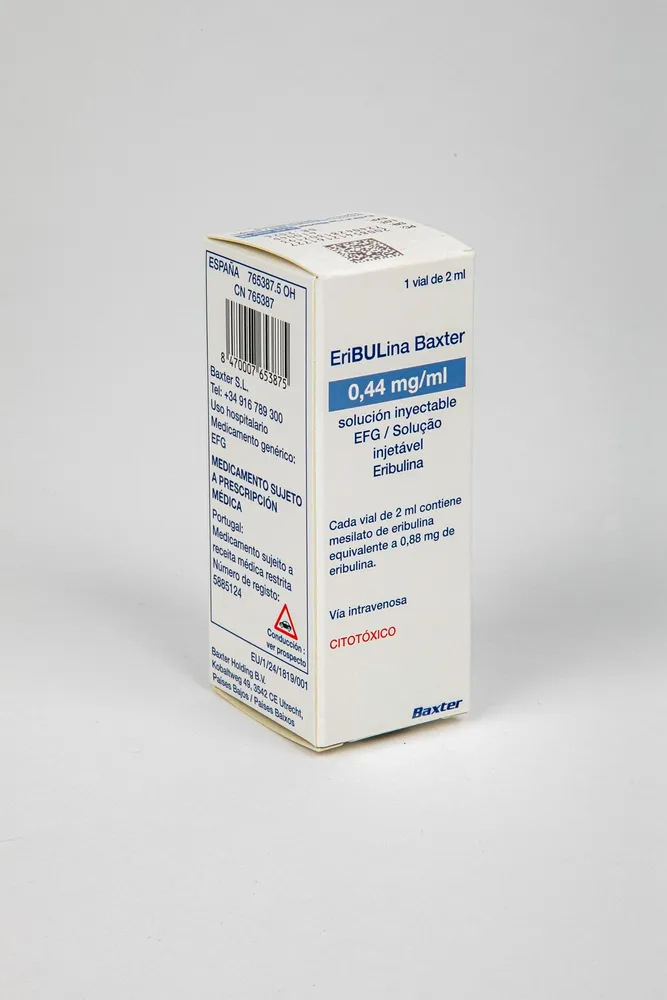
Table of Contents
Package leaflet: Information for the user
Introduction
Package leaflet: information for the user
Eribulina Baxter 0.44 mg/ml solution for injection EFG
eribulin
Read all of this leaflet carefully before you start using this medicine, because it contains important information for you.
- Keep this leaflet, as you may need to read it again.
- If you have any questions, ask your doctor or nurse.
- If you experience any side effects, talk to your doctor or nurse, even if it is a side effect not listed in this leaflet. See section 4.
Contents of this leaflet
- What Eribulina Baxter is and what it is used for
- What you need to know before using Eribulina Baxter
- How to use Eribulina Baxter
- Possible side effects
- How to store Eribulina Baxter
- Contents of the pack and other information
1. What Eribulina Baxter is and what it is used for
Eribulina Baxter contains the active substance eribulina and is an anticancer medicine that works by slowing the growth and spread of cancer cells.
It is used to treat adult patients with locally advanced or metastatic breast cancer (breast cancer that has spread beyond the original tumour) when at least one prior treatment has stopped being effective.
It is also used to treat adult patients with advanced or metastatic liposarcoma (a type of cancer arising in fatty tissue) when a prior treatment has stopped being effective.
2. What you need to know before using Eribulina Baxter
Do not use Eribulina Baxter
- if you are allergic to eribulin mesilate or to any of the other ingredients of this medicine (listed in section 6).
- if you are breastfeeding.
Warnings and precautions
Talk to your doctor or nurse before starting treatment with Eribulina Baxter:
- if you have liver problems
- if you have fever or an infection
- if you experience numbness, tingling, prickling sensations, touch sensitivity, or muscle weakness
- if you have heart problems
If any of the above conditions affect you, inform your doctor, as they may wish to discontinue your treatment or reduce your dose.
Children and adolescents
Do not administer this medicine to children aged between 0 and 18 years, as it has no effect in this population.
Other medicines and Eribulina Baxter
Inform your doctor if you are taking, have recently taken, or might need to take any other medicines.
Pregnancy, breastfeeding and fertility
Eribulina Baxter may cause severe birth defects and must not be used during pregnancy unless clearly necessary after careful consideration of the risks to both you and the baby. It may also cause permanent fertility problems in men who take it, and they should discuss this with their doctor before starting treatment. Women of childbearing age must use highly effective contraceptive methods during treatment with Eribulina Baxter and for up to 7 months after completion of treatment.
Eribulina Baxter must not be used during breastfeeding due to the potential risk to the infant.
Men with partners of childbearing potential must not make them pregnant while receiving Eribulina Baxter. They must use effective contraception during treatment with Eribulina Baxter and for up to 4 months after completion of treatment.
Driving and use of machines
Eribulina Baxter may cause adverse effects such as fatigue (very common) and dizziness (common). Do not drive or operate machinery if you feel tired or dizzy.
Eribulina Baxter contains anhydrous ethanol
This medicine contains 78.9 mg (0.1 ml) of ethanol (alcohol) per vial. The amount in 2 ml of this medicine is equivalent to 2 ml of beer or less than 1 ml of wine. The small amount of alcohol contained in this medicine does not produce any noticeable effect.
Eribulina Baxter contains sodium
This medicine contains less than 1 mmol of sodium (23 mg) per vial; i.e., essentially “sodium-free”.
3. How to use Eribulina Baxter
A qualified healthcare professional will administer Eribulina Baxter to you as an intravenous injection over a period of 2 to 5 minutes. The dose you receive is based on your body surface area (expressed in square meters, or m²), calculated from your weight and height. The usual dose of Eribulina Baxter is 1.23 mg/m², although your doctor may adjust it depending on the results of blood tests or other factors. After administration of Eribulina Baxter, it is recommended to flush the vein with a saline solution to ensure the complete dose of Eribulina Baxter is delivered.
Frequency of administration of Eribulina Baxter
Eribulina Baxter is usually administered on days 1 and 8 of each 21-day cycle. Your doctor will determine how many treatment cycles you should receive. Depending on the results of blood tests, your doctor may need to delay administration of the medicine until blood test results return to normal values. At that point, your doctor may also decide to reduce the dose administered to you.
If you have any further questions about the use of this medicine, ask your doctor.
4. Possible adverse effects
Like all medicines, this medicine can cause adverse effects, although not everyone experiences them.
If you experience any of the following serious symptoms, stop taking Eribulina Baxter and contact your doctor immediately:
- Fever, with very rapid heartbeat, fast and shallow breathing, cold, pale, moist or mottled skin, and/or confusion. These may be signs of a condition called sepsis, a severe and serious reaction to infection. Sepsis is uncommon (may affect up to 1 in 100 people) and can be life-threatening and lead to death.
- Difficulty breathing or swelling of the face, mouth, tongue, or throat. These may be signs of an uncommon allergic reaction (may affect up to 1 in 100 people).
- Severe skin rashes with blistering of the skin, mouth, eyes, and genitals. These may be signs of a condition called Stevens-Johnson syndrome/toxic epidermal necrolysis. The frequency of this condition is unknown, but it can be fatal.
Other adverse effects:
Very common adverse effects (may affect more than 1 in 10 people) are:
- Decrease in white or red blood cells
- Tiredness or weakness
- Nausea, vomiting, constipation, diarrhea
- Numbness, tingling, or prickling sensations
- Fever
- Loss of appetite, weight loss
- Difficulty breathing, cough
- Joint, muscle, and back pain
- Headache
- Hair loss
Common adverse effects (may affect up to 1 in 10 people) are:
- Decrease in platelets (which may lead to bruising or prolonged bleeding)
- Infection with fever, pneumonia, chills
- Rapid heartbeat, hot flushes
- Dizziness, lightheadedness
- Increased tear production, conjunctivitis (redness and burning of the eye surface), nosebleeds
- Dehydration, dry mouth, cold sores, mouth ulcers, indigestion, heartburn, abdominal pain or bloating
- Swelling of soft tissues, pain (particularly chest, back, and bone pain), muscle spasms or muscle weakness
- Infections in the mouth, respiratory tract, or urinary tract, pain when urinating
- Sore throat, irritated or runny nose, increased nasal secretion, flu-like symptoms, pharyngitis
- Abnormal liver function tests, altered levels of blood sugar, bilirubin, phosphates, potassium, magnesium, or calcium
- Difficulty sleeping, depression, altered sense of taste
- Rash, itching, nail problems, dry or red skin
- Excessive sweating (including night sweats)
- Ringing in the ears
- Blood clots in the lungs
- Shingles (herpes zoster)
- Skin swelling and numbness in hands and feet
Uncommon adverse effects (may affect up to 1 in 100 people) are:
- Blood clots
- Abnormal liver function tests (hepatotoxicity)
- Kidney failure, blood or protein in urine
- Extensive lung inflammation that may lead to scarring
- Inflammation of the pancreas
- Mouth ulcers
Rare adverse effects (may affect up to 1 in 1000 people) are:
- A serious blood clotting disorder that may lead to widespread blood clotting and internal bleeding.
Reporting of adverse effects
If you experience any adverse effects, consult your doctor or nurse, even if they are adverse effects not listed in this leaflet. You may also report them directly via the Spanish Pharmacovigilance System for Human Medicines: www.notificaRAM.es. By reporting adverse effects, you can help provide more information on the safety of this medicine.
5. Storage of Eribulina Baxter
Keep this medicine out of the sight and reach of children.
Do not use this medicine after the expiry date stated on the carton and vial after EXP. The expiry date refers to the last day of the month indicated.
Store below 30 °C.
If Eribulina Baxter is diluted for infusion:
Chemical and physical in-use stability has been demonstrated for the diluted solution for 24 hours between 15 °C and 25 °C and for 72 hours between 2 °C and 8 °C.
From a microbiological standpoint, the product should be used immediately. If not used immediately, the in-use storage times and conditions prior to use are the responsibility of the user and normally should not exceed 24 hours between 2 °C and 8 °C, unless dilution has taken place under controlled and validated aseptic conditions.
If undiluted Eribulina Baxter solution has been transferred into a syringe:
Chemical and physical in-use stability has been demonstrated for the undiluted solution in a syringe for 4 hours between 15 °C and 25 °C and for 24 hours between 2 °C and 8 °C.
Eribulina Baxter vials are for single use only. Any unused medicinal product should be discarded.
Medicines should not be disposed of via wastewater or household waste. Ask your pharmacist how to dispose of medicines no longer required. These measures will help protect the environment.
6. Contents of the pack and other information
Composition of Eribulina Baxter
- The active substance is eribulin. Each 2 ml vial contains eribulin mesilate equivalent to 0.88 mg of eribulin.
- The other components are anhydrous ethanol and water for injections, with possible presence in very small amounts of concentrated hydrochloric acid (to adjust pH) and sodium hydroxide (to adjust pH).
Appearance of Eribulina Baxter and contents of the pack
Eribulina Baxter is a clear, colourless, aqueous, injectable solution essentially free from visible particles, supplied in a glass vial containing 2 ml of solution. Each carton contains 1 vial.
Marketing Authorization Holder
Baxter Holding B.V.
Kobaltweg 49
3542 CE, Utrecht
The Netherlands
Manufacturer
Baxter Oncology GmbH
Kantstraße 2
33790 Halle/Westfalen
Germany
Further information on this medicinal product is available upon request by contacting the local representative of the Marketing Authorization Holder:
Belgium/Belgium/Belgium Baxter Belgium SPRL/BVBA Tel/Tel: +32 (0)2 386 80 00 | Lithuania UAB „Baxter Lithuania“ Tel: +37052527100 |
/ | Luxembourg/Luxembourg Baxter Belgium SPRL/BVBA Tél/Tel: +32 (0)2 386 80 00 |
Czech Republic BAXTER CZECH spol. s r.o. Tel: +420 225 774 111 | Hungary Baxter Hungary Kft. Tel: +36 1 202 1980 |
Denmark Baxter A/S Tlf: +45 4816 6400 | Malta Baxter Holding B.V. Tel: +44 (0)1635 206345 |
Germany Baxter Deutschland GmbH Tel: +49 (0)89 31701‑0 | Netherlands Baxter B.V. Tel: +31 (0)30 2488 911 |
Estonia OÜ Baxter Estonia Tel: +372 651 5120 | Norway Baxter AS Tlf: +47 22 58 48 00 |
Greece Baxter (Hellas) Ε.Π.Ε., Tel: +30 210 28 80 000 | Austria Baxter Healthcare GmbH Tel: +43 1 71120 0 |
Spain Baxter S.L. Tel: +34 91 678 93 00 | Poland Baxter Polska Sp. z o.o. Tel: +48 22 488 37 77 |
France Baxter SAS Tél: +33 1 34 61 50 50 | Portugal Baxter Médico Farmacêutica, Lda. Tel: +351 21 925 25 00 |
Croatia Baxter Healthcare d.o.o. Tel: +385 1 6610314 | Romania BAXTER HEALTHCARE SRL Tel: +40 372 302 053 |
Ireland Baxter Holding B.V. Tel: +44 (0)1635 206345 | Slovenia Baxter d.o.o. Tel: +386 1 420 16 80 |
Iceland Baxter Medical AB Sími: +46 8 632 64 00 | Slovakia Baxter Slovakia s.r.o. Tel: +421 2 32 10 11 50 |
Italy Baxter S.p.A. Tel: +390632491233 | Finland/Finland Baxter Oy Puh/Tel: +358 (09) 862 111 |
| Sweden Baxter Medical AB Tel: +46 (0)8 632 64 00 |
Latvia Baxter Latvia SIA Tel: +371 677 84784 | United Kingdom (Northern Ireland) Baxter Holding B.V. Tel: +44 (0)1635 206345 |
Baxter is a registered trademark of Baxter International Inc.
Date of the most recent review of this leaflet:
Detailed information on this medicine is available on the website of the European Medicines Agency: https://www.ema.europa.eu.