Enspryng 120 mg solution for injection in pre-filled syringe
Spain
Table of Contents
Package leaflet: Information for the user
Introduction
Package leaflet: information for the patient
Enspryng 120 mg solution for injection in pre-filled syringe
satralizumab
Read this entire leaflet carefully before you start using this medicine, because it contains important information for you.
- Keep this leaflet, as you may need to read it again.
- If you have any questions, ask your doctor, pharmacist, or nurse.
- This medicine has been prescribed for you only, and you should not give it to other people, even if they have the same symptoms as you, since it may harm them.
- If you experience any adverse reactions, consult your doctor, pharmacist, or nurse, even if they are adverse reactions not listed in this leaflet. See section 4.
In addition to this leaflet, your doctor will also provide you with a patient information card containing important safety information you should know before and during treatment with Enspryng. Keep this information card with you at all times.
Contents of the leaflet
- What Enspryng is and what it is used for
- What you need to know before using Enspryng
- How to use Enspryng
- Possible side effects
- How to store Enspryng
- Contents of the pack and other information
Instructions for use
1. What Enspryng is and what it is used for
What Enspryng is
Enspryng contains the active substance satralizumab. It is a type of protein called a monoclonal antibody. Monoclonal antibodies are designed to recognize a specific substance in the body and bind to it.
What Enspryng is used for
Enspryng is a medicine used to treat neuromyelitis optica spectrum disorder (NMOSD) in adults and adolescents from the age of 12.
What is meant by NMOSD
NMOSD refers to a disease of the central nervous system that mainly affects the optic nerves and the spinal cord. It occurs due to a malfunction of the immune system (the body's defenses) that attacks the body's nerves.
- Damage to the optic nerves causes inflammation, which in turn leads to pain and loss of vision.
- Damage to the spinal cord causes weakness or loss of movement in the legs or arms, loss of sensation, and problems with bladder or bowel function.
During an NMOSD attack, inflammation occurs in the nervous system. This also happens when the disease recurs (relapse). The inflammation causes new symptoms or the recurrence of previous symptoms.
How Enspryng works
Enspryng blocks the action of a protein called interleukin-6 (IL-6), which is involved in the process leading to damage and inflammation in the nervous system. By blocking its effects, Enspryng reduces the risk of NMOSD relapse or attack.
2. What you need to know before using Enspryng
Do not use Enspryng:
- if you are allergic to satralizumab or to any of the other ingredients of this medicine (listed in section 6).
If you are in any of the situations above or are unsure, do not use Enspryng and consult your doctor, pharmacist, or nurse.
Warnings and precautions
If you experience any adverse reaction, contact your doctor immediately (see section 4. Possible side effects).
Talk to your doctor, pharmacist, or nurse before starting Enspryng if you are in any of the following situations (or if you are unsure).
Infections
You must not use Enspryng while you have an infection. Inform your doctor or nurse immediately if you think you have any signs of infection before, during, or after treatment with Enspryng, such as:
- fever or chills
- persistent cough
- sore throat
- cold sores or genital ulcers (herpes simplex)
- shingles (herpes zoster)
- redness, swelling, tenderness, or pain on the skin
- nausea or vomiting, diarrhea, or stomach pain.
This information is also included in the patient alert card provided by your doctor. It is important that you keep this card with you at all times and show it to any doctor, nurse, or caregiver.
Your doctor will wait until the infection is under control before administering Enspryng or allowing you to continue Enspryng injections.
Vaccines
Inform your doctor if you have recently received any vaccine or might receive one in the near future.
- Your doctor will check whether you need any vaccines before starting treatment with Enspryng.
- You must not receive live or live attenuated vaccines (for example, the BCG vaccine for tuberculosis or vaccines against yellow fever) while being treated with Enspryng.
Liver enzymes
Enspryng may affect your liver and increase levels of certain liver enzymes in the blood. Your doctor will perform blood tests before starting and during treatment with Enspryng to monitor proper liver function. Inform your doctor or nurse immediately if you experience any of the following signs of liver damage during or after treatment with Enspryng:
- yellowing of the skin or the whites of the eyes (jaundice)
- dark-colored urine
- nausea and vomiting
- abdominal pain
White blood cell count
Your doctor will perform blood tests before starting and during treatment with Enspryng to monitor your white blood cell levels.
Children and adolescents
This medicine should not be given to children under 12 years of age, as it has not yet been studied in this age group.
Other medicines and Enspryng
Inform your doctor or pharmacist if you are taking, have recently taken, or might need to take any other medicines.
Inform your doctor or pharmacist if you are taking medicines such as warfarin, carbamazepine, phenytoin, or theophylline, as dose adjustments may be necessary.
Pregnancy and breastfeeding
If you are pregnant or breastfeeding, think you may be pregnant, or plan to become pregnant, consult your doctor or pharmacist before using this medicine.
Your doctor may advise you to stop breastfeeding if you need to be treated with Enspryng. It is unknown whether Enspryng passes into breast milk.
Driving and using machines
It is unlikely that Enspryng will affect your ability to drive, ride a bicycle, or operate tools or machinery.
3. How to use Enspryng
Follow exactly the administration instructions for this medicine given by your doctor or pharmacist. If in doubt, consult your doctor or pharmacist again.
Amount of Enspryng to be used
Each injection contains 120 mg of satralizumab. The first injection will be administered under the supervision of your doctor or nurse.
- The first three injections are given once every 2 weeks. These are known as the "loading doses".
- After that, the injection will be given every 4 weeks. This is known as the "maintenance dose". You must continue with the injections every 4 weeks for as long as your doctor prescribes.
How to use Enspryng
- Enspryng is administered by injection under the skin (subcutaneously).
- For each injection, you must inject the full content of the syringe.
Initially, your doctor or nurse may administer the Enspryng injection to you. However, your doctor may decide that you can self-administer the Enspryng injections or that an adult caregiver may administer them.
- You or your caregiver will receive training on how to give Enspryng injections.
- Speak with your doctor or nurse if you or your caregiver have any questions about administering the injections.
Carefully read and follow the "Instructions for use" at the end of this leaflet on how to inject Enspryng.
If you use more Enspryng than you should
Since Enspryng comes in a pre-filled syringe, it is unlikely that you will receive an excessive amount. However, if you are concerned, consult your doctor, pharmacist, or nurse.
If you accidentally inject more than the prescribed dose, you must contact your doctor. When you visit the doctor, always bring the outer packaging.
If you forget to use Enspryng
For the treatment to be fully effective, it is very important not to miss any injections.
If your doctor or nurse is administering the injections and you miss an appointment, you should schedule another one immediately.
If you are self-administering Enspryng injections and miss a dose, administer it as soon as possible. Do not wait until the next scheduled dose. After injecting the missed dose, you should administer the next dose:
- if it was a loading dose: 2 weeks later
- if it was a maintenance dose: 4 weeks later
If in doubt, consult your doctor, pharmacist, or nurse.
If you stop using Enspryng
Do not stop treatment with Enspryng suddenly without first consulting your doctor. If you have any further questions about the use of this medicine, ask your doctor, pharmacist, or nurse.
4. Possible adverse effects
Like all medicines, this medicine can cause adverse effects, although not everyone experiences them.
Allergic reaction
Inform your doctor immediately or go to the nearest hospital emergency department if you experience any signs of an allergic reaction during or after the injection. For example:
- chest tightness or wheezing
- feeling of difficulty breathing
- fever or chills
- severe dizziness or feeling faint
- swelling of the lips, tongue, or face
- skin itching, hives, or rash
Do not administer the next dose until you have spoken with your doctor and he or she tells you it is safe to do so.
Injection-related reactions (very common: may affect more than 1 in 10 people)
In most cases, these are mild reactions, although some may be serious.
Inform your doctor or nurse immediately if you experience any of the following signs during or after the injection, especially within the first 24 hours after the injection:
- redness, itching, pain, or swelling at the injection site
- skin rash, redness or itching of the skin, or hives
- hot flushes
- headache
- irritation, swelling, or sore throat
- feeling of difficulty breathing
- low blood pressure (dizziness and feeling faint)
- fever or chills
- feeling tired
- nausea, vomiting, or diarrhea
- fast heart rate, rapid heartbeat, or increased pulse (palpitations)
Inform your doctor or nurse immediately if you experience any of the above symptoms.
Other adverse effects:
Very common (may affect more than 1 in 10 people):
- headache
- joint pain
- high levels of lipids in the blood (fats)
- low white blood cell count
Common (may affect up to 1 in 10 people):
-
feeling of stiffness
-
migraine
-
slow heart rate (bradycardia)
-
increased blood pressure
-
difficulty falling asleep
-
swelling in the lower legs, feet, or hands
-
skin rash or itching
-
allergies or allergic rhinitis
-
inflammation of the stomach (gastritis), including stomach pain and nausea
-
weight gain
-
blood tests showing:
-
low fibrinogen levels (a protein involved in blood clotting)
-
high liver enzyme levels (transaminases, a possible sign of liver problems)
-
high bilirubin levels (a possible sign of liver problems)
-
low platelet count (which may cause easy bleeding and bruising)
Reporting of adverse effects
If you experience any type of adverse effect, consult your doctor, pharmacist, or nurse, even if it is a possible adverse effect not listed in this leaflet. You may also report them directly through the national reporting system included in Appendix V. By reporting adverse effects, you can help provide more information on the safety of this medicine.
5. Storage of Enspryng
- Keep this medicine out of the sight and reach of children.
- Do not use this medicine after the expiry date stated on the label of the pre-filled syringe and on the carton, following “EXP”. The expiry date refers to the last day of the month indicated.
- Store in a refrigerator (between 2 °C and 8 °C). Do not freeze. Do not use the syringe if it has been frozen. Always keep the syringe dry.
- Keep pre-filled syringes in their outer packaging to protect them from light and moisture.
- If stored in the outer packaging and unopened, Enspryng may be kept outside the refrigerator at temperatures below 30°C for a single period of up to 8 days. Do not return Enspryng to the refrigerator after removal.
- Do not use and discard the pre-filled syringe if it has been outside the refrigerator for more than 8 days.
Do not use this medicine if you notice that it is cloudy, has changed colour, or contains particles. Enspryng is a liquid that is colourless to slightly yellow.
The medicine should be injected immediately after removing the needle cap, and within 5 minutes, to prevent the medicine from drying and blocking the needle. If the pre-filled syringe is not used within 5 minutes after removing the needle cap, it must be discarded into a puncture-resistant container and a new syringe used.
Medicines must not be disposed of via wastewater or household waste. Ask your pharmacist how to dispose of unused medicines and their packaging. This will help protect the environment.
6. Contents of the pack and other information
Composition of Enspryng
- The active substance is satralizumab. Each pre-filled syringe contains 120 mg of satralizumab in 1 ml.
- The other components are histidine, aspartic acid, arginine, poloxamer 188 and water for injections.
Nature of the product and contents of the container
- It is a liquid, colourless to slightly yellow.
- Enspryng is an injectable solution.
- Enspryng is available in packs containing 1 pre-filled syringe and in multiple packs of 3 boxes, each box containing 1 pre-filled syringe. Not all pack sizes may be marketed.
Marketing Authorization Holder
Roche Registration GmbH
Emil-Barell-Strasse 1
79639 Grenzach-Wyhlen
Germany
Manufacturer
Roche Pharma AG
Emil-Barell-Strasse 1
79639 Grenzach-Wyhlen
Germany
Further information on this medicinal product is available upon request from the local representative of the Marketing Authorization Holder:
Belgium/Belgium/Belgium Luxembourg/Luxembourg N.V. Roche S.A. Belgium/Belgium/Belgium Tel/Tel: +32 (0) 2 525 82 11 | Lithuania UAB “Roche Lithuania” Tel.: +370 5 2546799 |
| |
Czech Republic Roche s. r. o. Tel.: +420 - 2 20382111 | Hungary Roche (Hungary) Kft. Tel.: +36 - 1 279 4500 |
Denmark Roche Pharmaceuticals A/S Tlf: +45 - 36 39 99 99 | |
Germany Roche Pharma AG Tel.: +49 (0) 7624 140 | Netherlands Roche Nederland B.V. Tel.: +31 (0) 348 438050 |
Estonia Roche Estonia OÜ Tel.: + 372 - 6 177 380 | Norway Roche Norway AS Tlf: +47 - 22 78 90 00 |
Greece, Cyprus Roche (Hellas) A.E. Greece Tel.: +30 210 61 66 100 | Austria Roche Austria GmbH Tel.: +43 (0) 1 27739 |
Spain Roche Farma S.A. Tel: +34 - 91 324 81 00 | Poland Roche Poland Sp. z o.o. Tel.: +48 - 22 345 18 88 |
France Roche Tél: +33 (0) 1 47 61 40 00 | Portugal Roche Farmacêutica Química, Lda Tel.: +351 - 21 425 70 00 |
Croatia Roche d.o.o. Tel.: +385 1 4722 333 | Romania Roche Romania S.R.L. Tel.: +40 21 206 47 01 |
Ireland, Malta Roche Products (Ireland) Ltd. Ireland/Ireland Tel.: +353 (0) 1 469 0700 | Slovenia Roche farmacevtska družba d.o.o. Tel.: +386 - 1 360 26 00 |
Iceland Roche Pharmaceuticals A/S c/o Icepharma hf Sími: +354 540 8000 | Slovakia Roche Slovakia, s.r.o. Tel.: +421 - 2 52638201 |
Italy Roche S.p.A. Tel.: +39 - 039 2471 | Finland/Finland Roche Oy Puh/Tel: +358 (0) 10 554 500 |
Sweden Roche AB Tel.: +46 (0) 8 726 1200 | |
Latvia Roche Latvia SIA Tel.: +371 - 6 7039831 |
Date of the most recent review of this leaflet:
Detailed information about this medicine is available on the website of the European Medicines Agency: http://www.ema.europa.eu.
There are also links to other websites about rare diseases and orphan medicinal products.
Instructions for use
Read these instructions for use:
-
Before starting to use the pre-filled syringe
-
Each time you are dispensed the prescribed medicine again, in case it contains new information.
-
This information does not replace consultation with your doctor or nurse regarding your illness or treatment.
-
Your doctor or nurse will decide whether you can self-administer Enspryng injections at home or whether a caregiver may administer them. They will also show you or your caregiver the correct and safe way to use the syringe before first use.
-
If in doubt, consult your doctor or nurse.
Important information
- Each syringe is pre-filled with a medicine called Enspryng.
- Each Enspryng pack contains only one pre-filled syringe.
- Each pre-filled syringe can be used only once.
- Do not share your syringes with other people.
- Do not remove the needle cap until you are ready to administer the Enspryng injection.
- Do not use the syringe if it has been dropped or is damaged.
- Do not attempt to disassemble the syringe at any time.
- Do not leave the syringe unattended.
- Do not reuse the same syringe.
Materials needed to administer the injection
Each Enspryng pack contains:
- 1 single-use pre-filled syringe.
You will also need the following items, which are not included in the pack:
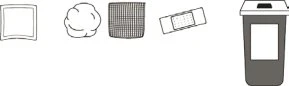
- 1 alcohol-impregnated wipe
- 1 sterile cotton ball or gauze pad
- 1 adhesive bandage (plaster)
- 1 puncture-resistant sharps container for the safe disposal of the needle cap and used syringe. See step 21 “How to dispose of Enspryng” at the end of these instructions for use.
Enspryng pre-filled syringe
(see figures A and B)
Before use:
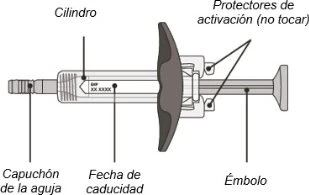
Figure A
After use:
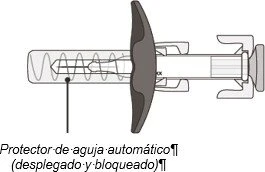
Figure B
The syringe has an automatic needle shield that covers the needle once the injection is complete.
Prepare to administer Enspryng
- Remove the pack containing the syringe from the refrigerator and place it on a clean, flat work surface (such as a table).
- Check the expiry date on the back of the pack (see figure C). Do not use the syringe if the pack has expired.
- Check that the front of the pack is properly sealed (see figure C). Do not use the syringe if the pack’s security seal is broken.
If the expiry date has passed or the seal is broken, go to step 21 “How to dispose of Enspryng” and contact your doctor or nurse.
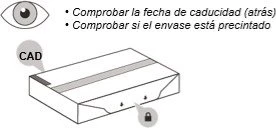
Figure C
- Open the sealed pack (see figure D).
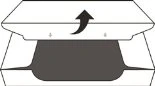
Figure D
- Carefully remove the syringe from the pack by holding the barrel (see figure E).
- Do not turn the pack upside down to remove the syringe.
- Do not touch the activation guards, as this may damage the syringe.
- Do not hold the syringe by the plunger or the needle cap.
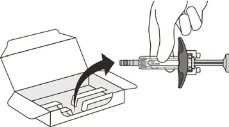
Figure E
Examine the syringe
(see figure F)
- Check the syringe’s expiry date. Do not use the syringe if it has expired.
- Inspect the syringe to ensure there is no damage. Do not use it if it is cracked or broken.
- Through the viewing window, check that the liquid is clear and colourless to slightly yellow.
Do not inject the medicine if the liquid is cloudy, has changed colour, or contains particles.
- Small air bubbles in the syringe may be present. This is normal and you should not attempt to remove them.
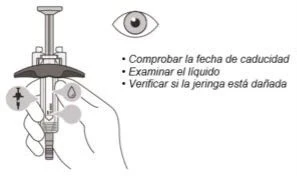
Figure F
If the expiry date has passed, the syringe is damaged, or the liquid is cloudy, discoloured, or contains particles, do not use the medicine. Proceed to step 21 “How to dispose of Enspryng” and contact your doctor or nurse.
Allow the syringe to reach room temperature
- After examining the syringe, leave it on a clean, flat work surface (such as a table) for 30 minutes to reach room temperature (see figure G).
It is important to allow the syringe to warm up gradually, as cold medicine may be uncomfortable and harder to push the plunger.
- Do not speed up the warming process by heating the syringe in any way.
- Do not remove the needle cap while waiting for the syringe to reach room temperature.

Figure G
Wash your hands
- Wash your hands with soap and water (see figure H).
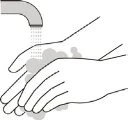
Figure H
Choose the injection site
- Choose an injection site from the following:
- lower abdomen (belly), or
- the front and middle part of the thighs (see figure I).
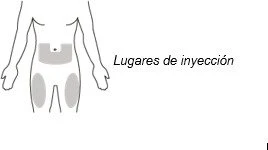
Figure I
- Do not inject within 5 cm of the navel.
- Do not inject into moles, scars, bruises, or areas where the skin is tender, red, hard, or damaged.
Choose a different injection site for each new injection. Select a new site at least 2.5 cm away from the previous injection site.
Clean the injection site
- Clean the injection site with an alcohol-impregnated wipe and allow it to air dry.
- Do not fan or blow on the cleaned area.
- Do not touch the injection site again before administering the injection.
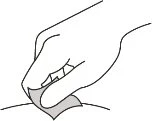
Figure J
How to inject Enspryng
- Hold the syringe barrel with your thumb and index finger. With the other hand, pull off the needle cap. You may see a drop of liquid at the tip of the needle; this is normal and will not affect the dose (see figure K).
- Use the syringe within 5 minutes after removing the needle cap; otherwise, the needle may become blocked.
- Do not remove the needle cap until you are ready to administer the Enspryng injection.
- Do not reattach the needle cap once removed, as this may damage the needle.
- Do not touch the needle or allow it to touch any surface after removing the cap.
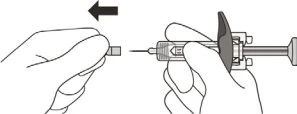
Figure K
- Immediately dispose of the needle cap into the puncture-resistant sharps container. See step 21 “How to dispose of Enspryng”.
- Hold the syringe barrel with your thumb and index finger. With the other hand, pinch the cleaned area of skin (see figure L).
- With a quick, dart-like motion, insert the needle into the skin at an angle between 45° and 90° (see figure L).
- Do not change the angle of the injection during administration.
- Do not reinsert the needle.
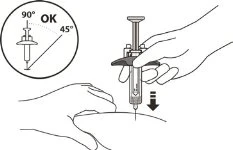
Figure L
-
Once the needle is inserted, gently release the pinched skin.
-
Slowly inject the entire medicine by gently pushing the plunger down until it touches the activation guards (see figure M).
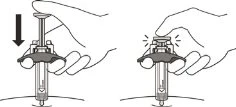
Figure M
- Carefully release the plunger and allow the needle to be withdrawn from the skin, maintaining the same angle used for insertion (see figure N).
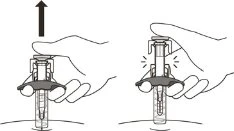
Figure N
- Then, the automatic needle shield will cover the needle. If the needle is not covered, carefully place the syringe into a puncture-resistant sharps container to prevent injury. See step 21 “How to dispose of Enspryng”.
Caring for the injection site
- There may be slight bleeding at the injection site. You may press the injection site gently with a cotton ball or gauze until bleeding stops, without rubbing. If needed, you may also cover the site with an adhesive bandage. If the medicine comes into contact with the skin, wash the area with water.
How to dispose of Enspryng
- Do not attempt to recap the syringe. Immediately place the used syringe into a sharps disposal container after use (see figure O). Do not throw the syringe into your household waste or recycle it.
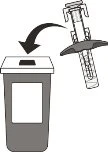
Figure O
- Ask your doctor, nurse, or pharmacist where you can obtain a “sharps” container or what other type of puncture-resistant container you can use to safely dispose of used syringes and needle caps.
- Dispose of the entire sharps container as instructed by your doctor or pharmacist.
- Do not throw the sharps container into your household waste.
- Do not recycle the used sharps container.