Emconcor 5 mg film-coated tablets
Spain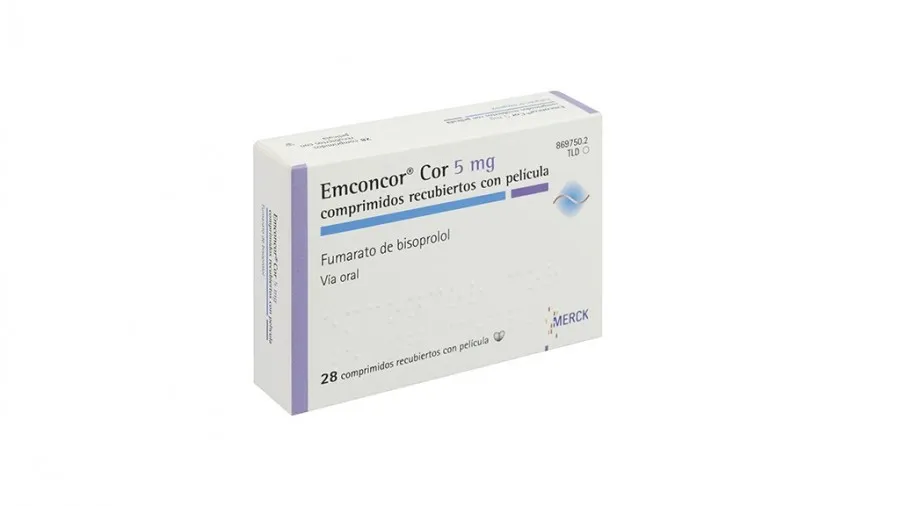
Table of Contents
Package leaflet: Information for the user
Introduction
Package leaflet: information for the user
Emconcor 5 mg film-coated tablets
Bisoprolol fumarate
Read the entire leaflet carefully before you start taking this medicine, because it contains important information for you.
- Keep this leaflet, as you may need to read it again.
- If you have any questions, ask your doctor or pharmacist.
- This medicine has been prescribed for you only, and you should not give it to other people, even if they have the same symptoms as you, because it may harm them.
- If you experience any adverse effects, consult your doctor or pharmacist, even if they are adverse effects not listed in this leaflet.
Leaflet contents:
- What Emconcor is and what it is used for
- What you need to know before taking Emconcor
- How to take Emconcor
- Possible side effects
- How to store Emconcor
- Contents of the pack and other information
1. What Emconcor is and what it is used for
The active substance in Emconcor is bisoprolol. Bisoprolol belongs to a group of medicines called beta-blockers. These medicines work by affecting the body's response to certain nerve impulses, especially in the heart. As a result, bisoprolol slows the heartbeat and makes the heart more effective at pumping blood throughout the body. At the same time, it reduces the heart's need for blood and oxygen.
Emconcor is used to treat high blood pressure (hypertension) and chronic stable angina.
2. What you need to know before taking Emconcor
Do not take Emconcor
Do not take Emconcor if you have any of the following conditions:
- allergy to bisoprolol or to any of the other ingredients of this medicine (listed in section 6),
- severe asthma,
- severe circulatory problems in the limbs (such as Raynaud's syndrome), which may cause tingling in the fingers and toes or make them pale or blue,
- untreated phaeochromocytoma, which is a rare tumour of the adrenal gland,
- metabolic acidosis, a condition in which there is too much acid in the blood.
Do not take Emconcor if you have any of the following heart conditions:
- acute heart failure,
- worsening heart failure requiring intravenous injection of medicines that increase the heart's pumping strength,
- cardiogenic shock, which is a severe acute heart condition causing low blood pressure and circulatory failure,
- certain heart conditions causing very slow heart rate or irregular pulse (second- or third-degree atrioventricular block, sinoatrial block, sick sinus syndrome),
- slow heart rate causing symptoms,
- low blood pressure causing symptoms.
Warnings and precautions
If you have any of the following conditions, inform your doctor before taking Emconcor:
- diabetes,
- strict fasting,
- certain heart conditions such as heart failure, heart rhythm disorders, or severe chest pain at rest (Prinzmetal's angina),
- circulation problems in the legs,
- asthma or chronic respiratory disease. Your doctor may need to adjust your asthma medication dose,
- obstructive respiratory disease,
- history of scaly skin rash (psoriasis),
- tumour of the adrenal gland (phaeochromocytoma),
- thyroid disorder.
Additionally, inform your doctor if you are undergoing:
- desensitisation treatment (for allergies), as Emconcor may make allergic reactions more likely or more severe,
- anaesthesia (e.g. for surgery), as Emconcor may affect how your body responds in this situation.
Children and adolescents
The use of Emconcor is not recommended in children and adolescents.
Taking Emconcor with other medicines
Tell your doctor or pharmacist if you are taking, have recently taken, or might need to take any other medicines.
Do not take the following medicines with Emconcor without specific advice from your doctor:
-
Certain medicines used to treat high blood pressure, angina, or irregular heartbeat (e.g. verapamil and diltiazem).
-
Certain medicines used to treat high blood pressure such as clonidine, methyldopa, moxonidine. However, do not stop taking these medicines without first consulting your doctor.
Consult your doctor before taking the following medicines with Emconcor; your doctor may need to monitor you more frequently:
-
Certain medicines used to treat high blood pressure or angina.
-
Certain medicines for irregular or abnormal heartbeats.
-
Some eye drops used to treat glaucoma (containing beta-blockers).
-
Some medicines used to treat Alzheimer's disease, dementia, or glaucoma.
-
Medicines used in emergencies to treat serious circulatory conditions.
-
Insulin or other medicines used to treat diabetes.
-
Anaesthetics (e.g. during surgery).
-
Medicines used to treat heart failure (digoxin).
-
Non-steroidal anti-inflammatory drugs (NSAIDs) used to treat arthritis, pain, or inflammation.
-
Epinephrine, a medicine used to treat severe allergic reactions and cardiac arrest.
-
Any medicine that may lower blood pressure as either an intended or unintended effect, such as antihypertensives or certain antidepressants.
-
Mefloquine, used for prevention or treatment of malaria.
Pregnancy and breastfeeding
There is a risk that using Emconcor during pregnancy may harm the baby.
If you are pregnant or planning to become pregnant, inform your doctor. Your doctor will decide whether you can take Emconcor during pregnancy.
It is unknown whether Emconcor passes into human breast milk. Breastfeeding is not recommended during treatment with Emconcor.
Driving and using machines
Your ability to drive or operate machinery may be affected depending on how you tolerate the medicine. Exercise particular caution at the start of treatment, when doses or medications are changed, and when taking alcohol with this medicine.
Important information about some of the ingredients of Emconcor
Athletes are advised that this medicine contains a substance that may result in a positive doping test.
3. How to take Emconcor
Follow exactly the instructions for use of this medicine as given by your doctor or pharmacist. If in doubt, please consult your doctor or pharmacist again.
Treatment with Emconcor should be initiated gradually with low doses, which should be slowly increased. In all cases, the dose must be individually adjusted, particularly according to heart rate and therapeutic response.
Dosage
For both indications, the usual dose is one Emconcor 5 tablet or half a tablet of Emconcor 10 (equivalent to 5 mg of bisoprolol) once daily.
If necessary, the dose may be increased to one tablet of Emconcor 10 mg or two tablets of Emconcor 5 mg (equivalent to 10 mg of bisoprolol) once daily.
The maximum recommended dose is 20 mg once daily.
Duration of treatment
Treatment with Emconcor is usually long-term.
Dosage in case of hepatic or renal impairment
In patients with mild to moderate impairment of liver or kidney function, dose adjustment is normally not required. In patients with severe renal impairment (creatinine clearance <20 ml/min) and in patients with severe hepatic impairment, the daily dose should not exceed 10 mg.
Dosage in the elderly
No dose adjustment is required in elderly patients.
Method of administration
Take the tablet with a little water in the morning, with or without food. Do not crush or chew the tablet.
If you take more Emconcor than you should
If you have taken more Emconcor than you should, inform your doctor immediately. Your doctor will decide which actions are necessary.
Symptoms of overdose include slowing of the heart rate (bradycardia), difficulty in breathing (bronchospasm), a severe drop in blood pressure, acute heart failure, or decreased blood sugar levels.
In case of overdose or accidental ingestion, contact the Toxicology Information Service: Tel. 91.562.04.20.
If you forget to take Emconcor
Do not take a double dose to make up for missed doses. Take your usual dose the following morning.
If you stop taking Emconcor
Never stop taking Emconcor except on the advice of your doctor. Otherwise, your condition may worsen significantly. Treatment should not be stopped abruptly, especially in patients with ischaemic heart disease. If treatment has to be discontinued, your doctor will instruct you how to gradually reduce the dose.
If you have any further questions about the use of this medicine, ask your doctor or pharmacist.
4. Possible adverse effects
Like all medicines, Emconcor may cause adverse effects, although not everyone experiences them.
The following adverse effects are listed below according to their possible frequency of occurrence:
Frequent (may affect up to 1 in 10 people):
- fatigue, dizziness, headache: These adverse effects occur especially at the beginning of treatment. They are usually mild and tend to disappear within 1–2 weeks
- sensation of coldness or numbness in hands or feet
- stomach or intestinal problems such as nausea, vomiting, diarrhoea or constipation
Uncommon (may affect up to 1 in 100 people):
- decreased heart rate (bradycardia)
- worsening of heart failure
- weakness
- sleep disturbances
- depression
- low blood pressure
- heart rhythm problems
- respiratory problems in patients with asthma or chronic respiratory disease
- muscle weakness and muscle cramps
Rare (may affect up to 1 in 1,000 people):
- increased levels of fat in the blood
- reduced tear production (take this into account if you wear contact lenses)
- hearing problems
- allergic nasal discharge
- increase in certain liver enzymes (ALAT, ASAT), inflammation of the liver (hepatitis)
- allergic-type reactions such as itching, redness, skin rash. You should consult your doctor immediately if you experience more severe allergic reactions, which may include swelling of the face, neck, tongue, mouth or throat, or difficulty breathing
- erectile problems
- nightmares, hallucinations
- fainting
Very rare (may affect up to 1 in 10,000 people):
- eye irritation and redness (conjunctivitis)
- onset or worsening of scaly skin rash (psoriasis); psoriasis-like rash
- hair loss
If you experience any adverse effects, consult your doctor or pharmacist, even if they are adverse effects not listed in this leaflet.
Reporting of adverse effects
If you experience any type of adverse effect, consult your doctor, pharmacist, or nurse, even if they are possible adverse effects not listed in this leaflet. You may also report them directly through the Spanish Pharmacovigilance System for Human Medicines: www.notificaRAM.es.
By reporting adverse effects, you can help provide more information on the safety of this medicine.
5. Storage of Emconcor
No special storage conditions are required.
Keep this medicine out of the sight and reach of children.
Do not use this medicine after the expiry date stated on the carton after EXP. The expiry date refers to the last day of the month indicated.
Medicines must not be disposed of via wastewater or household waste. Return any unused medicines and their containers to the SIGRE point at your pharmacy. If you are in doubt, ask your pharmacist how to dispose of medicines and containers you no longer need. This will help protect the environment.
6. Contents of the pack and other information
Composition of Emconcor
-
The active substance is bisoprolol fumarate. Each Emconcor 5 tablet contains 5 mg.
-
The other components are:
Tablet core: anhydrous colloidal silica, magnesium stearate, crospovidone, microcrystalline cellulose, corn starch, anhydrous calcium hydrogen phosphate.
Coating: titanium dioxide (E 171), macrogol 400, dimethicone, yellow iron oxide (E 172), hypromellose.
Appearance of the product and contents of the pack
Emconcor 5: Pale yellow, scored on both sides, heart-shaped tablets.
Packs of 60 tablets.
Marketing Authorization Holder and Manufacturer:
Marketing Authorization Holder:
Merck, S.L.
María de Molina, 40
28006, Madrid
Spain
Manufacturer:
Merck Healthcare KGaA
Frankfurter Strasse 250
D-64293 Darmstadt
Germany
or
Merck, S.L.
Polígono Merck, 08100
Mollet del Vallés (Barcelona)
Spain
Date of the most recent revision of this leaflet: 11/2020
Detailed and up-to-date information on this medicinal product is available on the website of the Spanish Agency of Medicines and Medical Devices (AEMPS) http://www.aemps.gob.es/