Elvanse 50 mg hard capsules
Spain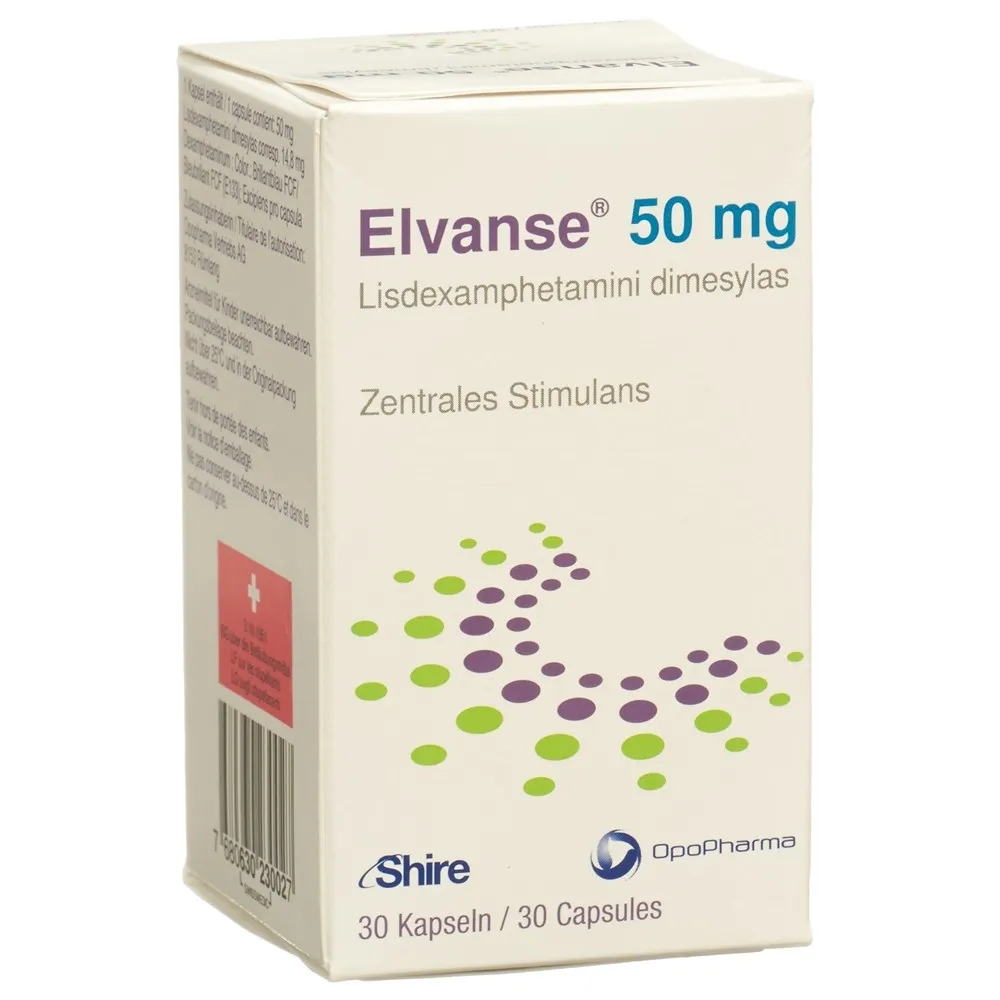
Table of Contents
Package leaflet: Information for the user
Introduction
Package leaflet: Information for the user
Elvanse 50 mg hard capsules
lisdexamfetamine dimesylate
Read the entire leaflet carefully before you start taking this medicine, because it contains important information for you.
- Keep this leaflet, as you may need to read it again.
- If you have any questions, ask your doctor or pharmacist.
- This medicine has been prescribed for you only, and you should not give it to other people, even if they have the same symptoms as you, because it may harm them.
- If you experience any adverse reactions, consult your doctor or pharmacist, even if they are adverse reactions not listed in this leaflet. See section 4.
Leaflet contents:
- What Elvanse is and what it is used for
- What you need to know before taking Elvanse
- How to take Elvanse
- Possible adverse effects
- How to store Elvanse
- Contents of the pack and other information
1. What Elvanse is and what it is used for
What Elvanse is
Elvanse contains the active substance lisdexamfetamine dimesylate, which acts on brain activity. It helps improve attention, concentration, and reduce impulsivity.
Elvanse is a prolonged-release medicine that gradually acts over 13 hours.
What it is used for
Elvanse is part of a comprehensive treatment programme for "attention deficit hyperactivity disorder" (ADHD)
in children and adolescents aged between 6 and 18 years when previous treatment with methylphenidate has been inadequate for ADHD.
- in adults who have had ADHD since childhood. If you have not previously received treatment for ADHD, your doctor will check whether you had ADHD since childhood before prescribing Elvanse.
You should inform your doctor if you do not feel better or if you feel worse after one month of treatment. Elvanse is not recommended for all patients with ADHD, and the decision to use this medicine is based on a thorough medical evaluation.
Elvanse is not indicated for the treatment of ADHD in children under 6 years of age, as it is unknown whether it is safe or beneficial in such young individuals.
How Elvanse works
Elvanse improves activity in certain parts of the brain that are underactive. The medicine may help improve attention, concentration, and reduce impulsive behaviour.
The medicine is administered as part of a treatment programme that usually includes:
- psychological therapy
- educational therapy
- social therapy
- behavioural therapy
- occupational therapy
It can only be prescribed by doctors experienced in treating people with behavioural problems.
About ADHD
People with ADHD have difficulties with:
- staying seated
- concentrating
These individuals are not to blame for being unable to do these things. However, ADHD can cause problems in daily life. Children and adolescents with ADHD may have difficulties learning and completing homework. They may struggle to behave appropriately at home, at school, and in other settings.
ADHD does not affect a person's intelligence.
2. What you need to know before taking Elvanse
DO NOT take Elvanse:
- if you are allergic to lisdexamfetamine, to amphetamines, or to any of the other ingredients of this medicine (listed in section 6);
- if you are taking a medicine called a “monoamine oxidase inhibitor” (MAOI) used for depression, or if you have taken an MAOI within the last 14 days;
- if you have thyroid problems;
- if you feel unusually elated, more active, or less inhibited than normal;
- if you have or have ever had heart problems, such as a heart attack, irregular heartbeat, chest pain or discomfort, heart failure, heart disease, or congenital heart defects;
- if you have high or very high blood pressure or narrowing of the blood vessels;
- if you have increased intraocular pressure (glaucoma);
- if you have a condition called phaeochromocytoma (a rare tumour usually growing in the adrenal glands located above the kidneys).
Do not take Elvanse if any of the conditions listed above apply to you. If you are unsure, consult your doctor or pharmacist before taking Elvanse, as it may worsen these conditions.
Warnings and precautions
Talk to your doctor or pharmacist before starting treatment with Elvanse if:
-
you have ever abused prescription medicines or drugs;
-
you have had kidney problems;
-
you have had seizures (fits, convulsions, epilepsy) or abnormalities in the electroencephalogram (EEG);
-
you have had uncontrollable tremors anywhere in the body or repeat sounds and words;
-
you have high blood pressure;
-
you have a personal or family history of irregular heartbeat (seen on an electrocardiogram), or if you have a condition or are taking treatment that makes you prone to arrhythmias or sodium disturbances;
-
you have a heart problem not included in the section above “Do not take Elvanse”;
-
you have a history of stroke;
-
you have a mental health condition, including:
-
sudden mood swings (from manic to depressive states, known as “bipolar disorder”);
-
you start behaving aggressively or hostilely, or these behaviours worsen;
-
you see, hear, or feel things that are not real (hallucinations);
-
you believe things that are not real (delusions);
-
you feel more suspicious than usual (paranoia);
-
you feel restless, anxious, or tense;
-
you feel depressed or guilty.
Or if you are a woman who could become pregnant, plan to become pregnant, or are pregnant (see section "Pregnancy and breastfeeding").
Inform your doctor or pharmacist if any of the conditions listed above apply to you before starting treatment. Elvanse may worsen these conditions. Your doctor will want to monitor how the medicine affects you.
If not used correctly, Elvanse may cause abnormal behaviour and drug dependence. Inform your doctor if you or your child have ever abused or been dependent on alcohol, prescription medicines, or drugs. Do not give this medicine to anyone else, even if they appear to have similar symptoms.
Elvanse may cause heart rhythm disorders in some patients. If you experience palpitations or irregular heartbeat during treatment, you must inform your doctor immediately. The risk of heart problems may increase with higher doses. Therefore, the recommended dose must be followed.
Checks your doctor will make before you start taking Elvanse
These checks are made to determine whether Elvanse is the right medicine for you. Your doctor will ask you about:
- other medicines you are taking;
- whether there is a family history of unexplained sudden death;
- any other medical problems (such as heart problems) that you or your family members have had;
- how you feel, whether you feel happy or sad, if you have strange thoughts, or if you have had these feelings in the past;
- whether there is a family history of “tics” (repeated, uncontrollable tremors in any part of the body or repetition of sounds and words);
- any mental health or behavioural problems that you or your family members have had. Your doctor will review your mental health history and check whether anyone in your family has a history of suicide, bipolar disorder (mood swings from manic to depressive states), or depression.
It is important to provide as much information as possible. This will help your doctor decide whether Elvanse is the right medicine for you. Your doctor may decide that further tests are needed before you start taking this medicine.
Effect on weight
- Elvanse may cause weight loss in some patients.
- It may also prevent weight gain in children and adolescents.
- If the patient is a child or adolescent, your doctor will closely monitor weight, height, and eating habits.
- If growth is slower than expected or weight loss occurs, your doctor may stop treatment with Elvanse.
- In adult patients, your doctor will monitor weight and eating habits.
Using Elvanse with other medicines
Tell your doctor or pharmacist if you are taking, have recently taken, or might need to take any other medicines.
DO NOT take Elvanse if:
- you are taking a medicine called a “monoamine oxidase inhibitor” (MAOI) used for depression, or if you have taken an MAOI within the last 14 days. Using an MAOI with Elvanse may cause a sudden increase in blood pressure. Your doctor or pharmacist can tell you if you are taking a medicine that is an MAOI.
Elvanse may interact with other medicines. If you are taking any of the following medicines, consult your doctor or pharmacist before taking Elvanse:
- medicines for serious mental health conditions;
- medicines used to raise or lower blood pressure;
- medicines used during surgery, such as painkillers;
- cough and cold remedies. Some of these medicines may affect blood pressure, so it is important to consult your pharmacist when purchasing such medicines;
- medicines that may affect the acidity of urine, such as vitamin C (ascorbic acid) or sodium bicarbonate (e.g. in medicines for indigestion).
If you are unsure whether your medicines are included in the list above, consult your doctor or pharmacist before taking Elvanse.
Doping control and use in athletes
Patients should be advised that this medicine may produce a positive result in drug tests.
Pregnancy and breastfeeding
If you are pregnant, think you may be pregnant, or plan to become pregnant, consult your doctor before using this medicine.
Elvanse is converted in the body into other substances that can cross the placenta and pass into breast milk.
Available data on the use of Elvanse during the first three months of pregnancy do not indicate an increased risk of congenital malformations in the child, but may increase the risk of pre-eclampsia (a condition that usually occurs after 20 weeks of pregnancy and is characterised by high blood pressure and protein in the urine) and premature birth. Newborns exposed to amphetamines during pregnancy may experience withdrawal symptoms (tremor, irritability, hypertonia). You should not use this medicine during pregnancy unless specifically instructed by your doctor, nor should you breastfeed while taking Elvanse.
Driving and using machines
You may feel dizzy, have difficulty focusing your eyes, or experience blurred vision when taking Elvanse. If this happens, it is dangerous to carry out activities such as driving, operating machinery, riding a bicycle or horse, or climbing trees.
Elvanse contains sodium
This medicine contains less than 1 mmol of sodium (23 mg) per capsule; this is, essentially “sodium-free”.
3. How to take Elvanse
How much to take
Follow exactly the dosing instructions for this medicine as prescribed by your doctor. If in doubt, consult your doctor or pharmacist again.
Elvanse is intended only for you. Do not give this medicine to anyone else, even if they have similar symptoms.
The maximum daily dose is 70 mg.
How to take Elvanse
- Take Elvanse in the morning before breakfast. It can be taken with or without food.
- There are two ways to take Elvanse:
o Swallow the capsule whole with a glass of water.
o Open the capsule and empty its contents into:
- a soft food such as yoghurt
- a glass of water or orange juice
Use a spoon to break up any lumps and mix Elvanse thoroughly with the yoghurt, water, or orange juice until everything is well mixed. Take all the yoghurt or drink all the water or orange juice immediately after mixing with Elvanse. Do not store it. Do not worry if a film remains in the glass or container; this is not the active ingredient.
Dosage
- Your doctor will tell you which capsule to take each day.
- The recommended starting dose at the beginning of treatment is 30 mg. Your doctor may later increase the dose to 50 mg or 70 mg. The maximum daily dose is 70 mg.
- If you have kidney problems, your doctor may reduce your dose.
- If you are elderly, your doctor will evaluate your blood pressure and cardiovascular status before starting and during treatment (see section 2 “Do not take Elvanse” and section “Warnings and precautions”). Your doctor may also need to reduce your dose.
- Do not split the dose of a capsule; take the entire contents of the capsule. Do not take less than the full contents of one capsule per day.
If you do not feel better after 1 month of treatment
If you do not feel better, inform your doctor. You may need a different treatment.
If you misuse Elvanse
- If you misuse Elvanse, you may experience abnormal behavior or develop dependence on the medicine. Therefore, inform your doctor if you have ever abused alcohol, prescription medicines, or drugs, or if you have had dependence on any of these substances.
If you take more Elvanse than you should
In case of overdose or accidental ingestion, contact a doctor, pharmacist, or call the Toxicology Information Service immediately at telephone number 915620420, indicating the medicine and the amount ingested.
Signs of overdose may include:
- restlessness, tremors, increased involuntary movements, muscle twitching, rapid breathing, confusion, tendency to fight or argue, seeing, feeling, or hearing things that are not real (hallucinations), panic state, high fever, or muscle collapse. Fatigue and depression may follow;
- nausea, vomiting, diarrhoea, and stomach cramps may also occur;
- changes in heart rate (slow, fast, or irregular), high or low blood pressure, circulatory collapse, seizures, and coma may also occur;
- headache, confusion, seizures, and visual disturbances may also occur.
If you forget to take Elvanse
Do not take a double dose to make up for missed doses. If you forget a dose, wait until the next day. Avoid taking the dose in the afternoon due to the risk of sleep disturbances (insomnia).
If you stop taking Elvanse
If you stop taking this medicine, your ADHD symptoms may return.
Do not stop taking the medicine without first consulting your doctor. You should not stop taking the medicine suddenly or on your own.
What your doctor will do while you are on Elvanse treatment
Your doctor will perform some tests
- Before starting: to ensure that Elvanse is safe and beneficial for you.
- After starting: your doctor will perform tests at least every 6 months, and even more frequently.
Tests will also be performed when your dose is changed. These tests will include:
-
monitoring of appetite,
-
measurement of height and weight,
-
measurement of blood pressure and pulse,
-
checking whether you have experienced mood problems, changes in mood, or any other unusual feelings, or whether these issues have worsened while taking Elvanse.
Long-term treatment
Elvanse does not need to be taken indefinitely. If you take Elvanse for more than one year, your doctor should interrupt treatment for a brief period, such as during holidays. This allows assessment of whether you still need the medicine.
If you have any further questions about the use of this medicine, ask your doctor or pharmacist.
4. Possible adverse effects
Like all medicines, this medicine can cause adverse effects, although not everyone experiences them. Your doctor will inform you about these adverse effects.
Some adverse effects may be serious. If you experience any of the following adverse effects, contact your doctor immediately:
Frequent (may affect up to 1 in 10 people)
- irregular heartbeat (palpitations)
- chest pain (could be a sign of heart problems)
Uncommon (may affect up to 1 in 100 people)
- feeling more excited, active, or uninhibited than normal (mania)
- allergic reaction (hypersensitivity)
Frequency not known (cannot be estimated from available data)
- severe allergic reaction characterized by a marked drop in blood pressure, difficulty breathing, and hives/itching (anaphylactic reaction)
- seeing, feeling, or hearing things that are not real*, paranoia, and delusions (psychotic episodes)
- worsening of Tourette’s disorder, with symptoms such as repeated, difficult-to-control body jerks or repetition of sounds and words (tics)
- seizures (convulsive fits)
- abnormal heartbeat, potentially life-threatening irregular heartbeat (observed on an electrocardiogram). See section 2, “Warnings and precautions”
- allergic liver injury detectable by yellowing of the eyes and/or skin (eosinophilic hepatitis)
- swelling of the skin (angioedema) or severe skin rash with large blisters on the skin and mucous membranes (Stevens-Johnson syndrome)
- shortness of breath or swelling of the legs (signs of heart muscle disease)*
*The following serious adverse effects occur at different frequencies in children and adolescents compared to adults.
- seeing, feeling, or hearing things that are not real is uncommon in children and adolescents
- shortness of breath or swelling of the legs (signs of heart muscle disease) is uncommon in adolescents
If you experience any of the adverse effects listed above, contact your doctor immediately.
Other adverse effects include the following. If they become severe, inform your doctor or pharmacist:
Very frequent (may affect more than 1 in 10 people)
- decreased appetite
- difficulty sleeping
- dry mouth
- headache
Frequent (may affect up to 1 in 10 people)
- feeling restless, nervous, anxious, depressed, irritable, or having sudden mood changes
- feeling more tired* or restless
- inability to achieve or maintain an erection or changes in sexual desire
- dizziness
- uncontrollable tremors, shaking, or increased activity
- repeated, difficult-to-control jerks in any part of the body, or repetition of sounds and words (tics)
- fast or irregular heartbeat (tachycardia)
- high blood pressure*
- difficulty breathing
- nausea, vomiting, or diarrhoea
- constipation
- weight loss*
- excessive sweating
- stomach pain
- teeth grinding
Uncommon (may affect up to 1 in 100 people)
- fever*
- excessive talking
- feeling depressed, worried, sad, or uneasy (dysphoria)
- feeling excessively happy or excited (euphoria)
- excessive skin picking
- uncontrollable tremors or shaking
- feeling more sleepy than usual
- itching, skin rash*, or raised, red, itchy areas of skin (urticaria)
- blurred vision
- metallic taste or changes in taste sensation (dysgeusia)
- fainting
- nosebleeds
Frequency not known (cannot be estimated from available data)
- excessive dilation of the pupils*
- aggression
- poor blood circulation causing numbness and pale color in fingers and toes (Raynaud’s phenomenon)*
*The following adverse effects occur at different frequencies in children and adolescents compared to adults.
- weight loss is very frequent in children and adolescents
- stomach pain is very frequent in children
- high temperature (fever) is frequent in children and adolescents
- feeling more sleepy than usual is frequent in children and adolescents
- skin rash is frequent in children
- high blood pressure is uncommon in children and adolescents
- poor blood circulation causing numbness and pale color in fingers and toes (Raynaud’s phenomenon) is uncommon in children
- excessive dilation of the pupils is uncommon in children and adolescents
Reporting of adverse effects
If you experience any adverse effect, consult your doctor or pharmacist, even if it is a possible adverse effect not listed in this leaflet. You can also report them directly via the Spanish Pharmacovigilance System for Human Medicines: www.notificaram.es. By reporting adverse effects, you can help provide more information on the safety of this medicine.
5. Storage of Elvanse
Do not store above 25°C.
Keep this medicine out of the sight and reach of children.
Store this medicine in a safe place, out of reach of other people. It may seriously harm individuals for whom it has not been prescribed.
Do not use this medicine after the expiry date stated on the bottle and outer carton after EXP. The expiry date refers to the last day of the month indicated.
Do not use this medicine if the capsules show any sign of damage.
Medicines should not be disposed of via wastewater or household waste. Return unused medicines and their containers to the SIGRE collection point at your pharmacy. If you are unsure, ask your pharmacist how to dispose of medicines and containers you no longer need. This helps protect the environment.
6. Contents of the pack and other information
Composition of Elvanse
The active substance is lisdexamfetamine dimesylate.
Each 50 mg hard capsule contains 50 mg of lisdexamfetamine dimesylate, equivalent to 14.8 mg of dexamfetamine.
The other components are:
-
Capsule contents: microcrystalline cellulose (E460), sodium croscarmellose (E468), magnesium stearate (E572).
-
Capsule coating: gelatin, titanium dioxide (E171).
- The 50 mg capsule also contains brilliant blue FCF (E133).
-
Printing ink: shellac (E904), potassium hydroxide (E525), black iron oxide (E172), propylene glycol (E1520), and concentrated ammonia solution (E527).
Nature of the product and pack size
Hard capsules.
The 50 mg capsules have an opaque white body and an opaque blue cap, printed with “S489” and “50 mg” in black ink.
Pack sizes: 28, 30 or 90 capsules. Not all pack sizes may be marketed.
Marketing Authorisation Holder and Manufacturer
Marketing Authorisation Holder:
Takeda Pharmaceuticals International AG Ireland Branch
Block 2 Miesian Plaza
50-58 Baggot Street Lower
Dublin 2, D02 HW68, Ireland
E-mail: [email protected]
Manufacturer:
Shire Pharmaceuticals Ireland Limited
Block 2 & 3 Miesian Plaza
50-58 Baggot Street Lower
Dublin 2
Ireland
or
Takeda Pharmaceuticals International AG Ireland Branch
Block 2 Miesian Plaza
50 – 58 Baggot Street Lower
Dublin 2, D02 HW68
Ireland
or
Takeda GmbH,
Plant Oranienburg, Lehnitzstrasse 70-98,
16515 Oranienburg
Germany
For further information about this medicinal product, please contact the local representative of the Marketing Authorisation Holder:
Takeda Farmacéutica España S.A.
Calle Albacete, 5, 9th floor,
Edificio Los Cubos
28027 Madrid
Spain
Tel: +34 91 790 42 22
This medicinal product is authorised in the Member States of the European Economic Area and in the United Kingdom (Northern Ireland) under the following names:
Germany Elvanse
Austria Elvanse
Belgium Elvanse
Denmark Elvanse
Estonia Elvanse
Spain Elvanse
Finland Elvanse
Netherlands Elvanse
Ireland Tyvense
Luxembourg Elvanse
Norway Elvanse
Portugal Elvanse
Sweden Elvanse
United Kingdom (Northern Ireland) Elvanse
Date of the most recent review of this leaflet: 12/2025.
Detailed and up-to-date information on this medicinal product is available on the website of the Spanish Agency of Medicines and Health Products (AEMPS) http://www.aemps.gob.es/