Elfabrio 2 mg/ml concentrate for solution for infusion
Spain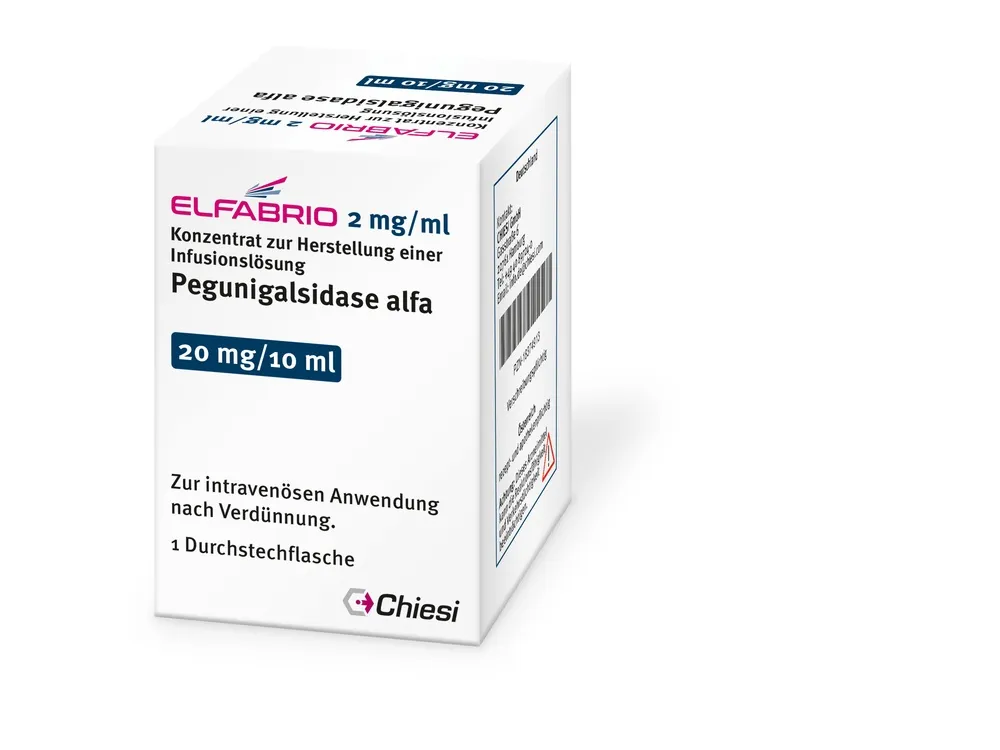
Table of Contents
Package leaflet: Information for the user
Introduction
Package leaflet: information for the user
Elfabrio 2 mg/ml concentrate for solution for infusion
pegunigalsidase alfa
This medicinal product is subject to additional monitoring, which will allow for rapid identification of new safety information. You can help by reporting any side effects you may experience. Section 4 includes information on how to report side effects.
Read all of this leaflet carefully before you start using this medicine, because it contains important information for you.
- Keep this leaflet, as you may need to read it again.
- If you have any questions, consult your doctor or pharmacist.
- This medicine has been prescribed for you only, and you should not give it to other people, even if they have the same symptoms as you, since it could harm them.
- If you experience any side effects, talk to your doctor or pharmacist, even if they are side effects not listed in this leaflet. See section 4.
Leaflet contents
- What Elfabrio is and what it is used for
- What you need to know before using Elfabrio
- How to use Elfabrio
- Possible side effects
- How to store Elfabrio
- Contents of the pack and other information
1. What Elfabrio is and what it is used for
Elfabrio contains the active substance pegunigalsidase alfa and is used as enzyme replacement therapy in adult patients with confirmed Fabry disease. Fabry disease is a rare genetic disorder that can affect many parts of the body. In patients with Fabry disease, a fatty substance is not properly cleared from the body's cells and accumulates in the walls of blood vessels, which may lead to organ failure. This fat accumulates in the cells of these patients because they do not have sufficient amounts of an enzyme called α-galactosidase-A, which is responsible for breaking it down. Elfabrio is used long-term to supplement or replace this enzyme in adult patients with confirmed Fabry disease.
2. What you need to know before using Elfabrio
Do not use Elfabrio
- if you are highly allergic to pegunigalsidase alfa or to any of the other components of this medicine (listed in section 6).
Warnings and precautions
Talk to your doctor before starting treatment with Elfabrio.
If you are receiving treatment with Elfabrio, you may experience an adverse reaction during or shortly after the infusion (see section 4). This is known as an infusion-related reaction and can sometimes be serious.
- Infusion-related reactions include dizziness, headache, nausea, low blood pressure, fatigue, and fever. If you experience an infusion-related reaction, you must inform your doctor immediately.
- If you have an infusion-related reaction, you may be given other medicines to treat it or help prevent future reactions. These may include medications used to treat allergies (antihistamines), medications used to treat fever (antipyretics), and medications to control inflammation (corticosteroids).
- If the infusion-related reaction is serious, your doctor will immediately stop the infusion and initiate appropriate medical treatment or slow down the infusion rate.
- If infusion-related reactions are severe or if there is a loss of effectiveness of this medicine, your doctor may perform a blood test to check whether you have developed antibodies that could affect the treatment outcome.
- In most cases, you can continue receiving Elfabrio even if you experience an infusion-related reaction.
In very rare cases, your immune system may fail to recognize Elfabrio, leading to an immunological kidney disease (membranoproliferative glomerulonephritis). Only one case was reported during clinical studies, with the only symptoms being a temporary decline in kidney function and excess protein in the urine. Symptoms resolved after discontinuation of treatment.
Monitoring of treatment
In patients who have switched to Elfabrio at 2 mg/kg body weight once every 4 weeks, periodic monitoring should be performed (e.g., after 3, 6, 12, 18, and 24 months). Monitoring should include at least the assessment of lyso-Gb3 concentration and renal (eGFR, proteinuria), cardiac (LVMI, NT-proBNP, troponin or ECG), and biochemical parameters. Any change in individual parameters should be interpreted in the context of the patient's overall clinical condition, and if clinically significant worsening occurs, the treatment regimen should be reevaluated.
Children and adolescents
This medicine should not be used in children and adolescents. The safety and efficacy of Elfabrio have not been established in children and adolescents aged 0 to 17 years.
Other medicines and Elfabrio
Inform your doctor if you are taking, have recently taken, or might need to take any other medicines.
Pregnancy and breastfeeding
You should not receive Elfabrio if you are pregnant, as there is no experience with Elfabrio in pregnant women. If you are pregnant, think you might be pregnant, or plan to become pregnant, consult your doctor before receiving this medicine.
It is unknown whether Elfabrio is excreted in human breast milk. Inform your doctor if you are breastfeeding or plan to breastfeed. Your doctor will help you decide whether to discontinue breastfeeding or discontinue treatment with Elfabrio, taking into account the benefits of breastfeeding for the child and the benefits of Elfabrio for you.
Driving and use of machines
Elfabrio may cause dizziness or vertigo. If you feel dizzy or lightheaded or experience syncope on the day of Elfabrio treatment, do not drive or operate machinery until you feel better.
Elfabrio contains sodium
This medicine contains 46 mg of sodium (main component of table/cooking salt) in each 10 ml vial. This corresponds to 2% of the maximum daily recommended sodium intake for an adult.
This medicine contains 11.5 mg of sodium (main component of table/cooking salt) in each 2.5 ml vial. This corresponds to 1% of the maximum daily recommended sodium intake for an adult.
3. How to use Elfabrio
This medicine should only be used under the supervision of a physician experienced in the treatment of Fabry disease or other similar disorders and must be administered solely by a healthcare professional.
The recommended dose is 1 mg/kg body weight administered once every two weeks.
Treatment may also be administered at a dose of 2 mg/kg body weight every four weeks in stable patients with a TSE.
Your doctor may determine that you can be treated at home if you meet certain criteria. Contact your doctor if you wish to receive treatment at home.
Special populations
Hepatic impairment
Dose adjustment is not required in patients with hepatic impairment.
Renal impairment
Dose adjustment is not required in patients with renal impairment. Renal function should be periodically evaluated during treatment with Elfabrio.
The presence of extensive kidney damage (eGFR < 60 ml/min) may limit the renal response to enzyme replacement therapy, possibly due to underlying irreversible anatomopathological changes. In these cases, renal function loss continues within the expected range of the natural progression of the disease. Periodic assessment of changes in estimated glomerular filtration rate (eGFR) is recommended during treatment with Elfabrio.
See the information for healthcare professionals at the end of this leaflet.
4. Possible adverse effects
Like all medicines, this medicine can cause adverse effects, although not everyone experiences them. Most adverse effects occur during or shortly after the infusion ("infusion-related reaction" – see section 2 "Warnings and precautions").
While receiving treatment with Elfabrio, you may experience some of the following reactions:
Serious adverse effects
Frequent adverse effects (may affect up to 1 in 10 people)
- hypersensitivity and severe allergic reaction (symptoms include excessive and prolonged contraction of the airway muscles causing difficulty breathing [bronchospasm], swelling of the face, mouth, and throat, wheezing ["whistling" when breathing], low blood pressure, hives, difficulty swallowing, rash, shortness of breath, flushing, chest discomfort, itching, nausea, chills, sneezing, and nasal congestion)
If these adverse effects occur, seek immediate medical attention and stop the infusion. Your doctor will provide appropriate medical treatment if necessary.
Other adverse effects include
Frequent (may affect up to 1 in 10 people)
- infusion-related reactions
- weakness
- nausea
- skin rash
- abdominal pain
- dizziness
- pain
- chest pain
- headache
- muscle and joint pain
- sensations such as numbness, tingling, or prickling (paraesthesia)
- itching (pruritus)
- diarrhea
- vomiting
- chills
- redness of the skin (erythema)
- sensation of spinning (vertigo), restlessness, irritability, or confusion
- changes in normal heart rhythm
- agitation
Uncommon (may affect up to 1 in 100 people)
- tremor
- high blood pressure (hypertension)
- bronchospasm (contraction of bronchial muscles causing airway obstruction) and difficulty breathing
- throat irritation
- tightness in the throat
- increased body temperature
- difficulty sleeping (insomnia)
- restless legs syndrome
- nerve damage in the arms and legs causing pain or numbness, burning, and tingling (peripheral neuropathy)
- nerve pain (neuralgia)
- burning sensation
- fainting (syncope)
- flushing
- condition in which stomach acid flows back into the esophagus (gastroesophageal reflux disease)
- inflammation of the stomach lining (mucosa) (dyspepsia)
- indigestion
- gas (flatulence)
- reduced sweating (hypohidrosis)
- immune-mediated kidney disease causing excess protein in the urine and kidney dysfunction (membranoproliferative glomerulonephritis)
- chronic nephropathy
- excess protein in the urine (proteinuria)
- tissue damage due to the medicine leaking from or being accidentally infused into surrounding tissue instead of the vein (perfusion site extravasation)
- swelling in the lower legs or hands (edema)
- swelling in the arms or legs
- flu-like illness
- nasal congestion and sneezing
- pain at the infusion site
- elevated uric acid in blood, elevated urine protein/creatinine ratio, and presence of white blood cells in urine in laboratory tests
- weight gain
- low blood pressure (hypotension)
Reporting of adverse effects
If you experience any adverse effect, talk to your doctor, even if it is a possible adverse effect not listed in this leaflet. You can also report them directly through the national reporting system listed in Appendix V. By reporting adverse effects, you can help provide more information on the safety of this medicine.
5. Storage of Elfabrio
Keep this medicine out of the sight and reach of children.
Do not use this medicine after the expiry date stated on the label and the carton, following «EXP». The expiry date refers to the last day of the stated month.
Store in a refrigerator (between 2 °C and 8 °C).
After dilution, the diluted solution should be used immediately. If not used immediately, the diluted solution may be stored for a maximum of 24 hours in a refrigerator (between 2 °C and 8 °C) or for a maximum of 8 hours at room temperature (below 25 °C).
Do not use this medicine if you observe solid particles or any change in colour.
Medicines must not be disposed of via wastewater or household waste. Ask your pharmacist how to dispose of medicines and containers you no longer need. This will help protect the environment.
6. Contents of the pack and other information
Composition of Elfabrio
- The active substance is pegunigalsidase alfa. Each vial contains 20 mg of pegunigalsidase alfa in 10 ml or 5 mg of pegunigalsidase alfa in 2.5 ml (2 mg/ml).
- The other components are: sodium citrate dibasic dihydrate, citric acid, and sodium chloride (see section 2, "Elfabrio contains sodium").
Appearance of the product and contents of the pack
Clear, colourless solution in a clear glass vial with a rubber stopper and sealed with an aluminium cap.
Pack sizes: 1, 5 or 10 vials.
Only certain pack sizes may be marketed.
Marketing Authorization Holder
Chiesi Farmaceutici S.p.A.
Via Palermo 26/A
43122 Parma
Italy
Manufacturer
Chiesi Farmaceutici S.p.A.
Via San Leonardo 96
43122 Parma
Italy
For further information about this medicinal product, please contact the local representative of the Marketing Authorization Holder:
Belgium/Belgium/Belgium Chiesi sa/nv Tel/Tel: + 32 (0)2 788 42 00 | Lithuania Chiesi Pharmaceuticals GmbH Tel: + 43 1 4073919 |
| Luxembourg/Luxembourg Chiesi sa/nv Tél/Tel: + 32 (0)2 788 42 00 |
Czech Republic Chiesi CZ s.r.o. Tel: + 420 261221745 | Hungary ExCEEd Orphan Distribution d.o.o. Tel.: +36 70 612 7768 |
Denmark Chiesi Pharma AB Tlf: + 46 8 753 35 20 | Malta Chiesi Farmaceutici S.p.A. Tel: + 39 0521 2791 |
Germany Chiesi GmbH Tel: + 49 40 89724-0 | Netherlands Chiesi Pharmaceuticals B.V. Tel: + 31 88 501 64 00 |
Estonia Chiesi Pharmaceuticals GmbH Tel: + 43 1 4073919 | Norway Chiesi Pharma AB Tlf: + 46 8 753 35 20 |
Greece Chiesi Hellas AEBE Tel: + 30 210 6179763 | Austria Chiesi Pharmaceuticals GmbH Tel: + 43 1 4073919 |
Spain Chiesi España, S.A.U. Tel: + 34 934948000 | Poland ExCEEd Orphan Distribution d.o.o. Tel.: +48 799 090 131 |
France Chiesi S.A.S. Tél: + 33 1 47688899 | Portugal Chiesi Farmaceutici S.p.A. Tel: + 39 0521 2791 |
Croatia Chiesi Pharmaceuticals GmbH Tel: + 43 1 4073919 | Romania Chiesi Romania S.R.L. Tel: + 40 212023642 |
Ireland Chiesi Farmaceutici S.p.A. Tel: + 39 0521 2791 | Slovenia CHIESI SLOVENIJA, d.o.o. Tel: + 386-1-43 00 901 |
Iceland Chiesi Pharma AB Sími: +46 8 753 35 20 | Slovakia Chiesi Slovakia s.r.o. Tel: + 421 259300060 |
Italy Chiesi Italia S.p.A. Tel: + 39 0521 2791 | Finland/Finland Chiesi Pharma AB Puh/Tel: +46 8 753 35 20 |
Cyprus Chiesi Farmaceutici S.p.A. Τηλ: + 39 0521 2791 | Sweden Chiesi Pharma AB Tel: +46 8 753 35 20 |
Latvia Chiesi Pharmaceuticals GmbH Tel: + 43 1 4073919 |
Date of the most recent review of this leaflet:
Other sources of information
Detailed information on this medicine is available on the website of the European Medicines Agency: https://www.ema.europa.eu. Links to other websites on rare diseases and orphan medicinal products are also available.
This information is intended for healthcare professionals only:
Dilution (using an aseptic technique)
- Determine the total number of vials required for the infusion.
The number of vials required is based on the total dose needed for each patient and requires calculating a dose based on body weight.
An example of calculating the total dose for an 80 kg patient prescribed a dose of 1 mg/kg is as follows:
- Patient weight (in kg) ÷ 2 = dose volume (in ml)
- Example: 80 kg (patient weight) ÷ 2 = 40 ml (volume to be withdrawn)
- In this example, 4 vials of the 10 ml vial (or 16 vials of the 2.5 ml vial) are required.
An example of calculating the total dose for an 80 kg patient prescribed a dose of 2 mg/kg is as follows:
- Patient weight (in kg) = dose volume (in ml)
- Example: 80 kg (patient weight) = 80 ml (volume to be withdrawn)
- In this example, 8 vials of the 10 ml vial (or 32 vials of the 2.5 ml vial) are required.
- Allow the required number of vials to reach room temperature before dilution (approximately 30 minutes).
Visually inspect the vials. Do not use if the closure cap is missing or broken. Do not use if solid particles are present or if a change in colour has occurred.
Avoid shaking or agitating the vials.
-
Withdraw and discard the same volume calculated in step 1 from an infusion solution of sodium chloride 9 mg/ml (0.9%) in the infusion bag.
-
Withdraw the required volume of Elfabrio solution from the vials and dilute with a sodium chloride 9 mg/ml (0.9%) infusion solution to the total volume based on the patient's body weight as specified in the following table.
Minimum total infusion volume for patients according to body weight
Patient weight | Minimum total perfusion volume |
<70 kg | 150 ml |
70-100 kg | 250 ml |
>100 kg | 500 ml |
Inject the Elfabrio solution directly into the infusion bag.
DO NOT inject into the air space within the infusion bag.
Gently invert the infusion bag to mix the solution, avoiding vigorous shaking or agitation.
The diluted solution must be administered using a low protein-binding 0.2 μm in-line filter.