Ebglyss 250 mg solution for injection in pre-filled syringe
Spain
Table of Contents
Package leaflet: Information for the user
Introduction
Package leaflet: information for the user
Ebglyss 250mg injectable solution in pre-filled syringe
lebrikizumab
This medicinal product is subject to additional monitoring, which will enable rapid identification of new safety information. You can help by reporting any side effects you may experience. Section 4 includes information on how to report side effects.
Read all of this leaflet carefully before you start using this medicine, because it contains important information for you.
- Keep this leaflet, as you may need to read it again.
- If you have any questions, ask your doctor, pharmacist or nurse.
- This medicine has been prescribed for you only, and you should not give it to other people, even if they have the same symptoms as you, because it may harm them.
- If you experience any side effects, talk to your doctor, pharmacist or nurse, even if they are side effects not listed in this leaflet. See section 4.
Contents of the package leaflet
- What Ebglyss is and what it is used for
- What you need to know before using Ebglyss
- How to use Ebglyss
- Possible side effects
- How to store Ebglyss
- Contents of the pack and other information
Instructions for use
1. What Ebglyss is and what it is used for
Ebglyss contains the active substance lebrikizumab.
Ebglyss is used to treat adults and adolescents aged 12 years and older with a body weight of at least 40 kg who have moderate to severe atopic dermatitis, also known as atopic eczema, that can be treated with systemic therapies (medications taken orally or by injection).
Ebglyss may be given alone or in combination with eczema treatments applied to the skin.
Lebrikizumab is a monoclonal antibody (a type of protein) that blocks the action of another protein called interleukin-13. Interleukin-13 plays an important role in the development of symptoms of atopic dermatitis. By blocking interleukin-13, Ebglyss can improve your atopic dermatitis and reduce skin itching and pain associated with the condition.
2. What you need to know before using Ebglyss
Do not use Ebglyss
- if you are allergic to lebrikizumab or any of the other ingredients of this medicine (listed in section 6).
If you think you may be allergic or are unsure, consult your doctor, pharmacist, or nurse before using Ebglyss.
Warnings and precautions
Consult your doctor, pharmacist, or nurse before starting to use Ebglyss.
Each time you receive a new pack of Ebglyss, it is important to record the date and the batch number (which you will find on the packaging after “Batch”) and keep this information in a safe place.
Allergic reactions
Very rarely, this medicine may cause allergic reactions (hypersensitivity). These reactions may occur shortly after starting Ebglyss, but they may also occur later. If you notice symptoms of an allergic reaction, you must stop using the medicine and contact your doctor or seek immediate medical attention. Signs of an allergic reaction include:
- breathing difficulties
- swelling of the face, mouth, and tongue
- fainting
- dizziness
- lightheadedness (due to a drop in blood pressure)
- hives, itching, and skin rash.
Eye problems
Consult your doctor if you develop or experience worsening of any eye problems, such as redness and discomfort in the eye, eye pain, or changes in vision.
Vaccines
Talk to your doctor about your current vaccination schedule. See section “Other medicines and Ebglyss”.
Children and adolescents
This medicine must not be used in children under 12 years of age with atopic dermatitis, or in adolescents aged 12 to 17 years who weigh less than 40 kg, as it has not been evaluated in this age group.
Other medicines and Ebglyss
Inform your doctor or pharmacist if:
- you are taking, have recently taken, or might need to take any other medicines;
- you have recently been vaccinated or plan to be vaccinated. You must not receive certain types of vaccines (live vaccines) during treatment with Ebglyss.
Pregnancy, breastfeeding, and fertility
If you are pregnant or breastfeeding, think you may be pregnant, or are planning to become pregnant, consult your doctor or pharmacist before using this medicine.
The effects of this medicine in pregnant women are unknown; it is best to avoid using Ebglyss during pregnancy unless your doctor advises you to use it.
It is unknown whether lebrikizumab passes into breast milk. If you are breastfeeding or plan to breastfeed, consult your doctor before using this medicine. You and your doctor must decide whether you will breastfeed or use Ebglyss. You should not do both.
Driving and using machines
It is unlikely that Ebglyss will affect your ability to drive or use machines.
Ebglyss contains polysorbates
This medicine contains 0.6 mg of polysorbate 20 (E 432) per pre-filled syringe, equivalent to 0.3 mg/ml. Polysorbates may cause allergic reactions. Inform your doctor if you have any known allergies.
3. How to use Ebglyss
Follow exactly the administration instructions for this medicine given by your doctor or pharmacist. If in doubt, consult your doctor or pharmacist again.
How much Ebglyss should be administered and for how long
Your doctor will decide how much Ebglyss you need and how long you should use it.
The recommended dose is:
- Two initial injections of 250 mg of lebrikizumab each (500 mg total) in week 0 and week 2.
- One injection of 250 mg every two weeks from week 4 to week 16.
Depending on how you respond to the medicine, your doctor may decide to stop treatment or continue giving you one injection of 250 mg every two weeks until week 24.
- One injection of 250 mg every four weeks from week 16 onwards (maintenance dose).
Ebglyss is administered by subcutaneous injection (under the skin) into the thigh or abdomen, except for the area within 5 cm around the navel. If someone else administers the injection, it may also be given into the upper arm. You and your doctor or nurse will decide whether you can self-inject Ebglyss.
It is recommended that you alternate the injection site with each dose. Ebglyss must not be injected into areas of sensitive, damaged, bruised or scarred skin, or into areas of skin affected by atopic dermatitis or other skin lesions. The initial 500 mg dose should be administered as two consecutive 250 mg injections at different injection sites.
It is important not to attempt self-injection until your doctor or nurse has trained you how to do so. It is also possible that a caregiver who has been properly trained may administer Ebglyss injections to you. For adolescents aged 12 years or older, it is recommended that Ebglyss be administered by an adult or under adult supervision.
Do not shake the pre-filled syringe.
Read the “Instructions for Use” of the pre-filled syringe carefully before administering Ebglyss.
If you use more Ebglyss than you should
If you use more Ebglyss than prescribed by your doctor or administer the dose earlier than scheduled, speak to your doctor, pharmacist, or nurse.
If you forget to use Ebglyss
If you have forgotten to inject a dose of Ebglyss, consult your doctor, pharmacist, or nurse.
If you forget to inject Ebglyss at your usual scheduled time, administer the injection as soon as you remember. The next dose should be injected on the regularly scheduled day.
If you stop using Ebglyss
Do not stop using Ebglyss without first talking to your doctor.
If you have any further questions about the use of this medicine, ask your doctor, pharmacist, or nurse.
4. Possible adverse effects
Like all medicines, this medicine may cause adverse effects, although not everyone experiences them.
Frequent (may affect up to 1 in 10 people)
- Redness and discomfort in the eye (conjunctivitis)
- Swelling of the eye due to an allergic reaction (allergic conjunctivitis)
- Dry eye
- Reactions at the injection site
Uncommon (may affect up to 1 in 100 people)
- Herpes zoster (shingles), a very painful blistering rash affecting one area of the body
- Increased eosinophils (a type of white blood cells, eosinophilia)
- Inflammation of the cornea (the transparent layer covering the front of the eye, keratitis)
- Itching, redness and swelling of the eyelids (blepharitis)
Reporting of adverse effects
If you experience any adverse effect, consult your doctor, pharmacist or nurse, even if it is a possible adverse effect not listed in this leaflet. You may also report them directly through the national reporting system listed in Appendix V. By reporting adverse effects, you can help provide more information on the safety of this medicine.
5. Storage of Ebglyss
Keep this medicine out of the sight and reach of children.
Do not use this medicine after the expiry date which is stated on the label after EXP. The expiry date refers to the last day of the month indicated.
Store in a refrigerator (between 2 °C and 8 °C). Do not freeze.
Keep in the original packaging to protect from light.
Do not use this medicine if you notice that the solution is cloudy, has changed colour, or contains visible particles. After removal from the refrigerator, Ebglyss must be stored below 30 °C and used within 7 days, otherwise it must be discarded. Once stored outside the refrigerator, it must not be refrigerated again. You may record the date of removal from the refrigerator on the medicine carton.
This medicine is for single use only.
Medicines should not be disposed of via wastewater or household waste. Ask your pharmacist how to dispose of medicines and packaging that you no longer need. This helps protect the environment.
6. Contents of the pack and other information
Composition of Ebglyss
- The active substance is lebrikizumab. Each pre-filled syringe contains 250 mg of lebrikizumab in 2 ml of solution (125 mg/ml).
- The other components are histidine, glacial acetic acid (E260), sucrose, polysorbate 20 (E432), and water for injections.
Nature and contents of the container
Ebglyss is a sterile injectable solution, ranging from clear to opalescent, colourless to slightly yellowish or slightly brownish, and free from visible particles. It is supplied in cardboard packs containing one single-dose pre-filled glass syringe, two single-dose pre-filled syringes, or three single-dose pre-filled syringes, and in multiple packs containing four single-dose pre-filled syringes (2 packs of 2), five single-dose pre-filled syringes (5 packs of 1), or six single-dose pre-filled syringes (3 packs of 2).
Only certain pack sizes may be marketed.
Marketing Authorization Holder and Manufacturer
Almirall, S.A.
Ronda General Mitre, 151
08022 Barcelona
Spain
For more information about this medicinal product, please contact the local representative of the Marketing Authorization Holder:
| Iceland Vistor ehf. Tel.: +354 535 70 00 |
| Italy Almirall SpA Tel.: +39 02 346181 |
Czech Republic/Slovak Republic Almirall s.r.o Tel: +420 739 686 638 | Netherlands Almirall B.V. Tel: +31 (0) 30 711 15 10 |
Denmark/Norway/Sweden Almirall ApS Tlf/Tel: +45 70 25 75 75 | Austria Almirall GmbH Tel.: +43 (0)1/595 39 60 |
Germany Almirall Hermal GmbH Tel.: +49 (0)40 72704-0 | Poland Almirall Sp. z o.o. Tel.: +48 22 330 02 57 |
France Almirall SAS Tel.: +33(0)1 46 46 19 20 | Portugal Almirall - Produtos Farmacêuticos, Lda. Tel.: +351 21 415 57 50 |
Ireland Almirall, S.A. Tel: +353 1800 849322 | Finland Orion Corporation Puh/Tel: +358 10 4261 |

Date of the most recent review of this leaflet:
Detailed information on this medicine is available on the website of the European Medicines Agency: http://www.ema.europa.eu
Instructions for use
Read these "Instructions for use" before administering this medicine and carefully follow all instructions step by step.
Important information about the Ebglyss pre-filled syringe with needle safety system:
Do not self-inject Ebglyss or inject it to another person until your doctor has explained how to do so. If in doubt, contact your doctor.
During use of the Ebglyss pre-filled syringe
- Consult your doctor regarding how often injections of this medicine will be administered.
- If you have visual impairments, do not use the Ebglyss pre-filled syringe without the assistance of a caregiver.
- To reduce the risk of accidental needle sticks, each pre-filled syringe has a needle safety system that automatically activates to cover the needle after injection.
- Immediately dispose of (discard) the used single-dose Ebglyss pre-filled syringe after use.
- Do not use the Ebglyss pre-filled syringe if it has been dropped on a hard surface or is damaged.
- Do not use the Ebglyss pre-filled syringe if the needle cap is missing or not securely attached.
- Do not touch the plunger head until you are ready to administer the injection.
- Do not remove air bubbles from the Ebglyss pre-filled syringe.
- Do not pull back on the plunger head at any time.
- Do not inject through clothing.
- Do not remove the needle cap until immediately before you are ready to administer the injection.
- Do not reuse a single-dose Ebglyss pre-filled syringe.
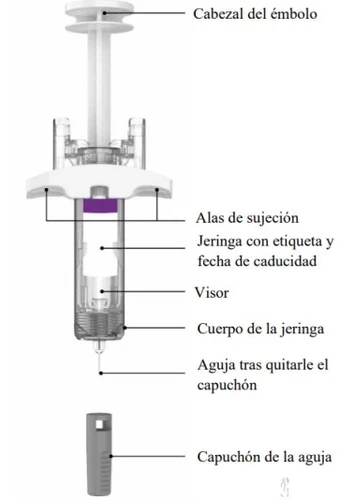
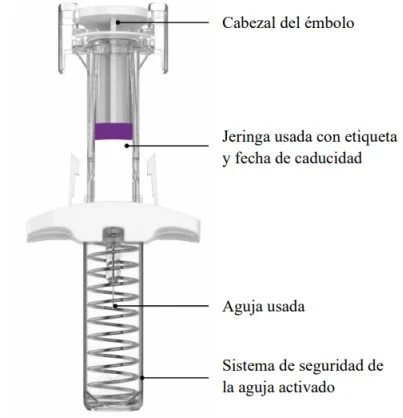
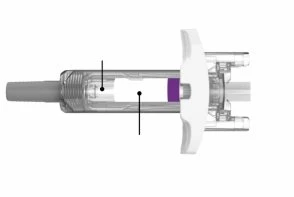
Parts of the Ebglyss pre-filled syringe with needle safety system
Before use

After use
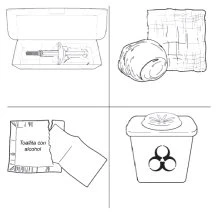
Preparation for Ebglyss Injection
| ||||
Inspect the pre-filled syringe
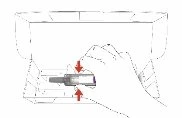
| When you receive the Ebglyss pre-filled syringes, always check that you have the correct medicine and dose and visually inspect the pre-filled syringe. Note: you may gently rotate the plunger head to view the syringe label. The label must state the word “Ebglyss”. Do not use the Ebglyss pre-filled syringe if the expiry date has passed. Do not use the Ebglyss pre-filled syringe if it is damaged. Look at the medicine through the viewing window of the Ebglyss pre-filled syringe. The liquid should be clear, colorless to slightly yellow or/and slightly brown. Note: It is normal to see a few air bubbles. Do not use the Ebglyss pre-filled syringe if the liquid has changed color or appears cloudy, contains flakes or visible particles, if the syringe shows signs of damage or has been dropped, or if the medicine is frozen. | |||
Do not heat the Ebglyss pre-filled syringe in a microwave or with hot water. Do not place the Ebglyss pre-filled syringe under direct sunlight. | ||||
Select the injection site
You or another person may self-inject or be injected in these areas.
Another person should administer the injection in this area. |
Do not inject into areas of skin that are tender, bruised, red, hard, scarred, or affected by atopic dermatitis or other skin lesions. | |||
Prepare the skin | Wash your hands thoroughly with soap and water. Clean the injection site with an alcohol wipe. Allow the injection site to dry before injecting. Do not touch the injection site again or blow on it before injecting. |

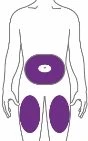
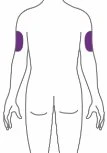
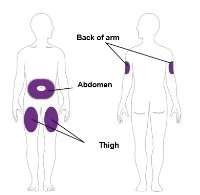
Ebglyss Injection | ||
1 | Remove the needle cap | |
Hold the Ebglyss pre-filled syringe in the middle of the barrel with the needle pointing away from you and pull off the needle cap. Do not recap the needle. Do not touch the needle. Inject the medication immediately after removing the needle cap. |
| |
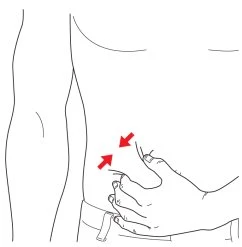
2 | Pinch the injection site | |
Gently pinch a fold of skin at the injection site (thigh or abdomen, except within 5 cm around the navel, or outer upper arm if being administered by a caregiver). |
| |
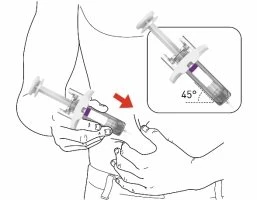
3 | Insert the needle | |
Insert the needle completely into the skin fold at an angle of approximately 45°. |
| |
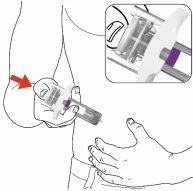
4 | Push the plunger head | |
Gently release the skin pinch while keeping the needle in place. Slowly and firmly push the plunger head until it stops and the syringe is empty. Note: It is normal to feel some resistance. |
| |
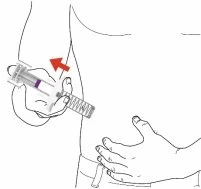
5 | Release and remove the needle | |
Lift your thumb to release the plunger, allowing the safety mechanism to cover the needle, then remove the syringe from the injection site. If bleeding occurs, gently press the injection site with a cotton ball or gauze pad. Do not recap the needle. Do not rub the skin surface after injection. |
| |
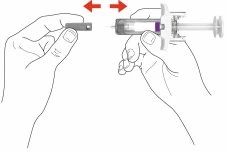
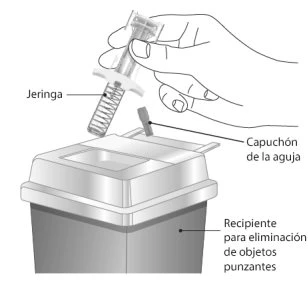
Dispose of the syringe safely | |
Place the used Ebglyss pre-filled syringe and the needle cap into a sharps disposal container immediately after use. | |
Do not dispose of (throw away) Ebglyss pre-filled syringes or needle caps in household waste. If you do not have a sharps disposal container, you may use a household container that:
|
|
When the sharps disposal container is almost full, follow your local guidelines for proper disposal. National laws may exist regarding the disposal of used needles and syringes. For more information about safe disposal of sharps, ask your doctor about available options in your area. Do not recycle the used sharps disposal container. |
Read the full pre-filled syringe leaflet before using Ebglyss.