Duracef 250 mg/5 ml powder for oral suspension
Spain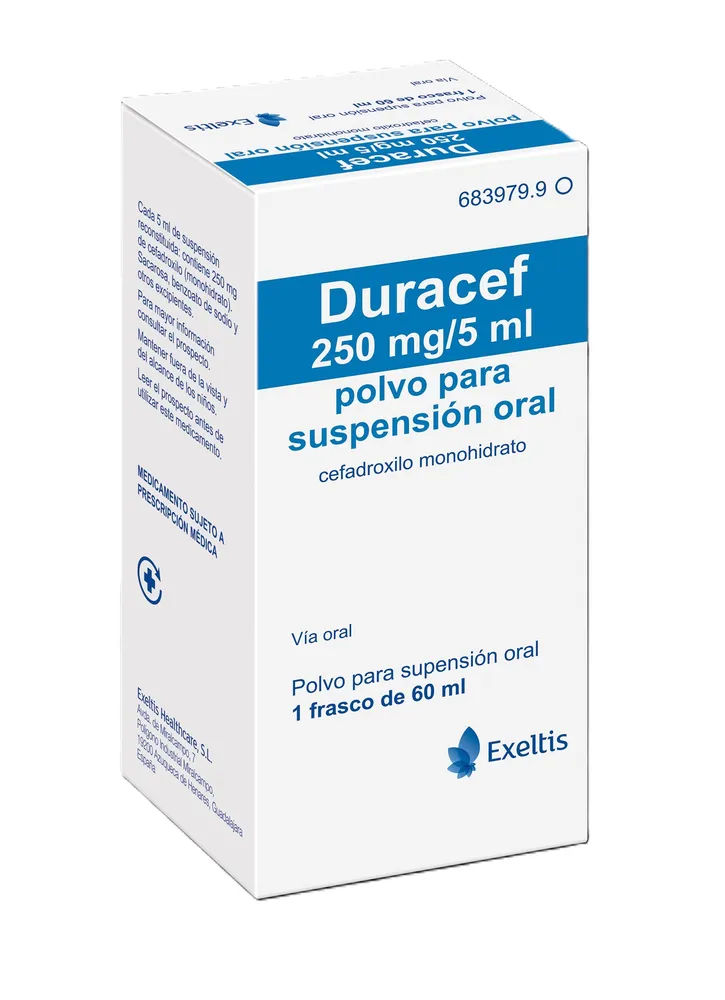
Table of Contents
- Package leaflet: Information for the user
- Introduction
- **Read the entire leaflet carefully before starting to take this medicine, as it contains important information for you.**
- **Package leaflet contents**
- 1. What Duracef is and what it is used for
- 1. What Duracef is and what it is used for
- 2. What you need to know before starting to take Duracef
- **Warnings and precautions**
- 3. How to take Duracef
- 4. Possible adverse effects
- 5. Storage of Duracef
- 6. Contents of the pack and other information
Package leaflet: Information for the user
Introduction
Package leaflet: information for the user
Duracef 250 mg/5 ml powder for oral suspension
cefadroxil monohydrate
Read the entire leaflet carefully before starting to take this medicine, as it contains important information for you.
- Keep this leaflet, as you may need to read it again.
- If you have any questions, consult your doctor or pharmacist.
- This medicine has been prescribed for you only, and you should not give it to other people, even if they have the same symptoms as you, because it may harm them.
- If you experience any adverse effects, consult your doctor or pharmacist, even if they are adverse effects not listed in this leaflet. See section 4.
Package leaflet contents
1. What Duracef is and what it is used for
- What you need to know before starting to take Duracef
- How to take Duracef
- Possible side effects
- Storage of Duracef
- Package contents and additional information
1. What Duracef is and what it is used for
Duracef contains cefadroxil monohydrate, an antibiotic that belongs to a group called cephalosporins.
Antibiotics are used to treat bacterial infections and are not effective against viral infections such as flu or the common cold.
It is important that you follow your doctor's instructions regarding dose, dosing interval, and duration of treatment.
Do not keep or reuse this medicine. If you have leftover antibiotic after finishing the treatment, return it to the pharmacy for proper disposal. Do not dispose of medicines via the sewage system or with household waste.
This medicine is used to treat the following infections:
- Pharyngotonsillitis
- Uncomplicated skin and soft tissue infections
- Uncomplicated urinary tract infections
2. What you need to know before starting to take Duracef
Do not take Duracef
- if you are allergic to cefadroxil or to any of the other ingredients of this medicine (listed in section 6).
- if you are allergic to cephalosporins.
- if you have had severe allergic reactions to any penicillin.
- in children 6 years of age or older weighing less than 40 kg with renal impairment or requiring hemodialysis.
Warnings and precautions
Consult your doctor or pharmacist before starting to take Duracef
- if you have ever had an allergic reaction to an antibiotic or suffer from asthma,
- if you have been told that your kidneys are not functioning properly or if you are undergoing dialysis (due to kidney problems). You may take this medicine, but your doctor will adjust the dose you should take,
- if you have ever had inflammation of the large intestine, known as colitis, or any other disease affecting the intestine.
If you are being treated with this medicine for a prolonged period, your doctor will perform periodic blood tests.
You should monitor for the possibility of developing certain gastrointestinal disorders, such as diarrhea, while taking this medicine. See section 4.
If you need a blood test
This medicine may affect the results of urine sugar tests and the blood test known as the Coombs test.
If you are to have such tests, inform the person taking the samples that you are taking this medicine.
Other medicines and Duracef
Inform your doctor or pharmacist if you are taking, have recently taken, or might need to take any other medicines.
Duracef may be affected by other medicines that are eliminated through the kidneys.
Many medicines have this effect, so you should consult your doctor or pharmacist before taking this medicine.
You should consult your doctor or pharmacist if you are taking the following medicines:
-
anticoagulants (used to prevent blood clotting);
-
probenecid (used for gout). It may delay the elimination of this medicine from your body;
-
cholestyramine (used to lower high cholesterol).
Never take this medicine together with the following medicines:
-
antibiotics known as aminoglycosides (such as gentamicin), polymyxin B, and colistin;
-
other antibiotics that inhibit bacterial growth (such as tetracyclines, erythromycin, sulfonamides, chloramphenicol).
-
diuretics such as furosemide. Renal function may need to be evaluated during treatment.
You should leave a gap of 2 to 3 hours between taking Duracef and other medicines.
Taking Duracef with food and drinks
Duracef (cefadroxil) is a stable acid and may be administered orally, with or without food. Furthermore, administration with food may help reduce potential gastrointestinal disturbances associated with oral cephalosporin therapy.
Pregnancy and breastfeeding
If you are pregnant or breastfeeding, think you may be pregnant, or plan to become pregnant, consult your doctor or pharmacist before using this medicine.
Driving and using machines
While taking this medicine, you may experience headache, dizziness, nervousness, insomnia, and fatigue. These effects may impair your ability to drive or operate machinery. If this occurs, do not drive or operate machinery.
Duracef contains sucrose
This medicine contains sucrose. If your doctor has advised you that you have an intolerance to certain sugars, consult him before taking this medicine.
This medicine contains 62 mg of sodium benzoate in each 60 ml dose unit.
Sodium benzoate may increase the risk of jaundice (yellowing of the skin and eyes) in newborns (up to 4 weeks of age).
3. How to take Duracef
Follow exactly the instructions for administering this medicine as given by your doctor or pharmacist. If in doubt, consult your doctor or pharmacist again.
The dose prescribed by your doctor will depend on the nature and severity of the infection, as well as on how well your kidneys are functioning. Your doctor will explain this to you.
Adults: Adolescents and adults who require treatment with cefadroxil usually take cefadroxil in hard capsules. The capsules have a separate package leaflet.
Use in children
- The daily dose is calculated based on the child's body weight.
- In children, the dose may be increased up to 100 mg (2 ml)/kg/day.
- Duracef must not be taken by children with renal impairment or undergoing hemodialysis.
Elderly patients and patients with renal problems or undergoing hemodialysis:
Dosage adjustment is necessary.
The exact dose will have been determined by the doctor.
The following table provides a guide to the usual doses in adults and adolescents weighing 40 kg or more with normal renal function:
Indications | Recommended dose in adults and adolescents weighing greater than or equal to 40 kg with normal renal function | Recommended dose in children weighing less than 40 kg with normal renal function |
Uncomplicated urinary tract infections | 1,000 mg (20 ml) twice daily | 30 mg (0.6 ml)/kg/day divided into two doses, orally. |
Uncomplicated skin and soft tissue infections | ||
Pharyngitis and tonsillitis | 1,000 mg (20 ml) once daily for 10 days | 30 mg (0.6 ml)/kg/day divided into two doses, orally, for at least 10 days. Maximum dose: 2 grams (40 ml) per day. |
Instructions for the correct administration of the preparation
- Shake vigorously to loosen the powder.
- Add portions of water, shaking after each addition, taking care that the total volume does not exceed the mark indicated on the label (60 ml).
- If necessary, add water again until reaching this mark and shake well until a uniform suspension is obtained. Shake well before use.
Duration of treatment
Treatment should be continued for at least 2–3 days after the disappearance of acute symptoms.
In the case of streptococcal infections, the minimum duration of treatment should be 10 days.
If you take more Duracef than you should
If you take more cefadroxil than prescribed, contact your doctor immediately or go to the hospital. Symptoms of overdose include: nausea, hallucinations, increased reflexes, decreased consciousness, and even coma.
If you have taken more cefadroxil than you should, consult your doctor or pharmacist immediately, or call the Toxicology Information Service at 91 562 04 20, indicating the medication and the amount taken.
If you forget to take Duracef
If you forget to take your medicine, continue with the normal dose recommended by your doctor. Do not take a double dose to make up for forgotten doses.
If you stop taking Duracef
It is important that you take the medicine exactly as prescribed by your doctor. Do not stop taking it without consulting your doctor.
If you have any further questions about the use of this product, ask your doctor or pharmacist.
4. Possible adverse effects
Like all medicines, this medicine can cause adverse effects, although not everyone will experience them.
If any of the following effects occur, stop taking this medicine immediately and consult your doctor or go to the nearest emergency service:
Serious adverse effects (anaphylactic reaction) requiring emergency care:
Very rare (may affect up to 1 in 10,000 patients):
-
sudden onset of wheezing and chest tightness;
-
swelling of the eyelids, face, or lips;
-
loss of consciousness (fainting);
-
severe rash associated with blisters, in the eyes, mouth and throat, or genitals (Stevens-Johnson syndrome);
-
severe diarrhea or blood in the stool, indicating inflammation of the intestine called pseudomembranous colitis.
Rare (may affect up to 1 in 1,000 patients):
-
yellowing of the eyes or skin, changes in blood tests indicating kidney function abnormalities;
-
swelling of the tongue and throat;
-
decrease in the number of blood cells (symptoms may include fatigue, new infections, fever, sudden sore throat, and mouth ulcers); increase in the number of certain types of white blood cells; decrease in the number of blood cells necessary for clotting, which may cause bruising or bleeding.
If you think you are experiencing any of these signs, stop taking this medicine and contact a doctor or the nearest emergency service.
Other possible adverse effects:
Common (may affect up to 1 in 10 patients):
-
feeling unwell, stomach upset, abdominal pain, swollen tongue with redness and pain, diarrhea;
-
itching, rash, hives.
Uncommon (may affect up to 1 in 100 patients):
- mouth ulcers, vaginal thrush.
Rare (may affect up to 1 in 1,000 patients):
-
allergic reactions (including skin rash, less severe allergic reactions than those mentioned above, hives, itching);
-
changes in kidney function;
-
joint pain;
-
fever.
Very rare (may affect up to 1 in 10,000 patients):
-
a type of anemia, which can be severe, caused by the breakdown of red blood cells;
-
headache, numbness, dizziness, restlessness;
-
insomnia, tiredness;
-
abnormal blood test results.
Reporting of adverse effects
If you experience any type of adverse effect, consult your doctor or pharmacist, even if it is a possible adverse effect not listed in this leaflet. You may also report them directly via the Spanish Pharmacovigilance System for Human Medicinal Products: https://www.notificaram.es. By reporting adverse effects, you can help provide more information on the safety of this medicine.
5. Storage of Duracef
Once reconstituted, the suspension has a shelf life of 14 days when stored in the refrigerator (between 4º and 8ºC).
Keep this medicine out of the sight and reach of children.
Do not use this medicine after the expiry date stated on the container and blister pack, following “EXP”. The expiry date refers to the last day of the month indicated.
Store below 25ºC.
Medicines should not be disposed of via wastewater or household waste. Return any unused medicines and their containers to the SIGRE collection point at your pharmacy. If you have any doubts, ask your pharmacist how to properly dispose of unused medicines and their packaging. This will help protect the environment.
6. Contents of the pack and other information
Composition of Duracef 250 mg/5 ml powder for oral suspension
- The active substance is cefadroxil monohydrate, equivalent to 250 mg per 5 ml.
- The other components are: sodium benzoate (E 211), microcrystalline cellulose (E460), lemon flavour, raspberry flavour, strawberry flavour, polysorbate 40, tragacanth gum (E413) and sucrose.
Nature of the product and contents of the container
White to pale yellow granular powder with a characteristic fruity odour.
After reconstitution with water, 60 ml of suspension are obtained.
Duracef 250 mg/5 ml powder for suspension is supplied in containers containing powder to prepare 60 ml of suspension. The packs include a syringe and a spoon to facilitate administration of the product.
Marketing Authorisation Holder
Exeltis Healthcare, S.L.
Avda. de Miralcampo, 7
Polígono Industrial Miralcampo,
19200 Azuqueca de Henares, Guadalajara
Spain
Manufacturer
Laboratorios Atral S.A.
Rua Do Estacao, Ns 1 and 1A.
Castanheira Do Ribatejo,
2600-726, Portugal
Date of the most recent revision of this leaflet: December 2023
Detailed and up-to-date information on this medicinal product is available on the website of the Spanish Agency of Medicines and Medical Devices (AEMPS) http://www.aemps.gob.es.