Dupixent 200 mg solution for injection in pre-filled syringe
Spain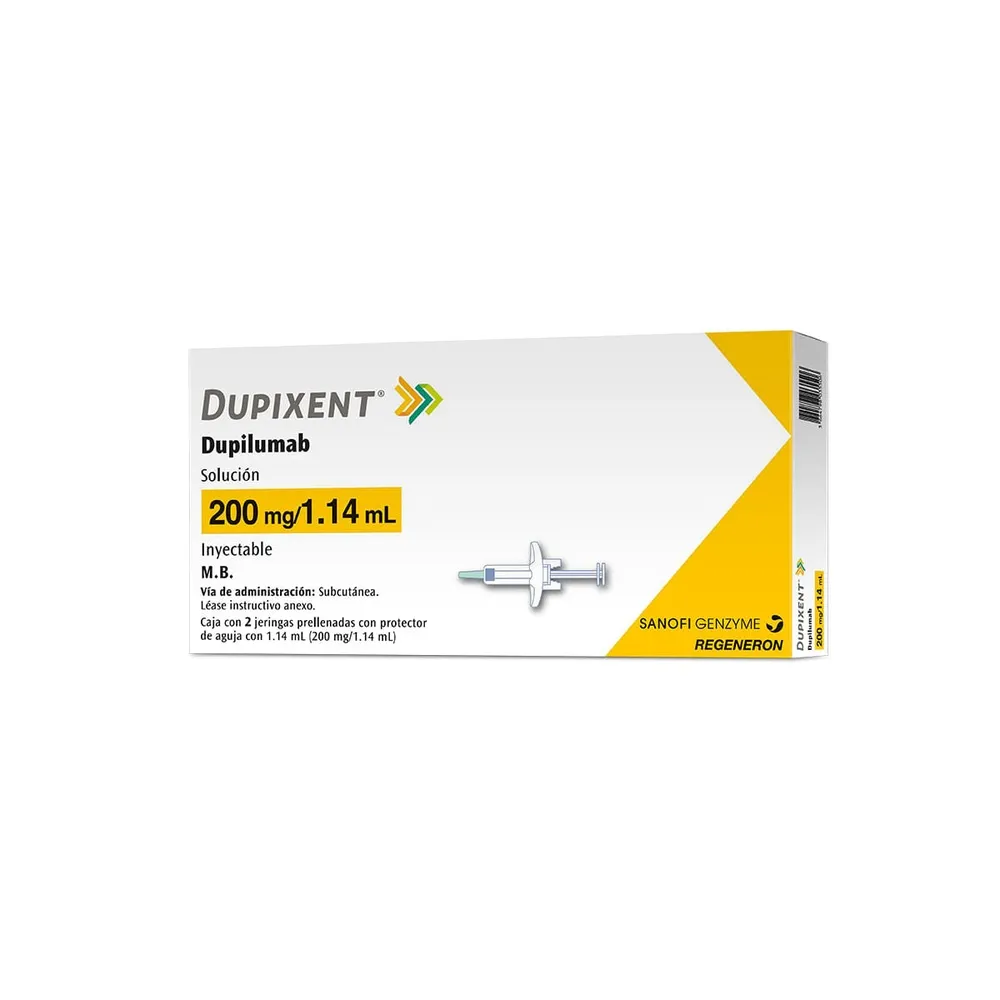
Table of Contents
Package leaflet: Information for the user
Introduction
Package leaflet: information for the user
Dupixent 300 mg solution for injection in pre-filled syringe
dupilumab
Read the entire leaflet carefully before you start using this medicine, because it contains important information for you.
- Keep this leaflet, as you may need to read it again.
- If you have any questions, ask your doctor, pharmacist or nurse.
- This medicine has been prescribed for you only and must not be given to other people, even if they have the same symptoms as you. It may harm them.
- If you experience any adverse reactions, consult your doctor, pharmacist or nurse, even if they are adverse reactions not listed in this leaflet. See section 4.
Contents of the leaflet
- What Dupixent is and what it is used for
- What you need to know before using Dupixent
- How to use Dupixent
- Possible side effects
- How to store Dupixent
- Contents of the pack and other information
1. What Dupixent is and what it is used for
What Dupixent is
Dupixent contains the active substance dupilumab.
Dupilumab is a monoclonal antibody (a type of specialised protein) that blocks the action of proteins called interleukin (IL)-4 and IL-13. Both play a key role in the development of signs and symptoms of atopic dermatitis, asthma, eosinophilic esophagitis (EoE), and chronic spontaneous urticaria (CSU).
What it is used for
Dupixent is used to treat adults and adolescents aged 12 years and older with moderate-to-severe atopic dermatitis, also known as atopic eczema. Dupixent is also used to treat children from 6 months to 11 years of age with severe atopic dermatitis. Dupixent may be used together with topical eczema medications applied to the skin or may be used alone.
Dupixent is also used, in combination with other asthma medications, for the maintenance treatment of severe asthma in adults, adolescents, and children aged 6 years and older whose asthma is not controlled with their current medication (e.g., corticosteroids).
Dupixent is also used to treat adults, adolescents, and children aged 1 year and older, weighing at least 15 kg, with eosinophilic esophagitis (EoE).
Dupixent is also used to treat adults, adolescents, and children aged 2 years and older with moderate-to-severe chronic spontaneous urticaria (CSU) not controlled with antihistamines, who have not received immunoglobulin E (IgE) blockers for their CSU.
How Dupixent works
Use of Dupixent for atopic dermatitis (atopic eczema) may improve your skin condition and reduce itching. Dupixent has also shown improvement in symptoms of pain, anxiety, and depression associated with atopic dermatitis. In addition, Dupixent helps improve sleep disturbances and overall quality of life.
Dupixent helps prevent severe asthma attacks (exacerbations) and may improve your breathing ability. Dupixent may also help reduce the amount of another group of medications you need to control your asthma, called oral corticosteroids, while preventing severe asthma attacks and improving your breathing.
Use of Dupixent for CSU may improve your skin condition by reducing itching and hives.
2. What you need to know before using Dupixent
Do not use Dupixent
- if you are allergic to dupilumab or to any of the other ingredients of this medicine (listed in section 6).
If you think you may be allergic, or are unsure, consult your doctor, pharmacist, or nurse before using Dupixent.
Warnings and precautions
Talk to your doctor, pharmacist, or nurse before starting Dupixent:
Dupixent is not a rescue medicine and should not be used to treat a sudden asthma attack.
Each time you receive a new pack of Dupixent, it is important to record the name of the medicine, the date of administration, and the batch number (found on the packaging after "Batch") and keep this information in a safe place.
Allergic reactions
- Rarely, Dupixent may cause serious adverse effects, including allergic reactions (hypersensitivity), anaphylactic reaction, and angioedema. These reactions may occur from minutes after administration of Dupixent up to seven days later. While using Dupixent, you should watch for signs of these conditions (i.e., breathing problems, swelling of the face, lips, mouth, throat, or tongue, fainting, dizziness, lightheadedness (low blood pressure), fever, general feeling of being unwell, swollen lymph nodes, hives, itching, joint pain, rash). These signs are listed under "Serious adverse effects" in section 4.
- Stop using Dupixent and tell your doctor or seek immediate medical help if you notice any signs of an allergic reaction.
Eosinophilic diseases
- Rarely, patients taking asthma medication may develop inflammation of blood vessels or lungs due to an increase in a certain type of white blood cells (eosinophilia).
- It is not known whether this is caused by Dupixent. This usually, but not always, occurs in people who are also taking a corticosteroid medicine that has been stopped or whose dose is being reduced.
- If you experience a combination of symptoms including flu-like illness, numbness or tingling in the arms or legs, worsening of lung symptoms and/or rash, inform your doctor immediately.
Parasitic infection (intestinal parasites)
-
Dupixent may weaken your resistance to infections caused by parasites. If you already have a parasitic infection, it should be treated before starting treatment with Dupixent.
-
Consult your doctor if you have diarrhea, gas, stomach discomfort, greasy stools, or dehydration, which may be signs of a parasitic infection.
-
If you live in or are traveling to an area where such infections are common, consult your doctor.
Asthma
If you have asthma and are taking asthma medication, do not change or stop taking your asthma medication without consulting your doctor. Talk to your doctor before stopping treatment with Dupixent or if your asthma is not controlled or worsens during treatment with this medicine.
Eye problems
Talk to your doctor if you develop or experience worsening eye problems, including eye pain or changes in vision.
Children and adolescents
- The safety and benefits of Dupixent in children under 6 months of age with atopic dermatitis are not yet known.
- The safety and benefits of Dupixent in children under 6 years of age with asthma are not yet known.
- The safety and benefits of Dupixent in children under 1 year of age, or with a body weight < 15 kg, with EoE are not yet known.
- The safety and benefits of Dupixent in children under 2 years of age with CSU are not yet known.
Other medicines and Dupixent
Tell your doctor or pharmacist
- if you are taking, have recently taken, or might need to take any other medicines.
- if you have recently been vaccinated or are due to be vaccinated.
Other asthma medicines
Do not stop or reduce your asthma medicines unless instructed by your doctor.
- These medicines (especially corticosteroids) should be stopped gradually.
- This should be done under the direct supervision of your doctor and depending on your response to Dupixent.
Pregnancy and breastfeeding
- If you are pregnant, think you may be pregnant, or plan to become pregnant, talk to your doctor before using this medicine. The effects of this medicine in pregnant women are unknown; therefore, it is preferable to avoid using Dupixent during pregnancy unless your doctor advises otherwise.
- If you are breastfeeding or plan to breastfeed, talk to your doctor before using this medicine. You and your doctor should decide whether to breastfeed or use Dupixent. You should not do both at the same time.
Driving and using machines
It is unlikely that Dupixent will affect your ability to drive or use machines.
Dupixent contains sodium
This medicine contains less than 1 mmol of sodium (23 mg) per 200 mg dose; hence, it is essentially "sodium-free".
Dupixent contains polysorbate
This medicine contains 2.28 mg of polysorbate 80 in each 200 mg dose (1.14 ml). Polysorbates may cause allergic reactions. Inform your doctor if you or your child has any known allergies.
3. How to use Dupixent
Follow exactly the instructions for administering this medicine given by your doctor or pharmacist. If in doubt, consult your doctor or pharmacist again.
What dose of Dupixent you will receive
Your doctor will decide which dose of Dupixent is suitable for you.
Recommended dose in adolescents with atopic dermatitis
The recommended dose of Dupixent for adolescents (aged 12 to 17 years) with atopic dermatitis is based on body weight:
Body weight of the patient | Initial dose | Subsequent doses (every two weeks) |
Less than 60 kg | 400 mg (two injections of 200 mg) | 200 mg |
60 kg or more | 600 mg (two injections of 300 mg) | 300 mg |
Recommended dose in children aged 6 to 11 years with atopic dermatitis
The recommended dose of Dupixent for children (aged 6 to 11 years) with atopic dermatitis is based on body weight:
Body weight of the patient | Initial dose | Subsequent doses |
15 kg to less than 60 kg | 300 mg (one 300 mg injection) on day 1, followed by 300 mg on day 15 | 300 mg every 4 weeks*, starting 4 weeks after the day 15 dose |
60 kg or more | 600 mg (two 300 mg injections) | 300 mg every two weeks |
- The dose may be increased to 200 mg every two weeks based on the physician's judgment.
Recommended dose in children 6 months to 5 years of age with atopic dermatitis
The recommended dose of Dupixent for children 6 months to 5 years of age with atopic dermatitis is based on body weight:
Patient body weight | Initial dose | Subsequent doses |
5 kg to less than 15 kg | 200 mg (one 200 mg injection) | 200 mg every 4 weeks |
15 kg to less than 30 kg | 300 mg (one 300 mg injection) | 300 mg every 4 weeks |
Recommended dose in adult and adolescent patients with asthma (12 years of age and older)
For most patients with severe asthma, the recommended dose of Dupixent is:
- An initial dose of 400 mg (two injections of 200 mg)
- Followed by 200 mg every two weeks administered by subcutaneous injection.
For patients with severe asthma who are taking oral corticosteroids, or for patients with severe asthma and comorbid moderate-to-severe atopic dermatitis, or adults with comorbid severe chronic rhinosinusitis with nasal polyposis, the recommended dose of Dupixent is:
- An initial dose of 600 mg (two injections of 300 mg)
- Followed by 300 mg every two weeks administered by subcutaneous injection.
Recommended dose in children with asthma
The recommended dose of Dupixent for children (6 to 11 years of age) with asthma is based on body weight:
Body weight of the patient | Initial and subsequent doses |
15 kg to less than 30 kg | 300 mg every 4 weeks |
30 kg to less than 60 kg | 200 mg every two weeks or 300 mg every 4 weeks |
60 kg or more | 200 mg every two weeks |
For patients aged 6 to 11 years with asthma and coexisting severe atopic dermatitis, your doctor will decide which dose of Dupixent is appropriate for you.
Recommended dose in adults, adolescents, and children (from 1 year of age) with eosinophilic esophagitis (EoE)
Body weight | Dosage |
≥15 kg to <30 kg | 200 mg every two weeks |
≥30 kg to <40 kg | 300 mg every two weeks |
≥40 kg | 300 mg every week |
Recommended dose in adults with chronic spontaneous urticaria (CSU)
The recommended dose of Dupixent for adult patients is an initial dose of 600 mg (two 300 mg injections), followed by 300 mg administered every two weeks.
Recommended dose in children and adolescents aged 6 to 17 years with chronic spontaneous urticaria (CSU)
The recommended dose of Dupixent for children and adolescents (aged 6 to 17 years) with chronic spontaneous urticaria is based on body weight:*
Body weight | Initial dose | Subsequent doses |
15 kg to less than 30 kg | 300 mg (one 300 mg injection) on Day 1, followed by 300 mg on Day 15 | 300 mg every 4 weeks (Q4W), starting 4 weeks after the Day 15 dose |
30 kg to less than 60 kg | 400 mg (two 200 mg injections) | 200 mg every two weeks (Q2W) |
60 kg or more | 600 mg (two 300 mg injections) | 300 mg every two weeks (Q2W) |
*For patients weighing 5 kg to less than 15 kg, the recommended dose is 200 mg every 4 weeks (Q4W).
Recommended dose in children 2 to 5 years of age with chronic spontaneous urticaria (CSU)
The recommended dose of Dupixent for children (2 to 5 years of age) with chronic spontaneous urticaria is based on body weight:
Body weight | Initial and subsequent dose |
5 kg to less than 15 kg | 200 mg every four weeks (E4W) |
15 kg to less than 30 kg | 300 mg every four weeks (E4W) |
Dupixent Injection
Dupixent is administered by injection under your skin (subcutaneous injection). You and your doctor or nurse should decide whether you will self-inject Dupixent.
Before self-injecting Dupixent, you must be properly trained by your doctor or nurse. Your Dupixent injection may also be administered by a caregiver after appropriate training by a healthcare professional. Each pre-filled syringe contains one dose of Dupixent (200 mg). Do not shake the pre-filled syringe. Carefully read the “Instructions for Use” included at the end of the leaflet before using Dupixent.
If you use more Dupixent than you should
If you use more Dupixent than you should, or if you have administered the dose too soon, consult your doctor, pharmacist, or nurse.
If you forget to use Dupixent
If you have forgotten to inject a dose of Dupixent, consult your doctor, pharmacist, or nurse.
In addition,
If your dosing schedule is every week and you miss a dose of Dupixent:
- administer the Dupixent injection as soon as possible and start a new weekly dosing schedule from the day you remember to give yourself the injection.
If your dosing schedule is every two weeks and you miss a dose of Dupixent:
- administer the Dupixent injection within 7 days after the missed dose, then resume your original schedule.
- if the missed dose is not administered within 7 days, wait until the next scheduled dose to administer your Dupixent injection.
If your dosing schedule is every 4 weeks and you miss a dose of Dupixent:
- administer the Dupixent injection within 7 days after the missed dose, then resume your original schedule.
- if the missed dose is not administered within 7 days, start a new dosing schedule every 4 weeks from the day you remember to give yourself the injection.
If you stop using Dupixent
Do not stop treatment with Dupixent without first discussing it with your doctor.
If you have any further questions about the use of this medicine, ask your doctor, pharmacist, or nurse.
4. Possible adverse effects
Like all medicines, this medicine may cause adverse effects, although not everyone gets them.
Dupixent may cause serious adverse effects, including rare allergic reactions (hypersensitivity), including anaphylactic reaction, serum sickness, serum sickness-like reaction; signs may include:
- breathing problems
- swelling of the face, lips, mouth, throat or tongue (angioedema)
- fainting, dizziness, feeling faint (low blood pressure)
- fever
- general feeling of being unwell
- swelling of lymph nodes
- hives
- itching
- joint pain
- skin rash
If you develop an allergic reaction, stop using Dupixent and contact your doctor immediately.
Other adverse effects
Common (may affect up to 1 in 10 people):
- injection site reactions (e.g., localized redness, swelling, itching, pain, bruising)
- red and itchy eyes
- eye infection
- herpes (of the lips and skin)
- an increase in a certain type of white blood cells (eosinophils)
- joint pain (arthralgia)
Uncommon (may affect up to 1 in 100 people):
- swelling of the face, lips, mouth, throat or tongue (angioedema)
- itching, redness and swelling of the eyelids
- inflammation of the surface of the eye, sometimes with blurred vision (keratitis)
- facial rash or redness
- dry eyes
Rare (may affect up to 1 in 1,000 people):
- serious allergic reactions (hypersensitivity)
- ulcers in the outer transparent layer of the eye, sometimes with blurred vision (ulcerative keratitis)
Additional adverse effects in children aged 6 to 11 years with asthma
Common: pinworm infection (enterobiasis)
Reporting of adverse effects
If you experience any adverse effect, talk to your doctor, pharmacist, or nurse, even if it is a possible adverse effect not listed in this leaflet. You can also report them directly through the national reporting system listed in Appendix V. By reporting adverse effects, you can help provide more information on the safety of this medicine.
5. Storage of Dupixent
Keep this medicine out of the sight and reach of children.
Do not use this medicine after the expiry date stated on the label and the carton after EXP. The expiry date refers to the last day of the month indicated.
Store in a refrigerator (between 2 °C and 8 °C). Do not freeze. Keep in the original packaging to protect from light.
If necessary, the pre-filled syringe may be removed from the refrigerator and stored in its packaging at room temperature up to 25 °C for a maximum of 14 days, protected from light. The date when it is removed from the refrigerator should be recorded in the space provided for this purpose on the outer carton. The carton must be discarded if it has been kept outside the refrigerator for more than 14 days or if the expiry date has passed.
Do not use this medicine if you notice that the solution is cloudy, discolored, or contains particles.
Medicines should not be disposed of via wastewater or household waste. Ask your doctor, pharmacist, or nurse how to dispose of medicines and packaging no longer required. This will help protect the environment.
6. Contents of the pack and other information
Composition of Dupixent
- The active substance is dupilumab.
- Each pre-filled syringe contains 200 mg of dupilumab in 1.14 ml of injectable solution.
- The other components are L-Arginine monohydrochloride, L-Histidine, L-Histidine monohydrochloride monohydrate, polysorbate 80 (E 433), sodium acetate trihydrate, glacial acetic acid (E 260), sucrose, and water for injections.
Presentation of the product and contents of the pack
Dupixent is a clear to slightly opalescent, colourless to pale yellow solution supplied in a glass pre-filled syringe with a needle cap.
Dupixent is available as 200 mg pre-filled syringes in packs containing 1 or 2 pre-filled syringes, or in a multiple pack containing 6 (3 packs of 2) pre-filled syringes.
Some pack sizes may not be marketed.
Marketing Authorization Holder
Sanofi Winthrop Industrie
82 avenue Raspail
94250 Gentilly
France
Manufacturer
SANOFI WINTHROP INDUSTRIE
1051 Boulevard Industriel,
76580 LE TRAIT,
France
For more information about this medicine, please contact the local representative of the Marketing Authorization Holder:
Belgium/Belgium/Belgium Sanofi Belgium Tel/Tel: +32 (0)2 710 54 00 | Lithuania Swixx Biopharma UAB Tel: +370 5 236 91 40 |
| Luxembourg/Luxembourg Sanofi Belgium Tél/Tel: +32 (0)2 710 54 00 (Belgium/Belgium) |
Czech Republic Sanofi s.r.o. Tel: +420 233 086 111 | Hungary SANOFI-AVENTIS Zrt. Tel.: +36 1 505 0050 |
Denmark Sanofi A/S Tlf: +45 45 16 70 00 | Malta Sanofi S.r.l. Tel: +39 02 39394275 |
Germany Sanofi-Aventis Deutschland GmbH Tel.: 0800 04 36 996 Tel. from abroad: +49 69 305 70 13 | Netherlands Sanofi B.V. Tel: + 31 20 245 4000 |
Estonia Swixx Biopharma OÜ Tel: +372 640 10 30 | Norway sanofi-aventis Norge AS Tlf: +47 67 10 71 00 |
Greece Sanofi-Aventis Μονοπρόσωπη AEBE Tel: +30 210 900 16 00 | Austria sanofi-aventis GmbH Tel: +43 1 80 185 – 0 |
Spain sanofi-aventis, S.A. Tel: +34 93 485 94 00 | Poland Sanofi Sp. z o.o. Tel.: +48 22 280 00 00 |
France Sanofi Winthrop Industrie Tél: 0 800 222 555 Call from abroad: +33 1 57 63 23 23 | Portugal Sanofi - Produtos Farmacêuticos, Lda Tel: +351 21 35 89 400 |
Croatia Swixx Biopharma d.o.o. Tel: +385 1 2078 500 | Romania Sanofi Romania SRL Tel: +40 (0) 21 317 31 36 |
Ireland sanofi-aventis Ireland Ltd. T/A SANOFI Tel: +353 (0) 1 403 56 00 | Slovenia Swixx Biopharma d.o.o. Tel: +386 1 235 51 00 |
Iceland Vistor ehf. Sími: +354 535 7000 | Slovakia Swixx Biopharma s.r.o. Tel: +421 2 208 33 600 |
Italy Sanofi S.r.l. Tel: 800 536389 | Finland Sanofi Oy Puh/Tel: +358 (0) 201 200 300 |
Cyprus C.A. Papaellinas Ltd. Tel: +357 22 741741 | Sweden Sanofi AB Tel: +46 (0)8 634 50 00 |
Latvia Swixx Biopharma SIA Tel: +371 6 616 47 50 | |
Date of the most recent review of this leaflet:
Other sources of information
Detailed information on this medicine is available on the European Medicines Agency website: http://www.ema.europa.eu.
Dupixent 200mg solution for injection in pre-filled syringe with needle guard
dupilumab
Instructions for use
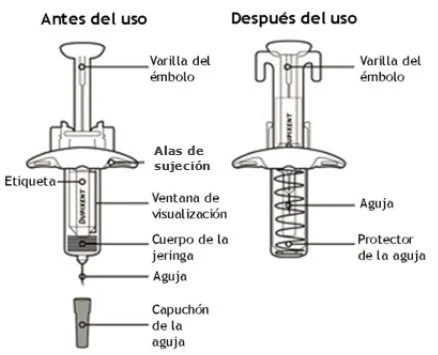
The drawing below shows the parts of the Dupixent pre-filled syringe with needle guard.
Important information
This device is a single-use pre-filled syringe. It contains 200 mg of Dupixent for injection under the skin (subcutaneous injection).
Do not attempt to inject yourself or another person unless you have been trained by your healthcare professional. In adolescents aged 12 years and older, Dupixent should be administered by or under the supervision of an adult. In children under 12 years of age, Dupixent should be administered by a caregiver.
- Read all instructions carefully before using the syringe.
- Check with your healthcare professional how often the medicine should be injected.
- Ask your healthcare professional to show you how to use the syringe correctly before using it for the first time.
- Change the injection site each time you give the injection.
- Do not use the syringe if it has fallen on a hard surface or has been damaged.
- Do not use the syringe if the needle cap is missing or not properly attached.
- Do not touch the plunger rod until you are ready for injection.
- Do not inject through clothing.
- Do not try to remove air bubbles from the syringe.
- To help prevent accidental needle injuries, each pre-filled syringe comes with a needle guard that automatically activates to cover the needle after the injection has been administered.
- Never pull back on the plunger rod.
- Do not reuse the syringe.
Storage of Dupixent
- Keep the syringe(s) out of the reach and sight of children.
- Keep unused syringes in their original packaging and store them in the refrigerator between 2 °C and 8 °C.
- Do not keep Dupixent at room temperature (< 25 °C) for more than 14 days. If you need to remove the pack from the refrigerator permanently, write the date you removed it in the space provided on the outer carton, and use Dupixent within the following 14 days.
- Do not shake the syringe at any time.
- Do not heat the syringe.
- Do not freeze the syringe.
- Do not expose the syringe to direct sunlight.
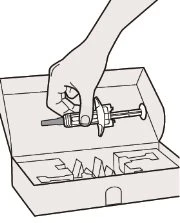
Step 1: Remove
Remove the syringe from the packaging by holding it in the middle of the syringe barrel.
 Do not remove the needle cap until you are ready for injection.
 Do not use the syringe if it has fallen on a hard surface or has been damaged.
Step 2: Prepare
Make sure you have the following:
- the Dupixent pre-filled syringe
- 1 alcohol wipe*
- 1 cotton ball or gauze*
- a sharps container* (see Step 12)
*Items not included in the pack
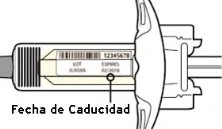
Check the label:
- Check the expiry date.
- Confirm you have the correct medicine and dose.
 Do not use the syringe if the expiry date has passed.
 Do not keep Dupixent at room temperature for more than 14 days.
Step 3: Check
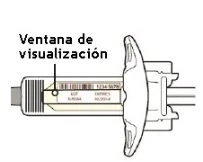
Look at the medicine through the viewing window of the syringe:
Check that the liquid is clear and colourless to pale yellow.
Note: You may see an air bubble, which is normal.
 Do not use the syringe if the liquid is cloudy or discoloured, or if it contains flakes or particles.
Step 4: Wait 30 minutes
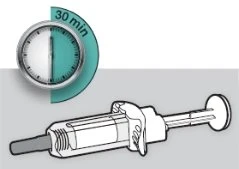
Place the syringe on a flat surface for at least 30 minutes and allow it to reach room temperature naturally.
 Do not heat the syringe in a microwave, warm water, or direct sunlight.
 Do not expose the syringe to direct sunlight.
 Do not keep Dupixent at room temperature for more than 14 days.
Step 5: Choose
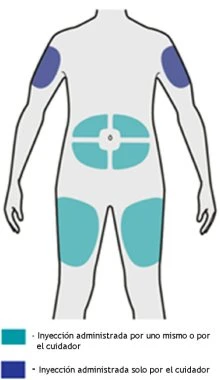
Select the injection site.
- You may inject the medicine into your thigh or abdomen (belly), avoiding the area within about 5 cm around your navel.
- If someone else is giving you the injection, it may also be given in the upper arm.
- Change the injection site each time you give the injection.
 Do not inject into sensitive, damaged, bruised, or scarred skin.
Step 6: Clean
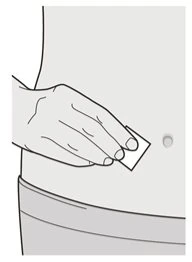
Wash your hands.
Clean the injection site with an alcohol wipe.
Allow the skin to dry before proceeding with the injection.
 Do not touch the injection site or blow on it before injecting.

Step 7: Remove
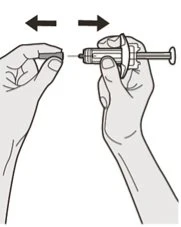
Hold the syringe in the middle of the barrel with the needle pointing away from you and remove the needle cap.
 Do not recap the needle.
 Do not touch the needle.
Inject the medicine immediately after removing the needle cap.
Step 8: Pinch
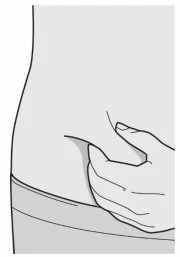
Pinch a fold of skin at the injection site, as shown in the drawing.
Step 9: Insert
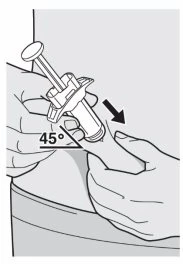
Insert the needle fully into the skin fold at an angle of approximately 45°.
Step 10: Push
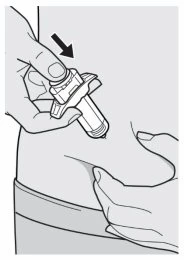
Release the skin pinch.
Slowly and steadily push the plunger rod down until it stops and the syringe is empty.
Note: You may feel slight resistance, which is normal.
Step 11: Release and Remove
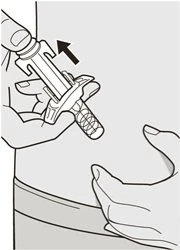
Lift your thumb to release the plunger rod until the needle is covered by the needle guard, then remove the syringe from the injection site.
If you see any blood, gently press on the injection site with a cotton ball or gauze.
 Do not recap the needle.
 Do not rub the skin after the injection.
Step 12: Dispose
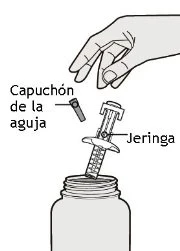
Dispose of the syringe and needle cap in a sharps container.
 Do not recap the needle.
Always keep the container out of reach of children.