Duodopa 20 mg/ml + 5 mg/ml intestinal gel
Spain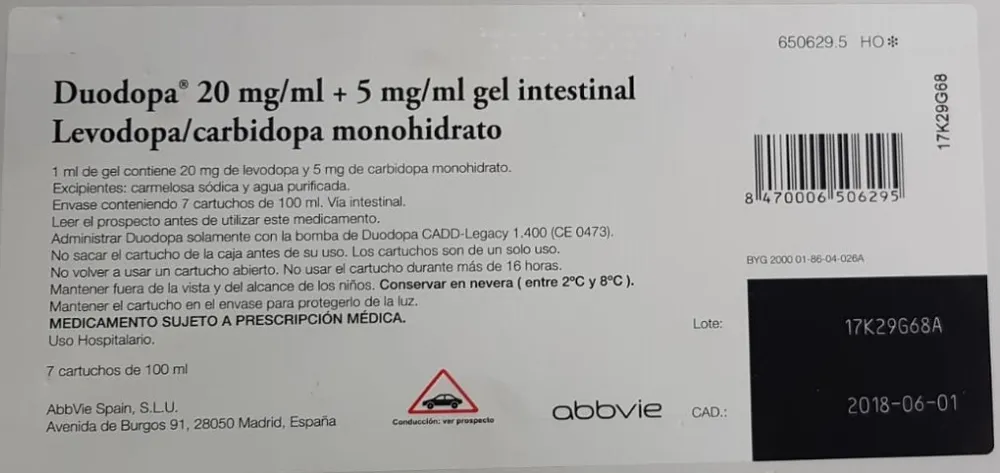
Table of Contents
Package leaflet: Information for the user
Introduction
Package leaflet: information for the user
Duodopa 20 mg/ml + 5 mg/ml intestinal gel
levodopa/carbidopa monohydrate
Read this entire leaflet carefully before you start using this medicine, because it contains important information for you.
- Keep this leaflet. You may need to read it again.
- If you have any questions, ask your doctor, pharmacist, or nurse.
- This medicine has been prescribed for you only, and you should not give it to others, even if they have the same symptoms as you, because it may harm them.
- If you experience any adverse reactions, consult your doctor, pharmacist, or nurse, even if they are adverse reactions not listed in this leaflet. See section 4.
Contents of the leaflet
- What Duodopa is and what it is used for
- What you need to know before using Duodopa
- How to use Duodopa
- Possible adverse effects
- How to store Duodopa
- Contents of the pack and other information
1. What Duodopa is and what it is used for
Duodopa belongs to a group of medicines used for Parkinson's disease.
Duodopa is a gel administered via a pump and a tube directly into your small intestine. The gel contains two active substances:
- Levodopa
- Carbidopa
How Duodopa works
- Levodopa is converted in the body into a substance called dopamine. This adds to the dopamine already present in your brain and spinal cord. Dopamine helps transmit signals between nerve cells.
- Low dopamine levels cause the symptoms of Parkinson's disease, such as tremor, feelings of stiffness, slow movement, and balance disorders.
- Treatment with levodopa increases the amount of dopamine in your body, thereby reducing these symptoms.
- Carbidopa enhances the effect of levodopa and also reduces its adverse effects.
2. What you need to know before starting to use Duodopa
Do not use Duodopa if
- You are allergic to levodopa, carbidopa, or any of the other ingredients of this medicine (listed in section 6).
- You have an eye disorder called "narrow-angle glaucoma".
- You have severe heart problems.
- You have a serious irregular heartbeat (arrhythmia).
- You have had a severe stroke.
- You are taking antidepressant medicines known as selective MAO-A inhibitors or non-selective MAO inhibitors such as moclobemide and phenelzine.
- You have a tumour in the adrenal gland (phaeochromocytoma).
- You have hormonal disorders such as overproduction of cortisol (Cushing's syndrome) or very high thyroid hormone levels (hyperthyroidism).
- You have ever had skin cancer or have any suspicious mole or skin mark that has not been checked by your doctor.
Do not use Duodopa in any of the cases listed above. If you are unsure, consult your doctor before using Duodopa.
Warnings and precautions
Talk to your doctor before starting to use Duodopa if:
- You have ever had a heart attack, blockage of blood vessels in your heart, or any other heart disease, including heart arrhythmias.
- You have a lung problem (such as asthma).
- You have ever had a hormonal disorder.
- You have ever had depression with suicidal thoughts or any other mental illness.
- You have an eye disorder called "open-angle glaucoma".
- You have had a stomach ulcer.
- You have ever had seizures (fits).
- You have ever had surgery in the upper abdomen (upper abdominal surgery).
- You have been informed of progressive weakness, pain, numbness, or loss of sensation in fingers or feet (polyneuropathy) in patients treated with levodopa/carbidopa intestinal gel. Your doctor will examine for signs and symptoms of neuropathy before starting treatment with levodopa/carbidopa intestinal gel and periodically thereafter. Inform your doctor if you already have neuropathy or a medical condition associated with neuropathy.
If you are in any of the situations mentioned (or are unsure whether you are), consult your doctor or pharmacist before using Duodopa.
Be careful with the following side effects
Neuroleptic Malignant Syndrome
Do not stop treatment with Duodopa or reduce your dose unless instructed by your doctor. Stopping treatment or suddenly reducing Duodopa may cause a serious disorder called "Neuroleptic Malignant Syndrome" (see section 4 "Serious side effects").
Feeling dizzy or sleepy
If you find yourself falling asleep suddenly (sleep attacks), feel very sleepy, or feel drowsy or dizzy:
- You must not drive or operate tools or machinery until you are fully awake again and no longer feel drowsy or dizzy (see section 2 "Driving and use of machines").
Skin changes
Inform your doctor, pharmacist, or nurse if you notice any suspicious skin mark or mole that appears or worsens (see section 4 "Possible side effects").
Impulse control disorders (changes in your behaviour)
Inform your doctor if you, your family, or caregiver notice that you develop impulses or urges to behave in ways that are unusual for you, or if you cannot resist the impulse, urge, or temptation to carry out certain activities that may be harmful to you or others. These behaviours are called "impulse control disorders" and include:
- Gambling addiction.
- Excessive eating or spending.
- Abnormally increased sex drive or increased sexual thoughts or feelings.
Your doctor may need to review your treatment. They will discuss with you ways to manage or reduce these symptoms (see section 4 "Impulse control disorders – changes in your behaviour").
Inform your doctor if you, or your family/caregiver, notice that you are developing addiction-like symptoms, leading to a desire for high doses of Duodopa and other medicines used to treat Parkinson's disease.
Problems with the pump or tube
Some problems may occur related to the use of the pump and tube:
- You may experience reduced ability to handle the pump or tube, worsening of your Parkinson's disease symptoms, or reduced mobility (bradykinesia). The pump and tube may not be working properly.
- If you experience abdominal pain, nausea, or vomiting, inform your doctor immediately if you have any of these symptoms (see section 4 "Serious side effects").
- You may have other side effects affecting the intestine and the site where the tube is inserted (see section 4 "Problems with the pump or tube").
Duodopa and cancer
In the body, carbidopa (one of the active substances in Duodopa) breaks down into a substance called "hydrazine". Hydrazine may possibly damage genetic material and cause cancer. However, it is unknown whether the amount of hydrazine produced by normal doses of Duodopa is sufficient to cause cancer.
Laboratory tests
Your doctor may carry out regular blood tests if you are using this medicine.
Surgical procedures
If you need to undergo any surgical procedure (including dental procedures), inform your doctor (or dentist) that you are using Duodopa.
Children and adolescents
Duodopa must not be given to children or young people under 18 years of age.
Other medicines and Duodopa
Tell your doctor or pharmacist if you are taking, have recently taken, or might need to take any other medicines. This includes medicines obtained without a prescription, as well as herbal remedies.
Do not use Duodopa if you are taking:
- Antidepressant medicines known as non-selective MAO-A inhibitors or selective MAO inhibitors such as moclobemide or phenelzine.
Consult your doctor or pharmacist before starting to use Duodopa if you are taking other medicines for:
- Anaemia, such as iron tablets.
- Tuberculosis, such as isoniazid.
- Anxiety, such as benzodiazepines.
- Nausea, such as metoclopramide.
- High blood pressure, such as antihypertensives.
- Blood vessel spasms, such as papaverine.
- Seizures (fits) or epilepsy, such as phenytoin.
- Parkinson's disease, such as tolcapone, entacapone, amantadine.
- Mental disorders, antipsychotics such as phenothiazines, butyrophenones, and risperidone.
- Severe allergic reactions, asthma, chronic bronchitis, heart disease, and low blood pressure, such as anticholinergics and sympathomimetics.
- If you are taking a medicine that may lower blood pressure. This may cause something called "orthostatic hypotension", which may make you feel dizzy when standing up from a chair or bed. Duodopa may worsen this effect. Always change position slowly.
Use of Duodopa with food and drink
In some patients, Duodopa may not work properly if taken with, or shortly after, foods high in protein such as meat, fish, dairy products, seeds, and nuts. Consult your doctor to find out if you might be affected.
Pregnancy and breastfeeding
- If you are pregnant or breastfeeding, think you may be pregnant, or are planning to become pregnant, consult your doctor before using this medicine.
- Do not use Duodopa if you are breastfeeding.
Driving and use of machines
Do not drive or operate tools or machinery until you are certain how Duodopa affects you.
- Duodopa may make you feel very sleepy, or you may frequently fall asleep suddenly (sleep attacks).
- Duodopa may lower your blood pressure, which may make you feel drowsy or dizzy.
Do not drive or operate any tools or machinery until you feel fully alert again and no longer feel drowsy or dizzy.
3. How to use Duodopa
Follow exactly the instructions for administering this medicine as given by your doctor, pharmacist, or nurse. If in doubt, consult your doctor or pharmacist again.
About Duodopa gel and its pump
- Duodopa is a gel delivered via a pump and a tube directly into your small intestine.
- The gel comes in a plastic cartridge. The cartridge is connected to a pump.
- The pump is connected to a tube placed into your small intestine.
- The pump delivers a small, continuous dose throughout the day. This means that the level of medicine in your blood remains constant. This also means that some movement-related side effects are reduced.
How much to use
- Your doctor will decide how much Duodopa you will receive and for how long.
- Usually, a higher morning dose, called a "bolus dose", will be administered. This allows you to quickly reach the correct level of medicine in the blood. After this dose, a continuous dose ("maintenance dose") is given.
- If needed, you may receive an additional dose, as instructed by your doctor.
If you use more Duodopa than you should
If you have administered a larger dose of Duodopa than you should have, contact your doctor or go to a hospital immediately. Take the packaging with you. The following effects may occur:
- Difficulty opening the eyes.
- Uncontrollable muscle spasms affecting the eyes, head, neck, or body (dystonia).
- Involuntary movements (dyskinesia).
- Unusual fast, slow, or irregular heartbeats (arrhythmia).
If you forget to use Duodopa
- Restart your pump with your usual dose as soon as possible.
- Do not increase the dose to make up for the missed dose.
If you stop or reduce Duodopa treatment
Do not stop using Duodopa or reduce the dose unless your doctor tells you to do so, as sudden interruption or reduction of Duodopa dosage may cause a serious condition called "Neuroleptic Malignant Syndrome". This condition is more likely to occur if you are also taking a medicine called an "antipsychotic" (see section 4 "Serious adverse reactions").
If you have any further questions about using this medicine, ask your doctor, pharmacist, or nurse.
4. Possible adverse effects
Like all medicines, this medicine can cause adverse effects, although not everyone will experience them.
Serious adverse effects of Duodopa
Stop using Duodopa and consult your doctor if you notice any of the following serious adverse effects. You may require urgent medical treatment:
- Acute eye pain, headache, blurred vision, nausea, and vomiting. These may be symptoms of closed-angle glaucoma. Uncommon: may affect up to 1 in 100 patients.
- Fever, sore throat or mouth, or problems urinating. These may be signs of a blood white cell disorder called "agranulocytosis". Your doctor will take a blood sample to check for this. Very rare (may affect up to 1 in 10,000 patients).
- Swelling of the face, tongue, or throat that may make swallowing or breathing difficult; any type of skin irritation. These may be symptoms of a severe allergic reaction (anaphylactic reaction). Frequency not known. Cannot be estimated from available data.
Inform your doctor immediately if you notice any of the following serious adverse effects:
-
Neuroleptic Malignant Syndrome, symptoms may include:
-
Rapid heartbeat, changes in blood pressure, and sweating, followed by fever.
-
Rapid breathing, muscle rigidity, loss of consciousness, and coma.
-
Elevated levels of a protein in the blood (an enzyme called "creatine phosphokinase"). This will be measured by your doctor.
Rare: may affect up to 1 in 1,000 patients.
For more information about Neuroleptic Malignant Syndrome, see section 3 “If you stop using Duodopa or reduce the dose”.
Other adverse effects of Duodopa
Inform your doctor, pharmacist, or nurse if you notice any of the following adverse effects:
Very common: may affect more than 1 in 10 patients
- Falls.
- Weight loss.
- Malaise (nausea), constipation.
- Anxiety, depression, inability to fall asleep (insomnia).
- Involuntary movements (dyskinesia), worsening of Parkinson’s disease symptoms.
- Dizziness when standing up or changing posture (orthostatic hypotension) due to low blood pressure. Always change positions slowly; do not stand up quickly.
- Urinary tract infections.
Common: may affect 1 in 10 patients
- Weight gain.
- Irregular heartbeat.
- Loss of appetite.
- Fatigue, weakness.
- High or low blood pressure.
- Anaemia (low iron levels in blood).
- Pain, neck pain, muscle cramps, muscle weakness.
- Falling asleep suddenly (sleep attacks), feeling very drowsy, sleep disorders.
- Increased amino acids or homocysteine in blood, vitamin B6 and B12 deficiency.
- Dizziness, feeling faint or fainting (syncope).
- Difficulty swallowing or dry mouth, altered taste (bitter taste).
- Headache.
- Progressive weakness or pain, numbness, or loss of sensation in fingers or feet (polyneuropathy).
- Skin rashes, itching, increased sweating, swelling due to fluid retention (edema).
- Difficulty urinating (urinary retention) or inability to control urine flow (incontinence).
- Seeing, hearing, or feeling things that are not real (hallucinations), confusion, abnormal dreams, feeling agitated, impulsive behavior, psychotic disorder.
- Abdominal distension, diarrhoea, gas (flatulence), indigestion (dyspepsia), feeling unwell (vomiting).
- Unexpected or sudden onset of Parkinson’s disease symptoms, known as the "on-off phenomenon".
- Reduced sense of touch, uncontrollable muscle spasms affecting the eyes, head, neck, and body (dystonia), tremors.
Impulse control disorders – changes in your behavior. These are common and may affect 1 in 10 patients.
Some people are unable to resist the impulse to carry out an action that could be harmful to themselves or others. This may include:
- Strong urge to gamble excessively despite serious personal or family consequences.
- Increased or altered interest in and engagement in sexual behavior causing concern to you or others, for example, increased sex drive.
- Uncontrolled or excessive shopping or spending.
- Overeating (consuming large amounts of food in a short period of time), or compulsive eating (eating more food than normal and more than needed to satisfy hunger).
Inform your doctor if you, your family, or caregiver notice that you develop any of these behaviors. Your doctor will discuss with you ways to manage or reduce these symptoms.
Uncommon: may affect 1 in 100 patients
- Dark urine.
- Hoarseness, chest pain.
- Hair loss, skin redness, rash.
- Unusual increase in saliva production.
- Swelling of veins (phlebitis).
- Changes in walking pattern.
- Suicidal thoughts (suicide).
- Feeling tired or generally unwell.
- Rapid and irregular heartbeat (palpitations).
- Abnormally low white blood cell count that may lead to bleeding.
- Disorientation, euphoria, increased sexual desire, nightmares, dementia, fears.
- Difficulty controlling movements and violent involuntary contractions.
- Difficulty opening the eyes, double vision, blurred vision, damage to the optic nerve (ischaemic optic neuropathy).
Rare: may affect 1 in 1,000 patients
- Abnormal thoughts.
- Irregular breathing pattern.
- Prolonged and painful erection that does not go away.
- Suspicious moles or skin marks that appear to worsen or skin tumor (malignant melanoma).
- Dark saliva or dark sweat, burning sensation of the tongue, teeth grinding, hiccups.
Frequency not known (cannot be estimated from available data)
Desire for large doses of Duodopa exceeding those required to control motor symptoms, known as dopamine dysregulation syndrome. Some patients experience severe abnormal involuntary movements (dyskinesias), mood changes, or other adverse effects after taking high doses of Duodopa.
Inform your doctor, pharmacist, or nurse if you notice any of the adverse effects listed above.
Adverse effects of the pump and tube
The following adverse effects have been reported with the pump and tube ("tube delivery system"). Inform your doctor or nurse if you experience any of these adverse effects.
- If you experience reduced ability to handle the pump or tube, worsening of your Parkinson’s disease symptoms, or reduced mobility (bradykinesia), the pump and tube may not be functioning properly.
- If you have abdominal pain, feel unwell (nausea), and are vomiting, inform your doctor immediately if you experience any of these symptoms, as you may have a problem with the pump or tube.
Very common: may affect more than 1 in 10 patients
- Abdominal pain.
- Infection at the site where the tube enters the abdomen due to surgery.
- Thickening of the scar tissue at the site where the tube enters the abdomen.
- Problems related to tube placement such as pain and swelling in the mouth or throat, difficulty swallowing, abdominal discomfort, pain or swelling, injury to throat, mouth, or stomach, bleeding, vomiting, gas (flatulence), anxiety.
- Problems at the site where the tube enters the abdomen: red skin, sores, discharge, pain, or irritation.
Common: may affect 1 in 10 patients
- Infection at the incision site, post-procedural infection after tube placement in the intestine.
- Inflammation of the stomach wall.
- Infection in the intestine or at the site where the tube enters the abdomen.
- Movement of the tube within the abdomen or blockage of the tube (resulting in reduced drug absorption).
- Pain when breathing, feeling short of breath, chest infections (pneumonia, including aspiration pneumonia).
Uncommon: may affect 1 in 100 patients
- Inflammation of the colon (colitis).
- Inflammation of the pancreas (pancreatitis).
- The tube passes through the wall of the large intestine.
- Blockage (obstruction), bleeding, or intestinal ulcer.
- Slipping of one part of the intestine into an adjacent part (intestinal intussusception).
- Food becoming stuck around the tube causing blockage.
- Abscess (collection of infection, which may occur after tube placement in the intestine).
Unknown: frequency not known
- Decreased blood flow in the small intestine.
- The tube perforates the stomach or small intestine wall.
- Blood infection (sepsis).
Adverse effects when levodopa and carbidopa are taken orally
The following adverse effects have been reported when oral medications containing levodopa and carbidopa (the same active substances as Duodopa) were taken. These adverse effects may also occur with Duodopa:
Rare: may affect 1 in 1,000 patients
- Anaemia, low iron levels in blood.
- An eye disorder called "Horner’s syndrome".
- Inability to open the mouth fully (trismus).
- Red or purple skin rash resembling small bruises (Henoch-Schönlein purpura).
- Neuroleptic Malignant Syndrome (see section 4 “Serious adverse effects”).
- Prolonged dilation of the pupil (mydriasis), reduced eye movements.
Very rare: may affect 1 in 10,000 patients
- Changes in blood test results.
Reporting of adverse effects
If you experience any adverse effect, consult your doctor, pharmacist, or nurse, even if it is a possible adverse effect not listed in this leaflet.
You can also report them directly via the Spanish Pharmacovigilance System for Human Medicines: www.notificaRAM.es. By reporting adverse effects, you can help provide more information on the safety of this medicine.
5. Storage of Duodopa
-
Keep this medicine out of the sight and reach of children.
-
Do not use this medicine after the expiry date stated on the packaging after EXP.
-
Store and transport in a refrigerator (2°C to 8°C). Keep the cartridge in its carton to protect it from light.
-
The gel cartridges must be used within 24 hours after removal from the refrigerator.
-
The medicine cartridges are for single use only. The cartridge must not be used for longer than 24 hours, even if some gel remains.
-
Do not reuse an opened cartridge.
-
The gel may turn slightly yellow. This does not affect the medicine.
-
Medicines should not be disposed of via wastewater or household waste. Ask your pharmacist how to dispose of medicines and packaging you no longer need. This helps protect the environment. Return used cartridges to the pharmacy; do not reuse them.
6. Contents of the pack and other information
Composition of Duodopa
- The active substances are levodopa and carbidopa monohydrate. 1 ml of gel contains 20 mg of levodopa and 5 mg of carbidopa monohydrate.
- The other components are sodium carmellose and purified water.
Nature of the product and pack contents
Duodopa is available in cartridges (plastic PVC bags with a protective hard plastic overwrap) containing 100 ml, with 7 cartridges in each pack. The gel is white or slightly yellowish.
Marketing Authorization Holder
AbbVie Spain, S.L.U. Avenida de Burgos, 91. 28050 Madrid
Manufacturer
HP Halden Pharma AS
Svinesundsveien 80
NO-1788 Halden
Norway
AbbVie Logistics B.V.
Zuiderzeelaan 53
8017 JV Zwolle
Netherlands
This medicinal product is authorized in all European Economic Area (EEA) Member States under the following name:
Duodopa
Date of the most recent review of this summary: October 2023
Detailed and up-to-date information on this medicinal product is available on the website of the Spanish Agency of Medicines and Health Products (AEMPS) http://www.aemps.gob.es/