Droperidol Kalceks 2,5 mg/ml solution for injection EFG
Spain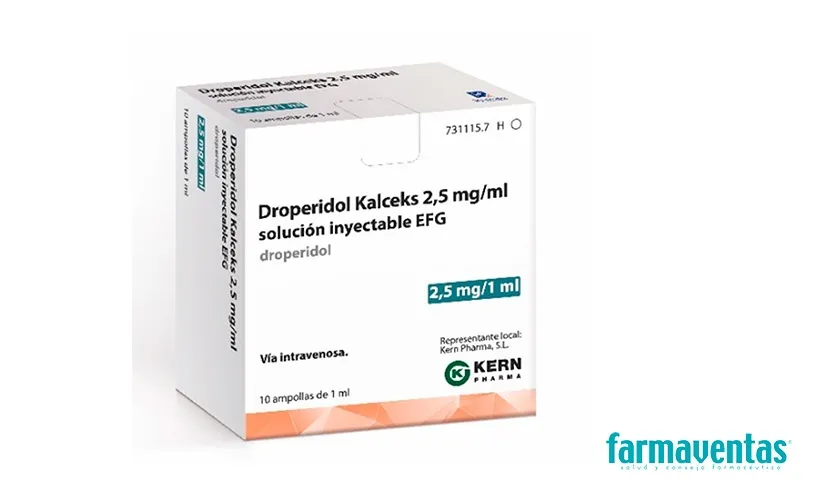
Table of Contents
- Package leaflet: Information for the user
- Introduction
- 1. What Droperidol Kalceks is and what it is used for
- 2. What you need to know before Droperidol Kalceks is administered to you
- 3. How Droperidol Kalceks will be administered to you
- 4. Possible adverse effects
- 5. Storage of Droperidol Kalceks
- 6. Contents of the pack and other information
Package leaflet: Information for the user
Introduction
Package leaflet: Information for the user
Droperidol Kalceks 2.5 mg/ml injection solution EFG
droperidol
Read all of this leaflet carefully before you start using this medicine, because it contains important information for you.
- Keep this leaflet, you may need to read it again.
- If you have any questions, ask your doctor or nurse.
- If you experience any side effects, talk to your doctor or nurse, even if it is a side effect not listed in this leaflet. See section 4.
Contents of the leaflet
- What Droperidol Kalceks is and what it is used for
- What you need to know before being given Droperidol Kalceks
- How Droperidol Kalceks is administered
- Possible side effects
- How to store Droperidol Kalceks
- Contents of the pack and other information
1. What Droperidol Kalceks is and what it is used for
Droperidol Kalceks is an injectable solution containing droperidol, an active substance belonging to a group of medicines called butyrophenone derivatives. Droperidol is used to prevent the feeling of nausea or vomiting when waking up after surgery or when receiving morphine-derived analgesics after surgery.
2. What you need to know before Droperidol Kalceks is administered to you
Do not administer Droperidol Kalceks
- if you are allergic to droperidol or to any of the other components of this medicine (listed in section 6);
- if you are allergic to a group of medicines used to treat psychiatric disorders called butyrophenones (for example: haloperidol, triperidol, benperidol, melperone, domperidone);
- if you or someone in your family has abnormalities in the electrocardiogram (ECG);
- if you have low levels of potassium or magnesium in the blood;
- if your heart rate is less than 55 beats per minute (your doctor or nurse will check this), or if you are taking medicines that may cause this condition;
- if you have a tumor of the adrenal glands (pheochromocytoma);
- if you are in a coma;
- if you have Parkinson's disease;
- if you have severe depression.
Warnings and precautions
Talk to your doctor or nurse before this medicine is administered to you, as special precautions are required if:
- you have epilepsy, or a history of epilepsy;
- you have heart problems or a history of heart disease;
- you have a family history of sudden death;
- you have kidney disorders (especially if undergoing long-term dialysis);
- you have any lung disease or breathing difficulties;
- you have prolonged vomiting or diarrhea;
- you are using insulin;
- you are taking potassium-depleting diuretics (for example: furosemide or bendroflumethiazide);
- you are taking laxatives;
- you are taking glucocorticoids (a type of steroid hormone);
- you or someone in your family has a history of blood clots, as this type of medicine has been associated with blood clot formation;
- you are or have been a heavy drinker (of alcohol).
Other medicines and Droperidol Kalceks
Tell your doctor or nurse if you are taking, have recently taken, or might need to take any other medicines, as some medicines should not be used together with droperidol.
Do not administer this medicine if you are taking any of the following medicines, as the combination increases the risk of irregular heartbeats that could lead to a heart attack (myocardial infarction):
What the medicine is used for | Medicine(s) |
Heart arrhythmias, irregular heartbeats | Class IA and III antiarrhythmics |
Bacterial infections | Macrolide and fluoroquinolone antibiotics |
Malaria | Antimalarials |
Allergies | Antihistamines |
Mental illnesses, for example, schizophrenia | Antipsychotics |
Heartburn | Cisapride |
Parasite infestation or fungal infection | Pentamidine |
Nausea or vomiting | Domperidone |
Opioid dependence; pain | Methadone |
Metoclopramide and other neuroleptics should be avoided while using droperidol, as this increases the risk of movement disorders induced by these medications.
Other medicines that may affect or be affected when used simultaneously with droperidol.
Droperidol, the active substance of this medicine:
- may increase the effects of sedatives such as barbiturates, benzodiazepines, and morphine-derived products;
- may enhance the effects of medicines used to lower blood pressure;
- may increase the effects of various medicines, for example, certain antifungals, antivirals, and antibiotics.
If you are taking any of these medicines, you must inform your doctor or nurse.
Droperidol Kalceks with alcohol
Avoid drinking alcohol during the 24 hours before and after using droperidol.
Pregnancy, breastfeeding, and fertility
If you are pregnant, consult your doctor so that they can decide whether you should receive this medicine.
In newborns of mothers who have received droperidol during the third trimester (last three months of pregnancy), the following symptoms may occur: tremors, muscle stiffness and/or weakness, drowsiness, agitation, breathing difficulties, and feeding problems. If your child shows any of these symptoms, you may need to consult your doctor.
If you are breastfeeding and are to receive droperidol, treatment will be limited to a single dose. You may resume breastfeeding upon waking after the procedure.
Ask your doctor for advice before taking any medicine.
Driving and use of machines
The effect of droperidol on the ability to drive and use machines is significant.
Do not drive or operate machinery for at least 24 hours after taking this medicine.
Droperidol Kalceks contains sodium
This medicine contains less than 1 mmol of sodium (23 mg) per ml, which is essentially "sodium-free".
3. How Droperidol Kalceks will be administered to you
This medicine will be given to you by a doctor or nurse as an injection into a vein.
The dose of droperidol and the way it is administered will depend on your condition. Your doctor will determine the amount of medicine you need based on various criteria, such as your weight, age, and medical condition.
If you have any further questions about the use of this medicine, ask your doctor or nurse.
4. Possible adverse effects
Like all medicines, this medicine can cause adverse effects, although not everyone experiences them.
Tell your doctor or nurse immediately if you experience any of the following serious adverse effects:
- Increase in body temperature, sweating, salivation, muscle stiffness, or tremors. These may be symptoms of a condition called neuroleptic malignant syndrome (rare side effect).
- Severe allergic reaction or rapid swelling of the face or throat; difficulty swallowing; hives; or breathing difficulties (rare side effect).
The following side effects have been reported:
Common (may affect less than 1 in 10 people):
- Drowsiness
- Low blood pressure
Uncommon (may affect less than 1 in 100 people):
- Anxiety
- Rolling of the eyes
- Fast heartbeat, for example, more than 100 beats per minute
- Dizziness
Rare (may affect up to 1 in 1,000 people):
- Confusion
- Agitation
- Irregular heartbeats
- Skin rash
Very rare (may affect less than 1 in 10,000 people):
- Blood disorders (usually related to red blood cells or platelets). Your doctor will advise you.
- Mood changes such as sadness, anxiety, depression, and irritability
- Involuntary muscle movements
- Seizures or tremors
- Heart attack (cardiac arrest)
- Torsade de pointes (an irregular pulse that may be life-threatening)
- QT interval prolongation on electrocardiogram (ECG) (a condition affecting heart rhythm)
- Sudden death
Frequency not known (cannot be estimated from available data):
- Inappropriate secretion of antidiuretic hormone (excessive release of the hormone, leading to excess water and reduced sodium levels in the body)
- Hallucinations
- Epileptic seizures
- Parkinson's disease
- Fainting
- Breathing difficulties
Reporting of adverse effects
If you experience any adverse effect, consult your doctor or pharmacist, even if it is a possible adverse effect not listed in this leaflet. You can also report them directly via the Spanish Pharmacovigilance System for Human Medicinal Products: www.notificaRAM.es. By reporting adverse effects, you can help provide more information on the safety of this medicine.
5. Storage of Droperidol Kalceks
Keep this medicine out of the sight and reach of children.
This medicine does not require any special storage temperature.
Store the ampoules in the outer packaging to protect them from light.
Shelf-life after opening of the ampoule
Use immediately after first opening.
Shelf-life after dilution
Compatibility and in-use stability have been demonstrated for Droperidol Kalceks 2.5 mg/ml solution for injection EFG with morphine in a 9 mg/ml (0.9%) sodium chloride injectable solution in polypropylene (PP) and polycarbonate (PC) syringes for 14 days at 25°C (protected from light) and at temperatures between 2 to 8°C.
From a microbiological standpoint, the diluted solution should be used immediately. If not used immediately, storage in use and conditions prior to use are the responsibility of the user and normally should not exceed 24 hours at a temperature of 2 to 8°C, unless the dilution was carried out under controlled and validated aseptic conditions.
Do not use this medicine after the expiry date stated on the carton and on the ampoule after 'CAD/EXP'. The expiry date refers to the last day of the month indicated.
For single use only. Any unused solution must be discarded.
The solution should be inspected visually before use. Do not use this medicine if visible signs of deterioration are observed. It should only be used if the solution is clear, colourless and free from visible particles.
Medicines should not be disposed of via wastewater or household waste. Ask your pharmacist how to dispose of medicines you no longer use. This will help protect the environment.
6. Contents of the pack and other information
Composition of Droperidol Kalceks
- The active substance is droperidol.
Each 1 ml ampoule of injectable solution contains 2.5 mg of droperidol.
? The other components are: tartaric acid, mannitol, sodium hydroxide (for pH adjustment), water for injections.
Appearance of Droperidol Kalceks and contents of the pack
Clear, colourless solution, free from visible particles.
Amber glass type I ampoules containing 1 ml of injectable solution with a scored neck. The ampoules are placed in a tray and packaged in a cardboard box.
Pack sizes: 5 or 10 ampoules.
Only certain pack sizes may be commercially available.
Marketing Authorisation Holder and Manufacturer:
AS KALCEKS
Krustpils iela 71E, Riga, LV‑1057, Latvia
Tel.: +371 67083320
E‑mail: [email protected]
Further information about this medicinal product is available upon request from the local representative of the Marketing Authorisation Holder:
EVER Pharma Therapeutics Spain SL
c/ Toledo 170
28005 Madrid
Spain
Date of the most recent revision of this leaflet: March 2021
Detailed information on this medicinal product is available on the website of the Spanish Agency of Medicines and Health Products (AEMPS) (http://www.aemps.gob.es/)
This information is intended for healthcare professionals only:
Incompatibilities
Incompatible with barbiturates. This medicinal product must not be mixed with others except those mentioned below in the section "Instructions for use".
Instructions for use
For single use only. Any unused solution must be discarded.
The solution should be inspected visually before use. Do not use this medicinal product if visible signs of deterioration are observed. Use only if the solution is clear, colourless, and free from visible particles.
For use in PCA (patient-controlled analgesia): withdraw droperidol and morphine with a syringe and prepare the desired volume with an injectable solution of sodium chloride 9 mg/ml (0.9%).
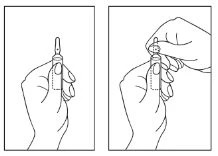
Instructions for opening the ampoule:
- Turn the ampoule so that the coloured mark faces upwards. If any solution remains in the upper part of the ampoule, gently tap with the finger to ensure all the solution moves to the lower part of the ampoule.
- Use both hands to open it: while holding the lower part of the ampoule with one hand, use the other hand to snap off the top part of the ampoule in the direction opposite to the coloured mark (see images below).
Any unused medicinal product and materials that have come into contact with it must be disposed of in accordance with local regulations.