Doxazosin Neo Stada 8 mg prolonged-release tablets EFG
Spain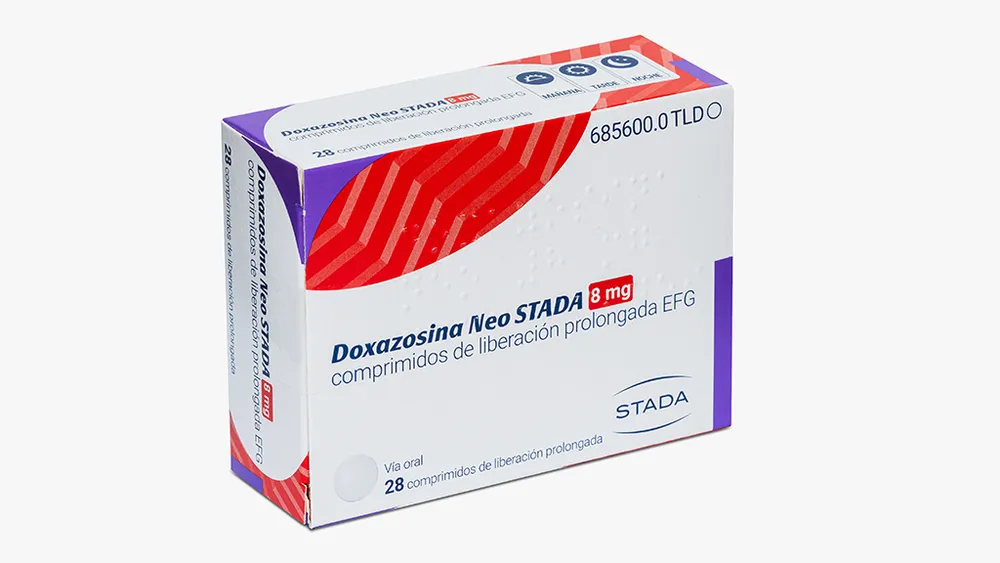
Table of Contents
- Package leaflet: Information for the user
- Introduction
- 1. What Doxazosina Neo Stada is and what it is used for
- 2. What you need to know before taking Doxazosina Neo Stada
- 3. How to take Doxazosina Neo Stada
- 4. Possible adverse effects
- 5. Storage of Doxazosin Neo Stada
- 6. Contents of the pack and other information
Package leaflet: Information for the user
Introduction
Package leaflet: information for the user
Doxazosina Neo Stada 8 mg prolonged-release tablets EFG
Read the entire leaflet carefully before you start taking this medicine, because it contains important information for you.
- Keep this leaflet, as you may need to read it again.
- If you have any questions, ask your doctor or pharmacist.
- This medicine has been prescribed for you only and must not be given to other people, even if they have the same symptoms as you, because it could harm them.
- If you experience any adverse effects, consult your doctor or pharmacist, even if they are adverse effects not listed in this leaflet. See section 4.
Leaflet contents:
- What Doxazosina Neo Stada is and what it is used for
- What you need to know before taking Doxazosina Neo Stada
- How to take Doxazosina Neo Stada
- Possible side effects
- How to store Doxazosina Neo Stada
- Contents of the pack and other information
1. What Doxazosina Neo Stada is and what it is used for
Your doctor may have prescribed doxazosin because you have high blood pressure, which can increase your risk of heart disease or stroke if left untreated. The active substance in the tablets, doxazosin, belongs to a group of medicines known as alpha-1 blockers. These medicines work by widening blood vessels, making it easier for the heart to pump blood through them. This helps lower high blood pressure and reduces the risk of heart disease.
Doxazosin may also have been prescribed to treat symptoms of benign enlargement of the prostate (benign prostatic hyperplasia, BPH). This condition means that the prostate, which is located just below the bladder in men, is enlarged. This makes it difficult to empty the bladder. Doxazosin works by relaxing the muscles around the outlet of the bladder and the prostate gland, making it easier to empty the bladder.
Doxazosin contained in Doxazosina Neo Stada may be authorized for the treatment of other conditions not listed in this leaflet. Ask your doctor, pharmacist, or other healthcare professional if you have any further questions, and always follow their instructions.
2. What you need to know before taking Doxazosina Neo Stada
Do not take Doxazosina Neo Stada:
- If you are allergic to doxazosin or to any of the other ingredients of this medicine (listed in section 6).
- If you have low blood pressure or have ever experienced a drop in blood pressure causing dizziness or fainting upon standing up from a sitting or lying position.
- If you have benign enlargement of the prostate and, at the same time, upper urinary tract obstruction, chronic urinary infection, or bladder stones.
- If you have or have had a gastrointestinal obstruction.
- If you are taking this medicine to treat high blood pressure and are breastfeeding.
- If you are taking this medicine to treat symptoms of benign prostatic hyperplasia (BPH) and have low blood pressure.
- If you have overflow urinary incontinence or are unable to pass urine, with or without worsening of kidney function.
Warnings and precautions
Talk to your doctor or pharmacist before starting Doxazosina Neo Stada.
- At the beginning of treatment, you may experience a drop in blood pressure accompanied by dizziness, weakness, and, rarely, fainting. Avoid situations that could lead to injury if these symptoms occur.
- If you have an acute heart condition, such as heart failure.
- If you have any liver disease. In cases of severe liver disease, the use of doxazosin is not recommended.
- If you are also taking medications used to treat erectile dysfunction (PDE-5 inhibitors, e.g., sildenafil, tadalafil, vardenafil), as they may cause a significant drop in blood pressure. This is most likely to occur shortly after taking the PDE-5 inhibitor. Therefore, doxazosin treatment should be stable before starting PDE-5 inhibitor therapy. Your doctor may consider using a lower starting dose of the PDE-5 inhibitor.
- Before starting treatment with doxazosin, your doctor may perform tests to rule out other conditions such as prostate cancer, which can cause symptoms similar to benign prostatic hyperplasia.
- If you are scheduled for cataract eye surgery (clouding of the lens), you must inform your ophthalmologist that you are currently taking or have previously taken doxazosin. This is because doxazosin may cause complications during surgery, which can be managed if this information is communicated to the specialist.
Occasionally, you may notice in your stools something that looks like a tablet. This is normal. The active ingredient in the prolonged-release tablets is contained within a non-absorbable shell, specially designed to slowly release the medicine into the body. Once the release process is complete, the empty shell is excreted in the faeces.
Talk to your doctor or pharmacist if you have any doubts.
Children and adolescents
Doxazosin is not recommended for use in children and/or adolescents under 18 years of age, as safety and efficacy have not yet been established.
Other medicines and Doxazosina Neo Stada
Tell your doctor or pharmacist if you are taking, have recently taken, or might need to take any other medicines.
Some patients who take alpha-blockers to treat high blood pressure or prostate enlargement may feel dizzy or lightheaded, possibly due to a drop in blood pressure when standing up quickly. Some patients have experienced these symptoms when taking medications for erectile dysfunction (impotence) together with alpha-blockers. To reduce the likelihood of such symptoms, a regular daily dose of the alpha-blocker should be taken before starting erectile dysfunction medication.
Tell your doctor or pharmacist if you are using or have recently used any other medicines, including those obtained without a prescription. Specifically inform your doctor if you are taking any of the following medicines:
- Other alpha-blockers and other medicines used to treat high blood pressure.
- Non-steroidal anti-inflammatory drugs (NSAIDs), e.g., ibuprofen.
- Oestrogens (female sex hormone).
- Dopamine, ephedrine, adrenaline, metaraminol, methoxamine, phenylephrine (medicines known as sympathomimetics, used, for example, to treat heart disorders, low blood pressure, asthma, and nasal congestion).
- Medicines used to treat bacterial or fungal infections, for example, clarithromycin, itraconazole, ketoconazole, telithromycin, voriconazole.
- Medicines used in the treatment of HIV, for example, indinavir, nelfinavir, ritonavir, saquinavir.
- Nefazodone, a medicine used to treat depression.
Taking Doxazosina Neo Stada with food and drink
Doxazosin can be taken with or without food.
Pregnancy, breastfeeding, and fertility
Only for the indication of hypertension:
If you are pregnant or breastfeeding, think you may be pregnant, or are planning to become pregnant, consult your doctor or pharmacist before using this medicine.
Do not take doxazosin without first talking to your doctor if you are pregnant or trying to become pregnant.
Experience with the use of doxazosin during pregnancy is limited.
Do not take doxazosin if you are breastfeeding. Alternatively, breastfeeding must be discontinued if treatment with doxazosin is necessary.
No effect of doxazosin on male fertility has been reported.
Driving and using machines
Doxazosin may cause drowsiness. Exercise particular caution when taking the first dose, when your dose is increased, or when restarting treatment after a break. If you feel dizzy or lightheaded, you should not drive or operate machinery.
It is your responsibility to assess whether you are fit to drive or perform work requiring a high level of alertness. One of the factors that may affect your ability to do so is the use of medicines, due to their effects and/or side effects. These effects and side effects are described in other sections. Therefore, read all the information in this leaflet for guidance. Consult your doctor or pharmacist if you have any doubts.
Doxazosina Neo Stada contains sodium
This medicine contains less than 23 mg of sodium (1 mmol) per tablet; i.e., it is essentially “sodium-free”.
3. How to take Doxazosina Neo Stada
Follow exactly the instructions for use of this medicine as given by your doctor. If in doubt, consult your doctor or pharmacist again.
Method of administration
Doxazosin has been specially formulated to allow slow release of the active substance throughout the day. Choose a time of day that is convenient for you and take the tablets at that time every day. The tablets must be swallowed whole with sufficient liquid. They must not be chewed, split, or crushed.
Treatment of high blood pressure and symptoms of benign prostatic hyperplasia:
Adults (including elderly patients)
The recommended dose of doxazosin is 4 mg daily, although your doctor may increase your dose up to a maximum of 8 mg of doxazosin (one tablet) per day.
The maximum recommended dose is 8 mg of doxazosin once daily. The optimal effect may take up to four weeks to be achieved.
Patients with liver problems
Your doctor may reduce your dose or monitor your condition more closely. Doxazosin is not recommended for use in patients with severe liver problems.
If you take more Doxazosina Neo Stada than you should
If you take too many tablets or, for example, a child has accidentally taken the medicine, contact your doctor immediately or go to the nearest hospital emergency department. If you have taken too many tablets, you may experience dizziness or lightheadedness due to low blood pressure. Lie down on your back with your feet elevated higher than your head.
In cases of overdose or accidental ingestion, contact your doctor or pharmacist immediately, or call the Toxicology Information Service at telephone number 91 562 04 20, stating the name of the medicine and the amount ingested.
If you forget to take Doxazosina Neo Stada
If you forget to take a dose, do not worry. Simply take the next dose at your usual time the following day.
Do not take a double dose to make up for missed doses.
If you stop taking Doxazosina Neo Stada
Continue taking the tablets until your doctor tells you to stop.
If you have any questions about using this medicine, ask your doctor or pharmacist.
4. Possible adverse effects
Like all medicines, this medicine can cause adverse effects, although not everyone experiences them.
Some of these adverse effects could be serious:
If you experience any of the following effects, stop taking this medicine immediately, inform your doctor or go to the nearest hospital emergency department:
- Allergic reactions such as wheezing, difficulty breathing, extreme dizziness or fainting, swelling of the face or throat, or a severe skin rash with red spots or blisters (may affect between 1 and 10 in every 1,000 people).
- Chest pain (angina pectoris; may affect between 1 and 10 in every 1,000 people), increased heart rate or irregular heartbeat (may affect fewer than 1 in every 10,000 people), heart attack or myocardial infarction (may affect between 1 and 10 in every 1,000 people).
- Yellowing of the skin or whites of the eyes (jaundice), caused by liver problems (may affect fewer than 1 in every 10,000 people).
Common (may affect up to 1 in every 10 people):
- Palpitations (strong heartbeat), increased heart rate.
- Dizziness, headache, drowsiness.
- Feeling of dizziness or "spinning head".
- Inflammation of the respiratory tract (bronchitis), cough, difficulty breathing (dyspnea), rhinitis (nasal itching, nasal discharge, and nasal congestion).
- Abdominal discomfort, stomach discomfort (dyspepsia), dry mouth, nausea.
- Inflammation of the bladder (cystitis), uncontrolled urination.
- Skin itching.
- Back pain, muscle pain.
- Lung infection (respiratory tract infection), kidney or bladder infection (urinary tract infection).
- Low blood pressure, sudden drop in blood pressure upon standing.
- Weakness, flu-like symptoms, swelling especially of the feet and lower limbs (edema).
Uncommon (may affect up to 1 in every 100 people):
- Weight gain.
- Reduced senses, fainting, tremor.
- Tinnitus (ringing in the ears).
- Nosebleeds.
- Constipation, diarrhea, flatulence, vomiting, inflammation of the stomach and intestines.
- Pain during urination, blood in the urine, increased frequency of urination.
- Skin rash.
- Pain and stiffness in the joints (arthralgia).
- Increased or decreased appetite, gout (a painful form of arthritis).
- Pain, swelling especially of the face (facial edema).
- Increased concentration of liver enzymes.
- Inability to achieve an erection.
- Anxiety, depression, insomnia.
Rare (may affect up to 1 in every 10,000 people):
- Decreased heart rate.
- Decreased concentration of certain blood cells (leukopenia, thrombocytopenia).
- Dizziness upon standing, tingling sensation with numbness.
- Blurred vision.
- Narrowing of the airways with difficulty breathing or wheezing (bronchospasm).
- Problems urinating, increased need to urinate at night, increased production and volume of urine.
- Hair loss, unusual bleeding or bruising under the skin, rashes.
- Muscle cramps, muscle weakness.
- Hot flushes.
- Fatigue, general malaise.
- Obstruction of bile excretion from the liver (cholestasis), inflammation of the liver (hepatitis).
- Breast enlargement in men.
- Persistent and painful penile erection. Seek urgent medical attention.
- Agitation, restlessness.
Frequency not known (cannot be estimated from available data):
- Intraoperative Floppy Iris Syndrome (IFIS) complications during cataract surgery (see section 2 "Warnings and precautions").
- Delayed ejaculation – occurs when semen is redirected into the urinary bladder instead of normal ejaculation through the urethra.
Reporting of adverse effects
If you experience any type of adverse effect, consult your doctor or pharmacist, even if it is a possible adverse effect not listed in this leaflet. You may also report them directly via the national reporting system included in the Spanish System for Pharmacovigilance of Human Medicines: www.notificaRAM.es. By reporting adverse effects, you can help provide more information on the safety of this medicine.
5. Storage of Doxazosin Neo Stada
Keep this medicine out of the sight and reach of children.
Do not use this medicine after the expiry date stated on the carton and blister after EXP. The expiry date is the last day of the month indicated.
This medicine does not require any special storage conditions.
Medicines must not be disposed of via wastewater or household waste. Dispose of empty containers and unused medicines at the SIGRE collection point at your pharmacy. Ask your pharmacist how to dispose of containers and medicines you no longer need. This will help protect the environment.
6. Contents of the pack and other information
Composition of Doxazosina Neo Stada
- The active substance is doxazosin (as mesilate).
Each prolonged-release tablet contains 8 mg of doxazosin (as mesilate).
- The other components are:
Tablet core: polyethylene oxide (MW 900,000), polyethylene oxide (MW 200,000); microcrystalline cellulose, povidone (K29-32), butylhydroxytoluene (E321), all-rac-α-tocopherol, anhydrous colloidal silica, sodium stearyl fumarate.
Tablet coating: methacrylic acid-ethyl acrylate copolymer (1:1), 30% dispersion of hydrated colloidal silica, macrogol 1300-1600, titanium dioxide (E171).
Appearance of the product and contents of the pack
Doxazosina Neo Stada prolonged-release tablets are white, round, biconvex tablets, marked with the letters “DH” on one side.
The medicine is packaged in:
PVC/PVDC/aluminum blisters containing 7, 10, 14, 15, 28, 30, 50, 56, 60, 98, and 100 tablets.
Calendar blister packs: 7, 14, 28, 56, and 98 tablets.
Unit-dose packaging: 50x1 tablets.
Only certain pack sizes may be commercially available.
Marketing Authorization Holder and Manufacturer
Marketing Authorization Holder
Laboratorio STADA, S.L.
Frederic Mompou, 5
08960 Sant Just Desvern (Barcelona)
Spain
Manufacturer:
STADA ARZNEIMITTEL AG
Stadastrasse 2-18
D-61118 Bad Vilbel
Germany
Date of the most recent review of this leaflet: December 2021
Detailed and up-to-date information on this medicinal product is available on the website of the Spanish Agency of Medicines and Health Products (AEMPS) http://www.aemps.es