Doxazosin CINFA 4 mg tablets EFG
Spain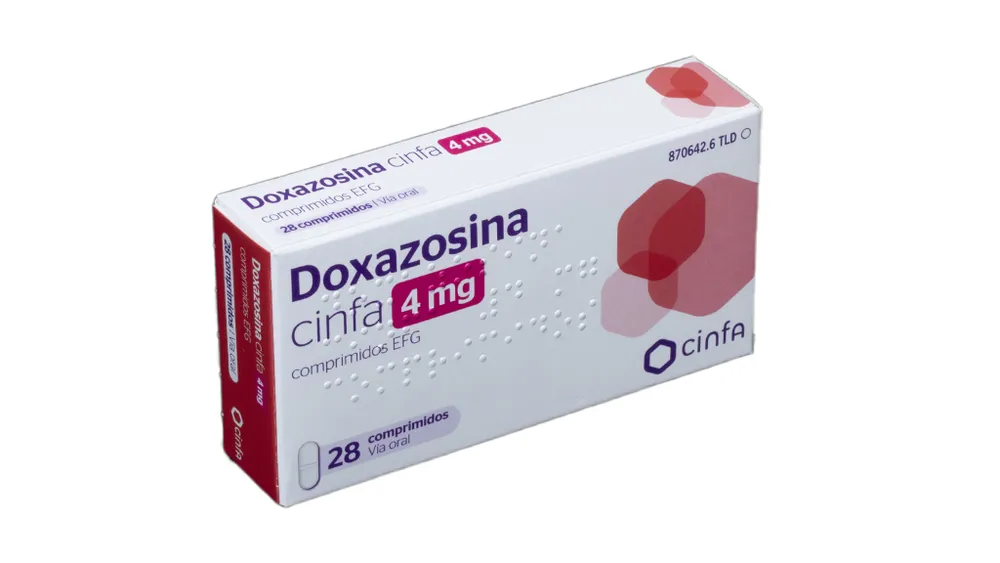
Table of Contents
Patient Information Leaflet
Introduction
Patient Information Leaflet
doxazosina cinfa 4 mg tablets EFG
doxazosin mesylate
Read the entire leaflet carefully before you start taking this medicine, as it contains important information for you.
- Keep this leaflet, as you may need to read it again.
- If you have any questions, ask your doctor or pharmacist.
- This medicine has been prescribed for you only, and you should not give it to others, even if they have the same symptoms as you, because it could harm them.
- If you experience any adverse effects, consult your doctor or pharmacist, even if they are adverse effects not listed in this leaflet. See section 4.
Leaflet Contents
- What doxazosina cinfa is and what it is used for
- What you need to know before taking doxazosina cinfa
- How to take doxazosina cinfa
- Possible side effects
- How to store doxazosina cinfa
- Contents of the pack and other information
1. What doxazosina cinfa is and what it is used for
Doxazosin is a vasodilating drug used for the treatment of high blood pressure (hypertension) and benign prostatic hyperplasia.
Doxazosin is indicated for the treatment of elevated arterial blood pressure (hypertension) and for the treatment of urinary flow obstruction and associated irritative symptoms in benign prostatic hyperplasia (BPH).
Doxazosin may be used in patients with BPH, whether hypertensive or normotensive. Patients with both conditions may be treated with doxazosin as monotherapy.
2. What you need to know before starting doxazosina cinfa
Treatment with doxazosina requires periodic monitoring by your doctor.
Do not take doxazosina cinfa
- If you are allergic to doxazosina, to quinazolines, or to any of the other ingredients of this medicine (listed in section 6).
- You have experienced hypotension (dizziness) when taking other medicines to lower blood pressure.
- You have an enlarged prostate gland together with upper urinary tract congestion, chronic urinary tract infections, or bladder stones.
- You suffer or have suffered from any form of gastrointestinal obstruction.
- You have low blood pressure.
Warnings and precautions
Talk to your doctor or pharmacist before taking doxazosina cinfa if:
- you have liver problems. Since there is no clinical experience in patients with severe hepatic impairment, use in these patients is not recommended.
- you suffer from a serious heart condition, such as heart failure or pulmonary edema.
Especially at the beginning of treatment with this medicine, dizziness and weakness may occur, and in rare cases fainting. Therefore, caution should be exercised at the start of treatment, and situations that could lead to injury if these symptoms occur should be avoided.
Before starting treatment with doxazosina, your doctor may perform tests to rule out other diseases such as prostate cancer, which can cause the same symptoms as benign prostatic hyperplasia.
If you are scheduled for cataract surgery, please inform your doctor before the procedure if you are currently taking or have previously taken doxazosina. This is because doxazosina may cause complications during surgery, which can be anticipated and managed by your ophthalmologist if they are informed in advance.
Prolonged and painful erections may occur very rarely. If this happens, consult a doctor immediately.
Children and adolescents
The use of doxazosina is not recommended in children and adolescents under 18 years of age, as safety and efficacy have not been established.
Other medicines and doxazosina cinfa
Inform your doctor or pharmacist if you are taking, have recently taken, or might need to take any other medicines.
Doxazosina has been administered together with other antihypertensives and other medicines such as nonsteroidal anti-inflammatory drugs, antibiotics, oral antidiabetics, gout medications, anticoagulants, digoxin, warfarin, phenytoin, and indomethacin without negative consequences. Doxazosina enhances the effect of other antihypertensive medicines in lowering blood pressure.
Consult your doctor or pharmacist before taking doxazosina if you are taking any of the following medicines, as they may alter the effect of doxazosina:
- Medicines to treat erectile dysfunction (e.g., sildenafil, tadalafil, vardenafil).
- Medicines that reduce blood pressure.
- Medicines used to treat bacterial or fungal infections, e.g., clarithromycin, itraconazole, ketoconazole, telithromycin, voriconazole.
- Medicines used in the treatment of HIV, e.g., indinavir, nelfinavir, ritonavir, saquinavir.
- Nefazodone, a medicine used to treat depression.
Taking doxazosina cinfa with food and drink
Doxazosina may be taken with or without food.
Pregnancy and breastfeeding
If you are pregnant or breastfeeding, think you may be pregnant, or plan to become pregnant, consult your doctor or pharmacist before using this medicine.
Doxazosina may pass into breast milk in small amounts. You should not take doxazosina while breastfeeding unless your doctor advises you to do so.
Driving and using machines
Your ability to perform activities such as operating machinery or driving vehicles may be impaired, especially at the beginning of treatment with doxazosina.
doxazosina cinfa contains lactose
This medicine contains lactose. If your doctor has told you that you have an intolerance to certain sugars, consult with them before taking this medicine.
doxazosina cinfa contains sodium
This medicine contains less than 23 mg of sodium (1 mmol) per tablet; therefore, it is essentially “sodium-free”.
3. How to take doxazosin cinfa
Follow exactly the instructions for use of this medicine as given by your doctor or pharmacist. If in doubt, consult your doctor or pharmacist again.
Your doctor will decide which dose of doxazosin is most suitable for you. Do not take more tablets than specified by your doctor.
Depending on individual response, your doctor may adjust the dosage of doxazosin.
Doxazosin is administered orally.
Doxazosin can be taken either in the morning or at night.
Arterial hypertension
Doxazosin is administered orally. The recommended dose is 2–4 mg once daily. Treatment should be initiated with 1 mg once daily for 1 or 2 weeks. Depending on the patient's response, the dose may be increased to 2 mg, 4 mg, 8 mg, or up to a maximum of 16 mg daily, with intervals of 1 or 2 weeks between dose increases, until the desired reduction in blood pressure is achieved.
Doxazosin may be administered together with other medications prescribed by your doctor for the treatment of arterial hypertension.
Benign prostatic hyperplasia
Doxazosin is administered orally. The recommended dose is 2–4 mg once daily. Treatment should be initiated with 1 mg once daily. Depending on the individual patient's response, the dose may be increased to 2 mg, 4 mg, or up to a maximum of 8 mg daily, at intervals of 1 or 2 weeks between dose increases.
Follow these instructions unless your doctor has given you different advice.
Remember to take your medicine.
Your doctor will advise you on how long your treatment with doxazosin should last. Do not stop treatment prematurely, as this may be harmful to your health.
If you feel that the effect of doxazosin is too strong or too weak, consult your doctor or pharmacist. Do not take more tablets than recommended by your doctor.
If you take more doxazosin cinfa than you should
In case of overdose or accidental ingestion, contact your doctor or pharmacist immediately or call the Toxicology Information Service at telephone number: 91 562 04 20, indicating the medicine and the amount ingested.
An overdose of doxazosin may cause a drop in blood pressure. In this case, sit down with your head lowered.
If you forget to take doxazosin cinfa
Do not take a double dose to make up for a missed dose. It is important to take doxazosin regularly at the same time each day. If you forget to take a dose, take it as soon as possible. However, if it is almost time for your next dose, skip the missed dose.
If you stop treatment with doxazosin cinfa
If you have any further questions about the use of this medicine, ask your doctor or pharmacist.
4. Possible adverse effects
Like all medicines, this medicine can cause adverse effects, although not everyone experiences them.
Reactions to doxazosin vary in intensity from one individual to another and should be especially considered at the beginning of treatment or when changing medication; they are generally mild.
Frequent (may affect up to 1 in 10 people):
- Respiratory tract infection, urinary tract infection
- Dizziness, headache, drowsiness (somnolence)
- Vertigo
- Awareness of strong or rapid heartbeats (palpitations), increased heart rate (tachycardia)
- Hypotension, postural hypotension
- Inflammation of the bronchi (bronchitis), cough, difficulty breathing (dyspnea), inflammation of the nasal mucosa (rhinitis)
- Abdominal pain, indigestion (dyspepsia), dry mouth, nausea
- Itching (pruritus)
- Back pain, muscle pain (myalgia)
- Inflammation of the bladder (cystitis), urinary incontinence
- Fatigue (asthenia), chest pain, flu-like illness, swelling of hands, feet or ankles (peripheral edema)
Uncommon (may affect up to 1 in 100 people):
- Allergic reaction
- Abnormal loss of appetite (anorexia), gout, increased appetite
- Anxiety, depression, difficulty in falling or staying asleep (insomnia)
- Interruption of blood supply to the brain (stroke), decreased sensation (hypoesthesia), temporary loss of consciousness (syncope), tremor
- Ringing in the ears (tinnitus)
- Chest pain or tightness (angina pectoris, myocardial infarction)
- Nosebleed (epistaxis)
- Constipation, diarrhea, flatulence, vomiting, gastroenteritis
- Abnormal liver function tests
- Skin rash
- Joint pain (arthralgia)
- Painful urination (dysuria), blood in urine (hematuria), frequent urination
- Impotence
- Pain, swelling of the face
- Weight gain
Rare (may affect up to 1 in 1,000 people):
- Obstruction of the digestive tract
Very rare (may affect up to 1 in 10,000 people):
- Decreased number of white blood cells (leucopenia), decreased number of blood platelets (thrombocytopenia)
- Agitation, restlessness
- Postural dizziness, tingling (paresthesia)
- Blurred vision
- Decreased heart rate (bradycardia), disturbances in heart rhythm (cardiac arrhythmias)
- Hot flushes
- Difficulty breathing (bronchospasm)
- Blockage or suppression of bile flow (cholestasis), inflammation of the liver (hepatitis), yellowing of the skin (jaundice)
- Hair loss (alopecia), confluent purplish skin spots (purpura), red raised itchy rashes appearing on the skin surface (urticaria)
- Muscle cramps, muscle weakness
- Urination disorders, need to urinate at night (nocturia), increased frequency of urination (polyuria) or increased urine volume (diuresis)
- Enlargement of male breast glands (gynaecomastia)
- Fatigue, general malaise
- Persistent and painful erection of the penis. Consult a doctor urgently.
Adverse effects of unknown frequency (cannot be estimated from available data):
IFIS (Intraoperative Floppy Iris Syndrome, a certain eye disorder that may occur during cataract surgery)
Retrograde ejaculation (semen entering the bladder during ejaculation)
No differences in adverse events were observed between young and elderly patients.
Reporting of adverse effects
If you experience any type of adverse effect, consult your doctor or pharmacist, even if they are possible adverse effects not listed in this leaflet. You may also report them directly via the Spanish Pharmacovigilance System for Human Medicines: http://www.notificaram.es. By reporting adverse effects, you can help provide more information on the safety of this medicine.
5. Storage of doxazosin cinfa
Keep this medicine out of the sight and reach of children.
This medicine does not require any special storage conditions.
Do not use this medicine after the expiry date stated on the packaging after EXP. The expiry date is the last day of the month indicated.
Medicines must not be disposed of via wastewater or household waste. Dispose of unused medicines and their containers at the SIGRE collection point at your pharmacy. If you are in doubt, ask your pharmacist how to dispose of unused medicines and their containers. This will help protect the environment.
6. Contents of the pack and other information
Composition of doxazosin cinfa
- The active substance is doxazosin. Each tablet contains 4 mg of doxazosin as doxazosin mesylate.
- The other components are: microcrystalline cellulose, lactose, sodium carboxymethyl starch (type A) (from potato), colloidal anhydrous silica, sodium lauryl sulfate and magnesium stearate.
Appearance of the medicinal product and contents of the pack
White, oblong, uncoated tablets, marked with the code D4 on one side and a score line on the same side.
Presented in PVC-PVDC/ALU blisters, available in packs of 28 tablets.
Marketing Authorization Holder and Manufacturer
Laboratorios Cinfa, S.A.
Carretera Olaz-Chipi, 10. Polígono Industrial Areta
31620 Huarte (Navarra) – Spain
Date of the most recent revision of this leaflet: November 2020
Detailed information on this medicinal product is available on the website of the Spanish Agency of Medicines and Medical Devices (AEMPS) http://www.aemps.gob.es/
You can access detailed and up-to-date information about this medicine by scanning with your mobile phone (smartphone) the QR code included in the package leaflet and outer packaging. You can also access this information at the following internet address: https://cima.aemps.es/cima/dochtml/p/63068/P_63068.html
QR code link: https://cima.aemps.es/cima/dochtml/p/63068/P_63068.html