Dotagraf 0.5 mmol/ml solution for injection EFG
Spain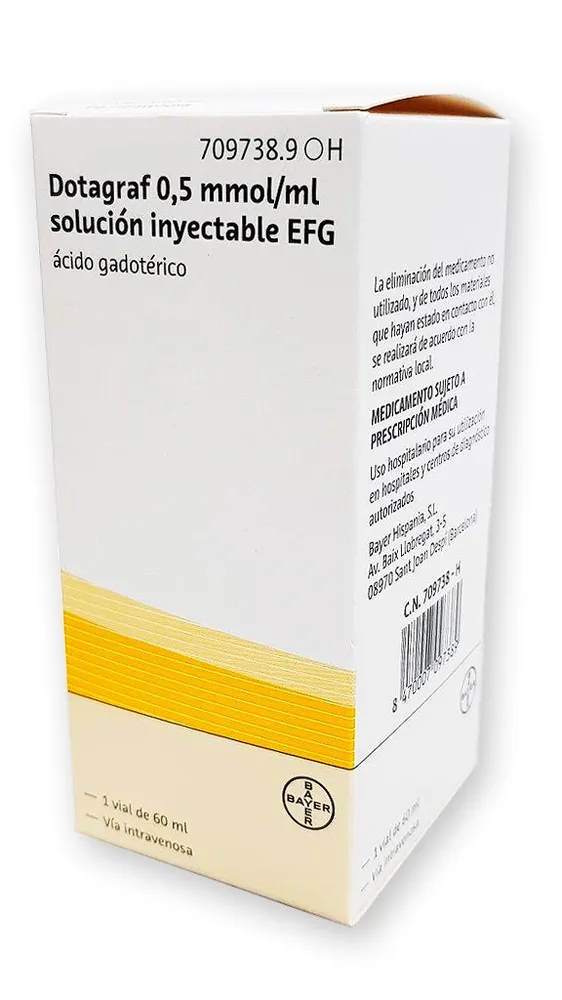
Table of Contents
Package leaflet: Information for the patient
Introduction
Package leaflet: Information for the patient
Dotagraf 0.5 mmol/ml injection solution EFG
Gadoterate acid
Read the entire leaflet carefully before you are given the medicine, as it contains important information for you.
- Keep this leaflet, as you may need to read it again.
- If you have any questions, consult your doctor or radiologist.
- If you experience any adverse reactions, consult your doctor, radiologist, or pharmacist, even if they are adverse reactions not listed in this leaflet. See section 4.
Leaflet contents
-
What Dotagraf is and what it is used for
-
What you need to know before receiving Dotagraf
-
How Dotagraf is administered
-
Possible adverse effects
- How to store Dotagraf
-
Contents of the pack and other information
1. What Dotagraf is and what it is used for
Dotagraf is a contrast medium containing gadoteric acid. It is intended solely for diagnostic use.
Dotagraf is indicated for contrast enhancement of images obtained by magnetic resonance imaging (MRI). Contrast enhancement improves visualization and delineation in:
Adults and pediatric population (0–18 years)
-
Magnetic resonance imaging (MRI) of the central nervous system, including abnormalities (lesions) of the brain, spinal cord, and adjacent tissues.
-
Whole-body MRI, including abnormalities (lesions) of the liver, kidneys, pancreas, pelvis, lungs, heart, breasts, and the musculoskeletal system.
Adults
- Magnetic resonance angiography (MRA), including abnormalities (lesions) or narrowing (stenosis) of arteries, except for coronary arteries.
2. What you need to know before using Dotagraf
Do not use Dotagraf
- if you are allergic to the active substance or to any of the other components of this medicine (listed in section 6).
- if you are allergic to medicines containing gadolinium (such as other contrast agents used in magnetic resonance imaging procedures).
Warnings and precautions
Talk to your doctor or radiologist before using Dotagraf if you:
- have previously had a reaction to contrast media during a prior test
- have asthma
- have a history of allergies (such as seafood allergy, hives, hay fever)
- are being treated with a beta-blocker (medicines used for heart problems and
blood pressure disorders, such as metoprolol) - have impaired kidney function
- have recently undergone, or are scheduled to undergo, a liver transplant
- suffer from a disease affecting the heart or blood vessels
- have had seizures or are receiving treatment for epilepsy.
In all of these cases, your doctor or radiologist will evaluate the benefit-risk ratio and decide whether Dotagraf should be administered to you. If you are given Dotagraf, your doctor or radiologist will take the necessary precautions and the administration will be carefully supervised.
Your doctor or radiologist may decide to perform a blood test to check your kidney function before deciding to use Dotagraf, especially if you are 65 years of age or older.
Newborns and infants
Due to the immaturity of renal function in newborns up to 4 weeks of age and infants up to 1 year of age, Dotagraf should be used in these patients only after careful evaluation by the physician.
Remove all metallic objects you may be wearing before the examination. Inform your doctor or radiologist if you have:
- a pacemaker
- a vascular clip
- an infusion pump
- a neurostimulator
- a cochlear implant (an implant inside the ear)
- any suspected metallic foreign body, particularly in the eye.
This is important because these may cause serious problems, as magnetic resonance imaging equipment uses very strong magnetic fields.
Use of Dotagraf with other medicines
Inform your doctor or radiologist if you are taking, have recently taken, or might need to take any other medicines.
In particular, please inform your doctor, radiologist, or pharmacist if you are taking or have recently taken medicines for heart conditions or blood pressure disorders such as beta-blockers, vasoactive substances, angiotensin-converting enzyme inhibitors, angiotensin II receptor antagonists.
Use of Dotagraf with food and drink
There are no known interactions between Dotagraf and food or drink. However, please consult your doctor, radiologist, or pharmacist whether you need to refrain from eating or drinking before the test.
Pregnancy and breastfeeding
If you are pregnant or breastfeeding, think you may be pregnant, or plan to become pregnant, consult your doctor or radiologist before using this medicine.
Pregnancy
Gadoteric acid may cross the placenta. It is unknown whether it affects the fetus. Dotagraf should not be used during pregnancy unless considered absolutely necessary.
Breastfeeding
Your doctor or radiologist will assess whether you should continue or interrupt breastfeeding for 24 hours after administration of Dotagraf.
Driving and using machines
There is no information available on the effects of Dotagraf on the ability to drive and use machines. If you feel unwell after the procedure, you should not drive or operate machinery.
3. How to use Dotagraf
Dotagraf will be administered by intravenous injection.
During the procedure, you will be under the supervision of a physician or radiologist. A needle will remain in your vein; this will allow the physician or radiologist to administer appropriate emergency medications if necessary. If you experience an allergic reaction, the administration of Dotagraf will be stopped.
Dotagraf may be administered manually or using an automatic injector. In newborns and infants, the product will only be administered manually.
The procedure will be performed in a hospital, clinic, or private practice. Healthcare personnel are aware of the precautions that must be taken for the procedure. They are also aware of any possible complications that may occur.
Dosage
Your physician or radiologist will determine the dose you will receive and will supervise the injection.
Dosage in special populations
The use of Dotagraf is not recommended in patients with severe renal impairment or in patients who have recently undergone, or are about to undergo, liver transplantation. However, if use is required, only one dose of Dotagraf should be administered during the procedure, and a second injection should not be given until at least 7 days have passed.
Newborns, infants, children, and adolescents
Due to the immaturity of renal function in newborns up to 4 weeks of age and infants up to 1 year of age, Dotagraf should only be used after careful medical evaluation. Newborns and infants should receive only one dose of Dotagraf during the procedure, and a second injection should not be administered until at least 7 days have passed.
Use for angiography is not recommended in children under 18 years of age.
Elderly patients
If you are 65 years of age or older, dosage adjustment is not necessary, but you may be given a blood test to check that your kidneys are functioning properly.
If you use more Dotagraf than you should
It is highly unlikely that you will be given an overdose. Dotagraf will be administered in medical facilities by trained personnel. In the rare event of overdose, Dotagraf can be removed from the body by hemodialysis (blood cleansing).
At the end of this leaflet, you will find additional information on use and handling by the physician or healthcare professional.
If you have any further questions about the use of this medicine, ask your physician or radiologist.
In case of overdose or accidental ingestion, contact the Toxicology Information Service (telephone 915620420).
4. Possible adverse effects
Like all medicines, this medicine can have adverse effects, although not everyone will experience them.
After administration, you will remain under observation for at least half an hour. Most side effects occur immediately or, sometimes, with a delay. Some effects may occur up to seven days after Dotagraf injection.
There is a small risk that you may have an allergic reaction to Dotagraf. Such reactions can be serious and, exceptionally, may cause shock (a case of allergic reaction that could endanger your life). Any of the symptoms described below may be the first signs of shock. Immediately inform your doctor, radiologist, or healthcare professional if you experience any of them:
- swelling of the face, mouth, or throat that may cause difficulty swallowing or breathing
- swelling of the hands or feet
- dizziness (low blood pressure)
- difficulty breathing
- wheezing
- cough
- itching
- runny nose
- sneezing
- eye irritation
- hives
- skin rash
Uncommon adverse effects (may affect up to 1 in 100 patients)
- hypersensitivity (allergic reactions)
- headache
- unusual taste in the mouth
- dizziness
- somnolence (sleepiness)
- tingling sensation, heat/burning, cold, and/or pain
- low or high blood pressure
- nausea (feeling of sickness)
- stomach pain
- rash
- sensation of warmth, sensation of cold
- asthenia (loss of energy, weakness)
- discomfort at injection site, reaction at injection site, cold sensation at injection site, swelling at injection site, extravasation of the product outside blood vessels which may cause inflammation (local redness and pain)
Rare adverse effects (may affect up to 1 in 1,000 patients)
-
anxiety, fainting (dizziness and feeling of imminent loss of consciousness)
- swelling of the eyes
- palpitations
- sneezing
- vomiting (with nausea)
- diarrhea
- increased salivation
-
hives, itching, sweating
-
chest pain, chills
Very rare adverse effects (may affect up to 1 in 10,000 patients)
- anaphylactic or anaphylactoid reactions (severe allergic reactions potentially life-threatening)
- agitation
- coma, seizures, syncope (brief loss of consciousness)
- disturbances in smell (frequent perception of unpleasant odors), tremor
- conjunctivitis, red eyes, blurred vision, increased lacrimation
- cardiac arrest, rapid or slow heartbeat, irregular heartbeat, vasodilation, pallor
- respiratory arrest, pulmonary edema, difficulty breathing, wheezing, nasal congestion, cough, dry throat, throat tightness with sensation of suffocation, respiratory spasms, throat swelling
- eczema, skin redness, swelling of the lips and localized in the mouth
- muscle cramps, muscle weakness, back pain
- general malaise, chest discomfort, fever, facial swelling, extravasation of the product outside blood vessels which may cause tissue necrosis at the injection site, inflammation of a vein
- decreased blood oxygen levels
Cases of nephrogenic systemic fibrosis (which causes hardening of the skin and may also affect soft tissues and internal organs) have been reported, most of them in patients who were administered Dotagraf together with other gadolinium-based contrast agents. If, during the weeks following the MRI study, you notice changes in the color and/or thickness of your skin anywhere on your body, inform the radiologist who performed the examination.
Reporting of adverse effects
If you experience any type of adverse effect, consult your doctor, pharmacist, or nurse, even if they are possible side effects not listed in this leaflet. You may also report them directly via the Spanish Pharmacovigilance System for Human Medicines: https://www.notificaram.es. By reporting adverse effects, you can help provide more information on the safety of this medicine.
5. Storage of Dotagraf
Keep this medicine out of the sight and reach of children.
This medicine does not require any special storage conditions.
Chemical and physical stability in use has been demonstrated for up to 72 hours at room temperature. From a microbiological standpoint, the product should be used immediately. If not used immediately, the times and conditions of storage prior to use are the responsibility of the user and should normally not exceed 24 hours at temperatures of 2º to 8ºC, unless reconstitution has taken place under controlled and validated aseptic conditions.
Do not use this medicine after the expiry date stated on the vial and on the outer packaging after EXP. The expiry date refers to the last day of the month indicated.
6. Contents of the pack and other information
Composition of Dotagraf
- The active substance is gadoteric acid. 1 ml of injectable solution contains 279.32 mg of gadoteric acid (as meglumine salt), equivalent to 0.5 mmol of gadoteric acid (as meglumine salt).
- The other components are meglumine, 1,4,7,10-tetraazacyclododecane-1,4,7,10-tetraacetic acid (DOTA), and water for injections.
Presentation of the product and contents of the container
Dotagraf is a clear, colourless to yellow, intravenous injectable solution.
Dotagraf pack sizes contain either 1 or 10 vials, each containing 60 ml or 100 ml of injectable solution.
Only certain pack sizes may be marketed.
Marketing Authorization Holder
Bayer Hispania, S.L.
Av. Baix Llobregat, 3-5
08970 Sant Joan Despí (Barcelona)
Manufacturer
Sanochemia Pharmazeutika GmbH
Landegger Strasse 7
2491 Neufeld/Leitha, Austria
This medicinal product is authorized in the Member States of the European Economic Area under the following names:
Austria, Germany | Dotagraf 0.5 mmol/ml injection solution |
Belgium | Dotagraph 0.5 mmol/ml solution for injection / solution injectable / Injektionslösung |
Bulgaria | Dotagraf 0.5 mmol/ml solution for injection |
Denmark, Estonia, Iceland, Italy, Portugal | Dotagraf |
Hungary | Dotagraf 0.5 mmol/ml multiple-dose injection solution |
Ireland | Dotagraf 279.32 mg/ml solution for injection |
Latvia | Dotagraf 0.5 mmol/ml solution for injection (for multiple use) |
Lithuania | Dotagraf 0.5 mmol/ml injection solution |
Luxembourg | Dotagraph 0.5 mmol/ml solution injectable |
Netherlands | Dotagraf 0.5 mmol/ml (for multiple use), solution for injection |
Poland | Dotagraf multidose |
Romania | Dotagraf 0.5 mmol/ml multidose vial, injectable solution |
Spain | Dotagraf 0.5 mmol/ml solution for injection EFG |
Sweden | Dotagraf (large injection vial) |
Other sources of information
Detailed information on this medicinal product is available on the website of the Spanish Agency for Medicinal Products and Health Products (AEMPS): http://www.aemps.gob.es
Date of the most recent review of this leaflet: November 2024
This information is intended for healthcare professionals only
Dosage
The lowest dose that provides sufficient enhancement for diagnostic purposes should be used. The dose must be calculated based on the patient's body weight and must not exceed the recommended dose per kilogram of body weight indicated in this section.
- Cranial and spinal magnetic resonance imaging (MRI): In neurological studies, the dose may range from 0.1 to 0.3 mmol per kilogram of body weight (mmol/kg b.w.), equivalent to 0.2 to 0.6 ml/kg b.w. After administration of 0.1 mmol/kg b.w. in patients with brain tumors, an additional dose of 0.2 mmol/kg b.w. may improve tumor characterization and facilitate therapeutic decision-making.
- Whole-body MRI and angiography: The recommended dose for intravenous injection is 0.1 mmol/kg body weight (equivalent to 0.2 ml/kg body weight) to provide adequate contrast for diagnosis.
Angiography: In exceptional circumstances (e.g., when satisfactory images cannot be obtained with the initial dose in a large vascular territory), a second consecutive injection of 0.1 mmol/kg b.w., equivalent to 0.2 ml/kg b.w., may be justified. However, if two consecutive doses of Dotagraf are expected to be administered before starting the angiography, it is advisable to administer only 0.05 mmol/kg b.w., equivalent to 0.1 ml/kg b.w., for each dose, depending on the MRI equipment used to obtain the images.
- Paediatric population:
Cranial and spinal MRI / Whole-body MRI: The recommended and maximum dose of Dotagraf is 0.1 mmol/kg body weight. More than one dose should not be used during the procedure.
Due to the immaturity of renal function in neonates up to 4 weeks of age and infants up to 1 year of age, Dotagraf should only be used in these patients after careful consideration, with a dose not exceeding 0.1 mmol/kg body weight. More than one dose should not be used during the procedure. Due to lack of data on repeated administration, Dotagraf injections should not be repeated unless the interval between injections is at least 7 days.
Dotagraf is not recommended for use in angiography in children under 18 years of age due to insufficient safety and efficacy data for this indication.
- Renal impairment: The adult dose applies to patients with mild to moderate renal impairment (GFR or glomerular filtration rate ≥30 ml/min/1.73 m²). See also the section “Renal impairment” below.
- Hepatic impairment: The adult dose applies to these patients. Caution should be exercised, especially during the perioperative period of liver transplantation.
Method of administration
Dotagraf is administered exclusively by intravenous route. Do not use by intrathecal route. Care must be taken to ensure strict intravenous injection: extravasation may lead to local intolerance reactions, requiring standard local management.
Infusion rate: 3–5 ml/min (higher infusion rates of up to 120 ml/min, equivalent to 2 ml/sec, may be used in angiographic procedures).
Optimal imaging acquisition: Approximately within a 45-minute period after injection.
Optimal imaging acquisition sequence: T1-weighted sequences.
Whenever possible, intravenous administration of the contrast agent should be performed with the patient in the supine position. After injection, the patient should remain under observation for at least 30 minutes, as experience shows that most adverse reactions occur during this time period.
The rubber stopper should be punctured only once with an appropriate extraction device (spike).
In general, the extraction device should have the following characteristics: spike, sterile air filter, luer connector, and sealing protective cap.
It may be used with a single-use manual syringe (sterile), filled either to perform a single-dose protocol or to inject a second contrast bolus if clinically necessary.
The contrast agent may only be administered using an automatic injector dedicated to a single patient for repeated administrations.
At the end of the imaging session, any remaining product in the vial and in the disposable device must be discarded no later than 24 hours after puncturing the rubber stopper. The specific instructions provided by the manufacturer of the equipment used must be carefully followed.
The injectable solution should be inspected visually before use. Only clear, particle-free solutions should be used.
Paediatric population
Depending on the amount of Dotagraf to be administered to the child, it is preferable to use Dotagraf vials with a single-use syringe of an appropriate volume to ensure greater accuracy in the injected volume.
In neonates and infants, the required dose should be administered manually.
Renal impairment
Prior to administration of Dotagraf, it is recommended to evaluate all patients for potential renal dysfunction using laboratory tests.
Cases of nephrogenic systemic fibrosis (NSF) have been reported following the use of some gadolinium-based contrast agents in patients with severe acute or chronic renal impairment (GFR or glomerular filtration rate < 30 ml/min/1.73 m²). Patients undergoing liver transplantation are at particular risk, as the incidence of acute renal failure is high in this group. Since NSF may occur with Dotagraf, it should only be used in patients with severe renal impairment and in patients during the perioperative period of liver transplantation after careful benefit-risk assessment and only if the diagnostic information is essential and cannot be obtained by non-contrast MRI. If Dotagraf use is necessary, the dose must not exceed 0.1 mmol/kg body weight. During an examination, no more than one dose should be administered. Due to the lack of data on repeated administration, Dotagraf should not be re-administered unless at least 7 days have elapsed between injections. Haemodialysis shortly after Dotagraf administration may be useful for eliminating Dotagraf from the body. There is no evidence supporting initiation of haemodialysis for the prevention or treatment of NSF in patients not already undergoing haemodialysis.
Elderly patients
Since renal elimination of gadoteric acid may be reduced in elderly patients, it is especially important to evaluate patients aged 65 years or older for potential renal dysfunction.
Neonates and infants
See the sections "Dosage and method of administration" and "Paediatric population".
Pregnancy and lactation
Dotagraf should not be used during pregnancy unless the woman's clinical condition requires treatment with gadoteric acid.
The decision to continue or interrupt breastfeeding 24 hours after administration of Dotagraf will be at the discretion of the physician and the breastfeeding mother.
Handling instructions
The detachable label from the vials should be affixed to the patient's medical record to allow accurate documentation of the gadolinium contrast agent used. The dose administered should also be recorded. If an electronic patient record is used, the name of the medicinal product, batch number, and dose should be included.