Dostinex 0.5 mg tablets
Spain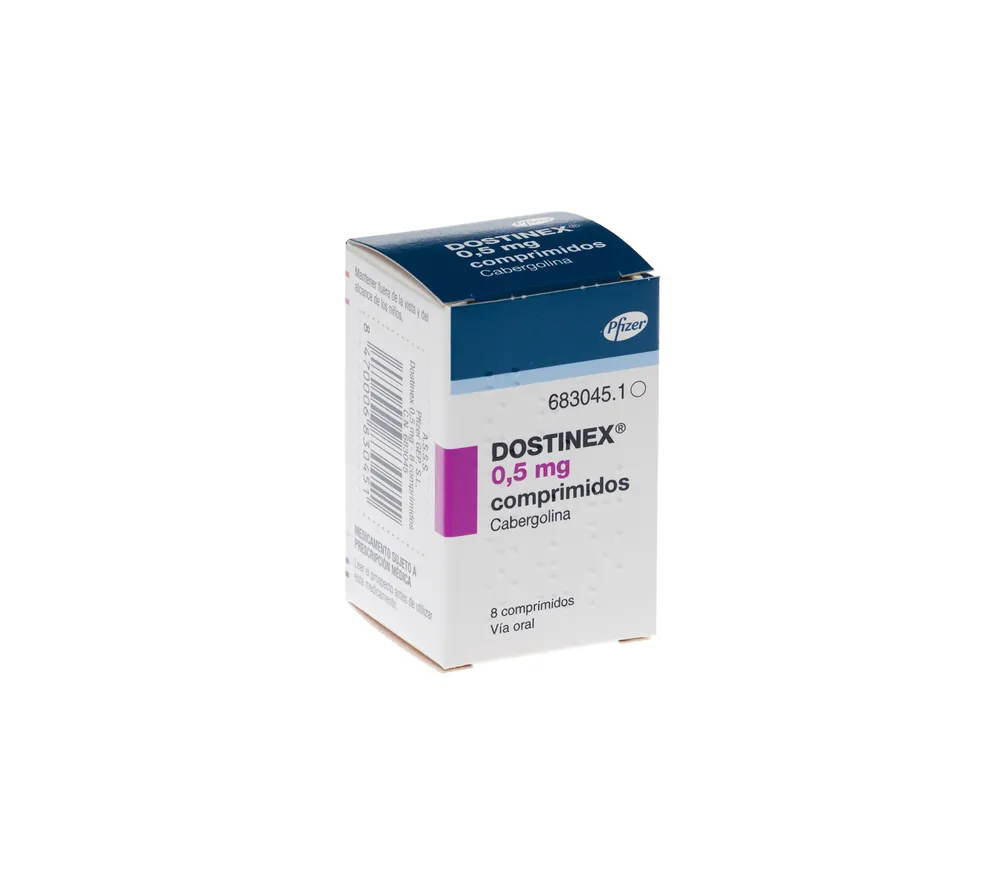
Table of Contents
Package Leaflet: Information for the User
Introduction
Package Leaflet: Information for the User
Dostinex 0.5mg Tablets
Cabergoline
Read the entire leaflet carefully before you start taking this medicine.
- Keep this leaflet as you may need to read it again.
- If you have any questions, ask your doctor or pharmacist.
- This medicine has been prescribed for you and you should not give it to others, even if they have the same symptoms, as it may harm them.
- If you experience any adverse effects, consult your doctor or pharmacist, even if they are effects not listed in this leaflet (see section 4).
Leaflet Contents:
- What Dostinex is and what it is used for
- What you need to know before taking Dostinex
- How to take Dostinex
- Possible adverse effects
- How to store Dostinex
- Contents of the pack and other information.
1. What Dostinex is and what it is used for
Dostinex is a medication used to prevent milk production immediately after childbirth, as well as to suppress existing lactation, in the following situations:
- After childbirth, once the mother decides not to breastfeed her child
- After childbirth, when breastfeeding is medically contraindicated for the mother or the newborn
- Following the delivery of a stillborn infant or after a miscarriage
Additionally, Dostinex is indicated for the treatment of disorders related to elevated levels of the hormone prolactin in the blood (hyperprolactinemic disorders), including absence of menstruation (amenorrhea), infrequent menstruation (oligomenorrhea), menstrual cycles without ovulation (anovulation), and milk discharge from the breast unrelated to the lactation period (galactorrhea).
Dostinex is also indicated in patients with conditions associated with hyperprolactinemic disorders, such as prolactin-secreting pituitary tumors (pituitary adenomas – micro- and macroprolactinomas), elevated prolactin levels without a known cause (idiopathic hyperprolactinemia), or empty sella syndrome.
2. What you need to know before taking Dostinex
Do not take Dostinex
- If you are allergic (hypersensitive) to any ergot alkaloid, to cabergoline, or to any of the other ingredients of this medicine (listed in section 6)
- If you are being treated with Dostinex for a prolonged period and have heart valve abnormalities.
- If you have severe liver disease (severe hepatic insufficiency).
- If you have a history of puerperal psychosis (postpartum syndrome characterized by depression, delusional thoughts, and thoughts of harming yourself and/or the baby).
- If you have high blood pressure during pregnancy associated with fluid retention (edema) and protein in the urine (pregnancy toxemia).
- If you have or have had fibrotic disorders (scarring tissue) affecting the lungs, heart, or abdomen.
- If you are being treated with medicines used to treat mental illnesses (antipsychotic medication).
Warnings and precautions
- If you have a serious heart or circulatory disease, pain and/or sudden color changes in the extremities (Raynaud's syndrome), stomach ulcer, or gastrointestinal bleeding.
- If you have severe hepatic insufficiency, you may require a lower dose.
- If you have had or currently have severe mental illnesses (especially of a psychotic type).
- If you are taking drugs that lower blood pressure. Dostinex may cause a drop in blood pressure upon changing position (postural hypotension).
- If you are being treated with Dostinex for a prolonged period, your doctor will assess the proper functioning of your heart, lungs, and kidneys before starting treatment and regularly during treatment. Your doctor will also perform an echocardiogram (an ultrasound of the heart) before starting treatment and periodically during treatment. If heart valve abnormalities are detected, treatment with Dostinex will not be initiated, or if such abnormalities develop during treatment, it must be discontinued.
- If you experience or develop clinical signs and/or symptoms of respiratory, cardiac, or renal disorders during treatment.
- If you develop an increased or obsessive sexual desire during treatment.
- If you notice altered behavior related to gambling during treatment.
- If you make impulsive or compulsive purchases during treatment.
- If you engage in compulsive eating during treatment.
- If you experience sudden sleepiness or sudden onset of sleep during treatment.
- If you are pregnant or think you might be pregnant.
If you are in any of the situations listed above, consult your doctor.
Tell your doctor immediately if you notice or someone else notices in you:
After giving birth, you may be at higher risk of certain conditions. These may include high blood pressure, myocardial infarction, seizures, strokes, or mental health problems. Therefore, your doctor must monitor your blood pressure frequently during treatment. Contact your doctor immediately if you experience high blood pressure, chest pain, or unusually severe or persistent headache (with or without vision problems).
Pregnancy must be ruled out before administering Dostinex. For patients of childbearing age, use of barrier contraception is recommended.
Before starting treatment, your doctor may perform tests to assess pituitary function. During prolonged treatment with Dostinex, your doctor may periodically perform gynecological examinations and liver function tests.
Taking Dostinex with other medicines
Inform your doctor or pharmacist if you are taking, have recently taken, or might need to take any other medicines, including those obtained without a prescription.
Certain medicines may interact with Dostinex; in such cases, your doctor may need to adjust your dose or discontinue one of the treatments.
It is especially important that you inform your doctor if you are taking any of the following medicines:
- Medicines known as dopamine antagonists (such as phenothiazines, butyrophenones, thioxanthenes, metoclopramide), as they may reduce the effect of Dostinex.
- A type of antibiotics called macrolides (such as erythromycin), as they may increase the adverse effects of Dostinex.
- Other ergot derivatives, such as bromocriptine, pergolide, ergotamine, dihydroergotamine, etc.
Taking Dostinex with food and drink
It is recommended that Dostinex be taken with food, as this improves its tolerability.
Pregnancy, breastfeeding, and fertility
Inform your doctor or pharmacist if you are taking, have recently taken, or might need to take any other medicines.
Pregnancy must be ruled out before administering Dostinex. After treatment, women who wish to become pregnant should wait at least one month after stopping the medication. If pregnancy occurs during treatment, Dostinex administration must be discontinued.
Dostinex must not be given to mothers who decide to breastfeed, as this medicine is used to suppress milk secretion and it is unknown whether it passes into breast milk. If milk secretion persists during treatment with Dostinex, you must not breastfeed your baby.
Driving and using machines
Dostinex may cause drowsiness or even sudden onset of sleep. If you experience any of these symptoms at the beginning or during treatment, do not drive, operate machinery, or perform activities requiring concentration until symptoms resolve, as this could seriously endanger your life and the lives of others.
Dostinex contains lactose
This medicine contains lactose. If your doctor has informed you that you have an intolerance to certain sugars, consult with him before taking this medicine.
3. How to take Dostinex
Follow exactly the instructions for administering Dostinex as given by your doctor. If you have any doubts, consult your doctor or pharmacist.
Dostinex is administered orally. It is recommended to take Dostinex with food.
For suppression of milk production: The recommended dose is 1 mg (2 tablets of 0.5 mg) given as a single dose on the first postpartum day.
For cessation of breastfeeding: It is recommended to administer 0.25 mg (half a tablet of 0.5 mg) every 12 hours for two days (total dose of 1 mg).
For disorders related to elevated prolactin hormone levels in the blood (hyperprolactinemic disorders): The recommended initial dose is 0.5 mg per week, administered in one or two doses (half a tablet of 0.5 mg) per week (e.g., Monday and Thursday). The weekly dose should be gradually increased, preferably by adding 0.5 mg (1 tablet) per week at monthly intervals, until your doctor determines the appropriate dose.
Use in children and adolescents
The use of Dostinex is not recommended in patients under 16 years of age.
Use in elderly patients
Although information from both studies and post-marketing experience is very limited, Dostinex does not appear to pose a special risk for elderly patients.
Use in patients with impaired kidney function
Dosage adjustment is not necessary in this patient group.
Use in patients with mild liver function impairment
Dosage adjustment is not necessary in this patient group.
If you take more Dostinex than you should
Contact your doctor immediately, go to the nearest emergency department, or consult the Toxicology Information Service at telephone number 91 562 04 20.
If you have taken more Dostinex than you should, the following symptoms may occur: nausea, vomiting, gastric discomfort, low blood pressure, and disturbances in thinking or perception.
If you forget to take Dostinex
Do not take a double dose to make up for forgotten doses.
If you stop taking Dostinex
Do not stop treatment before your doctor instructs you to do so, as the desired effect will not be achieved.
If you have any further questions about the use of this medicine, ask your doctor or pharmacist.
4. Possible adverse effects
Like all medicines, Dostinex can have adverse effects, although not everyone experiences them.
Very common adverse effects (may affect more than 1 in 10 patients):
- Dizziness
- Vertigo
- Headache
- Abdominal pain
- Gastric discomfort (dyspepsia), inflammation of the stomach (gastritis)
- Nausea
- Weakness (asthenia) and fatigue
- Heart valve disorders (cardiac valvulopathy), inflammation of the membranes surrounding the heart (pericarditis), and fluid accumulation in the membranes surrounding the heart (pericardial effusion)
Common adverse effects (may affect up to 1 in 10 patients):
- Decrease in blood pressure in patients undergoing long-term treatment
- Drop in blood pressure upon changing position (postural hypotension)
- Drowsiness (somnolence)
- Asymptomatic decrease in blood pressure
- Depression
- Hot flushes
- Constipation
- Vomiting
- Breast pain
Uncommon adverse effects (may affect up to 1 in 100 patients):
- Constriction of blood vessels in the fingers (digital vasospasm) and fainting
- Leg cramps
- Decrease in hemoglobin levels following restoration of menstruation in amenorrheic women
- Transient loss of vision affecting half of the visual field (transient hemianopsia)
- Sudden loss of consciousness (syncope)
- Increased heart rate (palpitations)
- Nosebleed (epistaxis)
- Tingling sensation (paraesthesia)
- Increased sexual desire
- Shortness of breath (dyspnea)
- Hair loss (alopecia)
- Rash
- Fluid retention (edema)
- Exaggerated allergic reaction (hypersensitivity reaction)
- Formation of fibrous tissue in an organ (fibrosis), including in the lung
- Fluid accumulation in the membranes covering the lung (pleural effusion)
Rare adverse effects (may affect between 1 and 10 in 10,000 patients):
- Pain in the upper abdomen
Very rare adverse effects (may affect up to 1 in 10,000 patients):
- Formation of fibrous tissue in the lung (pleural fibrosis)
Adverse effects with unknown frequency (cannot be estimated from available data):
- Chest pain and acute, suffocating tightness in the chest, usually located behind the sternum and sometimes radiating (angina pectoris)
- Aggressive behavior, delusions
- Obsessive sexual desire (hypersexuality)
- Gambling addiction
- Loss of contact with reality (psychotic disorder)
- Hallucinations
- Vision disturbances
- Respiratory disorders, reduced breathing capacity (respiratory failure), inflammation of the membranes covering the lung, chest pain
- Sudden and unexpected onset of sleep, tremor
- Liver function abnormalities
- Increased levels of a type of enzyme (creatine phosphokinases) in the blood, abnormalities in liver function tests
Reporting of adverse effects
If you experience any type of adverse effect, consult your doctor or pharmacist, even if they are adverse effects not listed in this leaflet. You may also report them directly via the Spanish Pharmacovigilance System for Human Medicines: https://www.notificaram.es/. By reporting adverse effects, you can help provide more information on the safety of this medicine.
5. Storage of Dostinex
Store below 25°C.
Keep out of sight and reach of children.
Do not use Dostinex after the expiry date stated on the packaging. The expiry date is the last day of the month indicated.
Medicines should not be disposed of via wastewater or household waste. Dispose of unused medicines and their containers at the SIGRE Point at your Pharmacy. If in doubt, ask your pharmacist how to properly dispose of medicines and containers you no longer need. This will help protect the environment.
6. Contents of the pack and other information
Composition of Dostinex
- The active substance is cabergoline. Each tablet contains 0.5 mg of cabergoline.
- The other components are lactose and leucine.
Nature of the product and pack sizes
Dostinex is presented as white, capsule-shaped tablets with a central score line allowing the tablet to be divided into equal halves.
Dostinex is available in packs containing 2 and 8 tablets.
Marketing Authorization Holder and Manufacturer
Marketing Authorization Holder:
Pfizer, S.L.
Avda. de Europa, 20-B,
Parque Empresarial La Moraleja
28108 Alcobendas (Madrid)
Spain
Manufacturer:
Pfizer Italia S.r.L.
Località Marino del Tronto – 63100
Ascoli Piceno (AP)
Italy
Date of the most recent review of this summary: 10/2020
Detailed and up-to-date information on this medicine is available on the website of the Spanish Agency of Medicines and Health Products (AEMPS) http://www.aemps.gob.es/.