Dormicum 7.5 mg film-coated tablets
Spain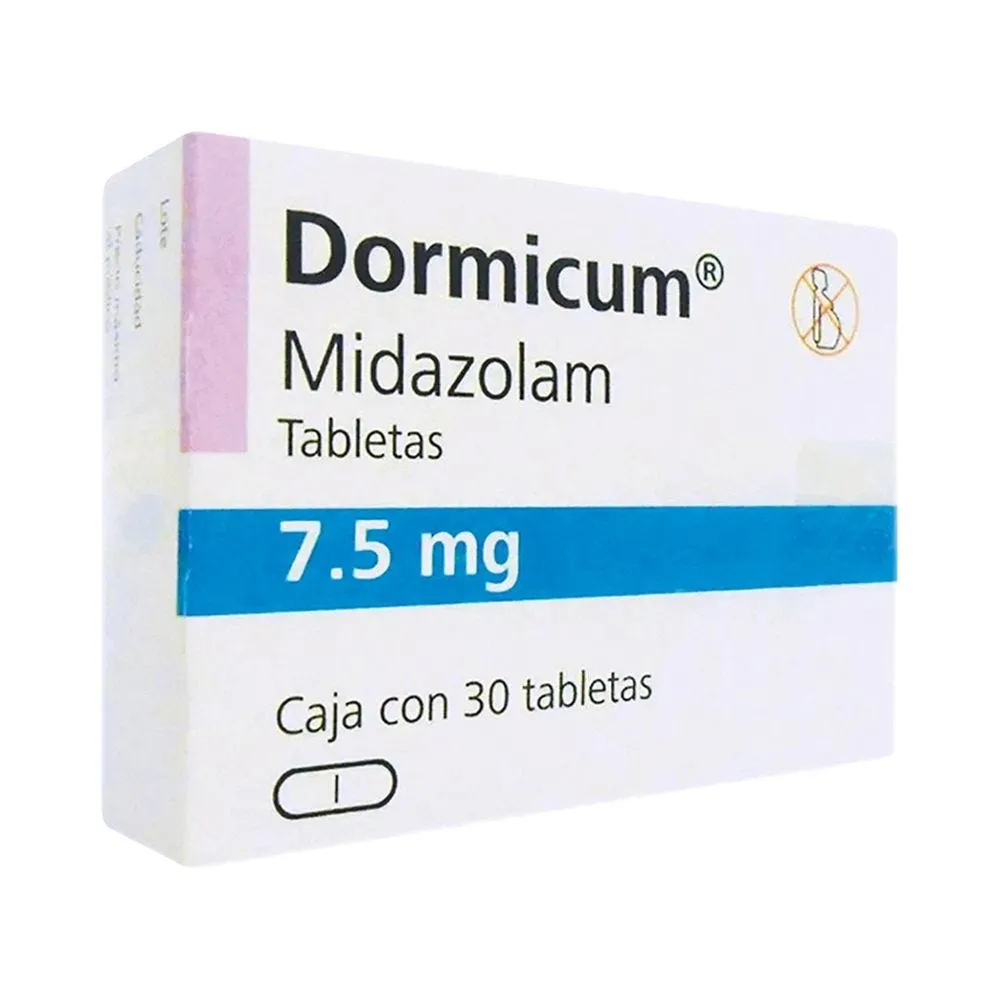
Table of Contents
Package leaflet: Information for the user
Introduction
Package leaflet: information for the user
Dormicum 7.5 mg film-coated tablets
Midazolam
Read the entire leaflet carefully before you start taking this medicine, because it contains important information for you.
- Keep this leaflet, as you may need to read it again.
- If you have any questions, ask your doctor or pharmacist.
- This medicine has been prescribed for you only, and you should not give it to other people, even if they have the same symptoms as you, because it could harm them.
- If you experience any adverse effects, consult your doctor or pharmacist, even if they are adverse effects not listed in this leaflet. See section 4.
Leaflet contents
- What Dormicum is and what it is used for
- What you need to know before taking Dormicum
- How to take Dormicum
- Possible adverse effects
- How to store Dormicum
- Contents of the pack and other information
1. What Dormicum is and what it is used for
Dormicum contains midazolam as the active substance. It belongs to a group of medicines known as benzodiazepines.
Midazolam is a potent, fast-acting sleep inducer. It simultaneously relieves anxiety, as well as muscle tension and spasms.
Doctors prescribe Dormicum for sleep rhythm disorders and for all forms of insomnia, especially when there are difficulties in falling asleep, either initially or after an early awakening.
2. What you need to know before taking Dormicum
Do not take Dormicum
- if you are allergic to the active substance midazolam, to other medicines in the benzodiazepine group in general, or to any of the other ingredients of this medicine (listed in section 6)
- if you have long-standing respiratory difficulties, whether related to sleep or not
- if you have severe muscle weakness (myasthenia gravis)
- if you have severe liver problems
- if you have or have had drug or alcohol dependence, unless your doctor specifically prescribes it
- if you are taking medications for fungal infections
- if you are taking a type of medicine used to treat HIV (AIDS) (HIV protease inhibitors, including ritonavir-boosted protease inhibitor formulations)
- Dormicum must not be administered to children under 12 years of age
Warnings and precautions
- if you have any liver or kidney disease,
- if you suffer from muscle weakness,
- if you have other illnesses,
- if you have allergies,
- if you are taking other medicines.
Your doctor will decide whether you should take a lower dose of Dormicum or should not take it at all.
After taking Dormicum, it is advisable to ensure that you can rest without being disturbed for 7 hours.
Children and adolescents
Children and adolescents must not take this medicine.
Taking Dormicum with other medicines
Inform your doctor or pharmacist if you are taking, have recently taken, or might need to take any other medicines. This point is very important because taking several medicines at the same time may increase or decrease their effects.
For example, tranquilizers, sleep-inducing medicines, medicines acting on the central nervous system, and medicines for treating fungal infections may increase the effect of Dormicum.
Therefore, you must not take Dormicum together with other medicines without consulting your doctor. You may start taking it only when your doctor authorizes you to do so.
Taking Dormicum with food, drinks, and alcohol
During treatment with Dormicum, avoid alcoholic beverages. Alcoholic drinks increase the effect of this medicine and may cause reduced reflexes, coordination problems, drowsiness, and cardiorespiratory depression (slow and shallow breathing and slow heart pumping). If you need further information, consult your doctor.
Pregnancy, breastfeeding, and fertility
If you are pregnant or breastfeeding, think you may be pregnant, or are planning to become pregnant, consult your doctor or pharmacist before using this medicine.
Your doctor will then decide whether you should be treated with Dormicum.
You must inform your doctor if you are breastfeeding. In this case, your doctor will decide whether you should be treated with Dormicum (since benzodiazepines are excreted in breast milk).
Driving and using machines
Dormicum is a medicine that causes drowsiness. Do not drive or operate heavy machinery until you have fully recovered. Your doctor must decide when you can resume these activities.
Dormicum contains lactose
If your doctor has diagnosed you with an intolerance to certain sugars, consult him before taking this medicine.
3. How to take Dormicum
Follow exactly the instructions for administering this medicine as given by your doctor or pharmacist. If in doubt, please consult your doctor or pharmacist again.
Depending on the nature of your illness, your response to the medication, your age and weight, your doctor will prescribe the appropriate dose. Treatment should begin with the lowest dose. The maximum dose must not be exceeded (15 mg per day, i.e. two tablets per day).
The recommended doses are as follows:
Adults: 1 - 2 tablets per day (7.5 - 15 mg of midazolam/day).
Elderly patients: 1 tablet per day (7.5 mg of midazolam/day).
In elderly patients with liver, kidney or muscle weakness problems, your doctor will prescribe a lower dose.
Dormicum may affect elderly patients more than younger patients. If you are elderly, your doctor may prescribe a lower dose and monitor your response to treatment. Please follow your doctor's instructions carefully.
Do not exceed the specified limits or the total daily dose prescribed by your doctor unless your doctor prescribes a higher dose.
Patients with renal or hepatic impairment
If you have renal insufficiency or mild to moderate hepatic insufficiency, your doctor will prescribe a lower dose. If you have severe hepatic insufficiency, you must not be treated with Dormicum.
Instructions for correct administration
Take Dormicum just before going to bed, swallowing the tablet whole with water or another non-alcoholic drink.
Under normal conditions, you should fall asleep within 20 minutes after taking Dormicum. It is advisable to ensure that you can rest undisturbed for at least 7 hours. If not, you may not remember events that occurred while you were awake, although this is rare.
The score line on the tablet is intended only for splitting the tablet if you find it difficult to swallow it whole.
Never change the prescribed dose by yourself.
To avoid withdrawal symptoms, you must not stop taking Dormicum abruptly, especially if you have been taking it for a long time (see section 4 of the package leaflet).
If you think that the effect of Dormicum is too strong or too weak, tell your doctor or pharmacist.
Duration of treatment
Your doctor will indicate how long you should take Dormicum. In most cases, only short-term treatment with this medicine is needed (generally not exceeding two weeks). Consult your doctor regularly so that he or she can decide whether treatment should continue. Do not extend treatment beyond the time recommended by your doctor.
If you take more Dormicum than you should
In case of overdose or accidental ingestion, contact your doctor or pharmacist immediately or call the Toxicology Information Service at telephone number: 91 562 04 20, indicating the medicine and the amount ingested.
If you forget to take Dormicum
Do not take a double dose to make up for a missed dose. Instead, continue with your normal dose.
If you stop taking Dormicum
When stopping treatment, symptoms such as restlessness, anxiety, insomnia, difficulty concentrating, headache, muscle pain, confusion, irritability and hot flushes may occur. Abrupt discontinuation of the medication is generally not recommended; instead, the dose should be gradually reduced according to your doctor's instructions.
If you have any further questions about the use of this medicine, ask your doctor or pharmacist.
4. Possible adverse effects
Like all medicines, this medicine can cause adverse effects, although not everyone will experience them.
Most patients tolerate this medicine well, but some, especially at the beginning of treatment, may feel somewhat drowsy or tired during the day.
The adverse effects that may occur during treatment with this medicine, which have been observed with unknown frequency (cannot be estimated from the available data), are:
Immune system disorders: Hypersensitivity reactions and angioedema (swelling of the face) may occur in predisposed individuals.
Chest pain has been observed as a sign of a severe allergic reaction known as Kounis syndrome.
Psychiatric disorders: Confusion, disorientation, emotional and mood disturbances, libido disorders (altered sexual desire), depression (use of this medicine may unmask pre-existing depression), restlessness, agitation, hyperactivity, nervousness, anxiety, irritability, aggressive behaviour, rage attacks, nightmares, abnormal dreams, hallucinations, inappropriate behaviour, physical dependence, withdrawal syndrome, and abuse.
Nervous system disorders: Somnolence (drowsiness), headache, dizziness (disturbance of balance), decreased alertness (slowed reflexes), ataxia (lack of coordination of voluntary movements), sedation (after surgery), and anterograde amnesia (a condition in which you do not remember events that occurred while awake after taking the medicine).
Eye disorders: Diplopia (double vision).
Cardiac disorders: Heart failure (heart does not pump blood effectively) and cardiac arrest (heart attack).
Musculoskeletal and connective tissue disorders: Muscle weakness.
Respiratory disorders: Respiratory depression (slow and shallow breathing).
Gastrointestinal disorders: Gastrointestinal disturbances.
Skin and subcutaneous tissue disorders: Skin reactions (skin disturbances).
General disorders and administration site conditions: Fatigue.
Injury, poisoning and procedural complications: Increased risk of falls and fractures in elderly patients and in patients taking other sedatives simultaneously (including alcoholic beverages).
Risk of dependence
The use of benzodiazepines may lead to dependence. This occurs mainly after prolonged, uninterrupted use of the medicine. To minimize the risk of dependence as much as possible, the following precautions should be observed:
-
Benzodiazepines should only be taken on a doctor's prescription (never because they worked in other patients) and should never be recommended to others.
- Do not increase the prescribed dose at all, nor extend the treatment beyond the recommended duration.
-
Consult your doctor regularly so they can decide whether treatment should continue.
If you consider any of the adverse effects you experience to be severe, or if you notice any adverse effect not mentioned in this leaflet, inform your doctor or pharmacist.
Withdrawal
To help minimize the occurrence of withdrawal syndrome/rebound insomnia (difficulty sleeping more intense than at the start of treatment), do not stop taking the medicine abruptly; instead, gradually reduce the dose, always following your doctor's instructions.
When stopping administration, insomnia, anxiety, headache, diarrhoea, confusion, muscle pain, mood changes, and restlessness may occur.
Reporting of adverse effects
If you experience any type of adverse effect, consult your doctor or pharmacist, even if it is an adverse effect not listed in this leaflet. You may also report them directly via the Spanish Pharmacovigilance System for Human Medicines: www.notificaRAM.es/. By reporting adverse effects, you can help provide more information on the safety of this medicine.
5. Storage of Dormicum
Keep this medicine out of the sight and reach of children.
Do not use this medicine after the expiry date which is stated on the packaging, after EXP. The expiry date is the last day of the month indicated.
Store in the original packaging.
Medicines should not be disposed of via wastewater or household waste. Dispose of unused medicines and their containers at a SIGRE collection point at your pharmacy. Ask your pharmacist how to dispose of medicines and containers you no longer need. This will help protect the environment.
6. Contents of the pack and other information
Composition of Dormicum
- The active substance is midazolam. Each tablet contains 7.5 mg of midazolam.
- The other components are anhydrous lactose, microcrystalline cellulose, pregelatinized corn starch, magnesium stearate, hypromellose, talc and titanium dioxide.
Appearance of the product and contents of the pack
Dormicum 7.5 mg film-coated tablets:
Film-coated oval tablets, white in colour, with the inscription "7.5" on one side of the tablet.
Available in packs of 20 tablets.
Marketing Authorisation Holder and Manufacturer
Marketing Authorisation Holder:
CHEPLAPHARM Arzneimittel GmbH
Ziegelhof 24
17489 Greifswald
Germany
Local representative:
Laboratorios Rubió, S.A.
C/ Industria, 29 - Pol. Ind. Comte de Sert
08755 Castellbisbal (Barcelona)
Spain
Manufacturer:
Recipharm Leganés S.L.U.
Calle Severo Ochoa 13
Leganés
28914 Madrid
Spain
Date of the most recent revision of this leaflet: August 2023.
Detailed and up-to-date information on this medicinal product is available on the website of the Spanish Agency for Medicines and Health Products (AEMPS) http://www.aemps.gob.es/