Dolostop Pediatric 100 mg/ml oral solution
Spain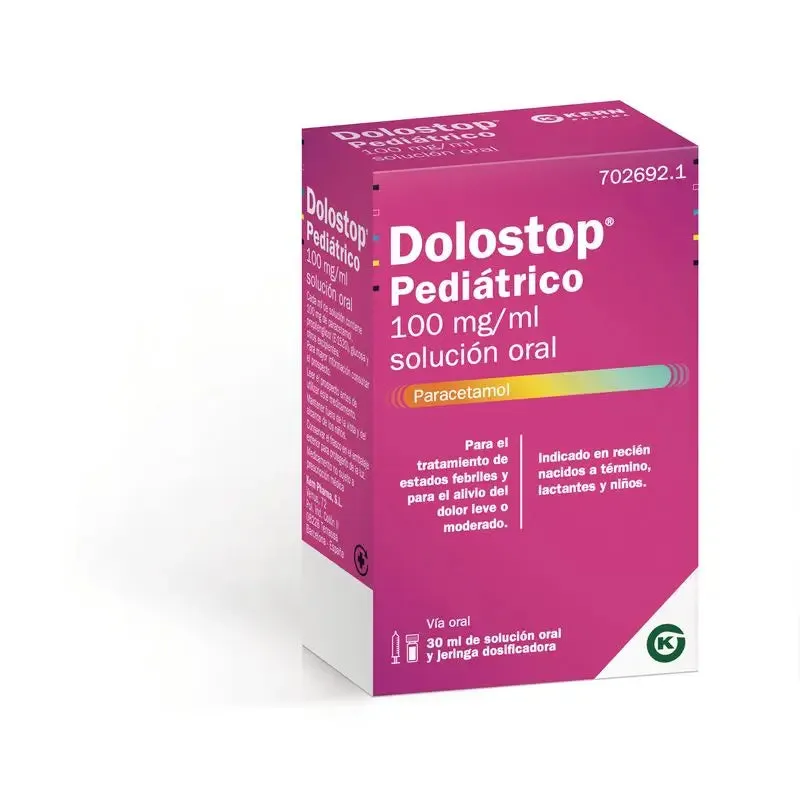
Table of Contents
- Package leaflet: Information for the user
- Introduction
- 1. What Dolostop Pediatric is and what it is used for
- 2. What you need to know before taking Dolostop Pediatric
- 3. How to take Dolostop Pediatric
- 4. Possible adverse effects
- 5. Storage of Dolostop Pediatric
- 6. Package contents and additional information
Package leaflet: Information for the user
Introduction
Package leaflet: Information for the user
Dolostop Pediatric 100 mg/ml oral solution
Paracetamol
Read the entire leaflet carefully before starting to take this medicine, because it contains important information for you.
Follow exactly the instructions for administration provided in this leaflet or those given by your doctor, pharmacist, or nurse.
- Keep this leaflet, as you may need to read it again.
- If you need advice or more information, consult your pharmacist.
- If you experience any adverse effects, consult your doctor, pharmacist, or nurse, even if they are adverse effects not listed in this leaflet. See section 4.
- You should consult a doctor if you worsen or do not improve after 3 days. If fever persists for more than 3 days or pain for more than 3 days in children (2 days for sore throat).
Contents of the leaflet:
- What Dolostop Pediatric is and what it is used for
- What you need to know before taking Dolostop Pediatric
- How to take Dolostop Pediatric
- Possible adverse effects
- Storage of Dolostop Pediatric
- Contents of the pack and other information
1. What Dolostop Pediatric is and what it is used for
Paracetamol belongs to a group of medicines called analgesics and antipyretics.
This medicine is indicated in full-term newborns, infants, and children for the treatment of febrile conditions and for relief of mild to moderate pain.
2. What you need to know before taking Dolostop Pediatric
Do not take Dolostop Pediatric
- If you are allergic (hypersensitive) to paracetamol or to any of the other components of this medicine (listed in section 6).
- If you have severe liver disease.
Warnings and precautions
Consult your doctor or pharmacist before starting to take this medicine.
- Do not exceed the recommended dose in section 3. To ensure this, check that no other medicines containing paracetamol are being taken simultaneously.
- Patients with mild or moderate liver disease should consult their doctor before taking this medicine.
- Patients with kidney, heart, or lung disease, anemia (reduced hemoglobin levels in the blood, with or without a reduction in red blood cells), or those who are chronically malnourished or dehydrated should consult their doctor before taking this medicine.
- Consumption of alcoholic beverages may increase the risk of liver damage from paracetamol.
- If pain persists for more than 3 days (2 days for sore throat) or fever for more than 3 days, or if symptoms worsen or new symptoms appear, treatment should be stopped and a doctor consulted. Avoid prolonged treatment.
During treatment with Dolostop, inform your doctor immediately if:
You have serious conditions such as severe renal failure or sepsis (when bacteria and their toxins circulate in the blood, causing organ damage), or if you suffer from malnutrition, chronic alcoholism, or are also taking flucloxacillin (an antibiotic). A serious condition called metabolic acidosis (an abnormality in blood and body fluids) has been reported in patients under these circumstances when paracetamol is used at regular doses for prolonged periods or when paracetamol is taken together with flucloxacillin. Symptoms of metabolic acidosis may include: severe difficulty breathing with deep and rapid breathing, drowsiness, malaise (nausea), and vomiting.
Children
You should consult a doctor before administering this medicine to children under 2 years of age.
Use of Dolostop Pediatric with other medicines
Tell your doctor or pharmacist if you are using, have recently used, or might need to use any other medicines.
This medicine must not be used together with other medicines for pain or fever (analgesics/antipyretics) unless directed by your doctor.
Paracetamol may increase the toxicity of chloramphenicol.
Barbiturates may enhance the toxicity of paracetamol.
Occasional use as an analgesic of choice may be allowed in patients receiving oral anticoagulants.
In particular, if you are taking medicines containing any of the following active substances, it may be necessary to adjust or discontinue treatment:
- Oral anticoagulants (acenocoumarol, warfarin).
- Anticonvulsants (lamotrigine, phenytoin, phenobarbital, methylphenobarbital, primidone).
- Antituberculosis agents (isoniazid, rifampicin).
- Cholestyramine (used to lower blood cholesterol levels).
- Medicines used to treat gout (antigout agents) (probenecid).
- Certain medicines used to increase urine output (loop diuretics such as furosemide).
- Metoclopramide and domperidone (used to prevent nausea and vomiting).
- Propranolol, used in the treatment of high blood pressure (hypertension) and heart rhythm disorders (cardiac arrhythmias).
- Flucloxacillin (antibiotic), due to a serious risk of blood and fluid imbalance (called metabolic acidosis with high anion gap) that requires urgent treatment (see section 2).
Interference with laboratory tests:
If you are scheduled for any laboratory tests (including blood or urine tests, skin tests using allergens, etc.), inform your doctor that you are taking this medicine, as it may alter the results of these tests.
Use of Dolostop Pediatric with food, drinks, and alcohol
This medicine can be taken with or without food and may be administered directly or diluted with water, milk, or fruit juice.
The use of paracetamol in patients who regularly consume alcohol (three or more alcoholic drinks per day) may cause liver damage.
Pregnancy, breastfeeding, and fertility
If you are pregnant, breastfeeding, think you may be pregnant, or plan to become pregnant, consult your doctor or pharmacist before using this medicine.
Oral use of paracetamol does not produce adverse effects in pregnant women, the fetus, or newborns. Reproduction studies show no malformations or toxic effects. If necessary, paracetamol may be used during pregnancy. Use the lowest effective dose that controls pain or fever, and use it for the shortest possible duration. Contact your doctor if pain or fever do not improve or if you need to take the medicine more frequently.
Paracetamol passes into breast milk, although no adverse effects have been reported in infants. Therefore, it may be used in breastfeeding women as long as the recommended dose is not exceeded. Caution should be exercised with prolonged use.
Driving and operating machinery
This medicine may impair your ability to drive or operate machinery due to its content of propylene glycol, which may produce symptoms similar to those of alcohol.
Dolostop Pediatric contains propylene glycol (E-1520) and glucose
This medicine contains 2.72 mg of propylene glycol per ml.
If the infant is less than 4 weeks old, consult your doctor or pharmacist, especially if the infant has been given other medicines containing propylene glycol or alcohol.
This medicine contains glucose. If your doctor has diagnosed you with an intolerance to certain sugars, consult him before taking this medicine.
3. How to take Dolostop Pediatric
Follow exactly the instructions for use provided in this leaflet or those indicated by your doctor, pharmacist, or nurse. If in doubt, consult your doctor or pharmacist.
Remember to take your medicine as prescribed.
Your doctor will determine the duration of treatment. Do not stop treatment earlier, as otherwise the expected results will not be achieved. Likewise, do not use this medicine for longer than prescribed by your doctor.
The dosage of the solution is measured in ml (100 mg/ml), using the oral syringe of 2 or 5 ml provided.
Use in children
For children under 2 years of age, the dose must always be determined by your doctor.
Children from 0 to 10 years of age:
The recommended daily dose of paracetamol is 60 mg/kg/day, i.e., 10 mg/kg every 4 hours (up to 6 doses/day) or 15 mg/kg every 6 hours (up to 4 doses in 24 hours). In children under 1 year of age, doses of 10 mg/kg are preferred.
For administration of 10 mg/kg with a minimum interval of 4 hours, the recommended dosing schedule is as follows:
Child's weight | Age (indicative) | Volume per dose in ml | Paracetamol amount per dose in mg |
3 - 4 kg | from 0 to 3 months | 0.4 ml | 40 mg |
4 to 8 kg | from 4 to 11 months | 0.4-0.8 ml | 40-80 mg |
8 to 10 kg | from 12 to 23 months | 0.8-1 ml | 80-100 mg |
10 to 15 kg | from 2 to 3 years | 1-1.5 ml | 100-150 mg |
15 to 20 kg | from 4 to 5 years | 1.5-2.0 ml | 150-200 mg |
20 to 25 kg | from 6 to 8 years | 2.0-2.5 ml | 200-250 mg |
25 to 32 kg | from 9 to 10 years | 2.5-3.2 ml | 250-320 mg |
For direct calculation, the child's weight in kg may also be multiplied by 0.10. The result is the number of ml of solution to be administered.
These doses may be repeated every 4 hours.
Alternatively, doses of 15 mg/kg may be administered with a minimum interval of 6 hours. In this case, for direct calculation, multiply the child's weight in kg by 0.15. The result is the number of ml of solution to be administered.
Administration of this preparation should be based on the onset of pain or fever symptoms. As these symptoms subside, this medication should be discontinued.
If you feel that the effect of this medicine is too strong or too weak, inform your doctor or pharmacist.
Instructions for use and route of administration
Oral use
Instructions for use:
1.- Open the bottle following the instructions indicated on the cap (on first opening, the seal will break).
2.- Insert the oral syringe by pressing it into the pierced opening of the cap.
3.- Invert the bottle and withdraw the required dose.
4.- Administer directly or dilute with water, milk, or fruit juice.
5.- The oral syringe should be washed with water after each use.
Close the bottle tightly after each administration.
If you take moreDolostopPediatrict han recommended
In case of overdose or accidental ingestion, contact your doctor or pharmacist immediately or call the Toxicology Information Service at telephone number 91 562 04 20, indicating the medication and the amount ingested.
If an overdose has occurred, seek urgent medical attention at a healthcare facility even if there are no symptoms, as serious symptoms often do not appear until 3 days after the overdose has been ingested, even in cases of severe poisoning. Symptoms of overdose may include dizziness, vomiting, loss of appetite, yellowing of the skin and eyes (jaundice), and abdominal pain.
An overdose of paracetamol is considered when a single dose exceeding 6 g is taken in adults or more than 100 mg per kg of body weight in children. Treatment for overdose is most effective when initiated within 4 hours of ingestion of the medication.
Patients undergoing treatment with barbiturates or those suffering from chronic alcoholism may be more susceptible to paracetamol overdose.
If you forget to takeDolostopPediatric
Do not take a double dose to make up for missed doses.
If you have missed a dose, take it as soon as possible and then continue with your regular dosing schedule. However, if the next dose is due shortly, skip the missed dose and take the next dose at the usual time.
4. Possible adverse effects
Like all medicines, paracetamol may produce adverse effects, although not everybody will experience them.
This medicine may cause the following adverse effects:
- Rare (may affect up to 1 in 1,000 people): malaise, increased levels of hepatic transaminases, and low blood pressure.
- Very rare (may affect up to 1 in 10,000 people): severe skin reactions, liver disorders (such as jaundice), decreased glucose levels, blood disorders (thrombocytopenia, agranulocytosis, leucopenia, neutropenia, haemolytic anaemia), cloudy urine, and kidney disorders.
- Frequency not known (cannot be estimated from available data): A serious condition that may cause the blood to become more acidic (called metabolic acidosis) in patients with severe illness who are using paracetamol (see section 2).
Reporting of adverse effects
If you experience any type of adverse effect, consult your doctor or pharmacist, even if it is an adverse effect not listed in this leaflet. You may also report them directly via the Spanish Pharmacovigilance System for Human Medicinal Products: www.notificaram.es. By reporting adverse effects, you can help provide more information on the safety of this medicine.
5. Storage of Dolostop Pediatric
Keep this medicine out of sight and reach of children.
Store the bottle in the outer packaging to protect it from light.
Do not use this medicine after the expiry date stated on the packaging after “EXP”. The expiry date refers to the last day of the month indicated.
After opening, the contents of the bottle should be used within 6 months.
Medicines should not be disposed of via wastewater or household waste. Dispose of containers and unused medicines at the SIGRE Point at your usual pharmacy. If in doubt, ask your pharmacist how to properly dispose of unused containers and medicines. This way, you will help protect the environment.
6. Package contents and additional information
Composition of Dolostop Pediatric
- The active substance is paracetamol. Each ml of solution contains 100 mg of paracetamol.
- The other components (excipients) are: macrogol 600, glycerol (E-422), sucralose (E-955), flavour masker (containing propylene glycol (E-1520)), strawberry flavour (containing propylene glycol (E-1520)), carmine red (E-120) (containing glucose), and water.
Appearance of the medicinal product and contents of the container
Dolostop Pediatric 100 mg/ml oral solution is presented as a red, transparent solution with a characteristic strawberry odour.
30 ml pack:
Clear plastic (PET) bottle containing 30 ml of oral solution, with a plastic adapter (LDPE) for inserting the dosing syringe, closed with a plastic cap (HDPE). A 2 ml plastic dosing syringe is included.
60 ml pack:
Clear plastic (PET) bottle containing 60 ml of oral solution, with a plastic adapter (LDPE) for inserting the dosing syringe, closed with a plastic cap (HDPE). A 5 ml plastic dosing syringe is included.
Marketing Authorization Holder and Manufacturer
Kern Pharma, S.L.
Venus, 72 - Pol. Ind. Colón II
08228 Terrassa - Barcelona
Spain
Date of the most recent revision of this package leaflet: February 2025
Detailed and up-to-date information on this medicinal product is available on the website of the Spanish Agency of Medicines and Health Products (AEMPS) http://www.aemps.gob.es/.