Diprosalic ointment
Spain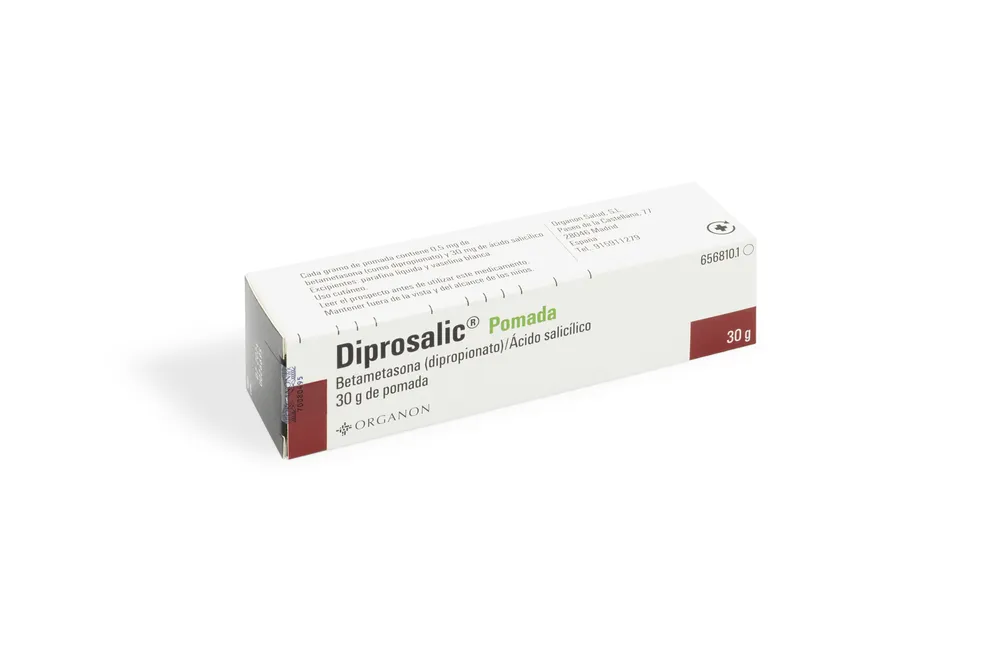
Table of Contents
- Package leaflet: Information for the user
- Introduction
- 1. What Diprosalic ointment is and what it is used for
- 2. What you need to know before using Diprosalic ointment
- 3. How to use Diprosalic ointment
- 4. Possible adverse effects
- 5. Storage of Diprosalic ointment
- 6. Contents of the container and other information
Package leaflet: Information for the user
Introduction
Package leaflet: information for the user
Diprosalic ointment
Betamethasone dipropionate / Salicylic acid
Read this entire leaflet carefully before you start using this medicine, because it contains important information for you.
-
Keep this leaflet, as you may need to read it again.
-
If you have any questions, ask your doctor or pharmacist.
-
This medicine has been prescribed for you only, and you should not give it to others, even if they have the same symptoms as you, because it may harm them.
- If you experience any adverse effects, consult your doctor or pharmacist, even if they are adverse effects not listed in this leaflet. See section 4.
Contents of the leaflet
- What Diprosalic ointment is and what it is used for
- What you need to know before using Diprosalic ointment
- How to use Diprosalic ointment
- Possible side effects
- How to store Diprosalic ointment
- Contents of the pack and other information
1. What Diprosalic ointment is and what it is used for
Diprosalic ointment is a medicine containing as active ingredients a combination of betamethasone (dipropionate) and salicylic acid. Betamethasone (dipropionate) is a corticosteroid (anti-inflammatory) which, when applied to the skin, reduces redness, inflammation, and itching caused by certain skin conditions. Salicylic acid reduces the thickness of the scaly layer on the skin's surface caused by the disease (keratolytic effect), allowing betamethasone to reach the lower affected layers of the skin.
Diprosalic ointment is indicated for the treatment of inflammatory manifestations of certain skin diseases in which the outer surface presents dry, scaly (hyperkeratotic) layers responsive to corticosteroids, such as scaly red lesions (psoriasis) and itchy eruptions appearing as bluish-white patches (lichen planus).
2. What you need to know before using Diprosalic ointment
Do not use Diprosalic ointment:
-
if you are allergic to betamethasone (dipropionate), salicylic acid, or any of the other components of this medicine (listed in section 6).
- if you have tuberculosis, syphilis, or viral infections (for example: herpes or chickenpox).
- on areas of skin affected by facial inflammation with redness (rosacea), acne, or inflammation around the mouth (perioral dermatitis).
- in skin diseases associated with thinning of the skin (atrophy).
- on areas of skin showing a vaccine reaction, such as redness or inflammation after vaccination.
-
in the eyes or on open wounds.
-
if you have diabetes.
-
in children under 2 years of age.
-
if you have a fungal infection anywhere in your body.
Warnings and precautions
Consult your doctor or pharmacist before starting to use Diprosalic ointment.
-
Corticosteroids, such as one of the active substances in this medicine, have significant effects on the body. The use of Diprosalic ointment over large areas of the body or for prolonged periods is not recommended, as this significantly increases the risk of adverse effects.
-
The medicine should not be applied under occlusive dressings (or under air-impermeable materials, such as certain diapers).
-
The medicine should not be applied to skin folds, such as the groin or armpits.
-
The medicine should not be applied to the face.
-
If irritation or hypersensitivity occurs, treatment should be discontinued and you should consult your doctor.
-
If you develop an infection during treatment with this medicine, you should consult your doctor regarding its management.
-
Diprosalic ointment must not come into contact with the eyes, open wounds, or mucous membranes (e.g., genital area). In case of contact with the eyes, rinse thoroughly with water for about 15 minutes.
-
The adverse effects associated with corticosteroid use, including adrenal gland suppression, may also occur with topical application due to systemic absorption of the active substance, especially when used over large skin areas, for prolonged periods, or under occlusive dressings. This is particularly relevant in children.
- If you use Diprosalic ointment for conditions other than those for which it was prescribed, it may mask symptoms and interfere with correct diagnosis and treatment.
- Inform your doctor if you have circulatory problems.
- Contact your doctor if you experience blurred vision or other visual disturbances.
Children
This medicine is contraindicated in children under 2 years of age and is not indicated in children under 12 years of age.
In children, corticosteroids are more likely to be absorbed through the skin, increasing the risk of adverse effects in other parts of the body compared to adult patients.
In children treated with topical corticosteroids, suppression of the adrenal glands located near the kidneys has been reported, leading to symptoms such as obesity, growth retardation, etc. (Cushing's syndrome), or increased pressure within the skull (intracranial hypertension), which may manifest, among other signs, as bulging of the fontanelle in infants and headaches.
Use of Diprosalic ointment with other medicines
Inform your doctor or pharmacist if you are taking, have recently taken, or might need to take any other medicines.
No interactions between Diprosalic ointment and other medicines are known.
Pregnancy, breastfeeding, and fertility
If you are pregnant, breastfeeding, think you may be pregnant, or plan to become pregnant, consult your doctor or pharmacist before using this medicine.
Pregnancy
As a general rule, Diprosalic ointment should not be used during the first trimester of pregnancy.
Diprosalic ointment should not be used during pregnancy unless your doctor considers that the potential benefit justifies the potential risk to the fetus.
Pregnant women or those planning to become pregnant should not use Diprosalic ointment over large areas of skin, in large amounts, or for prolonged periods, nor should they use occlusive dressings.
Breastfeeding
Do not apply Diprosalic ointment to the breasts during breastfeeding; avoid contact between the infant and treated areas.
Do not use this medicine during breastfeeding unless instructed by your doctor, and do not use it over large skin areas, in large amounts, or for prolonged periods, or under occlusive dressings.
Driving and using machines
Not applicable.
3. How to use Diprosalic ointment
Follow exactly the instructions for use of this medicine as given by your doctor. If in doubt, consult your doctor or pharmacist again.
The recommended dose is:
Adults and children over 12 years of age:
Apply a thin layer of the ointment to the affected area 1 or 2 times daily, in the morning and/or at night.
In some cases, your doctor may instruct you to use it less frequently if this is sufficient for your condition.
The duration of treatment should not exceed 2 weeks.
For topical use only.
The ointment should be applied in a thin layer with gentle massage, covering the affected area.
Use in children
Diprosalic ointment is not indicated for children under 12 years of age and is contraindicated in children under 2 years of age.
If you use more Diprosalic ointment than you should
Excessive use of topical corticosteroids (repeated overdosing) may produce adverse effects (see section 4).
If you use the ointment more often than you should or over large areas of skin, it may be absorbed into the body and cause various disorders; in children, this may affect their growth and development. Nausea, vomiting, and tinnitus may also occur.
In cases of chronic toxicity, corticosteroids should be withdrawn gradually. Treatment of overdose is symptomatic. Acute symptoms caused by excessive use of corticosteroids are generally reversible.
In case of overdose or accidental ingestion, contact your doctor or pharmacist immediately, go to a medical center, or call the Toxicology Information Service. Tel.: 91 562 04 20 (indicating the medicine and the amount ingested).
If you forget to use Diprosalic ointment
Do not apply a double dose to make up for missed doses.
Apply the dose as soon as possible and then continue with your usual treatment.
If you stop using Diprosalic ointment
If you have any further questions about the use of this medicine, ask your doctor or pharmacist.
4. Possible adverse effects
Like all medicines, this medicine can cause adverse effects, although not everyone will experience them.
The following reactions have been reported with the use of topical corticosteroids, especially after prolonged application, over large areas, with dressings or occlusive materials, and/or in children:
- Burning or stinging sensation
- Itching
- Thinning of the skin (atrophy)
- Skin irritation
- Changes in skin color
- Dryness or cracking of the skin
- Skin peeling
- Redness (erythema)
- Bruising
- Appearance of red spots
- Inflammation of hair follicles (folliculitis)
- Increased hair growth
- Specific skin inflammation around the upper lip and chin (perioral dermatitis)
- Skin stretch marks (striae)
- Acne
- Skin maceration
- Skin allergic reaction (contact dermatitis)
- Miliaria (red and white pimples in various parts of the body)
- Hair loss
- Abnormal skin sensation, such as numbness, tingling, pricking, or burning of the skin (paresthesia)
- Infections
Adverse effects may occur not only in the treated area but also in completely different areas of the body, which may happen if the active substance passes into the body through the skin.
This, for example, could increase eye pressure (glaucoma) or cause a condition characterized by a rounded face, fat accumulation, a hump, delayed wound healing, psychiatric symptoms, etc. (Cushing's syndrome); increased intracranial pressure, cataracts, and blurred vision, with frequency unknown (frequency cannot be estimated from available data).
Reporting of adverse effects
If you experience any type of adverse effect, consult your doctor or pharmacist, even if it is a possible adverse effect not listed in this leaflet. You may also report them directly through the Spanish Pharmacovigilance System for Human Medicines: https://www.notificaram.es. By reporting adverse effects, you can help provide more information on the safety of this medicine.
5. Storage of Diprosalic ointment
No special storage conditions are required.
Keep this medicine out of the sight and reach of children.
Do not use this medicine after the expiry date stated on the container after EXP. The expiry date refers to the last day of the month indicated. Use within three months of opening.
Do not use this medicine if you notice any visible signs of deterioration. Inform your doctor if you observe any changes in the appearance of Diprosalic ointment.
Medicines must not be disposed of via wastewater or household waste. Dispose of containers and unused medicines at a SIGRE Point at your pharmacy. If in doubt, ask your pharmacist how to dispose of containers and medicines you no longer need. This will help protect the environment.
6. Contents of the container and other information
Composition of Diprosalic ointment
- The active substances are betamethasone (dipropionate) and salicylic acid.
Each gram of ointment contains 0.5 mg of betamethasone (0.05 %) (0.64 mg of betamethasone dipropionate) and 30 mg of salicylic acid (3 %).
- The other components (excipients) are liquid paraffin and white soft paraffin.
Appearance of the product and contents of the container
Diprosalic ointment is a soft, white ointment.
It is supplied in tubes containing 30 g of ointment.
Marketing Authorisation Holder and Manufacturer
Marketing Authorisation Holder:
Organon Salud, S.L.
Paseo de la Castellana, 77
28046 Madrid
Spain
Tel.: 915911279
Manufacturer:
Organon Heist bv
Industriepark 30
2220 Heist-op-den-Berg
Belgium
Date of the most recent review of this product information: September 2017.
Detailed and up-to-date information on this medicine is available on the website of the Spanish Agency for Medicines and Health Products (AEMPS) http://www.aemps.gob.es/