Dipeptiven 200 mg/ml concentrate for solution for infusion
Spain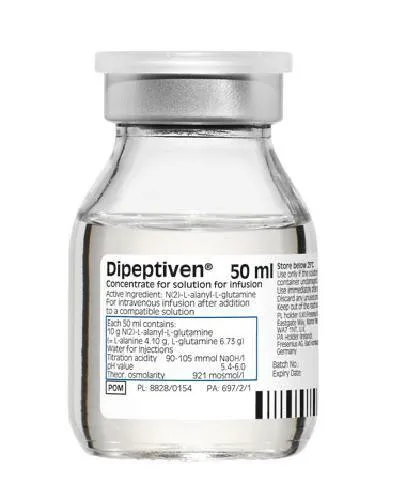
Table of Contents
Patient Information Leaflet
Introduction
PACKAGE LEAFLET: INFORMATION FOR THE USER
Dipeptiven 200 mg/ml concentrate for solution for infusion Alanine glutamine
Read the entire leaflet carefully before you start using this medicine.
- Keep this leaflet as you may need to read it again.
- If you have any questions, ask your doctor or pharmacist.
- If you experience any side effects that you consider to be serious, or notice any side effects not listed in this leaflet, inform your doctor or pharmacist.
Leaflet contents:
- What Dipeptiven is and what it is used for
- What you need to know before using Dipeptiven
- How to use Dipeptiven
- Possible side effects
- How to store Dipeptiven
- Further information
1. What DIPEPTIVEN is and what it is used for
DIPEPTIVEN is a concentrate solution for infusion. It is supplied in 50 ml and 100 ml glass vials. It belongs to a group of medicines called solutions for parenteral nutrition.
DIPEPTIVEN is indicated as part of a clinical nutritional regimen in patients in hypercatabolic and/or hypermetabolic states. It must be administered in conjunction with parenteral or enteral nutrition, or a combination of both.
2. What you need to know before using Dipeptiven
Do not use DIPEPTIVEN:
- If you are allergic (hypersensitive) to the active substance or to any of the other components of Dipeptiven.
- If you have severe renal impairment (creatinine clearance < 25 ml/min)
- If you have severe hepatic impairment
- If you suffer from severe metabolic acidosis
- If you are in circulatory shock
- If you have hypoxia – a condition in which oxygen levels are low
- If you have multiorgan failure – a condition in which two or more organs are not functioning normally
Your doctor must verify this.
Your doctor or healthcare professional must check before administration that the solution is clear and free of particles.
Take special care with DIPEPTIVEN:
-
Hepatic function parameters should be monitored regularly if you have compensated liver insufficiency.
-
Special attention should be paid to serum osmolarity, serum electrolyte levels, fluid balance, acid-base balance, liver function tests (alkaline phosphatase, ALT, AST, bilirubin), and possible symptoms of hyperammonemia.
Use of other medicines
Inform your doctor or pharmacist if you are using or have recently used any other medicines, including those obtained without a prescription.
No interactions with other medicines have been reported.
Pregnancy and breastfeeding
Consult your doctor or pharmacist before using any medicine.
DIPEPTIVEN must not be administered during pregnancy and breastfeeding.
Driving and using machines
Not applicable
3. HOW TO USE DIPEPTIVEN
Dipeptiven will be administered to you in the hospital.
You will receive Dipeptiven by infusion (intravenous drip). The volume and duration of the infusion will depend on your individual requirements. Your doctor will determine the appropriate dose you should receive.
It is recommended that the Dipeptiven solution be infused at room temperature.
If you have any further questions about the use of this product, consult your doctor or pharmacist.
If you use more DIPEPTIVEN than you should:
If more Dipeptiven is administered than prescribed, the administration of the medicine must be stopped immediately.
Chills, nausea, and vomiting may occur if the infusion rate exceeds the recommended speed.
In cases of overdose or accidental ingestion, contact the Toxicology Information Service, Telephone: 91-5620420.
4. Possible adverse effects
Like all medicines, Dipeptiven may produce adverse effects, although not everyone will experience them.
However, to date no adverse effects have been reported for DIPEPTIVEN.
Reporting of adverse effects
If you experience any type of adverse effect, consult your doctor or pharmacist, even if it is a possible adverse effect not listed in this leaflet.
You can also report them directly through the national reporting system included in Appendix V*. By reporting adverse effects, you can help provide more information on the safety of this medicine.
5. Storage of DIPEPTIVEN
Keep out of the reach and sight of children.
Your hospital doctor and pharmacist are responsible for the proper storage, use, and disposal of Dipeptiven.
Do not store above 25°C.
Do not use Dipeptiven after the expiry date stated on the container.
The expiry date refers to the last day of the month indicated.
The solution must be clear and colourless. Do not administer if this is not the case.
Any unused solution remaining after treatment must be discarded.
Medicines should not be disposed of via wastewater or household waste. Ask your pharmacist how to dispose of medicines and packaging you no longer need. This will help protect the environment.
6. ADDITIONAL INFORMATION
Composition of Dipeptiven
1 ml contains:
Alanylglutamine 200 mg (= 82.0 mg alanine, 134.6 mg glutamine)
The other components are: water for injections q.s.
Appearance of the product and contents of the container
Dipeptiven is a clear solution packed in glass vials.
It is available in container sizes of 50 ml and 100 ml.
Not all container sizes may be marketed.
Marketing Authorization Holder
Fresenius Kabi Deutschland GmbH
Else-Kröner-Strasse, 1
D-61352 Bad Homburg
Germany
Local Representative
Fresenius Kabi España, S.A.U.
Marina 16-18
08005-Barcelona
Spain
Manufacturer
Fresenius Kabi Austria GmbH
Hafnerstrasse 36
8055 Graz
Austria
This leaflet was last reviewed in June 2023.
Detailed and up-to-date information on this medicinal product is available on the website of the Spanish Agency of Medicines and Health Products (AEMPS): http://www.aemps.gob.es
This information is intended for healthcare professionals only:
This medicine must always be administered by trained personnel. It must be given by infusion after mixing with a compatible infusion solution.
The solution must be clear and colourless. Do not administer if it is not.
The content of each Dipeptiven container is intended for single use only. Any unused portion must be discarded.
Warnings and special precautions for use
For safe administration, the maximum dose of Dipeptiven must not exceed 2.5 ml (corresponding to 0.5 g of N(2)-L-alanyl-L-glutamine) per kg of body weight per day.
Dipeptiven should only be used as part of clinical nutrition, and its dosage is limited by the amount of protein/amino acids provided by nutritional support. Dipeptiven must not be administered when clinical conditions do not allow nutrition (e.g., circulatory shock, hypoxia, unstable critically ill patients, severe metabolic acidosis).
Oral/enteral intake of glutamine-supplemented formulas in combination with parenteral nutrition should be considered when calculating the prescribed dose of Dipeptiven.
Urticaria may develop after intravenous infusions of the product, even in the absence of known allergies to its components. One possible cause could be cold-induced urticaria due to cold infusions. Therefore, it is recommended to administer Dipeptiven solution at room temperature.
Regular monitoring of liver function parameters is advisable in patients with compensated liver insufficiency.
Serum electrolytes, serum osmolarity, fluid balance, acid-base status, creatinine clearance, urea, liver function tests (alkaline phosphatase, ALT, AST), and possible symptoms of hyperammonemia should be monitored.
Since sufficient data on the administration of DIPEPTIVEN to pregnant or breastfeeding women and children are currently not available, administration to these patient groups is not recommended.
Experience with the use of Dipeptiven for periods longer than nine days is limited.
The choice between peripheral or central venous access depends on the final osmolarity of the mixture. The generally accepted limit for peripheral infusion is approximately 800 mosm/l, although this may vary significantly depending on the patient's age, general condition, and characteristics of peripheral veins.
Dosage and method of administration
1.5 - 2.5 ml of Dipeptiven per kg of body weight (equivalent to 0.3 - 0.5 g of N(2)-L-alanyl-L-glutamine per kg of body weight). This corresponds to 100 to 175 ml of Dipeptiven for a 70 kg patient.
Maximum daily dose: 2.5 ml (equivalent to 0.5 g of N(2)-L-alanyl-L-glutamine) of Dipeptiven per kg of body weight.
The maximum daily dose of 0.5 g of N(2)-L-alanyl-L-glutamine per kg of body weight must be administered in combination with at least 1.0 g of amino acids/proteins per kg of body weight per day. Including the amino acids provided by Dipeptiven, this results in a total daily dose of at least 1.5 g of amino acids/proteins per kg of body weight.
The following examples illustrate the administration of Dipeptiven and amino acids as a solution for parenteral nutrition, and/or proteins as enteral nutrition formulas:
Daily amino acid/protein requirement: 1.2 g/kg body weight:
0.8 g amino acids/proteins + 0.4 g N(2)-L-alanyl-L-glutamine per kg body weight
Daily amino acid/protein requirement: 1.5 g/kg body weight:
1.0 g amino acids/proteins + 0.5 g N(2)-L-alanyl-L-glutamine per kg body weight
Daily amino acid/protein requirement: 2 g/kg body weight:
1.5 g amino acids/proteins + 0.5 g N(2)-L-alanyl-L-glutamine per kg body weight
Dipeptiven is a concentrated infusion solution not intended for direct administration.
Patients receiving total parenteral nutrition
The infusion rate depends on the infusion rate of the carrier solution and must not exceed 0.1 g of amino acids per kg body weight per hour.
Dipeptiven must be mixed with a compatible amino acid carrier solution or an amino acid-containing infusion regimen before administration. Dipeptiven may be diluted with 0.9% sodium chloride solution or 5% glucose solution.
Patients receiving total enteral nutrition
Dipeptiven is infused continuously over 20-24 hours per day. For peripheral venous infusion, Dipeptiven should be diluted to achieve an osmolarity ≤ 800 mosmol/l (e.g., 100 ml Dipeptiven + 100 ml 0.9% sodium chloride).
Patients receiving combined parenteral and enteral nutrition
The total daily dose of Dipeptiven should be administered with parenteral nutrition, i.e., mixed with a compatible amino acid solution or an amino acid-containing infusion regimen before administration.
The infusion rate depends on the carrier solution's infusion rate and should be adjusted according to the proportions of enteral and parenteral nutrition.
Maximum infusion rate
When adding Dipeptiven to parenteral nutrition mixtures, the maximum infusion rate should be adjusted according to the maximum infusion rates of the other nutrients.
If Dipeptiven is administered alone, clinical studies have shown that a dose of 0.5 g Dipeptiven/kg/day can be safely administered via a peripheral vein over 4 hours. This corresponds to 0.125 g/kg/hour (0.625 ml/kg/hour). If administered as part of total parenteral nutrition and accounts for 30% of the total amino acid load, the maximum infusion rate corresponds to 0.030 g/kg/hour.
Duration of administration
The duration of use should not exceed 3 weeks.
Incompatibilities
When mixing with a carrier solution, it is essential to ensure aseptic conditions, thorough mixing, and compatibility.
Other medicinal products must not be added to the mixture.
DIPEPTIVEN must not be stored after addition of other components.
The product should be used immediately after opening the container.
Instructions for use and handling
DIPEPTIVEN is a concentrated infusion solution not intended for direct administration. The concentrate must be added to the carrier solution under aseptic conditions before administration. DIPEPTIVEN is infused together with the carrier solution. For further details, see "Dosage and method of administration".
Any unused portions of the solution must be discarded.