Dimestil 1 mg/g gel
Spain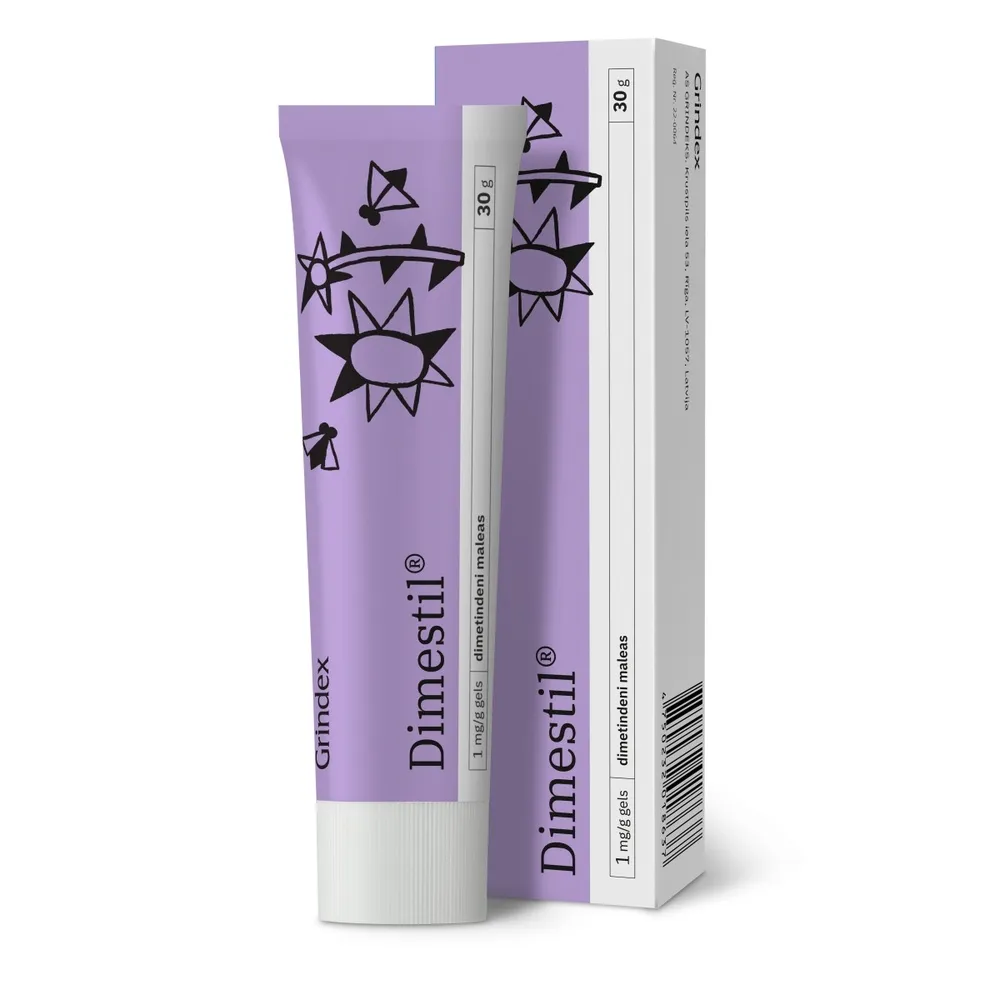
Table of Contents
- Package leaflet: Information for the user
- Introduction
- 1. What Dimestil 1 mg/g gel is and what it is used for
- 2. What you need to know before using Dimestil 1 mg/g gel
- 3. How to use Dimestil 1 mg/g gel
- 4. Possible adverse effects
- 5. Storage of Dimestil 1 mg/g gel
- 6. Contents of the pack and other information
Package leaflet: Information for the user
Introduction
Package leaflet: information for the user
Dimestil 1 mg/g gel
dimetindene maleate
Read the entire leaflet carefully before you start using this medicine, as it contains important information for you.
Follow exactly the instructions for use provided in this leaflet or as directed by your doctor or pharmacist.
- Keep this leaflet, as you may need to read it again.
- If you need advice or further information, consult your pharmacist.
- If you experience any adverse effects, consult your doctor or pharmacist, even if they are effects not listed in this leaflet. See section 4.
- You should consult a doctor if your condition worsens or if you do not improve after three days.
Contents of the leaflet
- What Dimestil 1 mg/g gel is and what it is used for
- What you need to know before using Dimestil 1 mg/g gel
- How to use Dimestil 1 mg/g gel
- Possible adverse effects
- How to store Dimestil 1 mg/g gel
- Contents of the pack and other information
1. What Dimestil 1 mg/g gel is and what it is used for
Dimestil contains an active substance that belongs to a group of medicines called antihistamines, which are used to relieve skin allergies and pruritus (itching) of various causes.
Dimestil reduces itching by blocking the action of histamine in the body. Histamine is a substance released by the body during allergic reactions. When this medicine penetrates the skin, it relieves itching and irritation within a few minutes. Dimestil also has local anaesthetic properties.
Dimestil is used for short-term relief of itching associated with skin reactions, such as skin rashes, urticaria, insect bites, sunburn, and superficial first-degree burns (reddened skin) in adults, adolescents, and children from one month of age.
Dimestil should be used under medical supervision in children between one month and two years of age.
You should consult a doctor if symptoms worsen or do not improve after three days.
2. What you need to know before using Dimestil 1 mg/g gel
Do not use Dimestil 1 mg/g gel
-
If you are allergic to dimetindene maleate or to any of the other ingredients of this medicine (listed in section 6). If in doubt, consult your doctor or pharmacist.
-
If you have second- or third-degree skin burns.
-
In infants under one month of age, especially premature infants.
-
Application over large areas of skin.
-
Application on damaged skin.
Warnings and precautions
- Avoid prolonged sun exposure of skin areas intensively treated with Dimestil 1 mg/g gel.
- Consult your doctor if you experience severe itching or skin lesions affecting large areas of skin.
- Do not use on large areas of skin or on mucous membranes.
If you have any doubts, consult your doctor or pharmacist before using this medicine.
Children
In infants and young children, avoid use on large areas of skin, especially if damaged or inflamed.
Do not use Dimestil in children under one month of age, particularly in premature infants (see "Do not use Dimestil 1 mg/g gel").
Other medicines and Dimestil 1 mg/g gel
Inform your doctor or pharmacist if you are taking, have recently taken, or might need to take any other medicines.
Pregnancy, breast-feeding and fertility
If you are pregnant or breast-feeding, think you may be pregnant or are planning to become pregnant, consult your doctor or pharmacist before using this medicine.
During pregnancy and breast-feeding, Dimestil should not be applied to large areas of skin, particularly if inflamed or damaged.
During breast-feeding, the gel must not be applied to the nipples.
Driving and using machines
The effect of Dimestil on the ability to drive and use machines is none or negligible.
Dimestil 1 mg/g gel contains benzalkonium chloride and propylene glycol
This medicine contains 0.05 mg of benzalkonium chloride per gram of gel. Benzalkonium chloride may cause skin irritation. This medicine should not be applied to the breasts during breast-feeding, as the infant may ingest it with breast milk. Do not apply to mucous membranes.
This medicine contains 150 mg of propylene glycol per gram of gel. Propylene glycol may cause skin irritation.
Do not use this medicine in infants under four weeks of age with open wounds or large areas of eroded or damaged skin (such as burns) without first consulting your doctor or pharmacist.
3. How to use Dimestil 1 mg/g gel
Follow exactly the instructions for use of the medicine provided in this leaflet or those given by your doctor or pharmacist. If in doubt, consult your doctor or pharmacist.
Recommended dose:
Apply a thin layer of Dimestil to the affected, itchy area of skin in adults, adolescents, and children up to three times daily.
Consult a doctor if symptoms worsen or do not improve after three days.
The maximum duration of treatment without medical supervision is seven days.
Use in children
In infants and young children, avoid using it over large areas of skin, especially if the skin is damaged or inflamed.
Do not use Dimestil in children under one month of age, particularly in premature infants (see "Do not use Dimestil 1 mg/g gel").
Dimestil should be used under medical supervision in children between one month and two years of age.
How to use Dimestil 1 mg/g gel
Dimestil is a topical medicine. It should be applied to intact skin, without wounds.
Do not cover the treated area with occlusive dressings.
Do not use on large areas of skin, damaged skin, or on mucous membranes.
Apply a small amount to the affected area. Then gently massage with your hand to promote penetration of the medicine into the skin.
If you use more Dimestil 1 mg/g gel than you should
Seek immediate medical advice if you or your child has used a considerable amount of this medicine on large areas of skin or if Dimestil has been accidentally ingested.
In case of overdose or accidental ingestion, consult your doctor, pharmacist, or call the Toxicology Information Service at telephone number 91 562 04 20, indicating the medicine and the amount ingested.
If you forget to use Dimestil 1 mg/g gel
If you forget to use Dimestil, apply it as soon as you remember, then continue with the usual dosing schedule. Do not apply a double dose to make up for a missed dose.
If you have any further questions about the use of this medicine, consult your doctor or pharmacist.
4. Possible adverse effects
Like all medicines, this medicine can cause adverse effects, although not everyone experiences them.
Uncommon (may affect fewer than 1 in 100 patients):
- dry skin,
- burning sensation.
Very rare (may affect fewer than 1 in 10,000 patients):
- allergic skin inflammation (allergic dermatitis).
Reporting of adverse effects
If you experience any adverse effects, consult your doctor or pharmacist, even if they are adverse effects not listed in this leaflet. You may also report them directly via the Spanish Pharmacovigilance System for Human Medicinal Products: www.notificaRAM.es. By reporting adverse effects, you can help provide more information on the safety of this medicine.
5. Storage of Dimestil 1 mg/g gel
Do not store above 25 °C. Do not freeze.
Use-by period after first opening: three months.
Keep out of the sight and reach of children.
Do not use this medicine after the expiry date stated on the carton and on the tube, after EXP. The expiry date refers to the last day of the month indicated.
Medicines should not be disposed of via wastewater or household waste. Dispose of empty containers and unused medicines at the SIGRE collection point at your pharmacy. If in doubt, ask your pharmacist how to dispose of containers and medicines you no longer need. This will help protect the environment.
6. Contents of the pack and other information
Composition of Dimestil 1 mg/g gel
-
The active substance is dimetindene maleate. 1 g of gel contains 1 mg of dimetindene maleate.
-
The other components are propylene glycol, carbomers type 974P, sodium hydroxide, disodium edetate, benzalkonium chloride, and purified water.
Appearance of the medicinal product and contents of the container
Dimestil is a colourless gel, ranging from transparent to slightly opalescent and practically odourless.
Primary packaging
Aluminium tube (30 g or 50 g) with a nozzle sealed with an aluminium protective membrane and a white screw cap made of HDPE (high-density polyethylene) or polypropylene (PP) with a conical tip for puncturing the membrane. The aluminium tubes have one of two possible types of epoxy-phenolic lacquer inner coatings (J 3092 or TU25/N 48567).
Secondary packaging
Cardboard box containing an aluminium tube and the package leaflet.
Only certain pack sizes may be marketed.
Marketing Authorisation Holder and Manufacturer
AS GRINDEKS
Krustpils iela 53, Riga, LV-1057, Latvia
Tel.: +371 67083205
Fax: +371 67083505
Email: [email protected]
Further information about this medicinal product is available from the local representative of the Marketing Authorisation Holder
Grindeks Kalceks España, S.L.
C/ José Abascal, 58 – 2º Dcha.
Madrid, 28003, Spain
This medicinal product is authorised in the Member States of the European Economic Area under the following names:
Portugal Dimestil
Latvia Dimestil 1 mg/g gels
Lithuania Frest 1 mg/g gelis
Estonia Dimestil
Czech Republic Frest
Slovakia Frest 1 mg/g gel
Hungary Dimestil 1 mg/g gel
Poland Frest
Romania Frest 1 mg/g gel
Slovenia Frest 1 mg/g gel
Austria Dimestil 1 mg/g gel
Germany Dimestil 1 mg/g Gel
Bulgaria Dimestil 1 mg/g ???
Croatia Dimetindenmaleate Grindeks 1 mg/g gel
Greece Dimestil 1 mg/g gel
Italy Frest
Spain Dimestil 1 mg/g gel
Date of the most recent revision of this leaflet: 03/2022
Detailed and up-to-date information on this medicinal product is available on the website of the Spanish Agency of Medicines and Health Products (AEMPS) http://www.aemps.gob.es/.