Diftavax suspension for injection in pre-filled syringe
Spain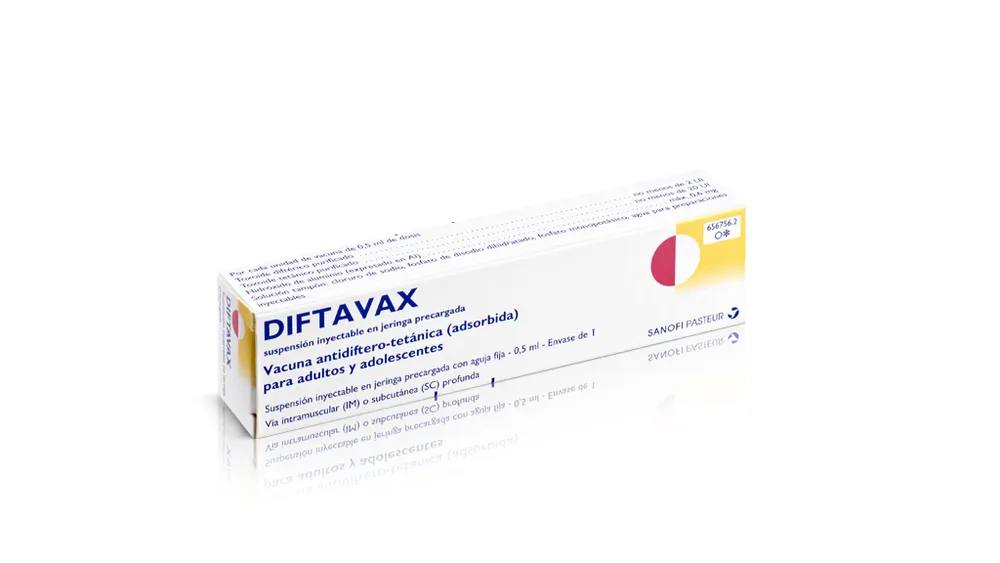
Table of Contents
Package leaflet: Information for the user
Introduction
Package leaflet: information for the user
DIFTAVAX injectable suspension in a pre-filled syringe
Diphtheria-tetanus vaccine (adsorbed) for adults and adolescents.
Read the entire leaflet carefully before you or your child is vaccinated, as it contains important information for you or your child.
- Keep this leaflet, as you may need to read it again.
- If you have any questions, consult your doctor or pharmacist.
- This medicine has been prescribed only for you and you must not give it to other people, even if they have the same symptoms, as it may harm them.
- If you experience any adverse effects, consult your doctor or pharmacist, even if they are adverse effects not listed in this leaflet. See section 4.
Contents of the leaflet
- What Diftavax is and what it is used for
- What you need to know before you or your child are given Diftavax
- How to use Diftavax
- Possible side effects
- How to store Diftavax
- Contents of the pack and other information
1. What Diftavax is and what it is used for
Diftavax (Td) is a vaccine. Vaccines are used to protect against infectious diseases.
Diftavax is indicated for active immunization against tetanus and diphtheria in children aged 7 years and older and in adults, in the following situations:
- For primary vaccination in individuals who have not been previously vaccinated against tetanus and diphtheria.
- To complete the primary vaccination course in individuals who did not complete it before the age of 7.
- As a booster dose when the primary vaccination course has been completed.
- In the case of wounds, for tetanus prophylaxis and as a booster dose for diphtheria.
2. What you need to know before you or your child use Diftavax
Do not use Diftavax:
- if you/your child are allergic to the active substance(s) or to any of the other components of this vaccine (listed in section 6).
- if you/your child have experienced serious adverse reactions after previous vaccinations against tetanus and/or diphtheria.
- in cases of wounds in immunodeficient individuals. In these cases, only tetanus vaccine should be administered and must not be combined with the diphtheria component. Therefore, Diftavax is not indicated in these patients.
- in case of wounds when there is an absolute contraindication to tetanus vaccine. In these cases, tetanus immunoglobulin should be administered (2 x 250 IU at 4-week intervals). Therefore, Diftavax is not indicated in these patients.
- if you/your child have a disease with high fever, acute infection, or in individuals who due to a history of exposure might be in the incubation period of an infection. In such cases, administration of Diftavax should be postponed. However, moderate fever or mild infection does not contraindicate vaccination.
- it should not be administered to individuals with a history of thrombocytopenia (reduced number of platelets in the blood), allergic reactions (hypersensitivity), or neurological complications following a previous tetanus and/or diphtheria vaccination.
- when at the time of vaccination there is an ongoing allergic reaction or central and/or peripheral nervous system complication. Your doctor will assess the risk of immunization versus the risk of contracting tetanus or diphtheria.
Warnings and precautions
Do not administer by intravascular injection: ensure that the needle does not enter a blood vessel.
Consult your doctor or pharmacist before starting to use Diftavax:
-
if you/your child have been vaccinated against tetanus and/or diphtheria within the last 5 years. To prevent hypersensitivity reactions (allergy), avoid injection within five years after vaccination in individuals who have completed a primary vaccination series and in those who have received a booster dose.
-
if you/your child are receiving concomitant immunosuppressive treatment (which suppresses the body's immune response). In such cases, it is recommended that vaccination be delayed until the end of treatment or that protective antibody levels be checked. However, vaccination is recommended for individuals with chronic immunodeficiency, such as HIV infection (human immunodeficiency virus), provided the disease state allows for antibody response induction, even if the response is limited.
-
if you/your child have had problems after previous vaccinations such as weakness and numbness in the limbs (Guillain-Barré syndrome) or decreased movement or sensation in the arm and shoulder due to a nerve problem (brachial neuritis). In these cases, the decision to administer any vaccine containing tetanus toxoid should be based on careful consideration of potential benefits and possible risks, regardless of whether the primary immunization schedule has been completed or not. Vaccination is generally justified when the primary immunization schedule is incomplete (e.g., fewer than three doses received).
Fainting may occur after any injection with a needle, or even before. Therefore, inform your doctor or nurse if you or your child have experienced fainting after any previous injection.
Use of Diftavax with other vaccines or medicines
Inform your doctor or pharmacist if you are using, have recently used, or might need to use any other medicines.
There is no evidence of any interaction with other medicines, and no studies have been conducted on interactions with diagnostic and/or laboratory tests.
No contraindication has been reported for the administration of Diftavax during a vaccination session with other routine vaccines.
Pregnancy, breastfeeding, and fertility
If you are pregnant or breastfeeding, think you may be pregnant, or plan to become pregnant, consult your doctor or pharmacist before using this vaccine.
For many years, clinical experience has not indicated any harmful effects on embryonic and/or fetal development.
Unimmunized or insufficiently immunized pregnant women may be vaccinated during the second and third trimesters of pregnancy, especially in the case of travel to countries with endemic diphtheria or in cases of suspected exposure.
Breastfeeding is not a contraindication.
Driving and use of machines
No studies have been conducted on the effects on the ability to drive and use machines.
DIFTAVAX, injectable suspension in a pre-filled syringe contains:
Potassium and sodium
DIFTAVAX contains less than 1 mmol of potassium (39 mg) and sodium (23 mg) per dose, and is therefore considered essentially “potassium-free” and “sodium-free”.
3. How to use Diftavax
Follow exactly the administration instructions for this vaccine as provided by your doctor. If in doubt, consult your doctor or pharmacist again.
- For primary vaccination, the following schedule is recommended:
1st dose on the scheduled date.
2nd dose 1-2 months after the 1st dose.
3rd dose 6-12 months after the 2nd dose.
-
After completion of the primary vaccination series, a single dose of 0.5 ml is recommended as a booster dose every five to ten years.
-
In vaccination related to wounds, it should be taken into account that the need for active immunization with or without passive immunization (tetanus immunoglobulin), depends on the type of wound and the patient's vaccination history. Tetanus immunoglobulin should be administered at a different injection site than the vaccine.
MINOR OR CLEAN WOUNDS
When it is known that the person has completed their primary tetanus vaccination series and received their last booster dose within the past 10 years, revaccination is not recommended, nor is the use of tetanus immunoglobulin.
When the person has completed their primary vaccination series but more than 10 years have passed since the last booster dose, a vaccine dose should be administered, and the next booster dose scheduled after 10 years. In these cases, administration of tetanus immunoglobulin is not necessary.
In individuals who have not completed the primary vaccination series, or in those whose immunization status is unknown or uncertain, vaccination is recommended (following the schedule for primary vaccination). In all these cases, administration of tetanus immunoglobulin is not necessary.
Other types of wounds, such as MAJOR AND CONTAMINATED WOUNDS
Vaccination should always be performed, unless the person has completed their primary tetanus vaccination series and has also received their last booster dose within the past 5 years. In individuals who have not completed their primary tetanus vaccination series, or in whom immunization status is unknown or uncertain, tetanus immunoglobulin should be administered in addition to the vaccine.
Method of administration
The content of 0.5 ml must be injected intramuscularly. The recommended injection site is the deltoid area – upper arm (except in young children).
Patients suffering from hemorrhagic diathesis should be vaccinated via deep subcutaneous route.
This medicine must never be administered intravenously.
The vaccine must not be administered intradermally.
This medicine will always be administered by a healthcare professional.
4. Possible adverse effects
Like all medicines, this vaccine may cause adverse effects, although not everyone will experience them.
Based on spontaneous reporting, the following adverse reactions have been reported during commercial use of Diftavax. These reactions have been reported very rarely (in up to one in 10,000 patients).
Organ system classification | Frequency | Adverse reactions |
Blood and lymphatic system disorders | Very rare | Lymphadenopathy (swelling of the lymph nodes) |
Not known | Thrombocytopenia (reduced number of platelets in the blood) | |
Immune system disorders | Very rare | Type I hypersensitivity reactions (immediate allergic reaction)/anaphylactic reaction (severe allergic reaction) |
Nervous system disorders | Very rare | Headache, malaise |
Vascular disorders | Very rare | Hypotension (low blood pressure) |
Skin and subcutaneous tissue disorders | Very rare | Allergy-like symptoms, generalized pruritus (widespread itching), urticaria (red, itchy skin rash), or edema (swelling), facial edema, angioedema, and Quincke's edema (swelling of the face, tongue, and trachea that may cause severe breathing difficulty) |
Musculoskeletal and connective tissue disorders | Very rare | Myalgia (muscle pain), arthralgia (joint pain) |
General disorders and administration site conditions | Very rare | Injection site reactions such as pain, rash, induration (hardening), or edema (swelling), which may occur within 48 hours and persist for one or two days. Formation of a subcutaneous nodule (lump under the skin) may sometimes accompany these reactions. Aseptic abscesses (pus-free lumps) have been rarely reported. The incidence and intensity of these local events may be influenced by the site, route, and method of administration, as well as the number of previous doses received. Pyrexia (transient fever), malaise. |
Renal and urinary disorders | Not known | Renal failure |
Brachial neuritis (reduced movement or sensation in the arm and shoulder due to a nerve problem) and Guillain-Barré syndrome (weakness and numbness of the limbs) have also been reported following administration of other vaccines containing tetanus toxoid.
Reporting of adverse reactions
If you experience any type of adverse reaction, consult your doctor or pharmacist, even if they are possible adverse reactions not listed in this leaflet. You may also report them directly through the Spanish Pharmacovigilance System for Human Medicinal Products: https://www.notificaRAM.es.
By reporting adverse reactions, you can help provide more information on the safety of this medicine.
5. Storage of Diftavax
Store in a refrigerator (between 2°C and 8°C). Do not freeze.
Keep this medicine out of the sight and reach of children.
Do not use this medicine after the expiry date stated on the packaging after EXP. The expiry date is the last day of the month indicated.
Medicines must not be disposed of via wastewater or household waste. Dispose of empty containers and unused medicines at a SIGRE collection point at your pharmacy. If you are unsure, ask your pharmacist how to dispose of containers and medicines you no longer need.
This way, you will help protect the environment.
6. Contents of the pack and other information
Composition of Diftavax
The active substances are:
- Purified diphtheria toxoid………………………………………………………not less than 2 I.U.
- Purified tetanus toxoid……………………………………………………………not less than 20 I.U.
- Aluminium hydroxide (expressed as Al)…………………………………………0.6 mg
The other components are:
Acetic acid (for pH adjustment), sodium hydroxide (for pH adjustment), and a buffer solution containing sodium chloride, disodium phosphate dihydrate, monopotassium phosphate, hydrochloric acid (for pH adjustment), sodium hydroxide (for pH adjustment), and water for injections.
Appearance of the product and contents of the pack
Pack containing 1 pre-filled syringe of 0.5 ml.
Marketing Authorisation Holder and Manufacturer
Marketing Authorisation Holder:
Sanofi Winthrop Industrie
82 avenue Raspail
94250 Gentilly
France
Manufacturer:
Sanofi Winthrop Industrie
1541 avenue Marcel Mérieux
69280 Marcy l’Etoile
France
or
Sanofi Winthrop Industrie
Voie de l’Institut – Parc Industriel
d’Incarville
B.P 101
27100 Val de Reuil
France
Local Representative
sanofi-aventis, S.A.
C/ Rosselló i Porcel, 21
08016 Barcelona
Spain
Tel: +34 93 485 94 00
Date of the most recent revision of this leaflet: June 2022
Detailed information on this medicinal product is available on the website of the Spanish Agency of Medicines and Medical Devices (AEMPS) http://www.aemps.gob.es/-----------------------------------------------------------------------------------------------------------------------
This information is intended exclusively for healthcare professionals:
Before vaccination, the vaccine should be thoroughly shaken and inspected visually to confirm that it appears normal and contains no foreign particles.
Disposal of unused medicine and of all materials which have come into contact with it should be carried out in accordance with local regulations.