Diarfin Flas 2 mg oral lyophilisate
Spain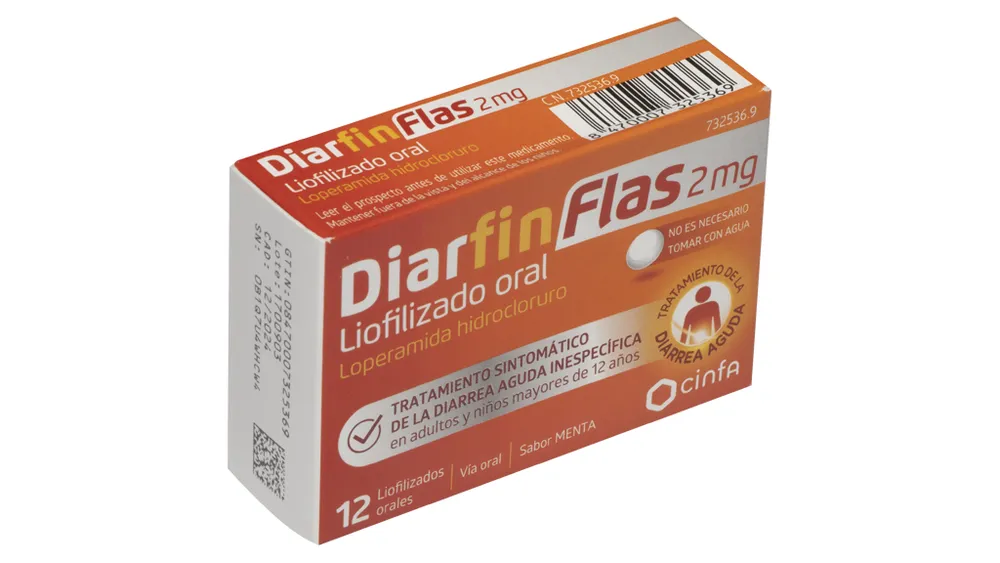
Table of Contents
Package leaflet: Information for the user
Introduction
Package leaflet: information for the user
Diarfin Flas 2mg oral lyophilisate
loperamide hydrochloride
Read the entire leaflet carefully before you start taking this medicine, as it contains important information for you.
Follow exactly the instructions for use provided in this leaflet or as directed by your doctor or pharmacist.
- Keep this leaflet, as you may need to read it again.
- If you need advice or more information, consult your pharmacist.
- If you experience any adverse effects, consult your doctor or pharmacist, even if they are adverse effects not listed in this leaflet. See section 4.
- You should consult a doctor if you worsen or do not improve after 2 days.
Contents of the leaflet
- What Diarfin Flas is and what it is used for
- What you need to know before taking Diarfin Flas
- How to take Diarfin Flas
- Possible adverse effects
- How to store Diarfin Flas
- Contents of the pack and other information
1. What Diarfin Flas is and what it is used for
This medicine contains loperamide hydrochloride, which helps stop diarrhea by solidifying stools and reducing the frequency of bowel movements. It is used to treat sudden, short-term (acute) episodes of diarrhea in adults and adolescents over 12 years of age. This medicine should not be used for more than 2 days without medical advice and supervision.
You should consult a doctor if your condition worsens or does not improve after 2 days.
2. What you need to know before taking Diarfin Flas
Do not take Diarfin Flas
- if you are allergic to loperamide hydrochloride or any of the other ingredients of this medicine (listed in section 6)
- in children under 2 years of age
- if you have acute dysentery, characterized by blood in the stool and high body temperature
- if you have ulcerative colitis
- if you suffer from bacterial enterocolitis caused by invasive microorganisms, including Salmonella, Shigella, and Campylobacter
- if you have antibiotic-associated pseudomembranous colitis
- in any case where bowel movements should not be suppressed. You must stop taking the medicine immediately if constipation or abdominal distension occurs.
Consult your doctor or pharmacist before taking loperamide hydrochloride if any of the above conditions apply to you.
Warnings and precautions
Consult your doctor or pharmacist before starting to take Diarfin Flas:
- if you have AIDS and experience stomach swelling, stop taking the oral lyophilisates immediately and contact your doctor right away
- if you have liver disease
- if your diarrhea lasts longer than 48 hours, stop taking the medicine and consult your doctor
- if you have severe diarrhea, you will lose a lot of fluids (dehydration). Important substances are also lost with these fluids. Symptoms of dehydration may include dry mouth and dizziness. Vomiting can lead to dehydration; this risk is especially high in young children and elderly people. Therefore, the first steps in managing diarrhea should be fluid replacement and retention in the body. This means drinking plenty of fluids and taking additional salt and sugar. At the pharmacy, you can obtain a special salt-and-sugar mixture (oral rehydration solution) that should be dissolved in water. Consult your doctor or pharmacist for advice.
Other medicines and Diarfin Flas
Inform your doctor or pharmacist if you are taking, have recently taken, or might need to take any other medicines.
If you are taking any of the following specific medicines:
- ritonavir (used to treat HIV)
- quinidine (used to treat heart rhythm disorders or malaria)
- oral desmopressin (used to treat excessive urination)
- itraconazole or ketoconazole (used to treat fungal infections)
- gemfibrozil (used to treat high cholesterol)
If you are unsure about any of the medicines you are taking, show the container or packaging to your pharmacist. If you are taking or have taken any of the above medicines, inform your doctor or pharmacist.
Pregnancy and breastfeeding
If you are pregnant or breastfeeding, think you might be pregnant, or are planning to become pregnant, consult your doctor or pharmacist before using this medicine.
Diarfin Flas should not be used during pregnancy, especially during the first trimester.
Small amounts of the medicine may be excreted in breast milk. Consult your doctor for appropriate treatment advice.
Driving and using machines
During diarrhea, you may experience dizziness, fatigue, or drowsiness. If you are affected, you should not drive, operate machinery, or engage in activities that could put you or others at risk.
Diarfin Flas contains sodium
This medicine contains less than 1 mmol of sodium (23 mg) per oral lyophilisate; i.e., it is essentially "sodium-free".
Diarfin Flas contains aspartame
This medicine contains 1.0 mg of aspartame per oral lyophilisate. Aspartame is a source of phenylalanine, which may be harmful in individuals with phenylketonuria (PKU), a rare genetic disorder in which phenylalanine accumulates because the body cannot properly eliminate it.
3. How to take Diarfin Flas
Follow exactly the instructions for use provided in this leaflet or those indicated by your doctor or pharmacist. If in doubt, consult your doctor or pharmacist.
Refer to the following table to determine the dose of medicine you should take.
- Remove the cap and pour out the oral lyophilisate to remove it. Do not press the oral lyophilisate against the foil to extract it.
- Place the correct number of oral lyophilisates on the tongue. These dissolve rapidly in the mouth, so you do not need water to swallow them. Do not chew. For oral use only.
- Do not use a dose higher than those indicated in the tables.
- Oral lyophilisates must not be used for prolonged treatment.
Short-term diarrhoea
Age | Initial dose | Dose repetition | Maximum daily dose |
Adolescents 12 years and older | 1 oral lyophilisate | 1 oral lyophilisate after each soft stool, at least one hour after the initial dose. | 4 oral lyophilisates |
Adults | 2 oral lyophilisates | 1 oral lyophilisate after each soft stool, at least one hour after the initial dose. | 6 oral lyophilisates |
Do not exceed the maximum daily dose. |
Elderly patients
Dosage adjustment is not necessary in elderly patients.
Patients with renal impairment
Dosage adjustment is not necessary in patients with renal impairment.
Patients with hepatic impairment
If you have hepatic impairment, you should consult your doctor or pharmacist before taking this medicine.
Duration of treatment with Diarfin Flas for short-duration diarrhoea
You may use this medicine for a maximum of 48 hours.
If diarrhoea persists beyond 48 hours, if you experience repeated diarrhoeal attacks, or if symptoms change, stop taking loperamide hydrochloride and consult your doctor.
If you take more Diarfin Flas than you should
If you take more loperamide hydrochloride than you should, contact your doctor or a hospital immediately for assistance. Symptoms may include: increased heart rate, irregular heartbeat, disturbances in heart rhythm (these symptoms may have potentially serious and possibly fatal consequences), muscle stiffness, lack of coordination in movements, drowsiness, difficulty urinating, or weak breathing.
Children react more intensely to high doses of loperamide hydrochloride than adults. If a child takes too much or shows any of the above symptoms, call a doctor immediately.
If you forget to take Diarfin Flas
You should only take this medicine when needed, carefully following the dosage instructions indicated above.
If you forget to take a dose, take it after the next loose bowel movement (defecation). Do not take a double dose to make up for a missed dose.
4. Possible adverse effects
Like all medicines, this medicine may cause adverse effects, although not everyone experiences them; most are usually mild.
Seek immediate medical attention.
Frequent (may affect up to 1 in 10 people):
- Nausea, constipation, or gas
- Headache
Uncommon (may affect up to 1 in 100 people):
- Itching or hives
- Stomach pain or bloating
- Dizziness or drowsiness
- Vomiting, indigestion
- Dry mouth
Rare (may affect up to 1 in 1,000 people):
- Allergic reactions including unexplained wheezing, difficulty breathing, fainting, or swelling of the face and throat
- Skin rashes that may be severe and lead to blistering or peeling of the skin
- Loss of consciousness or reduced level of consciousness (fainting, feeling faint, or decreased alertness), lack of coordination
- Difficulty urinating
- Severe constipation
- Burning or tingling sensation on the tongue
- Miosis (constriction of the pupil of the eye)
- Fatigue
Frequency not known (cannot be estimated from available data):
- Upper abdominal pain
- Abdominal pain radiating to the back
- Tenderness when touching the abdomen
- Fever
- Rapid pulse
- Nausea
- Vomiting
- Which may be symptoms of inflammation of the pancreas (acute pancreatitis)
If you experience any of these adverse effects, stop taking the medicine and seek immediate medical attention. Consult a doctor as soon as possible.
Reporting of adverse effects
If you experience any type of adverse effect, consult your doctor or pharmacist, even if it is a possible adverse effect not listed in this leaflet. You may also report them directly via the Spanish Pharmacovigilance System for Human Medicinal Products: https://www.notificaram.es. By reporting adverse effects, you can help provide more information on the safety of this medicine.
5. Storage of Diarfin Flas
Keep this medicine out of sight and reach of children.
This medicine does not require any special storage conditions. Do not use this medicine after the expiry date which is stated on the carton and blister pack after "EXP". The expiry date refers to the last day of the month indicated.
Medicines must not be disposed of via wastewater or household waste. Dispose of empty containers and unused medicines at the SIGRE Point located at your pharmacy. If you have any doubts, ask your pharmacist how to properly dispose of containers and medicines you no longer need. This will help protect the environment.
6. Contents of the pack and other information
Composition of Diarfin Flas
The active substance is loperamide hydrochloride.
Each oral lyophilisate contains 2 mg of loperamide hydrochloride.
The other components are pullulan, mannitol (E-421), sodium hydrogen carbonate, aspartame (E-951), polysorbate 80, mint flavour (corn maltodextrin, flavouring ingredients and modified waxy corn starch).
Appearance of the product and pack contents
Oral lyophilisate.
White or almost white, round tablets with the inscription “T” engraved on one side.
Blister packs containing 6 or 12 oral lyophilisates.
The blister is composed of PVC/polyamide/aluminium/PVC with a peelable sealing foil made of paper/PET/aluminium.
Only certain pack sizes may be marketed.
Marketing Authorization Holder and Manufacturer
Marketing Authorization Holder
Laboratorios Cinfa, S.A.
Carretera Olaz-Chipi, 10. Polígono Industrial Areta
31620 Huarte (Navarra) – Spain
Manufacturer
Laboratorios Cinfa, S.A.
Carretera Olaz-Chipi, 10. Polígono Industrial Areta
31620 Huarte (Navarra) – Spain
S.C. SANTA S.A.
Str. Panselelor nr.25, nr.27, and nr.29,
Brasov, Jud. Brasov - 500419
Romania
Fairmed Health Care GmbH
Maria-Goeppert-Strasse 3
23562 Lubeck, Germany
Misom Labs Ltd
Malta Life Sciences Park, LS2.01.06
Industrial Estate, San Gwann SGN 3000,
Malta
Date of the most recent revision of this leaflet: May 2022
Detailed information on this medicine is available on the website of the Spanish Agency for Medicines and Health Products (AEMPS) (http://www.aemps.gob.es/).