Diacomit 500 mg powder for oral suspension
Spain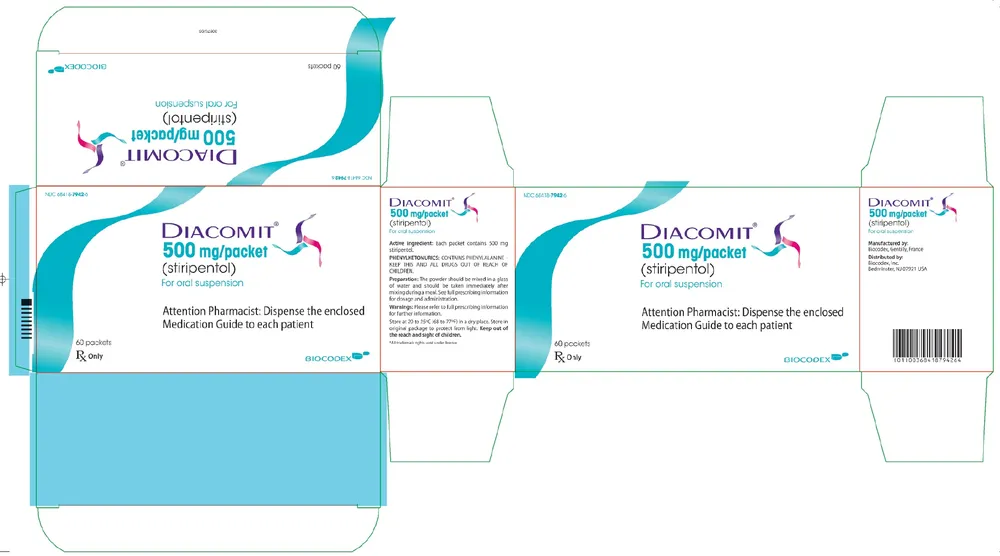
Table of Contents
Package leaflet: Information for the user
Introduction
Package leaflet: information for the user
Diacomit 250 mg Powder for oral suspension in sachet
Diacomit 500 mg Powder for oral suspension in sachet
stiripentol
Read the entire leaflet carefully before your child starts taking this medicine, as it contains important information for you.
- Keep this leaflet. You may need to read it again.
- If you have any questions, consult your child's doctor or pharmacist.
- This medicine has been prescribed for your child only. Do not give it to other people, even if they have the same symptoms, as it may harm them.
- If your child experiences any adverse effects, consult your child's doctor or pharmacist, even if they are effects not listed in this leaflet. See section 4.
Contents of the leaflet
- What Diacomit is and what it is used for
- What you need to know before your child takes Diacomit
- How to take Diacomit
- Possible side effects
- How to store Diacomit
- Contents of the pack and other information
1. What Diacomit is and what it is used for
Stiripentol, the active ingredient in Diacomit, belongs to a group of medicines called antiepileptic drugs.
It is used in combination with clobazam and valproate (other antiepileptic drugs) to treat a specific form of epilepsy known as severe myoclonic epilepsy in infancy (Dravet syndrome), which affects children. Your child's doctor has prescribed this medicine to help manage your child's epilepsy.
2. What you need to know before your child takes Diacomit
Your child must NOT take Diacomit
- if your child is allergic to stiripentol or to any of the other ingredients of this medicine (listed in section 6).
- if your child has ever experienced episodes of delirium (a mental state involving confusion, emotional disturbance, restlessness, and hallucinations).
Warnings and precautions
Talk to your child’s doctor or pharmacist before starting Diacomit
- if your child has kidney or liver problems.
- Your child’s liver function should be assessed before starting treatment with Diacomit and monitored every 6 months.
- Your child’s blood count should be evaluated before starting treatment with Diacomit and checked every 6 months.
- Your child’s growth rate should be carefully monitored due to gastrointestinal side effects of Diacomit, clobazam, and valproate, such as anorexia, loss of appetite, and vomiting.
If your child has problems with any of the components of Diacomit (e.g. aspartame, glucose, sorbitol), please refer to the section below: "Diacomit contains aspartame, glucose, sorbitol and sodium".
Other medicines and Diacomit
Inform your child’s doctor or pharmacist if your child is taking, has recently taken, or might need to take any other medicines.
Tell your doctor if your child is taking any of the following medicines:
-
medicines containing:
-
cisapride (used to treat symptoms of nocturnal heartburn);
-
pimozide (used to treat symptoms of Tourette syndrome: vocal tics and repetitive, uncontrollable body movements);
-
ergotamine (used to treat migraine);
-
dihydroergotamine (used to relieve signs and symptoms of age-related cognitive decline);
-
halofantrine (an antimalarial drug);
-
quinidine (used to treat heart rhythm disorders);
-
bepridil (used to control chest pain);
-
cyclosporine, tacrolimus, sirolimus (all three used to prevent rejection in liver, kidney, and heart transplants);
-
statins (simvastatin and atorvastatin, both used to lower blood cholesterol levels).
-
antiepileptic medicines containing:
-
phenobarbital, primidone, phenytoin, carbamazepine, diazepam.
-
medicines containing:
-
midazolam or triazolam (drugs used to reduce anxiety and insomnia — when combined with Diacomit, they may cause excessive drowsiness in your child);
-
chlorpromazine (used for mental illnesses such as psychosis).
-
If your child is taking medicines containing:
-
caffeine (a substance that helps restore mental alertness) or theophylline (a substance used in asthma treatment). Their combination with Diacomit should be avoided, as it may increase their blood levels, leading to gastrointestinal disturbances, increased heart rate, and insomnia.
-
If your child is taking medicines metabolized by certain liver enzymes:
-
citalopram (used to treat depressive episodes);
-
omeprazole (used for gastric ulcers);
-
HIV protease inhibitors (used in HIV treatment);
-
astemizole, chlorpheniramine (antihistamines);
-
calcium channel blockers (used to treat angina or cardiac arrhythmias);
-
oral contraceptives;
-
propranolol, carvedilol, timolol (used to treat high blood pressure);
-
fluoxetine, paroxetine, sertraline, imipramine, clomipramine (antidepressants);
-
haloperidol (antipsychotics);
-
codeine, dextromethorphan, tramadol (analgesics).
Taking Diacomit with food and drinks
DO NOT take Diacomit with milk or dairy products (yogurt, creamy cheeses, etc.), fruit juices, carbonated drinks, or foods and beverages containing caffeine or theophylline (e.g. cola, chocolate, coffee, tea, or energy drinks).
Pregnancy and breastfeeding
If your daughter is pregnant or breastfeeding, thinks she may be pregnant, or plans to become pregnant, consult her doctor before taking this medicine. Effective antiepileptic treatment must not be interrupted during pregnancy.
Breastfeeding is not recommended during treatment with this medicine.
Driving and using machines
This medicine may cause drowsiness in your child.
Your child should not operate tools or machinery or drive if affected in this way. Consult your child’s doctor.
Diacomit contains aspartame, glucose, sorbitol and sodium
This medicine contains 2.5 mg of aspartame per 250 mg sachet and 5 mg per 500 mg sachet. Aspartame is a source of phenylalanine, which may be harmful in patients with phenylketonuria (PKU), a rare genetic disorder in which phenylalanine accumulates because the body cannot properly eliminate it.
This medicine contains 2.4 mg of sorbitol per 250 mg sachet and 4.8 mg per 500 mg sachet.
Glucose may harm teeth.
If your doctor has diagnosed your child with an intolerance to certain sugars, consult him or her before taking this medicine.
This medicine contains less than 1 mmol of sodium (23 mg) per sachet; hence, it is essentially "sodium-free".
3. How to take Diacomit
Your child must take these sachets exactly as prescribed by your child's doctor. If in doubt, please consult your child's doctor or pharmacist again.
Dosage
The doctor will adjust the dose according to your child's age, weight, and condition, usually 50 mg per day per kg of body weight.
When to take Diacomit
Your child should take this medicine two or three times a day at regular intervals, as directed by your child's doctor; for example, in the morning, at midday, and at bedtime to cover both daytime and nighttime periods.
Dose adjustment
Dose increases should be gradual, replacing over several weeks the dose(s) of the other antiepileptic medicine(s), which will be simultaneously reduced. Your child's doctor will inform you about the new dose of the other antiepileptic medicine(s).
If you feel that the effect of this medicine is too strong or too weak, consult your child's doctor or pharmacist. The doctor will adjust the dose according to your child's condition.
There are slight differences between the capsules and the oral suspension powder of Diacomit. Please consult your doctor if your child experiences any problems when switching from capsules to oral suspension powder or vice versa. Any change between formulations (capsules and powder) should be carried out under strict supervision of your child's doctor.
In case of vomiting within the first few minutes after administration, the medicine is considered not to have been absorbed, and a new dose should be administered.
However, the situation changes if vomiting occurs more than one hour after taking the medicine, since stiripentol is rapidly absorbed.
In such a case, a significant fraction of the administered dose is considered to have been systemically absorbed in the gastrointestinal tract. Therefore, there is no need to administer an additional dose or adjust the next dose.
How to take Diacomit oral suspension powder
The powder must be dissolved in a glass of water and taken immediately after dissolution, during a meal. Your child must take Diacomit with food and must NOT take it on an empty stomach. For information about foods and drinks to avoid, please refer to the previous section "Taking Diacomit with food and drink".
If your child takes more Diacomit than they should
Contact your child's doctor if you know or suspect that your child has taken more of the medicine than prescribed.
If your child forgets to take Diacomit
It is important that your child takes this medicine regularly at the same time each day. If your child forgets a dose, they should take it as soon as you remember, unless it is almost time for the next dose. In that case, continue with the next dose as normal. Your child must NOT take a double dose to make up for a missed dose.
If your child stops taking Diacomit
Your child must NOT stop taking this medicine unless instructed by the doctor. Stopping treatment may trigger a seizure.
If you have any further questions about the use of this medicine, ask your child's doctor or pharmacist.
4. Possible side effects
Like all medicines, this medicine can cause side effects, although not everybody gets them.
Very common side effects (may affect more than 1 in 10 people):
- loss of appetite, weight loss (especially in combination with the antiepileptic medicine sodium valproate);
- insomnia, somnolence;
- ataxia (inability to coordinate muscle movements), hypotonia (reduced muscle strength), dystonia (involuntary muscle contractions).
Common side effects (may affect up to 1 in 10 people):
- increased levels of liver enzymes, especially when administered with the antiepileptic medicines carbamazepine or sodium valproate;
- aggression, irritability, agitation, hyperexcitability (state of unusual excitability);
- sleep disorders (abnormalities in sleep);
- hyperkinesia (exaggerated movements);
- nausea, vomiting;
- low count of a type of white blood cells.
Uncommon side effects (may affect up to 1 in 100 people):
- double vision when used together with the antiepileptic medicine carbamazepine;
- light sensitivity;
- rash, skin allergy, urticaria (pinkish, itchy skin swelling);
- fatigue (tiredness).
Rare side effects (may affect up to 1 in 1,000 people):
- decrease in the level of platelets in the blood;
- abnormal liver function test.
To eliminate these side effects, your child's doctor may need to adjust the dose of Diacomit or of any other medicines prescribed to your child.
Reporting of side effects
If your child experiences any type of side effect, consult your child's doctor or pharmacist, even if it is a possible side effect not listed in this leaflet. You may also report them directly through the national reporting system included in Appendix V*. By reporting side effects, you can help provide more information on the safety of this medicine.
5. Storage of Diacomit
- Keep this medicine out of the reach and sight of children.
- Your child must not use this medicine after the expiry date stated on the label after "EXP". The expiry date refers to the last day of the month indicated.
- Store in the original packaging to protect it from light.
Medicines should not be disposed of via wastewater or household waste. Ask your pharmacist how to dispose of medicines and packaging that you no longer need. This will help protect the environment.
6. Contents of the pack and other information
Composition of Diacomit 250 mg
- The active substance is stiripentol. Each sachet contains 250 mg of stiripentol.
- The other components of the sachet are povidone, sodium starch glycolate, dried glucose syrup, erythrosine (E127), titanium dioxide (E171), aspartame (E951), tutti frutti flavour (contains sorbitol), sodium carmellose, hydroxyethylcellulose.
Composition of Diacomit 500 mg
- The active substance is stiripentol. Each sachet contains 500 mg of stiripentol.
- The other components of the sachet are povidone, sodium starch glycolate, dried glucose syrup, erythrosine (E127), titanium dioxide (E171), aspartame (E951), tutti frutti flavour (contains sorbitol), sodium carmellose, hydroxyethylcellulose.
Appearance of Diacomit 250 mg and contents of the pack
This medicine is a light pink powder contained in sachets.
Packs contain 30, 60 or 90 sachets. Only some pack sizes may be marketed.
Appearance of Diacomit 500 mg and contents of the pack
This medicine is a light pink powder contained in sachets.
Packs contain 30, 60 or 90 sachets. Only some pack sizes may be marketed.
Diacomit is also available in the form of 250 mg and 500 mg oral capsules.
Marketing Authorisation Holder
Biocodex
22 rue des Aqueducs – F-94250 Gentilly - France
Tel: +33 1 41 24 30 00 - e-mail: [email protected]
Manufacturer
Biocodex
1 avenue Blaise Pascal - F-60000 Beauvais - France
For further information regarding this medicinal product, please contact the local representative of the Marketing Authorisation Holder:
AT/BE/BG/CY/DK/EL/ES/FR/HR/HU/IE/IS/IT/LU/MT/NL/NO/PL/PT/SE/SI
Biocodex
22 rue des Aqueducs – F-94250 Gentilly
/ Γaλλía/ France/ Francia/ Franciaország/ Frakkland/ Francija/ Franza/ Frankrijk/ Francja, Frankrike
Tél/Tel/Teπ/Τηλ/Sími: +33 (0)1 41 24 30 00
e-mail: [email protected]
CZ
Desitin Pharma spol. s r.o.
Opletalova 25
11121 Prague 1
Czech Republic
Tel: +420-2-222 45 375
e-mail: [email protected]
DE
Desitin Arzneimittel GmbH
Weg beim Jäger 214
D-22335 Hamburg
Germany
Tel: +49 (0)40 59101 525
e-mail: [email protected]
EE
Biocodex OÜ
Väike-Paala 1
11415 Tallinn
Estonia
Tel: +372 605 6014
e-mail: [email protected]
FI
Biocodex Oy
Metsänneidonkuja 8
02130 Espoo
Finland
Tel: +358 9 329 59100
e-mail: [email protected]
LT
Biocodex UAB
Savanoriu av. 349
LT-51480 Kaunas
Lithuania
Tel: +370 37 408681
e-mail: [email protected]
LV
Biocodex SIA
Kalnini A, Marupes nov.,
Marupe, LV-2167
Latvia
Tel: +371 67 619365
e-mail: [email protected]
RO
Desitin Pharma s.r.l.
Sevastopol street, no 13-17
Diplomat Business Centre, office 102
Sector 1, 010991 Bucharest
Romania
Tel: +40 21 252 3481
e-mail: [email protected]
SK
Desitin Pharma s.r.o.
Trojicné námestie 13
82106 Bratislava
Slovakia
Tel: +421-2-5556 38 10
e-mail: [email protected]
Date of the most recent revision of this leaflet
Other sources of information
Detailed information on this medicinal product is available on the website of the European Medicines Agency: http://www.ema.europa.eu. Links to other websites on orphan diseases and treatments are also provided.