Devik 25,000 IU/2.5 ml oral solution
Spain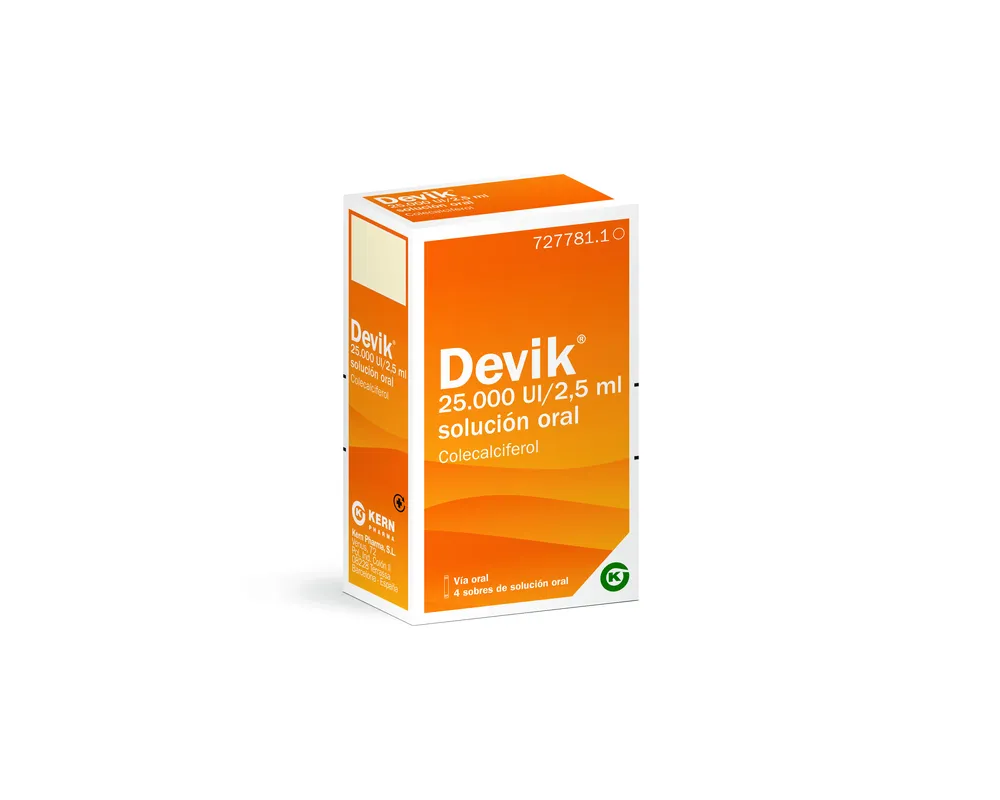
Table of Contents
Package leaflet: Information for the user
Introduction
Package leaflet: information for the user
Devik25.000UI/2.5ml oral solution
Colecalciferol
Read the entire leaflet carefully before you start using this medicine, because it contains important information for you.
- Keep this leaflet, as you may need to read it again.
- If you have any questions, consult your doctor or pharmacist.
- This medicine has been prescribed for you only, and you should not give it to other people, even if they have the same symptoms as you, because it may harm them.
- If you experience any adverse effects, consult your doctor or pharmacist, even if they are adverse effects not listed in this leaflet. See section 4.
Leaflet contents
- What Devik is and what it is used for
- What you need to know before taking Devik
- How to take Devik
- Possible side effects
- How to store Devik
- Contents of the pack and other information
1. What Devik is and what it is used for
Devik oral solution contains colecalciferol (vitamin D3). Vitamin D3 can be found in certain foods and is also produced by the skin upon exposure to sunlight. Vitamin D3 helps the kidneys and intestines absorb calcium and contributes to bone development. Deficiency of vitamin D3 is the main cause of rickets (inadequate bone mineralization in children) and osteomalacia (inadequate bone mineralization in adults).
Devik oral solution is used for the initial treatment of vitamin D deficiency in adults.
Your doctor may prescribe this medicine as a supplement to specific osteoporosis medication. Consult your doctor or pharmacist if you have any further questions, and always follow their instructions.
2. What you need to know before taking Devik
Do not take Devik
- If you are allergic to colecalciferol or any of the other ingredients of this medicine (listed in section 6).
- If you have high levels of calcium in your blood (hypercalcemia) or in your urine (hypercalciuria).
- If you have kidney stones (renal calculi) or severe renal failure.
- If you have high levels of vitamin D3 in your blood (hypervitaminosis D).
Warnings and precautions
Talk to your doctor, pharmacist, or nurse before starting to take Devik:
- If you are taking certain medicines used to treat heart conditions (e.g., cardiac glycosides such as digoxin).
- If you have sarcoidosis (an immune system disorder that can cause increased levels of vitamin D in the body).
- If you are taking other medicines containing vitamin D, or if you consume vitamin D–enriched foods or milk.
- If you are likely to have high exposure to sunlight while taking Devik.
- If you are taking additional supplements containing calcium. Your doctor will monitor your blood calcium levels to ensure they do not become too high while you are taking Devik.
- If you have kidney problems or any kidney disease. Your doctor may want to measure your blood or urine calcium levels.
- Your doctor should monitor your blood calcium levels through blood tests if you are taking a daily dose of vitamin D3 exceeding 1,000 IU over a prolonged period.
- If you have a parathyroid hormone imbalance (pseudohypoparathyroidism).
Children and adolescents
Use in children and adolescents under 18 years of age is not recommended.
Taking Devik with other medicines
Inform your doctor or pharmacist if you are using, have recently used, or might need to use any other medicines. It is especially important to do so if you are taking:
-
Medicines that act on the heart or kidneys, such as cardiac glycosides (e.g., digoxin) or diuretics (e.g., bendroflumethiazide). When taken at the same time as vitamin D, these medicines may cause a significant increase in calcium levels in the blood and urine.
-
Medicines containing vitamin D or vitamin D–rich foods, such as certain types of vitamin D–enriched milk.
-
Actinomycin (a medicine used to treat certain forms of cancer) and imidazole antifungals (e.g., clotrimazole and ketoconazole, medicines used to treat fungal diseases). These medicines may affect how your body processes vitamin D.
-
Medicines used to treat tuberculosis, such as rifampicin and isoniazid.
-
The following medicines, as they may interfere with the effect or absorption of vitamin D:
-
Antiepileptic medicines (anticonvulsants), barbiturates.
-
Glucocorticoids (steroid hormones such as hydrocortisone or prednisolone). These medicines may reduce the effect of vitamin D.
-
Medicines that lower cholesterol levels in the blood (such as cholestyramine or colestipol).
-
Certain weight-loss medicines that reduce the amount of fat absorbed by the body (e.g., orlistat).
-
Certain laxatives (such as liquid paraffin).
Devik with food, drinks, and alcohol
You should preferably take this medicine with a full meal to help your body absorb vitamin D. You may also mix the solution with cold or lukewarm foods to facilitate administration. For more information, see section 3 How to take Devik.
Pregnancy, breastfeeding, and fertility
If you are pregnant or breastfeeding, think you may be pregnant, or are planning to become pregnant, consult your doctor or pharmacist before using this medicine.
The use of this highly concentrated formulation is not recommended during pregnancy and breastfeeding.
Driving and using machines
There is limited information on the possible effects of this product on the ability to drive. However, it is not expected to affect your ability to drive or operate machinery.
3. How to take Devik
Follow exactly the instructions for the administration of Devik provided by your doctor or pharmacist. If in doubt, consult your doctor or pharmacist again.
This medicine has an olive oil with forest fruit flavour. Devik should preferably be taken with a substantial meal. Devik can be taken directly from the sachet, or you may mix the contents of a single-dose sachet of the oral solution with a small amount of cold or lukewarm food immediately before taking it. Make sure you take the full dose.
The amount of colecalciferol will depend on your vitamin D levels and your response to treatment.
Vitamin D deficiency
Use in adults
The recommended dose is 25,000 IU once weekly.
After the first month, a lower dose may be considered.
If deemed necessary by your doctor, a regimen of 50,000 IU/week (one single dose) for 6–8 weeks may be considered.
This initial treatment may be followed by a maintenance therapy, as directed by your doctor.
Alternatively, national dosing recommendations for the treatment of vitamin D deficiency may be followed.
Use in children
Devik is not suitable for use in children and adolescents under 18 years of age.
Pregnancy and breastfeeding
Use of Devik 25,000 IU/2.5 ml oral solution is not recommended in pregnant or breastfeeding women.
Use in patients with kidney problems
Devik must not be used in patients with severe renal insufficiency, as vitamin D in the form of colecalciferol is not normally metabolized and other forms of vitamin D should be used.
Use in patients with liver problems
No dose adjustment is required.
Use in elderly patients
Special monitoring of serum and urine calcium levels and renal function should be carried out in elderly patients. Consult your doctor.
If you take more Devik than you should
If you take more medicine than prescribed, stop taking this medicine and consult your doctor. If you cannot contact your doctor, go to the nearest emergency department and take the packaging with you.
The most common symptoms of overdose are: nausea, vomiting, excessive thirst, production of large amounts of urine over 24 hours, constipation and dehydration, as well as elevated levels of calcium in blood and urine (hypercalcaemia and hypercalciuria) observed in laboratory tests.
You may also contact the Toxicology Information Service at telephone number 915620420, indicating the medicine and the amount taken.
If you forget to take Devik
If you forget to take a dose of Devik, take the missed dose as soon as possible and take the next dose on the correct day. However, if it is almost time for the next dose, do not take the missed dose; simply take the next dose as usual.
Do not take a double dose to make up for a missed dose.
If you have any further questions about the use of this medicine, ask your doctor or pharmacist.
4. Possible adverse effects
Like all medicines, this medicine can cause adverse effects, although not everyone experiences them.
You should stop taking colecalciferol and consult your doctor immediately if you experience symptoms of severe allergic reactions, such as:
- Swelling of the face, lips, tongue or throat.
- Difficulty swallowing.
- Hives and difficulty breathing.
Possible adverse effects may include:
Uncommon (affects less than 1 in 100 people)
- Too much calcium in the blood (hypercalcemia). Symptoms include nausea, vomiting, loss of appetite, constipation, stomach pain, bone pain, excessive thirst, increased need to drink water, muscle weakness, drowsiness and confusion.
- Too much calcium in the urine (hypercalciuria)
Rare (affects less than 1 in 1,000 people)
- Skin rash
- Itching
- Urticaria
Reporting of adverse effects
If you experience any type of adverse effect, talk to your doctor, pharmacist or nurse, even if it is a possible adverse effect not listed in this leaflet. You can also report them directly through the Spanish Pharmacovigilance System for Human Medicinal Products: https://www.notificaram.es. By reporting adverse effects, you can help provide more information on the safety of this medicine.
5. Storage of Devik
Keep this medicine out of the sight and reach of children.
This medicine does not require any special storage conditions.
Do not use this medicine after the expiry date stated on the packaging after EXP. The expiry date refers to the last day of the month indicated.
Medicines should not be disposed of via wastewater or household waste. Dispose of containers and unused medicines at the SIGRE collection point at your pharmacy. If you are unsure, ask your pharmacist how to dispose of containers and medicines you no longer need. This will help protect the environment.
6. Contents of the pack and other information
Composition of Devik
The active substance is colecalciferol. 2.5 ml of solution contain 0.625 mg of colecalciferol, equivalent to 25,000 IU of vitamin D3.
The other components are: refined olive oil, glyceryl triacetate, triethyl citrate, propylene glycol, and flavourings.
What Devik looks like and contents of the pack
Devik is marketed in single-dose sachets containing 2.5 ml of oral solution.
This medicine is available in packs containing 1, 2, 3, 4, 5 or 6 sachets in a cardboard box.
Only certain pack sizes may be marketed.
Marketing Authorization Holder
Kern Pharma, S.L.
Venus, 72 – Pol. Ind. Colón II
08228 Terrassa – Barcelona
Spain
Manufacturer
Zinereo Pharma, S.L.U.
A Relva s/n, O Porriño
36410 Pontevedra
Spain
This medicine is authorized in the Member States of the European Economic Area under the following names:
Spain: Devik 25,000 IU/2.5 ml oral solution
Portugal: Devik 25,000 IU/2.5 ml oral solution
Date of the most recent review of this leaflet: November 2022
Detailed and up-to-date information on this medicine is available on the website of the Spanish Agency of Medicines and Health Products (AEMPS) http://www.aemps.gob.es/