Devik 10,000 IU/mL oral drops in solution
Spain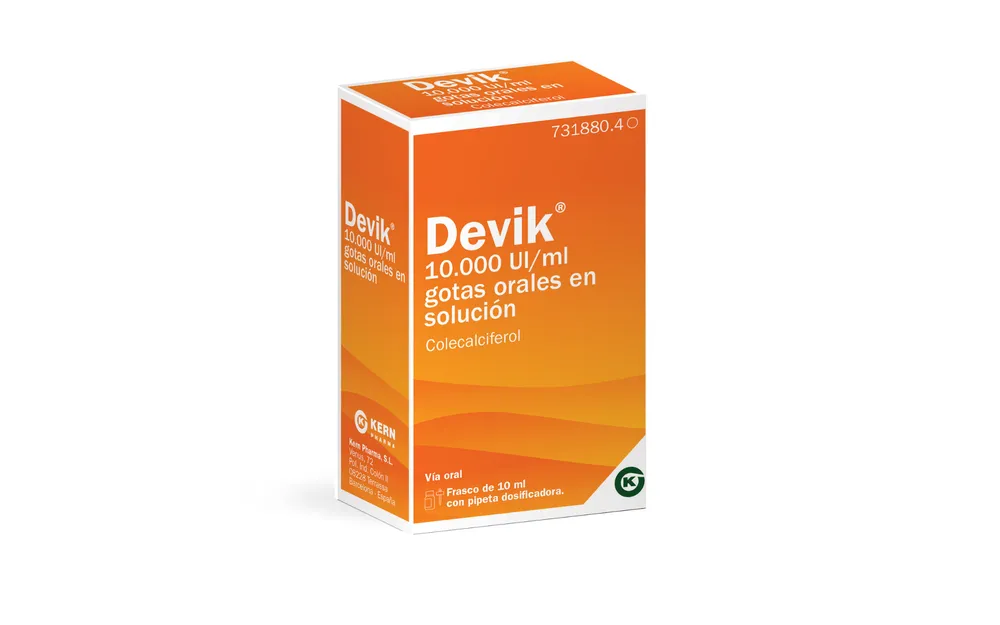
Table of Contents
- Package leaflet: Information for the user
- Introduction
- 1. What Devik is and what it is used for
- 2. What you need to know before you start taking Devik
- **Do not take Devik**
- **Warnings and precautions**
- **Use of Devik with other medicines**
- **Use of Devik with food, beverages, and alcohol**
- **Pregnancy, lactation, and fertility**
- 3. How to take Devik
- 4. Possible adverse effects
- 5. Storage of Devik
- 6. Contents of the pack and other information
Package leaflet: Information for the user
Introduction
Package leaflet: Information for the user
Devik® 10,000 IU/ml oral drops solution
Colecalciferol (vitamin D3)
Read the entire leaflet carefully before you start taking this medicine because it contains important information for you
- Keep this leaflet as you may need to read it again.
- If you have any questions, ask your doctor or pharmacist.
- This medicine has been prescribed for you only and must not be given to other people, even if they have the same symptoms as you, because it could harm them.
- If you experience any adverse effects, consult your doctor or pharmacist, even if they are adverse effects not listed in this leaflet. See section 4.
Contents of the leaflet
- What Devik is and what it is used for
- What you need to know before taking Devik
- How to take Devik
- Possible side effects
- How to store Devik
- Contents of the pack and other information
1. What Devik is and what it is used for
Devik contains colecalciferol (vitamin D3). Vitamin D3, which is fat-soluble, is found in certain foods and is produced by the body when the skin is exposed to sunlight. Vitamin D promotes calcium absorption in the kidneys and intestine, thereby supporting bone formation. Vitamin D deficiency is the main cause of rickets (inadequate bone mineralization in children) and osteomalacia (inadequate bone mineralization in adults).
Devik is indicated for the prevention and treatment of vitamin D deficiency due to inadequate dietary intake, insufficient exposure to sunlight, or impaired intestinal fat absorption; in adults, adolescents, and children at identified risk of vitamin D deficiency.
It may also be used as an adjunct in the prevention and treatment of bone mass loss (osteoporosis).
2. What you need to know before you start taking Devik
Do not take Devik
- if you are allergic to vitamin D3 or to any of the other ingredients of this medicine (listed in section 6).
- if you have high levels of calcium in your blood (hypercalcemia) or in your urine (hypercalciuria).
- if you have kidney stones (renal calculi) or severe renal failure.
- if you have high levels of vitamin D in your blood (hypervitaminosis D).
Warnings and precautions
Consult your doctor or pharmacist before starting to take Devik if,
- you are being treated with certain medications used for heart conditions (for example, cardiac glycosides, such as digoxin).
- you have sarcoidosis (an autoimmune disease that may cause increased levels of vitamin D in the body).
- you are being treated with medications containing vitamin D or consume vitamin D–fortified foods or milk.
- you are likely to be exposed to sunlight while using this medicine.
- you take other supplements containing calcium. Your doctor should monitor your calcium levels to ensure they do not become too high during treatment with Devik.
- you have kidney disease or kidney damage. Your doctor should monitor your blood and urine calcium levels.
- if you have high levels of lipids (fats) in the blood.
- your doctor should monitor blood calcium levels through laboratory tests if daily intake of vitamin D3 exceeds 1,000 IU for a prolonged period.
Use of Devik with other medicines
Inform your doctor or pharmacist if you are taking, have recently taken, or might need to take any other medicines. This is especially important if you are taking:
-
medicines used to treat heart or kidney diseases, such as cardiac glycosides (e.g., digoxin) or diuretics (e.g., bendroflumethiazide). When these medicines are used at the same time as vitamin D3, they may cause a significant increase in calcium levels in the blood and urine.
-
medicines containing vitamin D or foods rich in vitamin D, such as certain types of vitamin D-fortified milk.
-
actinomycin (a medicine used in the treatment of some types of cancer) and imidazole antifungals (e.g., clotrimazole and ketoconazole, medicines used to treat fungal infections). These medicines may interfere with the processing of vitamin D3 in the body.
-
the following medicines, as they may interfere with the effect or absorption of vitamin D3:
-
antiepileptic medicines (anticonvulsants), barbiturates.
-
glucocorticoids (steroid hormones such as hydrocortisone or prednisolone), which may reduce the effect of vitamin D3.
-
medicines that lower cholesterol levels in the blood (such as cholestyramine or colestipol).
-
certain medicines used for weight loss by reducing fat absorption (e.g., orlistat).
-
some laxatives (such as liquid paraffin).
Use of Devik with food, beverages, and alcohol
You should preferably take Devik with one of your main meals to help the absorption of vitamin D3. You may take it alone or by mixing the drops with cold or lukewarm food. For more information, see section 3, “How to take Devik”.
Pregnancy, lactation, and fertility
If you are pregnant or breastfeeding, think you may be pregnant, or are planning to become pregnant, consult your doctor before using this medicine.
Devik should be taken during pregnancy and lactation only under the recommendation of your doctor.
Vitamin D overdosage must be avoided during pregnancy, as prolonged hypercalcemia may cause delayed physical and mental development, narrowing of the aorta leading to reduced blood flow, and eye disease in the child (retinopathy).
Driving and use of machines
Information regarding possible effects of this medicine on the ability to drive is limited. However, effects on the ability to drive and use machines are not expected.
3. How to take Devik
Follow exactly the instructions for use of this medicine as given by your doctor. If in doubt, consult your doctor or pharmacist again.
The package contains a bottle and a dosing pipette. The bottle is closed with a child-resistant plastic cap. The dosing pipette is protected by a plastic tube that screws on.
To use the medicine, shake the bottle before use and follow the instructions below:
- To open the bottle, press the cap downwards while turning it at the same time. Do not discard the plastic cap; you will use it to close the bottle.
- Before using the pipette, unscrew the plastic tube that protects it. Do not discard the plastic tube; you will use it to store the pipette after each use.
- Insert the pipette into the bottle to draw out the contents, by pressing the rubber bulb at the upper end. Place the prescribed number of drops into a spoon.
- Close the bottle with its original cap, absorb any remaining oil on the tip of the pipette with a tissue, and store the pipette back into the plastic tube. Do not wash with water.
- Make sure both are securely closed. Store the bottle and the dosing pipette in the original container.
Devik should preferably be taken with main meals.
This medicine has an olive oil flavour. Devik may be taken alone or by mixing the prescribed number of drops with a small amount of cold or lukewarm food immediately before ingestion. Make sure you take the full dose.
Volume in drops (for use with dropper) | UI of Vitamin D3 |
2 drops | 400 IU |
3 drops | 600 IU |
4 drops | 800 IU |
6 drops | 1,200 IU |
10 drops | 2,000 IU |
12 drops | 2,400 IU |
20 drops | 4,000 IU |
Use in adults
The recommended dose for vitamin D deficiency and as a supplement to specific treatment for bone loss (osteoporosis) is 3-4 drops (600 IU - 800 IU) per day.
For the treatment of vitamin D deficiency, the usual dose is 4 drops (800 IU) daily. Higher doses should be adjusted according to desired serum levels of 25-hydroxycholecalciferol (25(OH)D), the severity of the disease, and the patient's response to treatment.
The daily dose should not exceed 4,000 IU (20 drops per day).
Use in children and adolescents
For the prevention of vitamin D deficiency in infants (0 to 11 months) at identified risk, the recommended dose is 2 drops (400 IU) per day. For prevention in children and adolescents (1 to 18 years) at identified risk, the recommended dose is 3-4 drops (600-800 IU) per day.
For the treatment of vitamin D deficiency in children and adolescents, the dose should be adjusted according to desired serum levels of 25-hydroxycholecalciferol (25(OH)D), the severity of the disease, and the patient's response to treatment. The daily dose should not exceed 1,000 IU per day for children under 1 year of age, 2,000 IU per day for children aged 1 to 10 years, and 4,000 IU per day for adolescents from 11 years of age.
In children, Devik may be mixed with a small amount of infant food, yogurt, milk, cheese, or other dairy products. Do not add Devik to bottles of milk or other food containers that the child may not completely consume at once, to avoid the child not receiving the full dose. Ensure that the child takes the complete dose. In children who have passed the breastfeeding stage, the prescribed dose should be administered with a main meal.
Do not store any product or food containing Devik for later use or for the next meal.
Special populations
This medicine should not be used in patients with severe renal insufficiency.
Use during pregnancy and lactation
The recommended dose is 600 IU/day (3 drops). Higher doses may be required after confirmation of vitamin D deficiency, but you should not take more than your doctor recommends. The maximum daily dose for pregnant and lactating women is 2,000 IU/day (10 drops).
If you take more Devik than you should
Vitamin D toxicity is characterized by hypercalcemia (high levels of calcium in the blood). The most common symptoms in case of overdose are: loss of appetite (anorexia), nausea, vomiting, diarrhea, excessive thirst, excessive urine production over a 24-hour period, weakness, nervousness, itching, dehydration, and elevated levels of calcium in the blood and urine (hypercalcemia and hypercalciuria) in clinical tests.
Hypervitaminosis D may also cause more serious disorders (cardiac, vascular, among others).
Cases of moderate hypervitaminosis can be managed simply by reducing or discontinuing vitamin D intake. In cases of more severe hypercalcemia, glucocorticoids or calcitonin may be administered to reduce plasma calcium levels.
In case of overdose or accidental ingestion, contact your doctor, pharmacist, or go to a medical center immediately, or call the Toxicology Information Service at telephone number 91 562 04 20, indicating the medication and the amount ingested.
Stop taking the medication and contact your doctor or pharmacist immediately if you or your child take more of this medicine than prescribed. If you cannot reach a doctor, go to the nearest hospital and bring the medicine packaging with you.
If you forget to take Devik
If you forget to take a dose of Devik, take the next dose as soon as possible. Afterwards, take the following dose at the usual time. However, if it is close to the time for the next dose, do not take the missed dose and instead take the next dose at the usual time.
Do not take a double dose to make up for missed doses.
If you have any further questions about the use of this medicine, ask your doctor or pharmacist.
4. Possible adverse effects
Like any other medicine, Devik may cause adverse effects, although not everyone will experience them. The possible adverse effects associated with the use of Devik may include:
Uncommon (affects 1 in 100 people):
- Excess calcium in the blood (hypercalcemia)
- Excess calcium in the urine (hypercalciuria)
Rare (affects 1 in 1,000 people):
- Skin rash (rash or skin eruption)
- Pruritus (itching)
- Urticaria
Reporting of adverse effects
If you experience any type of adverse effect, consult your doctor or pharmacist, even if it is a possible adverse effect not listed in this leaflet. You may also report them directly through the Spanish Pharmacovigilance System for Human Medicines: https://www.notificaram.es. By reporting adverse effects, you can help provide more information on the safety of this medicine.
5. Storage of Devik
Keep this medicine out of sight and reach of children.
This medicine does not require any special storage conditions.
Do not use this medicine after the expiry date stated on the packaging after EXP. The expiry date is the last day of the month indicated.
Medicines must not be disposed of via wastewater or household waste. Unused containers and medicines should be taken to the SIGRE collection point at your pharmacy. If you are unsure, ask your pharmacist how to dispose of containers and medicines you no longer need. This will help protect the environment.
6. Contents of the pack and other information
Composition of Devik
The active substance is colecalciferol (vitamin D3). 1 ml of oral solution (50 drops) contains 10,000 IU of colecalciferol (vitamin D3), equivalent to 0.25 mg.
1 drop contains 200 IU of colecalciferol (vitamin D3), equivalent to 0.005 mg.
The other components are: olive oil and berry flavour (containing glyceryl triacetate, triethyl citrate, propylene glycol and flavourings).
Appearance of Devik and contents of the pack
Devik is a clear yellowish oily liquid.
It is supplied in 10 ml amber glass bottles sealed with a metal cap. The product comes with a low-density polyethylene pipette for dispensing the product and a protective cover for the dispensing tube.
Marketing Authorization Holder and Manufacturer
Kern Pharma, S.L.
Venus, 72 - Pol. Ind. Colón II
08228 Terrassa - Barcelona
Spain
Date of the most recent revision of this leaflet: October 2021
Detailed information on this medicine is available on the website of the Spanish Agency of Medicines and Medical Devices (AEMPS): http://www.aemps.gob.es