Detrusitol 2 mg film-coated tablets
Spain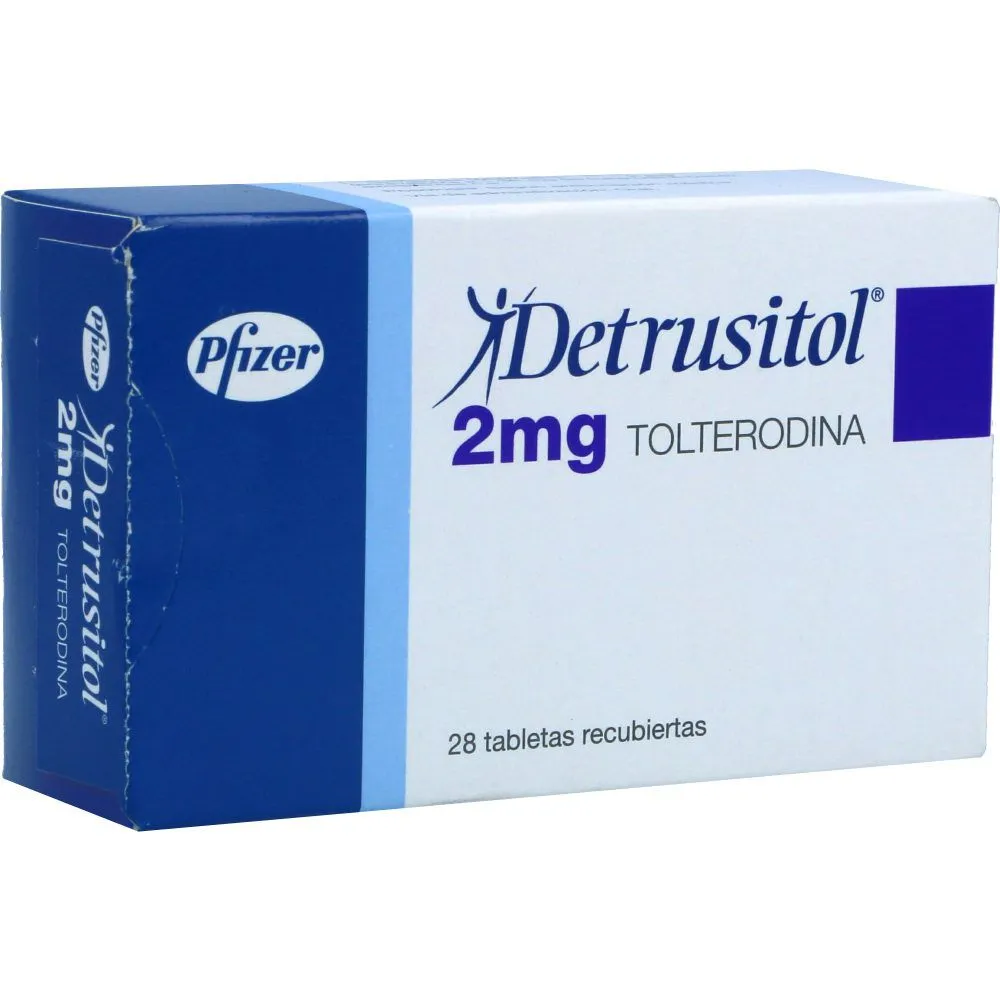
Table of Contents
Patient Information Leaflet
Introduction
Package Leaflet: Information for the Patient
Detrusitol 2 mg Film-coated Tablets
(Tolterodine tartrate)
Read this entire leaflet carefully before you start taking this medicine.
- Keep this leaflet, as you may need to read it again.
- If you have any questions, ask your doctor or pharmacist.
- This medicine has been prescribed for you and you should not give it to other people, even if they have the same symptoms as you, because it could harm them.
- If you experience any side effects, talk to your doctor or pharmacist, even if the side effects are not listed in this leaflet. See section 4.
Contents of this leaflet
- What Detrusitol is and what it is used for.
- What you need to know before taking Detrusitol.
- How to take Detrusitol.
- Possible side effects.
- How to store Detrusitol.
- Contents of the pack and other information.
1. What Detrusitol is and what it is used for
The active substance in Detrusitol is tolterodine. Tolterodine is a medicine that belongs to a group of medicines called antimuscarinics.
Detrusitol is used to treat the symptoms of overactive bladder syndrome. If you have overactive bladder syndrome, you may notice that:
- you are unable to voluntarily control your urine.
- you experience a sudden and urgent need to pass urine without prior warning and/or an increased number of times you urinate during the day.
2. What you need to know before taking Detrusitol
Do not take Detrusitol if:
- You are allergic (hypersensitive) to tolterodine or to any of the other ingredients of Detrusitol (listed in section 6).
- You are unable to empty urine from the bladder (urinary retention).
- You have uncontrolled narrow-angle glaucoma (increased intraocular pressure with loss of visual field, not adequately treated).
- You have myasthenia gravis (excessive muscle weakness).
- You suffer from severe ulcerative colitis (ulceration and inflammation in the colon).
- You have toxic megacolon (acute dilation of the colon).
Warnings and precautions:
Consult your doctor or pharmacist before starting Detrusitol if you think any of the following situations may apply to you:
-
If you have difficulty passing urine and/or have a weak or slow urinary stream.
-
If you have a gastrointestinal disorder affecting the passage and/or digestion of food.
-
If you have kidney problems (renal insufficiency).
-
If you have liver disease.
-
If you have neurological disorders affecting your blood pressure, intestinal or sexual function (any autonomic neuropathy).
-
If you have a hiatal hernia (herniation of an abdominal organ).
-
If you ever experience reduced intestinal movement or suffer from severe constipation (decreased gastrointestinal motility).
-
If you have significant heart disease such as:
-
abnormal heart rhythm (ECG)
-
slow heart rate (bradycardia)
-
pre-existing heart conditions such as:
-
cardiomyopathy (weakness of the heart muscle)
-
myocardial ischemia (reduced blood flow to the heart)
-
arrhythmia (irregular heart rhythm)
-
heart failure
-
• If you have abnormally low blood levels of potassium (hypokalemia), calcium (hypocalcemia), or magnesium (hypomagnesemia).
Other medicines and Detrusitol:
Inform your doctor if you are taking, have recently taken, or might need to take any other medicines.
Tolterodine, the active substance in Detrusitol, may interact with other medicines.
The use of tolterodine in combination with the following is not recommended:
- certain antibiotics (containing e.g.: erythromycin and clarithromycin).
- medicines used to treat fungal infections (containing e.g.: ketoconazole and itraconazole).
- medicines used to treat HIV.
Detrusitol should be used with caution when administered in combination with:
- certain medicines affecting food transit (containing e.g.: metoclopramide and cisapride).
- medicines used to treat irregular heart rhythm (containing e.g.: amiodarone, sotalol, quinidine, and procainamide).
- other medicines with a similar mode of action to Detrusitol Neo (antimuscarinic properties) or medicines with an opposite mode of action to Detrusitol Neo (cholinergic properties). Consult your doctor if you are unsure.
Taking Detrusitol with food and drinks
Detrusitol may be taken before, during, or after a meal.
Pregnancy and Breast-feeding
Pregnancy
You should not use Detrusitol if you are pregnant. Inform your doctor immediately if you are pregnant, think you may be pregnant, or are planning to become pregnant.
Breast-feeding
It is unknown whether tolterodine is excreted in breast milk. The use of Detrusitol is not recommended during breast-feeding. Consult your doctor or pharmacist before using any medicine.
Driving and using machines:
Detrusitol may cause dizziness, tiredness, or affect your vision; your ability to drive or operate machinery may be impaired.
Detrusitol contains sodium
This medicine contains less than 23 mg of sodium (1 mmol) per dose unit; this is essentially “sodium-free”.
3. How to take DETRUSITOL
Dosage:
Follow exactly the dosage instructions for Detrusitol provided by your doctor.
Consult your doctor or pharmacist if you have any doubts.
The recommended dose is one 2 mg tablet twice daily, except in patients with hepatic or renal disease, or in those experiencing bothersome side effects, in which case your doctor may reduce your dose to one 1 mg tablet twice daily.
The use of Detrusitol is not recommended in children.
Detrusitol is taken orally. The tablets must be swallowed whole.
Duration of treatment:
Your doctor will determine how long you should take Detrusitol. Do not stop treatment prematurely if you do not observe an immediate effect, as your bladder needs time to adjust. Complete the treatment course as prescribed by your doctor. If you notice no improvement by then, consult your doctor.
The benefit of treatment should be re-evaluated after 2–3 months of use.
Always consult your doctor if you are considering discontinuing treatment.
If you take more Detrusitol than you should:
If you or anyone else takes too many tablets, contact your doctor or pharmacist immediately.
In case of overdose or accidental ingestion, go to the nearest hospital or contact the Toxicology Information Service, Tel. 91 562 04 20.
If you forget to take Detrusitol:
If you miss a dose, take it as soon as possible. However, if it is almost time for your next dose, skip the missed dose and take the next one at your regular time. In this case, continue taking the tablets exactly as directed by your doctor.
Do not take a double dose to make up for the missed one.
If you have any further questions about the use of this product, consult your doctor or pharmacist.
4. Possible adverse effects
Like all medicines, this medicine can also have adverse effects, although not everyone experiences them.
You should consult your doctor immediately if you notice symptoms of angioedema such as:
- Swelling of the face, tongue, or pharynx.
- Difficulty swallowing.
- Hives and difficulty breathing.
Additionally, you should seek medical attention if you experience a hypersensitivity reaction (for example: itching, rash, hives, and difficulty breathing). This occurs infrequently (at least 1 in 1,000 patients).
Inform your doctor or go to the emergency department if you experience:
- Chest pain, difficulty breathing or fatigue (even at rest), difficulty breathing at night, swelling of the legs.
These may be symptoms of heart failure. This occurs infrequently (at least 1 in 1,000 patients).
The following adverse effects have been observed during treatment with Detrusitol with the following frequencies.
Very common (may affect more than 1 in 10 people):
- Dry mouth
- Headache
Common (may affect up to 1 in 10 people):
- Bronchitis
- Dizziness, drowsiness, muscle cramps in the fingers of the hands and feet
- Dry eyes, blurred vision
- Vertigo
- Palpitations
- Difficulty digesting (dyspepsia), constipation, abdominal pain, excessive air or gas in the stomach or intestines, vomiting
- Dry skin
- Pain or difficulty urinating, inability to empty the bladder
- Fatigue, chest pain, swelling due to fluid accumulation (e.g., in the ankles)
- Weight gain
- Diarrhea
Uncommon (may affect up to 1 in 100 people):
- Allergic reactions
- Nervousness
- Increased heart rate, heart failure, irregular heartbeat
- Heartburn
- Memory disturbance
Additional reported reactions include severe allergic reactions, confusion, hallucinations, flushed skin, angioedema, and disorientation. Cases of worsening dementia symptoms have been reported in patients receiving treatment for dementia.
If you consider any of the adverse effects you experience to be severe or if you notice any adverse effects not mentioned in this leaflet, inform your doctor or pharmacist.
Reporting of adverse effects
If you experience any type of adverse effect, consult your doctor or pharmacist, even if they are possible adverse effects not listed in this leaflet. You may also report them directly via the Spanish Pharmacovigilance System for Human Medicinal Products: www.notificaram.es.
By reporting adverse effects, you can help provide more information on the safety of this medicine.
5. Storage of DETRUSITOL
Keep Detrusitol out of the sight and reach of children.
Do not use this medicine after the expiry date stated on the package. The expiry date is the last day of the month indicated.
No special storage conditions are required.
Medicines must not be disposed of via wastewater or household waste. Ask your pharmacist how to dispose of medicines and packaging that you no longer need. This will help protect the environment.
6. Additional information
Composition of Detrusitol
The active substance in Detrusitol 2 mg tablets is tolterodine.
Each tablet contains 2 mg of tolterodine tartrate, equivalent to 1.37 mg of tolterodine.
The excipients are:
Core: microcrystalline cellulose, calcium hydrogen phosphate dihydrate, sodium starch glycolate (type B) (see section 2 “Detrusitol contains sodium”), magnesium stearate and colloidal anhydrous silica.
Coating: hypromellose, microcrystalline cellulose, stearic acid and titanium dioxide (E171).
Appearance of the product and contents of the container
Detrusitol 2 mg tablets are white, round, biconvex tablets with arches above and below the letters “DT”.
Pack sizes available for Detrusitol are:
Blister packs:
20 tablets (2 strips of 10)
30 tablets (3 strips of 10)
50 tablets (5 strips of 10)
100 tablets (10 strips of 10)
14 tablets (1 strip of 14)
28 tablets (2 strips of 14)
56 tablets (4 strips of 14)
280 tablets
560 tablets
Bottles: containing 60 or 500 tablets.
Not all pack sizes may be marketed.
Marketing Authorization Holder and Manufacturer:
Marketing Authorization Holder:
Farmasierra Laboratorios, S.L.
Carretera de Irún, km. 26,200
28700 San Sebastian de los Reyes (Madrid)
Spain
Manufacturer:
Pfizer Italia, S.r.l.
63100 Marino del Tronto
Ascoli Piceno, Italy
or
allphamed PHARBIL Arzneimittel GmbH
Hildebrandstr. 10-12
37081 Göttingen
Germany
This medicinal product is authorized under the name Detrusitol in the following Member States of the European Economic Area and in the United Kingdom (Northern Ireland):
Austria, Belgium, Luxembourg, Finland, France, Germany, Greece, Ireland, Italy, the Netherlands, Spain, Sweden and the United Kingdom (Northern Ireland).
Date of the most recent review of this leaflet: September 2025
Detailed and up-to-date information on this medicinal product is available on the website of the Spanish Agency for Medicines and Health Products (AEMPS) http://www.aemps.es/