Desmopressin Sandoz 120 micrograms sublingual tablets EFG
Spain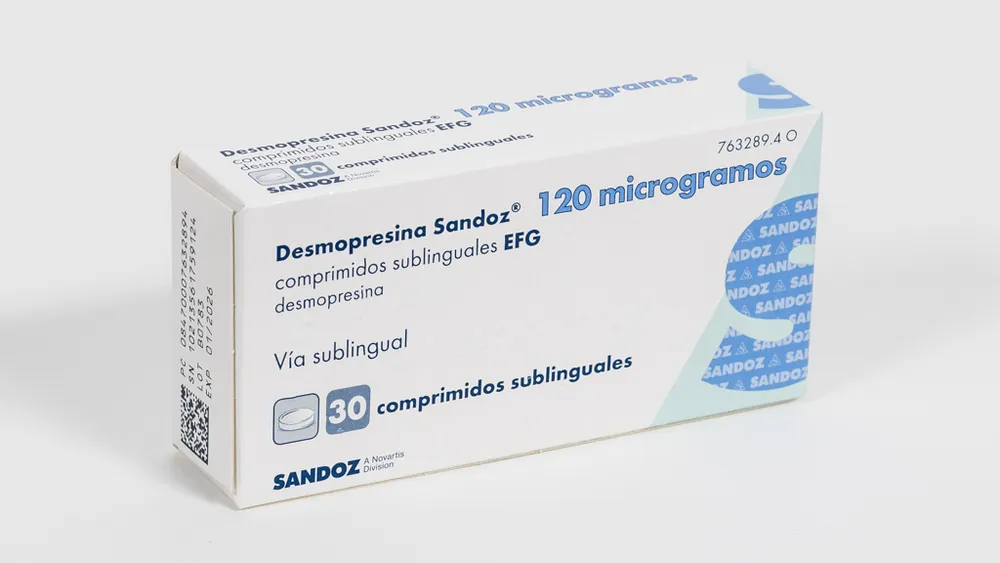
Table of Contents
- Package leaflet: Information for the user
- Introduction
- 1. What Desmopresina Sandoz is and what it is used for
- 2. What you need to know before taking Desmopresin Sandoz
- 3. How to take Desmopresin Sandoz
- 4. Possible adverse effects
- 5. Storage of Desmopressin Sandoz
- 6. Contents of the pack and other information
Package leaflet: Information for the user
Introduction
Package leaflet: information for the user
Desmopresin Sandoz 120 micrograms sublingual tablets EFG
Read the entire leaflet carefully before you start taking this medicine because it contains important information for you.
-
Keep this leaflet, as you may need to read it again.
- If you have any questions, ask your doctor or pharmacist.
-
This medicine has been prescribed for you only, and you should not give it to others, even if they have the same symptoms as you, because it may harm them.
- If you experience any adverse effects, consult your doctor or pharmacist, even if they are adverse effects not listed in this leaflet. See section 4.
Contents of the leaflet
- What Desmopresin Sandoz is and what it is used for
- What you need to know before taking Desmopresin Sandoz
- How to take Desmopresin Sandoz
- Possible adverse effects
- How to store Desmopresin Sandoz
- Contents of the pack and other information
1. What Desmopresina Sandoz is and what it is used for
Desmopresina Sandoz contains the active substance desmopressin, which reduces the amount of urine produced by the kidneys.
Desmopressin is used to treat:
- a chronic condition called diabetes insipidus, which causes extreme thirst and a constant production of large amounts of diluted urine. Important: This must not be confused with diabetes mellitus.
- enuresis (nocturnal urinary incontinence) in patients over 5 years of age who have normal urine concentrating ability.
2. What you need to know before taking Desmopresin Sandoz
Do not take Desmopresin Sandoz if:
- you are allergic to desmopressin or to any of the other ingredients of this medicine (listed in section 6),
- you drink unusually large amounts of fluids,
- you have heart problems or other conditions requiring treatment with medicines that increase urine secretion through the kidneys,
- you have moderate or severe kidney impairment,
- you know you have low levels of sodium in your blood,
- you have the syndrome of inappropriate antidiuretic hormone secretion, known as SIADH.
Warnings and precautions
Talk to your doctor or pharmacist before taking Desmopresin Sandoz:
- about fluid intake: drink as little as possible from 1 hour before taking the tablet until 8 hours after taking it,
- if you are an elderly patient,
- if you have a medical condition causing fluid and/or electrolyte imbalance in the body, such as an infection, fever, or stomach upset,
- if you have severe bladder problems or reduced urine output,
- if you have asthma, epilepsy, cystic fibrosis, or migraine,
- if you are at risk of increased intracranial pressure (a condition your doctor will inform you about).
Other medicines and Desmopresin Sandoz
Tell your doctor or pharmacist if you are taking, have recently taken, or might need to take any other medicines.
The effect of desmopressin may be increased, raising the risk of abnormal fluid retention in the body, if you are already taking:
- antidepressant medicines called tricyclic antidepressants or SSRIs,
- carbamazepine (used to treat epilepsy),
- chlorpromazine (used to treat psychosis or schizophrenia),
- medicines for diabetes called sulfonylureas,
- loperamide (used to treat diarrhoea),
- medicines for pain and/or inflammation, called non-steroidal anti-inflammatory drugs (NSAIDs), such as indomethacin, ibuprofen.
The effect of desmopressin may be reduced if you are already taking:
- dimethicone (used to treat symptoms of gas in the stomach).
Taking Desmopresin Sandoz with food and drinks
-
Before starting this medicine, your doctor should advise you about fluid intake, including alcoholic beverages.
-
If you are taking this medicine for enuresis, drink as little as possible from 1 hour before taking the tablet until 8 hours after.
-
Drinking too much may cause fluid retention, diluting the salt in your body. This can occur with or without warning signs or symptoms, which may include:
- unusually severe or prolonged headache,
- nausea or vomiting,
- unexplained weight gain,
- in severe cases, seizures and loss of consciousness.
If you experience any of these symptoms, stop treatment immediately and consult your doctor without delay.
Pregnancy and breastfeeding
Desmopressin may be used during pregnancy and breastfeeding, but only if prescribed by a doctor. There is only limited experience with the use of desmopressin in pregnant women with diabetes insipidus.
Desmopressin may be used during breastfeeding. Desmopressin passes into breast milk, but it is unlikely to affect breastfed infants.
If you are pregnant or breastfeeding, think you may be pregnant, or plan to become pregnant, consult your doctor or pharmacist before using this medicine.
Driving and using machines
There is no evidence to suggest that desmopressin affects the ability to drive or use machinery.
Desmopresin Sandoz contains lactose and sodium
If your doctor has informed you that you have an intolerance to certain sugars, consult him before taking this medicine.
This medicine contains less than 1 mmol of sodium (23 mg) per sublingual tablet; essentially “sodium-free”.
3. How to take Desmopresin Sandoz
Follow exactly the instructions for use provided by your doctor or pharmacist. If in doubt, consult your doctor or pharmacist again.
The dose will be determined by your physician and will be individually adjusted for you.
The recommended dose is:
- Diabetes insipidus
Adults and children – 60 micrograms three times daily. Your doctor may increase the dose depending on how well your symptoms are controlled.
- Enuresis (involuntary nighttime urination)
Adults and children aged 5 years and older – 120 micrograms at bedtime, after emptying the bladder. Your doctor may increase the dose to 240 micrograms at bedtime, depending on how well the enuresis is controlled. The need for continued treatment should be assessed every 3 months by establishing a treatment-free period of at least one week.
Use in elderly patients
Desmopressin should not be initiated until normal blood sodium levels have been confirmed. Blood sodium levels should be measured before starting treatment and again three days after starting treatment, as well as whenever the dose is increased or at any time deemed appropriate by your doctor.
If you are taking this medicine for nocturnal enuresis, drink as little as possible from 1 hour before taking a tablet until 8 hours afterwards.
Instructions for use
The tablet should be placed under the tongue, where it dissolves without water.
If you take more Desmopresin Sandoz than you should
If you take more desmopressin than you should, contact your doctor, pharmacist, or nearest hospital immediately.
An overdose may prolong the effect of desmopressin acetate and increase the risk of fluid retention and low blood sodium levels. Symptoms of severe fluid retention include seizures and loss of consciousness.
In case of overdose or accidental ingestion, contact your doctor or pharmacist immediately, or call the Toxicology Information Service at telephone number: 91 562 04 20, indicating the medication and the amount ingested.
If you forget to take Desmopresin Sandoz
Do not take a double dose to make up for forgotten doses.
If you stop taking Desmopresin Sandoz
You should only change or stop treatment if advised by your doctor.
If you have any further questions about the use of this medicine, ask your doctor or pharmacist.
4. Possible adverse effects
Like all medicines, this medicine can cause adverse effects, although not everyone experiences them.
Stop treatment and contact your doctor immediately if you experience any of the following serious adverse effects:
- multiple or severe symptoms of fluid retention. The adverse effects listed below marked with an asterisk (*) are included in this category,
- allergic reactions such as skin rash, itching, fever, swelling of the mouth, tongue, or airways causing difficulty swallowing or breathing.
Adverse effects observed in adults:
-
Very common (may affect more than 1 in 10 people):
-
headache*.
- Common (may affect up to 1 in 10 people):
-
low blood sodium levels,
-
dizziness,
-
high blood pressure,
-
nausea*,
-
stomach pain*,
-
diarrhoea,
-
constipation,
-
vomiting*,
-
problems urinating (frequent and abnormal urination during the day),
-
swelling of the tissues in the hands, arms, feet, or legs,
-
fatigue.
- Uncommon (may affect up to 1 in 100 people):
-
difficulty sleeping,
-
drowsiness,
-
clumsiness,
-
visual disturbances,
-
vertigo*,
-
sensation of increased heartbeat,
-
low blood pressure when standing up from a lying position,
-
shortness of breath,
-
stomach discomfort (indigestion, heartburn, flatulence, bloating),
-
sweating,
-
itching,
-
skin rashes,
-
hives,
-
muscle spasms,
-
muscle pain,
-
urinary disorders (such as urgent urination),
-
malaise*,
-
chest pain,
-
flu-like symptoms,
-
weight gain*,
-
increased liver enzymes,
-
low blood potassium levels.
- Rare (may affect up to 1 in 1,000 people):
-
confusion*,
-
allergic skin reaction.
-
Frequency not known (cannot be estimated from available data):
-
severe allergic reaction,
-
seizures,
-
dehydration,
-
muscle weakness,
-
coma,
-
high blood sodium levels.
Adverse effects observed in children up to 18 years of age:
-
Common (may affect up to 1 in 10 people):
-
headache*.
-
Uncommon (may affect up to 1 in 100 people):
-
emotional problems,
-
aggression,
-
stomach pain*,
-
nausea*,
-
vomiting*,
-
diarrhoea,
-
swelling of the tissues in the hands, arms, feet, or legs,
-
fatigue.
-
Rare (may affect up to 1 in 1,000 people):
-
anxiety,
-
drowsiness,
-
high blood pressure,
-
irritability,
-
nightmares,
-
mood changes.
-
Frequency not known (cannot be estimated from available data):
-
severe allergic reaction,
-
low blood sodium levels,
-
abnormal behaviour,
-
depression,
-
hallucinations,
-
insomnia (difficulty falling or staying asleep),
-
reduced attention,
-
increased muscle movements,
-
seizures*,
-
nosebleeds,
-
allergic skin reaction,
-
rash,
-
sweating,
-
hives.
Reporting of adverse effects
If you experience any type of adverse effect, talk to your doctor or pharmacist, even if it is a possible adverse effect not listed in this leaflet. You can also report them directly through the Spanish Pharmacovigilance System for Human Medicinal Products: https://www.notificaram.es. By reporting adverse effects, you can help provide more information on the safety of this medicine.
5. Storage of Desmopressin Sandoz
Keep this medicine out of the sight and reach of children.
Do not use this medicine after the expiry date stated on the packaging after EXP. The expiry date is the last day of the month indicated.
Store in the original blister pack to protect it from moisture. This medicine does not require any special storage temperature.
Medicines must not be disposed of via wastewater or household waste. Return unused medicines and their containers to the SIGRE collection point at your pharmacy. If you have any doubts, ask your pharmacist how to dispose of medicines and containers you no longer need. This will help protect the environment.
6. Contents of the pack and other information
Composition of Desmopresin Sandoz 120 micrograms sublingual tablets
- The active substance is desmopressin. Each sublingual tablet contains 120 micrograms of desmopressin (as desmopressin acetate).
- The other excipients are: monohydrate lactose, maize starch, citric acid (E330), sodium croscarmellose (E468), magnesium stearate (E470b).
Appearance of the product and contents of the pack
Sublingual tablet.
White or almost white octagonal tablet, rounded on the upper and lower surfaces, with the engraved mark "II" on one side and smooth on the other, 6.5 mm in length and 2 mm thick.
Aluminium/aluminium blisters with an integrated desiccant layer.
Pack sizes
30 sublingual tablets
Marketing Authorisation Holder and Manufacturer
Marketing Authorisation Holder
Sandoz Farmacéutica, S.A.
Parque Norte Business Park
Roble Building
C/ Serrano Galvache, 56
28033 Madrid
Spain
Manufacturer
Haupt Pharma Münster GmbH
Schleebrüggenkamp 15
D-48159 Münster
Germany
or
Lek Pharmaceuticals d.d.
Verovškova ulica 57
1526 Ljubljana
Slovenia
or
Adalvo Ltd.
Malta Life Sciences Park
Building 1, Level 4
Sir Temi Zammit Buildings
San Gwann, SGN 3000
Malta
Date of the most recent revision of this leaflet: June 2023
Detailed information on this medicine is available on the website of the Spanish Agency of Medicines and Health Products (AEMPS): http://www.aemps.gob.es/