Desferin 500 mg powder for injection or infusion solution
Spain
Table of Contents
- Package leaflet: Information for the user
- Introduction
- 1. What Desferin is and what it is used for
- 2. What you need to know before starting to use Desferin
- 3. How to use Desferin
- **Treatment of Chronic Iron Overload**
- **Treatment of acute iron poisoning**
- Desferin may be used in cases of poisoning with iron preparations. This treatment will be carried out in a hospital. In this case, the medicine will be administered to you by continuous intravenous infusion.
- **Treatment of chronic aluminium overload**
- **Desferin Test**
- 4. Possible adverse effects
- 5. Storage of Desferin
- 6. Additional Information
Package leaflet: Information for the user
Introduction
PACKAGE LEAFLET: INFORMATION FOR THE USER
Desferin 500 mg powder for injectable solution or infusion
Deferoxamine mesylate
Read the entire leaflet carefully before you start using the medicine.
|
Contents of the leaflet:
- What Desferin is and what it is used for
- What you need to know before starting to use Desferin
- How to use Desferin
- Possible side effects
- Storage of Desferin
Storage of the container and additional information
1. What Desferin is and what it is used for
Desferin belongs to the group of iron-chelating agents. It is used to remove excess iron and aluminium from the blood. This may be necessary in patients with certain types of anaemia who require frequent blood transfusions (which may lead to excess iron) and in patients with severe renal failure undergoing maintenance dialysis (which may lead to excess aluminium).
Desferin is indicated for the treatment of:
-
chronic iron overload, for example due to frequent blood transfusions in cases of beta-thalassaemia major
-
acute iron intoxication
-
chronic aluminium overload in patients with renal failure undergoing maintenance dialysis
Desferin may be used to detect iron or aluminium overload.
2. What you need to know before starting to use Desferin
Desferin is indicated for certain patients, but not for everyone.
Do not use Desferin
- If you are allergic (have previously experienced rash or shortness of breath) after using Desferin, you must inform your doctor.
Warnings and precautions
- Desferin must only be administered by intramuscular or slow subcutaneous injection or by slow intravenous infusion. DO NOT use rapid intravenous infusion, as this may lead to shock.
- If you have severe kidney disease.
- Never use a higher dose or concentration of Desferin than prescribed by your doctor, as this may cause adverse effects at the injection site, or even affect your vision or hearing, lungs, nervous system, or growth rate.
- If your doctor prescribes vitamin C supplements, make sure you have been taking Desferin regularly for at least 1 month, and take only the dose of vitamin C prescribed by your doctor. High doses of vitamin C (more than 500 mg daily) administered during treatment with Desferin for chronic iron overload may harm your heart.
- Desferin may increase the risk of certain serious infections. If you experience fever, sore throat, shortness of breath, abdominal pain, or general malaise during treatment with Desferin, these could be symptoms of a serious infection. In such cases, stop treatment with Desferin immediately and contact your doctor without delay.
- During treatment, your urine may become brownish-red due to increased iron content. This is usually harmless, but if you are concerned, speak to your doctor or nurse.
Your doctor may perform blood or urine tests and will carry out tests to monitor your vision and hearing before starting this medicine and at regular intervals thereafter. In children, growth and body weight will be monitored periodically.
Use of other medicines
Inform your doctor or pharmacist if you are taking or have recently taken any other medicines, including those obtained without a prescription, especially if you are taking a tranquilizer called prochlorperazine. You may need to adjust the dose or discontinue one of the medicines.
Additionally, do not take vitamin C in doses exceeding 200 mg daily during treatment with Desferin.
Pregnancy and breastfeeding
Consult your doctor or pharmacist before using any medicine.
In general, Desferin should not be taken during pregnancy or while breastfeeding unless your doctor advises treatment. Desferin may harm the unborn or nursing child. Your doctor will advise you accordingly.
Driving and use of machines
Do not drive or operate tools or machinery, as Desferin may affect your vision or hearing, cause dizziness, or lead to other nervous system disturbances.
Use in children
Desferin may be administered to children. In children under 3 years of age, growth must be closely monitored.
Use in the elderly
Desferin may be administered to elderly patients. The lowest effective dose will be used.
3. How to use Desferin
Follow exactly the administration instructions for Desferin given by your doctor. If you have any doubts, consult your doctor.
Your doctor will choose the appropriate dose and route of administration according to your specific condition and will inform you of the duration of your treatment with Desferin.
Make sure you take the medication regularly and exactly as directed by your doctor. This will help you achieve the best results and reduce the risk of adverse effects. If you have any questions about your treatment, consult your doctor.
Desferin must be reconstituted with water for injections. At the recommended concentration of 10%, the reconstituted solution is colorless to slightly yellowish. The solution should be clear. Do not use solutions that are cloudy or turbid.
The reconstituted Desferin solution may be further diluted with routinely used infusion solutions (0.9% NaCl, 5% glucose, Ringer's solution, Ringer-Lactate solution, peritoneal dialysis solutions such as Dianeal 137 Glucose 2.27%, Dianeal PD4 Glucose 2.27%, and CAPD/DPCA 2 Glucose 1.5%).
Treatment of Chronic Iron Overload
Your doctor will adjust the dose according to your individual condition. In most patients, a daily dose of 20–60 mg per kilogram of body weight is appropriate.
Desferin may be administered by slow subcutaneous infusion using an infusion pump, by intravenous infusion, or by intramuscular injection.
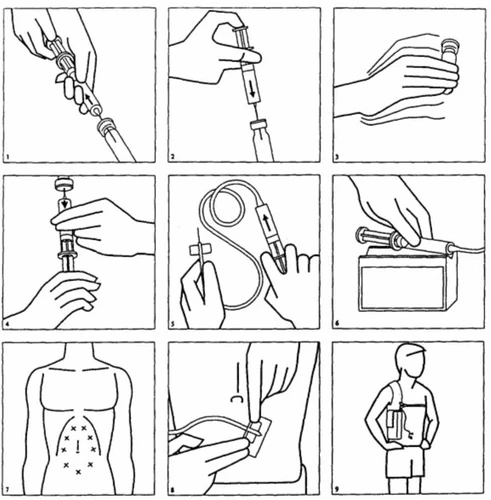
For long-term treatment in patients with iron overload, it is advisable to administer Desferin slowly subcutaneously via a lightweight, portable pump over a period of 8–12 hours (e.g., during the night). The pump must be set up carefully under aseptic conditions. Follow the instructions below to prepare the infusion solution and administer it subcutaneously:
- Draw into a syringe the required amount of water for injections:
- for subcutaneous (infusion pump) or intravenous use: 5 ml of water for injections (concentration after reconstitution: 95 mg/ml)
- for intramuscular use: 2 ml of water for injections (concentration after reconstitution: 213 mg/ml).
-
After cleaning the rubber stopper of the Desferin vial with alcohol, inject the contents of the syringe into the vial.
-
Shake the vial vigorously to dissolve the powder.
-
Draw the dissolved medication back into the syringe.
-
Attach the infusion set tubing to the syringe, connect the tubing to the needle, and then fill the empty space in the tubing with the injectable solution.
-
Place the syringe into the infusion pump.
-
For the infusion, insert the needle under the skin of the abdomen, arm, upper leg, or thigh. It is important to first clean the skin thoroughly with alcohol. Then firmly insert the needle up to the wings into a skin fold formed by the free hand. The tip of the needle should move freely when the needle is moved. If it does not move freely, the needle tip is too close to the skin surface. Try a new site after cleaning with alcohol.
-
Secure the needle firmly in place using adhesive tape.
-
The pump is usually worn attached to a belt or shoulder strap. Nighttime use is most convenient for the patient.
Your doctor may decide that you should also take vitamin C in addition to Desferin, starting at least one month after beginning regular treatment with Desferin. The maximum daily dose of vitamin C for adults is 200 mg, divided into several doses. For children under 10 years of age, 50 mg of vitamin C daily is sufficient; for children over 10 years of age, 100 mg daily is sufficient.
Treatment of acute iron poisoning
Desferin may be used in cases of poisoning with iron preparations. This treatment will be carried out in a hospital. In this case, the medicine will be administered to you by continuous intravenous infusion.
Treatment of chronic aluminium overload
Desferin is normally administered once a week by slow intravenous infusion during the last 60 minutes of a dialysis session or 5 hours before the dialysis session, depending on the aluminium concentration in the blood.
If you are receiving continuous ambulatory peritoneal dialysis (CAPD) or continuous cycling peritoneal dialysis (CCPD), you will need to use the Desferin dose before the final exchange of the day.
The dose of Desferin is 5 mg per kilogram of body weight.
The duration of treatment and any changes in the individual dose of Desferin will depend on the results of tests performed by your doctor.
Desferin Test
If your doctor wishes to check whether you have iron overload, you will be given 500 mg of Desferin intramuscularly. The iron content will be determined in urine collected over 6 hours.
If you are undergoing dialysis, your doctor will want to check whether you have aluminum overload. You will be administered 5 mg of Desferin per kilogram of body weight by slow intravenous infusion during the last 60 minutes of the dialysis session. The aluminum content will be determined in blood samples taken immediately before this dialysis session and the next one.
Use in children
If chelation therapy is started before the age of 3 years, growth should be carefully monitored, and the average daily dose should not exceed 40 mg/kg. Growth retardation could result from iron overload or from excessive doses of Desferin.
Patients over 65 years of age
In general, dose determination in elderly patients should be performed with caution, usually starting at the lower end of the dose range, since in elderly patients impaired liver, kidney, or heart function is more common, as well as the presence of other concomitant diseases and the use of other medications.
If you use more Desferin than you should
Inform your doctor immediately.
In case of overdose or accidental ingestion, consult your doctor or pharmacist or call the Toxicology Information Service at telephone number 915 620 420, indicating the medication and the amount used.
If you forget to use Desferin
Inform your doctor immediately.
4. Possible adverse effects
Like all medicines, Desferin may cause adverse effects, although not everyone will experience them.
An intravenous infusion of Desferin that is too rapid may cause unpleasant adverse effects and could even lead to collapse.
Very common (may affect more than 1 in 10 patients/people)
Musculoskeletal and connective tissue disorders: Joint pain, muscle pain. | |
General disorders and administration site conditions: Reaction at the injection site including pain, swelling, redness, itching, and lesion. |
Frequent (may affect between 1 in every 100 patients/people)
Disorders of the nervous system: Headache. | |
Gastrointestinal disorders: Nausea. | |
Skin and subcutaneous tissue disorders: Urticaria. | |
Musculoskeletal and connective tissue disorders: Growth retardation and bone disorders at high doses and in young children. | |
General disorders and administration site conditions: Fever. |
Uncommon (may affect between 1 and 10 in every 1,000 patients/people)
Ear and labyrinth disorders: Hearing loss and tinnitus. | |
Respiratory, thoracic and mediastinal disorders: Asthma. | |
Gastrointestinal disorders: Vomiting, abdominal pain. | |
General disorders and administration site conditions: Reaction at injection site including blistering, swelling, and burning. |
Rare (may affect between 1 and 10 in every 10,000 patients/people)
Infections and infestations: Fungal infections. | |
Ocular disorders: Vision loss, black spots, decreased visual acuity, blurred vision, night blindness, visual field defects, disturbances in color vision, retinal degeneration, cataracts. | |
Vascular disorders: Hypotension, tachycardia, and shock if administration precautions are not followed. |
Very rare (may affect fewer than 1 in 10,000 patients/people)
Infections and infestations: Fungal or bacterial infections accompanied by fever, acute diarrhea, abdominal pain, or swollen and painful throat (sign of low white blood cell levels). | |
Disorders of the blood and lymphatic system: Bleeding and appearance of bruises (sign of low platelet levels); fever, sore throat, or mouth ulcers due to infections (sign of low white blood cell levels). | |
Immune system disorders: Severe allergic reaction, with difficulty breathing and dizziness. | |
Nervous system disorders: Neurological disorders, including dizziness, worsening of aluminum-related dialysis encephalopathy (personality changes, severe headache, confusion, paralysis of part of the body, torticollis, abnormal eye movements, and abnormal speech), numbness and tingling sensations in feet and hands. | |
Respiratory, thoracic and mediastinal disorders: Severe breathing difficulty. | |
Gastrointestinal disorders: Diarrhea. | |
Skin and subcutaneous tissue disorders: Generalized rash. | |
Frequency not known (cannot be estimated from the available data)
Renal and urinary disorders: Low urine output (sign of kidney problem); abnormal kidney function test results; discoloration of urine. | |
Nervous system disorders: Seizures (mainly in patients on dialysis). | |
Musculoskeletal and connective tissue disorders: Muscle spasms. | |
Gastrointestinal disorders: Abnormal liver function test results. Endocrine disorders: In treatment for aluminum overload, may result in low calcium levels and worsening of hyperparathyroidism (a condition characterized by abnormally high activity of the parathyroid glands, which regulate calcium, phosphorus, and vitamin D levels in the blood and bones). |
If you consider any of the adverse effects you experience to be severe, or if you notice any adverse effects not listed in this leaflet, inform your doctor or pharmacist.
Reporting of adverse effects
If you experience any type of adverse effect, consult your doctor, pharmacist, or nurse, even if it is a possible adverse effect not mentioned in this leaflet. You can also report them directly through the Spanish Pharmacovigilance System for Human Medicines: https://www.notificaram.es. By reporting adverse effects, you can help provide more information on the safety of this medicine.
5. Storage of Desferin
Keep out of the reach and sight of children.
Do not use Desferin after the expiry date stated on the container (the expiry date refers to the last day of the month indicated).
Do not use Desferin if the solution appears cloudy or turbid.
Do not store above 30°C.
Vials are for single use only. Once the solution has been reconstituted, the product must be used immediately (within 3 hours). If the solution has been reconstituted under sterile conditions, it may be stored for a maximum of 24 hours at room temperature prior to the start of treatment.
Medicines must not be disposed of via wastewater or household waste. Dispose of unused containers and medicines at the SIGRE collection point at your usual pharmacy. Ask your pharmacist how to properly dispose of unused medicines and their containers. This will help protect the environment.
6. Additional Information
Composition of Desferin
The active substance in Desferin is deferoxamine mesylate.
Appearance of the product and contents of the pack
Desferin is supplied in vials containing 500 mg of white powder for injectable and perfusion solution.
Only clear, colorless to slightly yellow solutions should be used.
Marketing Authorization Holder
MITEM PHARMA
2-12, RUE DU CHEMIN DES FEMMES
91300 MASSY
FRANCE
Manufacturer
MITEM PHARMA
2-12, RUE DU CHEMIN DES FEMMES
91300 MASSY
FRANCE
or
Novartis Pharma GmbH
Roonstrasse 25
90429 Nuremberg - Germany
This leaflet was approved in June 2018
Detailed and up-to-date information on this medicine is available on the website of the Spanish Agency of Medicines and Medical Devices (AEMPS) http://www.aemps.gob.es/