Denvar 100 mg/5 ml granules for oral suspension
Spain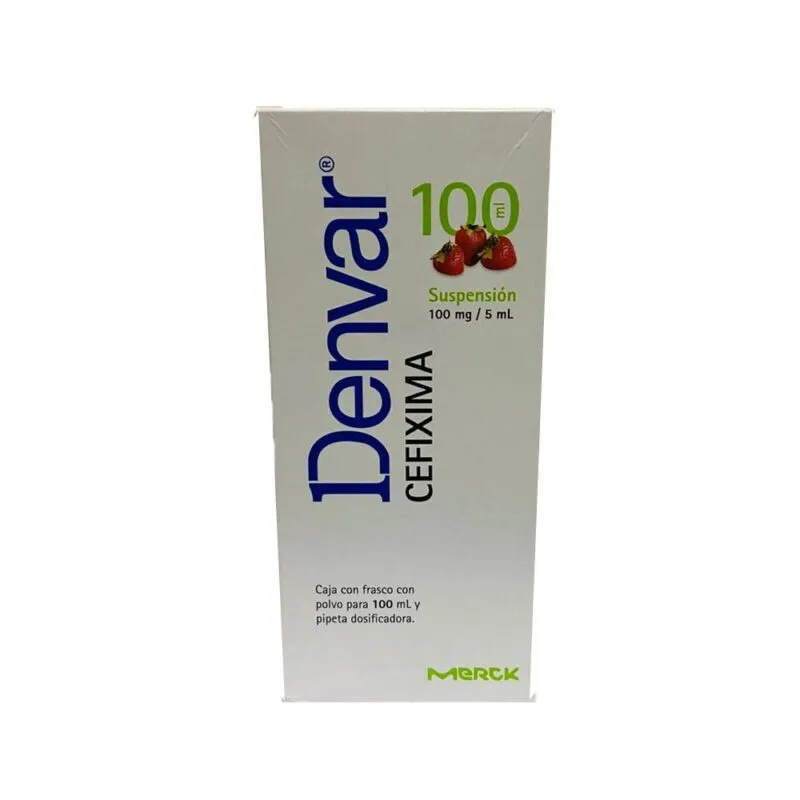
Table of Contents
- Package leaflet: Information for the user
- Introduction
- 1. What Denvar is and what it is used for
- 2. What you need to know before starting to take Denvar
- 3. How to take Denvar
- 4. Possible adverse effects
- 5. Storage of Denvar
- 6. Contents of the container and other information
- **Marketing Authorization Holder**
Package leaflet: Information for the user
Introduction
Package leaflet: information for the user
Denvar 100 mg/5 ml granules for oral suspension
cefixime
Read the entire leaflet carefully before you start taking this medicine, because it contains important information for you.
- Keep this leaflet, as you may need to read it again.
- If you have any questions, ask your doctor or pharmacist.
- This medicine has been prescribed for you only, and you should not give it to other people, even if they have the same symptoms as you, because it could harm them.
- If you experience any adverse effects, consult your doctor or pharmacist, even if they are adverse effects not listed in this leaflet. See section 4.
Contents of the leaflet
- What Denvar is and what it is used for
- What you need to know before taking Denvar
- How to take Denvar
- Possible adverse effects
- How to store Denvar
- Contents of the pack and other information
1. What Denvar is and what it is used for
Denvar contains a substance called cefixime, which belongs to the group of antibiotics known as "cephalosporins" and is used to treat infections caused by bacteria.
Antibiotics are used to treat bacterial infections and are not effective against viral infections such as influenza or the common cold.
It is important that you follow your doctor's instructions regarding dosage, dosing interval, and duration of treatment.
Do not store or reuse this medicine. If you have any antibiotic left over after finishing your treatment, return it to the pharmacy for proper disposal. Medicines must not be disposed of via wastewater or household waste.
Denvar is used to treat:
1.- Upper respiratory tract infections: pharyngitis and tonsillitis.
2.- Lower respiratory tract infections: acute bronchitis, exacerbations of chronic bronchitis, and pneumonia.
3.- Otorhinolaryngological (ENT) infections: otitis media.
4.- Uncomplicated urinary tract infections.
2. What you need to know before starting to take Denvar
Do not take Denvar
- If you are allergic to cefixime, to other cephalosporins or cephamicins, or to any of the other ingredients of this medicine (listed in section 6).
Warnings and precautions
Consult your doctor or pharmacist before starting to take Denvar:
- if you have previously experienced any type of allergic reaction to cephalosporins, penicillins, or any other medicine.
If you are allergic to other beta-lactam antibiotics (e.g., penicillin), a possible cross-allergic reaction with cefixime should be considered. Special caution is required in patients who have experienced an anaphylactic reaction to penicillins. The appearance of any allergic manifestation requires immediate discontinuation of treatment.
-
if you suffer from asthma or have a predisposition to allergic reactions.
-
if you develop severe skin reactions while taking this medicine, such as toxic epidermal necrolysis, Stevens-Johnson syndrome, or drug reaction with eosinophilia and systemic symptoms (DRESS syndrome). If this occurs, stop taking this medicine and contact your doctor immediately.
-
if you have drug-induced hemolytic anemia or a history of hemolytic anemias associated with this type of medicine.
-
if your treatment with cefixime is prolonged, the risk of superinfection by fungi or resistant bacteria may increase. If this occurs, your doctor will assess whether treatment interruption is necessary.
-
if you develop significant diarrhea, or notice blood, mucus, or pus in your stools. If this occurs, inform your doctor.
-
if you have severe gastrointestinal problems with nausea and vomiting.
-
if you are taking diuretic medicines and/or medicines that may be harmful to the kidneys. Your doctor may perform a test to monitor kidney function during treatment.
-
if you have severe renal impairment. Your doctor will adjust the dose and monitor you closely.
-
if you develop acute renal failure. If this occurs, stop taking this medicine and contact your doctor immediately.
Treatment with cefixime may increase the risk of developing drug-resistant bacteria.
Some antibiotics in the cephalosporin family may cause seizures, especially in patients with renal impairment when the dose has not been reduced. If seizures occur, stop taking this medicine and contact your doctor immediately.
Children
Not recommended for premature infants, newborns, and infants up to 6 months of age.
Other medicines and Denvar
Taking cefixime together with any of the following medicines may alter the effect of both cefixime and the other medicine:
-
diuretic medicines (such as ethacrynic acid or furosemide) or medicines that may be harmful to the kidneys (certain antibiotics, colistin, polymyxin, chloramphenicol)
-
medicines acting on blood vessels (such as nifedipine)
-
medicines used to control blood clotting (coumarins)
Inform your doctor or pharmacist if you are taking, have recently taken, or might need to take any other medicines.
Interference with laboratory tests:
Denvar may cause false positive results in urine tests for ketones and glucose, and false positive results in the direct Coombs test (a diagnostic test for certain types of anemia).
Use of Denvar with food and drinks
Denvar may be taken with food.
Pregnancy and breastfeeding
If you are pregnant or breastfeeding, think you may be pregnant, or plan to become pregnant, consult your doctor or pharmacist before using this medicine.
Due to insufficient information on the potential adverse effects of Denvar during pregnancy, Denvar is recommended during pregnancy only if prescribed by your doctor after evaluating the benefit-risk ratio.
It has not been detected that cefixime passes into breast milk.
Treatment with Denvar during breastfeeding is not recommended unless prescribed by your doctor after evaluating the benefit-risk ratio. Your doctor will decide whether to continue breastfeeding and cefixime treatment.
Driving and using machines
Based on current experience, Denvar has no effect on the ability to drive or operate machinery. However, some adverse effects may affect concentration and reaction time; therefore, this should be taken into account in situations where concentration and reaction capacity are important, such as when driving or operating machinery.
Denvar contains sucrose and sodium benzoate
This medicine contains sucrose. If your doctor has told you that you have an intolerance to certain sugars, consult with him before taking this medicine.
Patients with diabetes mellitus should be aware that this medicine contains approximately 2.5 g of sucrose per 5 ml of reconstituted suspension.
This medicine contains 2.5 mg of sodium benzoate in each 5 ml of reconstituted suspension.
This medicine contains less than 1 mmol of sodium (23 mg) per 5 ml of reconstituted suspension; hence, it is essentially “sodium-free”.
Denvar contains glucose and wheat starch
This medicine contains glucose (in maltodextrin derived from wheat). If your doctor has told you that you have an intolerance to certain sugars, consult with him before taking this medicine.
This medicine contains very low levels of gluten (derived from wheat starch) and it is very unlikely to cause problems if you have celiac disease. 5 ml of suspension contains no more than 20 ppm of gluten.
If you have a wheat allergy (distinct from celiac disease), you must not take this medicine.
3. How to take Denvar
Follow exactly the administration instructions for this medicine as indicated by your doctor. If in doubt, consult your doctor or pharmacist again.
Unless your doctor has given you different instructions, follow the instructions below:
The recommended daily dose for adults and children over 12 years of age is 200 mg every 12 hours (10 ml of reconstituted suspension) or 400 mg once daily (20 ml of reconstituted suspension).
In children under 12 years of age, the recommended daily dose is 8 mg/kg/day, which may be administered as a single dose or as doses of 4 mg/kg every 12 hours. The following table may serve as a guide:
Body weight (kg) Amount of suspension to administer in ml |
6.0 kg 2.5 ml per day 12.5 kg 5 ml per day or 2.5 ml every 12 h 25.0 kg 10 ml per day or 5 ml every 12 h 37.5 kg 15 ml per day or 7.5 ml every 12 h > 37.5 kg 20 ml per day or 10 ml every 12 h |
The recommended maximum dose should not exceed 12 mg/kg/day.
In women with uncomplicated acute cystitis, a dose of 400 mg once daily for 3 days is recommended.
Patients with renal problems
In case of renal insufficiency with a creatinine clearance ≥20 ml/min, dose adjustment is not necessary; if clearance is lower, the dose should be reduced by half. In hemodialysis patients, the cefixime dosage should not exceed 200 mg/day either.
Patients with hepatic problems
In patients with hepatic insufficiency, the fact that cefixime is not metabolized in the liver allows administration of the medicine without the need to adjust the dose.
Elderly patients
Dose adjustment is not necessary for elderly patients if kidney function is normal.
If you think that the effect of Denvar is too strong or too weak, tell your doctor or pharmacist.
INSTRUCTIONS FOR CORRECT ADMINISTRATION OF THE MEDICINE
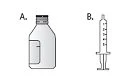
The package contains:
-
One bottle containing granules for oral suspension, with child-resistant cap.
-
One syringe.
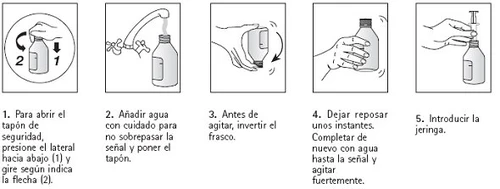
Preparation of the suspension
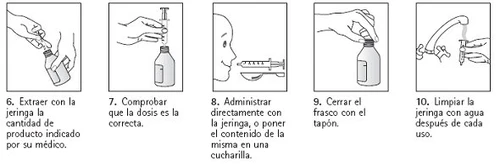
Administration of the dose
Shake well before use
If you take more Denvar than you should
Contact your doctor or pharmacist immediately.
Due to the low toxicity of cefixime, accidental massive ingestion is unlikely to result in intoxication. If it occurs, gastric lavage and symptomatic treatment are recommended. In case of severe allergic reactions, treatment should be symptomatic: adrenaline, corticosteroids, antihistamines.
In case of overdose or accidental ingestion, call the Toxicology Information Service at telephone number 91 562 04 20, indicating the medicine and the amount ingested.
If you forget to take Denvar
Do not take a double dose to make up for forgotten doses. Wait for your next dose and continue treatment as usual.
If you stop treatment with Denvar
Your doctor will advise you on the duration of your treatment with Denvar. Do not stop treatment early, as your symptoms may return.
If you have any further questions about the use of this medicine, ask your doctor or pharmacist.
4. Possible adverse effects
Like all medicines, this medicine can cause adverse effects, although not everyone experiences them.
If they occur, the following may be observed:
Frequent (may affect up to 1 in 10 people):
Diarrhoea, soft stools.
Uncommon (may affect up to 1 in 100 people):
Nausea, vomiting, indigestion, abdominal pain, urticaria, skin redness, rash, exanthema, headache, reversible increases in liver enzymes in the blood.
Rare (may affect up to 1 in 1,000 people):
Loss of appetite, flatulence, itching, mucosal inflammation, dizziness, fever, hypersensitivity reactions such as flushing, palpitations, difficulty breathing, decreased blood pressure, facial oedema, transient increase in blood urea concentration, pathogen resistance, predisposition to superinfections by fungi and resistant bacteria in case of prolonged administration, blood disorders (eosinophilia, increase in a type of blood cell).
Very rare (may affect up to 1 in 10,000 people):
Inflammation of the large intestine, toxic skin disorders (Stevens-Johnson syndrome, erythema multiforme), blood disorders (leucopenia, agranulocytosis, pancytopenia, thrombocytopenia, coagulation disorders, anaemia and other changes in blood count), transient hyperactivity, allergic shock, serum sickness-like reactions (e.g., joint pain and swelling, muscle pain, urticaria, etc.), hepatitis, yellowing of the skin, renal disorders.
Frequency not known (cannot be estimated from available data):
DRESS syndrome (drug reaction with eosinophilia and systemic symptoms), granulocytopenia (reduction in granulocyte white blood cells), increased bilirubin in blood (which may cause yellowing of the skin), acute renal failure including tubulointerstitial nephritis (a type of kidney inflammation).
An increased predisposition to seizures cannot be excluded.
Reporting of adverse effects
If you experience any type of adverse effect, consult your doctor or pharmacist, even if it is a possible adverse effect not listed in this leaflet. You may also report them directly via the Spanish Pharmacovigilance System for Human Medicinal Products: www.notificaRAM.es. By reporting adverse effects, you can help provide more information on the safety of this medicine.
5. Storage of Denvar
Keep this medicine out of the sight and reach of children.
Do not use this medicine after the expiry date stated on the packaging after EXP. The expiry date refers to the last day of the month indicated.
Before reconstitution, store below 25°C.
After reconstitution, store in the refrigerator (between 2°C and 8°C). The reconstituted suspension is valid for 14 days. Discard any unused product after this period. Record the day and month of reconstitution in the box provided for this purpose.
Medicines must not be disposed of via wastewater or household waste. Return unused medicines and their containers to your pharmacy’s SIGRE collection point. If you are unsure, ask your pharmacist how to dispose of unused medicines and their packaging. This will help protect the environment.
6. Contents of the container and other information
Composition of Denvar
-
The active substance is cefixime. Each 5 ml of reconstituted suspension contains 100 mg of
cefixime (as trihydrate). -
The other components (excipients) are sucrose, xanthan gum, strawberry flavour (contains maltodextrin derived from wheat) (see section 2), sodium benzoate (E 211).
Appearance of the product and contents of the container
Denvar is presented in containers with a granulate for preparing an oral suspension.
There are 2 container sizes: container with 1 g of cefixime to prepare 50 ml of oral suspension and container with 2 g of cefixime to prepare 100 ml of oral suspension.
The containers also contain a graduated syringe for administering the reconstituted medicine.
Marketing Authorization Holder
Merck, S.L.
María de Molina, 40
28006 Madrid
Spain
Manufacturer
Merck, S.L.
Polígono Merck
08100 Mollet del Vallés (Barcelona)
Spain
Date of the most recent review of this leaflet: 06/2022
Detailed and up-to-date information on this medicine is available on the website of the Spanish Agency of Medicines and Medical Devices (AEMPS): http://www.aemps.gob.es