Demilos 600 mg/1000 IU orodispersible tablets
Spain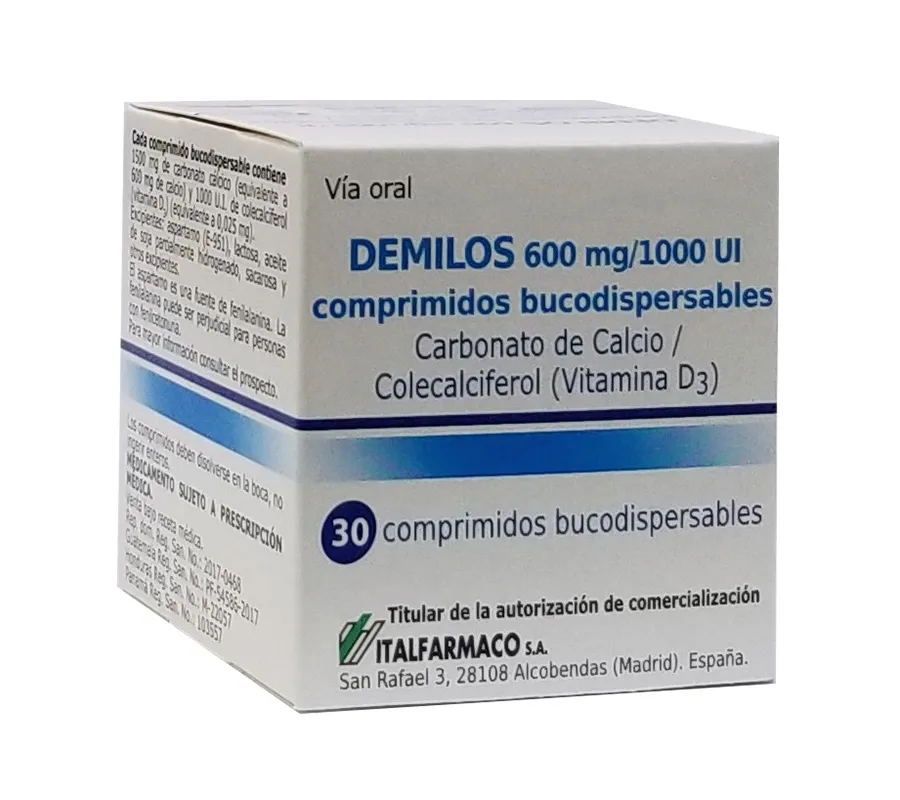
Table of Contents
- Patient Information Leaflet
- Introduction
- **Read the entire leaflet carefully before starting to take this medicine, as it contains important information for you.**
- **Package leaflet contents**
- 1. What Demilos is and what it is used for
- 2. What you need to know before starting to take Demilos
- **Do not take Demilos**
- **Warnings and precautions**
- **Other medicines and Demilos**
- **Taking Demilos with food, drinks, and alcohol:**
- **Pregnancy, lactation and fertility:**
- 3. How to take Demilos
- **If you take more Demilosdel than you should**
- **Symptoms of a Demilos overdose may include loss of appetite, thirst, abnormal production of large amounts of urine, nausea, vomiting, and constipation.**
- **If you forget to take Demilos**
- 4. Possible adverse effects
- 5. Storage of Demilos
- 6. Contents of the pack and other information
- **Composition of Demilos**
- **Appearance of the product and contents of the container**
- **Marketing Authorization Holder and Manufacturing Responsible Party:**
Patient Information Leaflet
Introduction
Patient Information Leaflet
Demilos 600 mg/1,000 IU orodispersible tablets
calcium carbonate/colecalciferol
Read the entire leaflet carefully before starting to take this medicine, as it contains important information for you.
- Keep this leaflet, as you may need to read it again.
- If you have any questions, consult your doctor, pharmacist, or nurse.
- This medicine has been prescribed for you only, and you should not give it to others, even if they have the same symptoms as you, because it may harm them.
- If you experience any adverse effects, consult your doctor, pharmacist, or nurse, even if the effects are not listed in this leaflet. See section 4.
Package leaflet contents
- What Demilos is and what it is used for
- What you need to know before taking Demilos
- How to take Demilos
- Possible side effects
- How to store Demilos
- Contents of the pack and other information
1. What Demilos is and what it is used for
Demilos is used to prevent and treat calcium or vitamin D3 deficiency in elderly individuals and as an additional treatment in osteoporosis in patients at risk of vitamin D or calcium deficiency, when dietary supplementation with 600 mg/day of calcium and 1,000 IU/day of vitamin D3 is appropriate.
Demilos contains calcium and vitamin D3, both important components in bone formation. Vitamin D3 regulates the absorption and metabolism of calcium as well as the incorporation of calcium into bone tissue.
If you have any doubts, consult your doctor or pharmacist and always follow their instructions.
Consult a doctor if your condition worsens or does not improve after a few days.
2. What you need to know before starting to take Demilos
Do not take Demilos
- If you are allergic to calcium, vitamin D, or any of the other ingredients of this medicine (listed in section 6).
- If you have hypercalcemia (high levels of calcium in the blood) or hypercalciuria (high levels of calcium in the urine).
- If you have hypervitaminosis D (high levels of vitamin D in the blood).
- If you have kidney stones.
- If you have renal failure.
- If you are allergic to soy or peanuts.
Warnings and precautions
Consult your doctor or pharmacist before starting to take Demilos
- If you have sarcoidosis (a specific type of connective tissue disease affecting the lungs, skin, and joints).
- If you are taking other medications containing vitamin D or calcium.
- If your kidneys are not functioning properly or you have a tendency to develop kidney stones.
- If you are immobilized due to osteoporosis.
Other medicines and Demilos
Inform your doctor or pharmacist if you are taking, have recently taken, or might need to take any other medicines.
The effect of treatment may be affected if this medicine is taken at the same time as other medicines used for:
- high blood pressure (thiazide diuretics),
- heart problems (cardiac glycosides such as digoxin),
- high cholesterol (cholestyramine),
- constipation (laxatives such as liquid paraffin),
- epilepsy (phenytoins or barbiturates),
- inflammatory diseases/immunosuppression (corticosteroids),
- obesity (orlistat).
Please ensure your doctor knows if you are taking any of the medicines listed above. Your dose may need to be adjusted.
If you take at the same time a medicine for
- osteoporosis (bisphosphonates),
you should take it at least one hour before taking Demilos.
If you take at the same time medicines for
- infections (quinolones),
you should take them two hours before or six hours after taking Demilos.
If you take at the same time medicines for
- infections (tetracyclines),
you should take them two hours before or six hours after taking Demilos.
If you take at the same time medicines for
- dental caries (sodium fluoride)
- anaemia (iron)
you should take these medicines at least three hours before taking Demilos.
If you take at the same time medicines for
- hypothyroidism (levotiroxine),
you should separate the administration of Demilos by at least four hours.
Taking Demilos with food, drinks, and alcohol:
Calcium absorption may be inhibited by foods containing oxalic acid (found in spinach and rhubarb) or phytic acid (found in whole grains). You should wait at least two hours before taking Demilos if you have consumed foods high in oxalic acid or phytic acid.
Pregnancy, lactation and fertility:
During pregnancy, daily intake should not exceed 1500 mg of calcium and 600 IU of vitamin D. Therefore, taking Demilos during pregnancy is not recommended.
Demilos may be taken during lactation. Calcium and vitamin D3 are excreted in breast milk. This should be taken into account when additional vitamin D is administered to the nursing infant.
If you are pregnant or breastfeeding, think you may be pregnant, or are planning to become pregnant, consult your doctor before using this medicine.
Driving and use of machinery
No effects on the ability to drive and use machines have been observed. |
Demilos contains aspartame
This medicine contains 8.67 mg of aspartame in each tablet. Aspartame contains a source of phenylalanine, which may be harmful if you have phenylketonuria (PKU), a rare genetic disorder in which phenylalanine accumulates because the body cannot properly eliminate it.
Demilos contains lactose and sucrose
If your doctor has informed you of an intolerance to certain sugars, consult with him before taking this medicine. It may harm your teeth.
3. How to take Demilos
Follow exactly the instructions for use of this medicine given by your doctor or pharmacist. If in doubt, consult your doctor or pharmacist again.
The dose is individually determined by your doctor.
The recommended dose is 1 tablet daily.
The tablets must be dissolved in the mouth. They must not be swallowed whole.
The tablets should preferably be taken after meals.
The amount of calcium in Demilos is lower than the daily intake usually recommended. Therefore, Demilos is recommended for patients who require an additional supply of vitamin D, but who have a daily intake of 500–1,000 mg of calcium. The calcium dose recommended for you must be determined by your doctor.
Use in children and adolescents
Demilos is not indicated in children and adolescents.
If you take more Demilosdel than you should
If you have taken more Demilos than you should, consult your doctor or pharmacist immediately or call the Toxicology Information Service at telephone number 91 562 04 20, indicating the medication and the amount ingested.
Symptoms of a Demilos overdose may include loss of appetite, thirst, abnormal production of large amounts of urine, nausea, vomiting, and constipation.
If you forget to take Demilos
Take it as soon as you remember. Then, take your next dose at the usual time. However, if it is already time for your next dose, skip the missed dose and continue with your regular schedule. Do not take a double dose to make up for forgotten doses.
If you have any further questions about the use of this medicine, ask your doctor or pharmacist.
4. Possible adverse effects
Like all medicines, this medicine can cause adverse effects, although not everyone experiences them.
You must stop taking Demilos and inform your doctor immediately if you experience symptoms of severe allergic reactions such as:
- Swelling of the face, lips, tongue, or throat
- Difficulty swallowing
- Hives and difficulty breathing.
Uncommon adverse effects (may affect up to 1 in 100 people): hypercalcemia (elevated calcium levels in serum) and/or hypercalciuria (elevated calcium levels in urine).
Rare adverse effects (may affect up to 1 in 1,000 patients): constipation, flatulence, nausea, abdominal pain, diarrhoea, pruritus, rash, and urticaria.
Adverse effects with unknown frequency (frequency cannot be estimated from available data): serious allergic reactions.
Other special populations
Patients with renal insufficiency may have a potential risk of hyperphosphatemia, nephrolithiasis, and nephrocalcinosis.
Reporting of adverse effects
If you experience any type of adverse effect, consult your doctor or pharmacist, even if it is a possible adverse effect not listed in this leaflet. You may also report them directly via the Spanish Pharmacovigilance System for Human Medicines: https://www.notificaram.es. By reporting adverse effects, you can help provide more information on the safety of this medicine.
5. Storage of Demilos
Keep this medicine out of sight and reach of children.
Keep the container tightly closed.
Do not use this medicine after the expiry date stated on the container, after EXP. The expiry date refers to the last day of the month indicated.
Store in the original container to protect from light.
Keep the container tightly closed to protect from moisture.
The shelf life is 60 days after first opening.
Do not use this medicine if you notice any visible signs of deterioration.
Medicines must not be disposed of via wastewater or household waste. Return unused medicines and their containers to the SIGRE Point at your pharmacy. If in doubt, ask your pharmacist how to dispose of medicines and containers you no longer need. This will help protect the environment.
6. Contents of the pack and other information
Composition of Demilos
The active substances are calcium carbonate 1500 mg, corresponding to 600 mg of calcium, and colecalciferol (vitamin D3). Each tablet contains 1,500 mg of calcium carbonate, equivalent to 600 mg of calcium, and 1,000 IU of colecalciferol, equivalent to 0.025 mg.
The other components are: maltodextrin, aspartame (E951), low-substituted hydroxypropylcellulose (E-463), monohydrate lactose, anhydrous citric acid (E330), orange flavor, stearic acid, ALL-rac-α-tocopherol (E 307), partially hydrogenated soybean oil, gelatin, sucrose, corn starch, and silicon dioxide.
Appearance of the product and contents of the container
Demilos is presented as white or almost white, round, bevelled orodispersible tablets.
Bottle of 30 or 60 tablets.
Only some pack sizes may be marketed.
Marketing Authorization Holder and Manufacturing Responsible Party:
Marketing Authorization Holder:
ITALFARMACO, S.A.
C/ San Rafael, 3
28108 Alcobendas, Madrid
Spain
Tel.: 91 657 23 23
Manufacturing Responsible Party:
ITALFARMACO, S.p.A.
Viale Fulvio Testi 330
20126 Milan
Italy
This medicinal product is authorized in the Member States of the European Economic Area under the following names:
Spain: Demilos 600mg/ 1000 IU buccodispersable tablets
France: Demilos 600mg/ 1000 UI orodispersible tablets
Italy: Dincrel 600mg/ 1000 UI orodispersible tablets
Ireland: Cadelius 600 mg/1,000 IU orodispersible tablets
Portugal: Demilos 600 mg + 1000 IU orodispersible tablets
Date of the most recent review of this leaflet: January 2022
Detailed and up-to-date information on this medicinal product is available on the website of the Spanish Agency of Medicines and Health Products (AEMPS) http://www.aemps.gob.es/gob/).