Decentan 8 mg tablets
Spain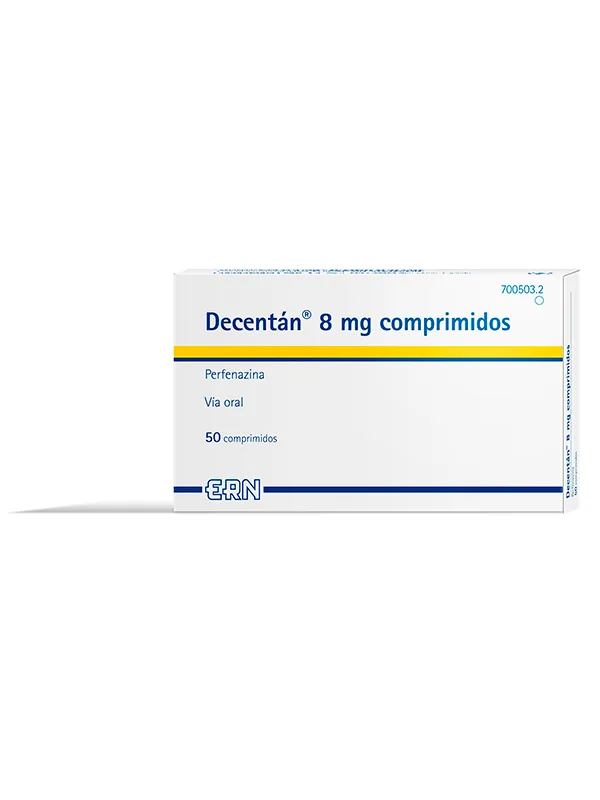
Table of Contents
Package leaflet: Information for the user
Introduction
Package leaflet: information for the user
Decentán 8 mg tablets
Perphenazine
Read the entire leaflet carefully before you start using this medicine, because it contains important information for you.
- Keep this leaflet, as you may need to read it again.
- If you have any questions, ask your doctor or pharmacist.
- This medicine has been prescribed for you only and must not be given to other people, even if they have the same symptoms as you, because it could harm them.
- If you experience any adverse effects, consult your doctor or pharmacist, even if they are adverse effects not listed in this leaflet. See section 4.
Contents of the leaflet:
- What Decentán is and what it is used for
- What you need to know before taking Decentán
- How to take Decentán
- Possible side effects
- How to store Decentán
- Contents of the pack and other information
1. What Decentán is and what it is used for
Decentán is a medicine whose active substance is perphenazine –a phenothiazine derivative– which belongs to a group of medicines called antipsychotics.
It is indicated for the treatment of acute psychotic syndromes, catatonic syndromes, delirium, and other exogenous psychotic syndromes, as well as psychomotor agitation.
2. What you need to know before taking Decentán
Do not take Decentán
- If you are allergic or have had any allergic reaction to perphenazine or to any of the other components of this medicine (listed in section 6).
- If you have severe depression.
- In cases of coma.
- In cases of alcohol intoxication and/or with hypnotic, tranquilizing, and antidepressant medications.
- If you have serious blood cell disorders (e.g., decreased white blood cells) or bone marrow conditions.
- If you suffer from severe liver disease.
- If you have heart diseases, slow heart rate, certain electrocardiogram abnormalities, or other heart disorders (congenital QT prolongation syndrome, coronary artery disease, conduction disorders—arrhythmias).
- If you are taking other medicines that also cause electrocardiogram abnormalities (QT interval prolongation).
Warnings and precautions
- If you have low potassium levels in the blood. If you are taking other medicines that cause low blood potassium levels and/or increase perphenazine blood levels.
- If you have serious low blood pressure problems or orthostatic circulatory disorders (related to sudden changes in position).
- If you suffer from any disease related to the blood-forming system.
- In patients at risk of venous thromboembolism (a blood vessel disorder related to clot formation blocking the vessels).
- If you are taking high doses of Decentán and are especially sensitive to this medicine, as you may develop certain types of arrhythmias.
- If you have kidney disease.
- If you have been diagnosed with a breast tumor.
- If you have pheochromocytoma (a certain type of tumor in the adrenal gland).
- If you have any liver disorder.
- If you have any thyroid-related disease.
- If you have chronic respiratory problems or asthma.
- If you have gastrointestinal stenosis (narrowing at any point of the esophagus, stomach, or intestines).
- If you have closed-angle glaucoma (an eye disease causing increased pressure inside the eye).
- If you have prostate problems.
- Elderly patients with significant general health deterioration. It should be noted that Decentán is not indicated for the treatment of behavioral disorders associated with dementia (a brain disorder causing memory loss, affecting language and attention, among others), and extreme caution should be exercised, especially in elderly patients with dementia (increased risk of death).
- Extreme caution should be exercised if Decentán is administered to patients with risk factors for cerebrovascular adverse events (e.g., cerebrovascular disease or embolism), particularly if they have dementia.
- If you suffer from any brain disorder or brain damage (e.g., Parkinson's disease).
- If you have or have ever had epilepsy.
- If you suffer from depression.
- If, while taking Decentán, you develop fever and muscle stiffness, contact your doctor immediately.
- If you have any disease causing muscle weakness (myasthenia gravis).
Decentán must be used under strict medical supervision.
Children and adolescents
Administration in children should only occur exceptionally, and extreme caution is recommended due to the risk of neurological adverse effects.
Other medicines and Decentán
Inform your doctor or pharmacist if you are taking, have recently taken, or might need to take any other medicine.
- Using Decentán together with medicines that also act on the central nervous system (psychotropic drugs, hypnotics, some analgesics, narcotics) or other medicines such as antihistamines (used for allergies or colds) may enhance the effects of these medicines more than expected.
- Decentán may increase the adverse effects caused by some antidepressants (e.g., delirium).
- If you take Decentán with medicines known as selective serotonin reuptake inhibitors (e.g., fluoxetine or paroxetine), your doctor may need to reduce your Decentán dose, as these medicines increase perphenazine blood levels.
- You should not take Decentán with medicines that alter the electrocardiogram, such as: antiarrhythmics, macrolide antibiotics, antimalarial medicines, antihistamines, antidepressants, or other neuroleptics; with medicines that reduce blood potassium levels (e.g., specific diuretics); or with medicines that decrease the metabolism of Decentán in the liver (e.g., certain antidepressants (monoamine oxidase inhibitors and selective serotonin reuptake inhibitors), antifungal imidazoles).
- The effects of Decentán may decrease if you take biperiden (a medicine used for Parkinson's disease) or antiepileptic medicines (e.g., barbiturates, carbamazepine).
- If you take Decentán with medicines that lower blood pressure, you may experience: dizziness, seeing "black spots," and increased heart rate.
- Also, the blood pressure-lowering effect of guanethidine, clonidine, and alpha-methyldopa may be weaker if you take Decentán.
- Concomitant use of Decentán and medicines containing reserpine is not recommended.
- For the treatment of hypotension (low blood pressure), adrenaline (epinephrine) should not be administered together with Decentán, as adrenaline administration may lead to a further drop in blood pressure.
- Concurrent use of Decentán and anticonvulsant medicines such as barbiturates or carbamazepine increases the metabolism of phenothiazines.
- Concurrent use of Decentán and phenytoin may lead to increased blood levels of phenytoin, reaching toxic levels.
- Concurrent use of Decentán and clozapine may cause blood disorders.
- Concurrent use of Decentán and propranolol leads to increased blood levels of both medicines.
- Decentán reduces the effect of medicines used to treat Parkinson's disease such as: bromocriptine, amantadine, levodopa, while increasing the effect of anti-nausea and anti-vomiting medicines such as: metoclopramide, bromopride, alizapride.
- Concurrent use of Decentán and pentetrazol may cause epileptic seizures.
- Concurrent use of Decentán and medicines containing piperazine increases the risk of adverse effects related to involuntary movements (muscle tone disorders), chorea (convulsions), as does concurrent use of Decentán and lithium salts, although in the latter case, lithium blood levels may also increase and, very rarely, reach neurotoxic levels.
- Decentán increases the effect of oral anticoagulants.
- Caffeine is believed to counteract the antipsychotic effects of Decentán.
- Decentán may potentiate respiratory depression caused by certain antibiotics such as: capreomycin, colistin, and polymyxin B.
- Decentán may cause a reduction in the effect of gonadorelin.
- In diabetic patients treated with insulin who take Decentán (especially at high doses), blood glucose control may become unstable, requiring appropriate dietary measures, treatment with other medicines, or adequate adjustment of antidiabetic agents.
- Alcohol consumption should be avoided during treatment with Decentán.
Pregnancy, breastfeeding, and fertility
If you are pregnant or breastfeeding, think you might be pregnant, or plan to become pregnant, consult your doctor or pharmacist before using this medicine.
Pregnancy
Decentán should not be used during the first trimester of pregnancy. During the second and third trimesters, your doctor should prescribe Decentán only if strictly necessary, considering the potential risks to both mother and child. If Decentán therapy is essential, note that Decentán may worsen constipation, a common condition during pregnancy. Also, the effect on the mother's blood pressure may affect placental circulation. Decentán should not be used during the last ten days of pregnancy to avoid extrapyramidal symptoms (movement disorders) or withdrawal symptoms in newborns.
If you plan to become pregnant or suspect you are pregnant, contact your doctor immediately.
Breastfeeding
Women who are breastfeeding should consult their doctor before taking this medicine, as perphenazine passes into breast milk. Therefore, if your doctor considers treatment with this medicine essential, discontinuation of breastfeeding should be considered.
Fertility
Decentán may increase levels of a hormone called prolactin, which could affect fertility in both men and women. Consult your doctor if you have any concerns about this.
Warning
Avoid exposure to sunlight (even on cloudy days) and ultraviolet (UVA) lamps while using this medicine.
Driving and using machines
This medicine may cause symptoms such as drowsiness, dizziness, or visual disturbances, and may reduce reaction ability. These effects, as well as the underlying illness, may impair your ability to drive vehicles or operate machinery. Therefore, do not drive, operate machinery, or engage in other activities requiring special attention until your doctor evaluates your response to this medicine.
The effect is even greater if combined with alcohol. Therefore, it is recommended not to take perphenazine and alcohol simultaneously.
Decentán contains lactose
If your doctor has informed you that you have an intolerance to certain sugars, consult with him before taking this medicine.
Effect on laboratory test results
Decentán may cause a false positive result in pregnancy tests.
3. How to take Decentán
Follow exactly the administration instructions for Decentán as indicated by your doctor. Your doctor will determine the duration of treatment and the dose based on the characteristics of your condition and your individual response. If in doubt, consult your doctor or pharmacist again.
In general, an initial dose of 1–3 tablets per day is recommended. The dose should be individually adjusted according to the response achieved.
It is recommended to take Decentán after meals with a little liquid.
If you take more Decentán than you should
In case of overdose or accidental ingestion, contact your doctor or pharmacist immediately or call the Toxicology Information Service at: 91 562 04 20, indicating the medication and the amount taken.
Generally, symptoms of Decentán poisoning only occur at very high doses (above 1,000 mg).
Poisoning symptoms range from drowsiness to coma; occasionally: excitement and delirium, confusion, more rarely epileptic seizures, fever, decreased body temperature (hypothermia), low blood pressure, tachycardia (increased heart rate), electrocardiogram abnormalities, arrhythmia, heart and circulatory failure (rapid onset in cases of severe poisoning), acute dyskinetic symptoms (abnormal involuntary movements: tremors, tics, etc.), tongue protrusion (abnormal protrusion of the tongue), ocular spasms, laryngeal or pharyngeal spasms, blurred vision, glaucoma (an eye disease characterized by increased intraocular pressure), intestinal paralysis, urinary retention, cyanosis (bluish discoloration of the skin and mucous membranes), respiratory depression, and (broncho)pneumonia (lung inflammation causing cough, fever, and difficulty breathing).
Treatment of poisoning should involve gastric lavage and administration of diuretics, analgesics, anti-Parkinson medication, and maintenance of vital functions.
4. Possible adverse effects
Like all medicines, Decentán may produce adverse effects, although not everyone experiences them.
Below are the adverse reactions classified by organ systems and frequencies. The frequencies are defined as: uncommon (between 1 and 100 in every 1,000 patients), rare (between 1 and 1,000 in every 10,000 patients), or very rare (up to 1 in every 10,000 people).
Nervous system and psychiatric disorders
Decentán may cause physical symptoms in hypersensitive patients or if the dose is too high; these symptoms mainly manifest as movement disorders ("extrapyramidal motor disorders").
At the beginning of treatment, the following may occur:
- Early dyskinesias (muscle cramps in the face/mouth, neck, and arms (e.g., torticollis).
- Symptoms similar to those produced by Parkinson's disease (e.g., reduced facial expression, hypokinesia (reduced motor activity, decreased movement), muscle rigidity, tremor).
- Difficulty falling asleep: this effect may be avoided by taking the last dose before 5 p.m.
After a long period of treatment, the following may occur:
- Akathisia (inability to remain still and a compulsion to move around).
- Late-onset dyskinesias (persistent movement disorders such as facial tics or involuntary body movements).
Except for tardive dyskinesia, the movement disorders caused by Decentán are usually reversible or can be corrected by reducing the dose or by adding a medication used for Parkinson's disease. In individual cases, tardive dyskinesias may persist after long-term therapy.
Patients with a predisposition may experience seizures while taking Decentán.
Treatment with Decentán may temporarily cause drowsiness.
Additionally, treatment with Decentán may cause: agitation, excitement, dizziness, headaches, depression, deep and prolonged sleep, delusional syndromes.
A very rare adverse reaction is "neuroleptic malignant syndrome," which causes: fever, muscle rigidity, lack of movement, sweating, excessive salivation, altered consciousness, and coma. This condition requires immediate discontinuation of Decentán and urgent hospitalization.
Blood and lymphatic system disorders
The risk of blood cell disorders (e.g., agranulocytosis) cannot be ruled out, especially during long-term treatment. Therefore, your doctor should perform regular blood tests.
Metabolism and nutrition disorders
Uncommon: weight gain, disturbances in glucose metabolism.
Eye disorders
Uncommon: difficulty focusing vision, increased intraocular pressure (closed-angle glaucoma).
Very rare: pigment deposits in the cornea and lens (during long-term treatment with high doses).
Cardiac disorders
Conduction disturbances (arrhythmias), increased heart rate, increased or decreased blood pressure.
Vascular disorders
Cases of venous thromboembolism (a blood vessel disorder related to clot formation blocking the vessels), including pulmonary embolism (a disease caused by obstruction of blood vessels in the lungs) and deep vein thrombosis (a condition caused by a blood clot forming in a deep vein of the body, usually in the leg veins), have been reported with the use of antipsychotic drugs (frequency not known).
Respiratory, thoracic and mediastinal disorders
Laryngitis, asthma.
Gastrointestinal disorders
Uncommon: dry mouth, constipation.
Rare: gastrointestinal discomfort (e.g., nausea and vomiting, especially after abrupt discontinuation of treatment).
Very rare: intestinal paralysis (paralytic ileus).
Hepatobiliary disorders
Rare: liver disorders (e.g., increased liver enzymes; bile accumulation).
Skin and subcutaneous tissue disorders
Rare: hypersensitivity reactions such as skin rashes, skin discoloration upon exposure to light (increased light sensitivity), and photosensitivity ("sun allergy"), sweating.
Very rare: autoimmune connective tissue disease.
Renal and urinary disorders
Uncommon: urinary dysfunction.
Endocrine disorders
Uncommon: hormonal disorders (e.g., galactorrhea (excessive or abnormal milk secretion), menstrual irregularities, sexual dysfunction).
If you consider any of the adverse effects you experience to be severe, or if you notice any adverse effect mentioned in this leaflet, inform your doctor or pharmacist.
Reporting of adverse effects
If you experience any type of adverse effect, consult your doctor or pharmacist, even if it is a possible adverse effect not listed in this leaflet. You may also report them directly via the Spanish Pharmacovigilance System for Human Medicines: www.notificaram.es. By reporting adverse effects, you can help provide more information on the safety of this medicine.
5. Storage of Decentán
Keep this medicine out of the sight and reach of children.
Do not use Decentán after the expiry date stated on the packaging after EXP. The expiry date refers to the last day of the month indicated.
Store below 30°C and in the original packaging to protect from light.
If you notice slight darkening of the tablets due to exposure to light, this does not affect their shelf life.
Medicines must not be disposed of via wastewater or household waste. Dispose of unused medicines and their containers at the SIGRE collection point at your pharmacy. If in doubt, ask your pharmacist how to properly dispose of unused medicines and their containers. This will help protect the environment.
6. Contents of the pack and other information
Composition of Decentán
- The active substance is perphenazine. Each tablet contains 8 mg of perphenazine.
- The other components are: monohydrate lactose, powdered cellulose, corn starch, anhydrous colloidal silica, sodium carmellose and magnesium stearate.
Appearance of the product and contents of the pack
Decentán is presented as yellowish-white, round, convex tablets with bevelled edges, marked with a cross on one side and an oval shape on the other.
Decentán is available in packs containing 25, 50 or 500 tablets in aluminum–PVC blisters.
Marketing Authorization Holder
LABORATORIOS ERN, S.A.
Perú, 228
08020 Barcelona
Spain
Manufacturer
Merck, S.L.
Polígono Merck
08100 Mollet del Vallés (Barcelona)
Spain
Or
CYNDEA PHARMA, S.L.
Polígono Industrial Emiliano Revilla Sanz
Avenida de Ágreda, 31 - 42110 Ólvega (Soria)
Or
LABORATORIOS ERN, S.A.
Gorgs Lladó, 188
08210 Barberá del Vallés, Barcelona. Spain
Date of the most recent revision of this leaflet: April 2018
Detailed and up-to-date information on this medicinal product is available on the website of the Spanish Agency for Medicines and Health Products (AEMPS) http://www.aemps.gob.es/.