Deanxit film-coated tablets
Spain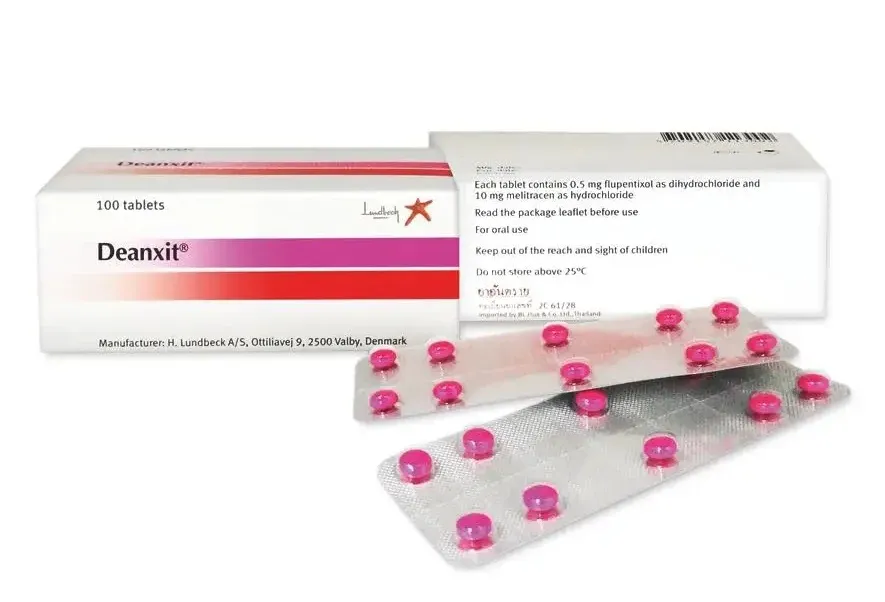
Table of Contents
- Patient Information Leaflet
- Introduction
- 1. What Deanxit is and what it is used for
- 2. What you need to know before starting to take Deanxit
- **Children and adolescents**
- 3. How to take Deanxit
- 4. Possible adverse effects
- 5. Storage of Deanxit
- 6. Contents of the container and other information
- **Appearance of the Product and Contents of the Package**
Patient Information Leaflet
Introduction
Patient Information Leaflet
Deanxit film-coated tablets
Flupentixol 0.5 mg (dihydrochloride) and melitracen 10 mg (hydrochloride)
Read the entire leaflet carefully before you start taking this medicine, as it contains important information for you.
- Keep this leaflet, as you may need to read it again.
- If you have any questions, consult your doctor or pharmacist.
- This medicine has been prescribed for you only and must not be given to other people, even if they have the same symptoms as you, since it could harm them.
- If you experience any adverse effects, consult your doctor or pharmacist, even if they are effects not listed in this leaflet. See section 4.
Leaflet Contents
- What Deanxit is and what it is used for
- What you need to know before taking Deanxit
- How to take Deanxit
- Possible side effects
- How to store Deanxit
- Contents of the pack and further information
1. What Deanxit is and what it is used for
Deanxit contains the active substances flupentixol and melitracen. Deanxit belongs to a group of medicines that relieve symptoms of depressed mood.
The combination of active substances forms a preparation with antidepressant, anxiolytic, and activating properties.
Deanxit is used to treat anxiety and depression in patients with or without psychosomatic symptoms.
2. What you need to know before starting to take Deanxit
Do not take Deanxit:
- If you are allergic to flupentixol, melitracen, or any of the other components of this medicine (listed in section 6).
- If you have reduced level of consciousness
- If you have a blood disorder
- If you have a rare adrenal gland abnormality (pheochromocytoma)
- If you have recently suffered a heart attack (myocardial infarction).
- If you have heart rhythm disturbances that can be seen on an electrocardiogram (ECG).
- If you are simultaneously taking a medication known as monoamine oxidase inhibitors (MAOIs).
MAOIs include medicines such as phenelzine, iproniazid, isocarboxazid, nialamide, tranylcypromine, and moclobemide, all of which are used to treat depression, and selegiline, which is used in the treatment of Parkinson's disease.
Even if you have stopped taking one of the following MAOIs—phenelzine, iproniazid, isocarboxazid, nialamide, or tranylcypromine for depression, or selegiline for Parkinson's disease—a gap of 2 weeks must elapse before starting Deanxit.
At least one day must have passed since discontinuing moclobemide.
Deanxit tablets are not suitable for patients with severe depression, such as those requiring hospitalization or electroconvulsive therapy (ECT), nor are they suitable for excitable or hyperactive patients.
Warnings and precautions
Tell your doctor or pharmacist before starting to take Deanxit if you:
- Have organic brain syndrome (which may result from alcohol or organic solvent intoxication)
- Have a history of seizures
- Have difficulty urinating
- Have an overactive thyroid gland (hyperthyroidism)
- Have a liver or heart disorder
- Are more agitated or hyperactive than normal, as this medicine may increase such feelings
- Have hypokalemia or hypomagnesemia (low potassium or magnesium levels in your blood) or a genetic predisposition to either condition
- Have a history of cardiovascular disorders
- Have diabetes (you may require adjustment of your antidiabetic treatment)
- Have glaucoma (increased intraocular pressure)
- Are scheduled to undergo surgery; it is advisable to discontinue the product several days before the procedure
- Are taking medications known as selective serotonin reuptake inhibitors (SSRIs)
- You or a family member have a history of blood clots, as medicines in this class have been associated with blood clot formation
Children and adolescents
The use of Deanxit is not recommended in children and adolescents.
Elderly patients
In elderly patients with dementia, a slight increase in the number of deaths has been observed among patients taking antipsychotics compared to those not taking these medications.
Suicidal thoughts and worsening of depression or anxiety disorder
If you are depressed and/or suffer from an anxiety disorder, you may occasionally have thoughts of harming yourself or taking your own life. These thoughts may increase when starting antidepressants, as all such medications require time to begin working—usually about two weeks, although in some cases it may take longer.
You may be more likely to experience these types of thoughts:
- If you have previously had thoughts of self-harm or suicide.
- If you are a young adult. Clinical trial data have shown an increased risk of suicidal behavior in psychiatric patients under 25 years of age treated with antidepressants.
If at any time you have thoughts of harming or killing yourself, contact your doctor or go directly to a hospital.
It may be helpful for you to inform a family member or close friend that you are depressed or have an anxiety disorder, and ask them to read this leaflet. You may ask them whether they notice your depression or anxiety worsening, or if they are concerned about changes in your behavior.
Manic episodes
Some patients with bipolar disorder may enter a manic phase. This is characterized by a rapid and excessive flow of ideas, exaggerated euphoria, and excessive physical activity. In such cases, it is important to consult your doctor, as your medication may need to be changed.
Use of Deanxit with other medicines
Inform your doctor or pharmacist if you are taking, have recently taken, or might need to take any other medicines.
Inform your doctor if you are taking any of the following medicines:
- Adrenaline, ephedrine, isoprenaline, noradrenaline, phenylephrine, and phenylpropanolamine (included in some cold remedies).
- Guanethidine and similar medicines (used to lower blood pressure).
- Tricyclic antidepressants.
- Medicines that affect heart rhythm (quinidine, amiodarone, sotalol, dofetilide, thioridazine, erythromycin, terfenadine, astemizole, gatifloxacin, moxifloxacin, cisapride, lithium).
- Medicines that cause disturbances in fluid and electrolyte balance (too little potassium or magnesium in your blood).
- Medicines that increase the concentration of Deanxit in the blood.
- Medicines that cause drowsiness (alcohol, barbiturates, and other sedative medicines).
- Lithium (for prevention and treatment of bipolar disorder).
- Levodopa (for treatment of Parkinson's disease).
Use of Deanxit with food, drinks, and alcohol
Deanxit may enhance the sedative effects of alcohol, leading to increased drowsiness. Alcohol consumption is not recommended during treatment with Deanxit.
Pregnancy, breastfeeding, and fertility
If you are pregnant, breastfeeding, think you may be pregnant, or are planning to become pregnant, consult your doctor or pharmacist before using this medicine.
Pregnancy
If you are pregnant or think you might be pregnant, consult your doctor. Deanxit should not be used during pregnancy unless clearly necessary.
The following symptoms may occur in newborns whose mothers took Deanxit during the third trimester (last three months of pregnancy): tremor, muscle stiffness and/or weakness, sleepiness, agitation, breathing difficulties, and feeding problems.
If your baby shows any of these symptoms, you should contact your doctor.
Breastfeeding
If you are breastfeeding, consult your doctor. You should not use Deanxit during breastfeeding, as small amounts of the medicine may pass into breast milk.
Fertility
Animal studies have shown that Deanxit affects fertility. Please consult your doctor.
Driving and use of machines
Generally, Deanxit does not cause drowsiness; however, if you feel dizzy or sleepy when starting this medicine, do not drive or operate tools or machinery until these effects have subsided.
Deanxit contains lactose
If your doctor has informed you that you have an intolerance to certain sugars, consult with him before taking this medicine.
Deanxit contains sodium
This medicine contains less than 23 mg of sodium (1 mmol) per tablet; hence, it is essentially "sodium-free".
3. How to take Deanxit
Follow exactly the instructions for use of this medicine as given by your doctor or pharmacist. If in doubt, consult your doctor or pharmacist again.
The recommended dose is:
Adults
Usually two tablets per day: 1 in the morning and 1 at midday.
Your doctor may increase the dose to 2 tablets in the morning and 1 at midday.
The maximum dose is 4 tablets per day.
Maintenance dose: generally, 1 tablet in the morning.
Elderly patients (over 65 years of age)
1 tablet in the morning.
Your doctor may increase the dose to 1 tablet in the morning and 1 tablet at midday.
Maintenance dose: generally, 1 tablet in the morning.
Deanxit can be taken with or without food.
Swallow the tablets with a glass of water. Do not chew them.
Duration of treatment
Patients generally respond to Deanxit treatment quite quickly. However, if you have taken the maximum dose for approximately one week and still do not feel better, your doctor may decide to discontinue treatment.
Your doctor will advise you on the duration of your treatment. Continue treatment as recommended by your doctor.
Do not change the dose of this medication without consulting your doctor.
If you take more Deanxit than you should
If you think that you or anyone else may have taken more Deanxit tablets than recommended, contact your doctor immediately or call the Toxicology Information Service at 91 562 04 20, indicating the medication and the amount ingested. Do this even if there are no signs of discomfort or poisoning. Take the Deanxit packaging with you if you go to a doctor or hospital.
Symptoms of overdose include drowsiness, irritability, excitement, hallucinations, dilated pupils, increased heart rate, difficulty urinating, dry mucous membranes, constipation, seizures, fever, unconsciousness, coma, breathing difficulties (bluish skin coloration), irregular heartbeats, heart problems that may cause shortness of breath or swollen ankles, low blood pressure, metabolic acidosis, hypokalemia (low potassium levels which may cause muscle weakness, spasms, or abnormal heart rhythm).
If you forget to take Deanxit
If you forget to take a dose, take the next dose at the scheduled time. Do not take a double dose to make up for the missed dose.
If you stop taking Deanxit
Do not stop taking Deanxit even if you start to feel better, unless your doctor has instructed you to do so.
If you have any further questions about the use of this medicine, ask your doctor or pharmacist.
4. Possible adverse effects
Like all medicines, this medicine can cause adverse effects, although not everyone will experience them.
If you experience any of the following symptoms, you must contact your doctor or go to hospital immediately.
Very rare (may affect up to 1 in 10,000 people):
-
Unusual movements of the mouth and tongue; this may be an early sign of a condition known as tardive dyskinesia.
-
High fever, unusual muscle stiffness, and disturbances in consciousness, especially if accompanied by sweating and rapid heartbeat; these symptoms may be signs of a rare condition called neuroleptic malignant syndrome, which has been reported with the use of various antipsychotics.
-
Yellowing of the skin and whites of the eyes; this may indicate liver involvement and be a sign of a condition known as jaundice.
-
Signs of infection such as unexplained sudden fever, sore throat, and mouth ulcers; these may be signs of a severely reduced white blood cell count and a condition known as agranulocytosis.
Frequency not known (frequency cannot be estimated from available data):
-
Suicidal thoughts or suicidal behaviour; see section “Warnings and precautions”.
-
Blood clots in the veins, particularly in the legs (symptoms include swelling, pain, and redness in the legs), which may travel through blood vessels to the lungs causing chest pain and difficulty breathing.
The following side effects are more pronounced at the beginning of treatment and most of them usually disappear during continued treatment:
Common (may affect up to 1 in 10 people):
-
Difficulty sleeping (insomnia), restlessness
-
Drowsiness, tremors, dizziness
-
Difficulty focusing on objects close to the eye (accommodation disorder)
-
Dry mouth
-
Constipation
-
Fatigue
-
Abnormal heart tracing on electrocardiogram (ECG)
Uncommon (may affect up to 1 in 100 people):
- Nightmares, anxiety, confusion
- Rapid heartbeat (tachycardia), irregular heartbeat (arrhythmia)
- Abnormal liver function tests
- Rash, hair loss (alopecia)
- Muscle pain (myalgia)
- Feeling of weakness
Rare (may affect up to 1 in 1,000 people):
- Nausea
- Digestive problems or discomfort in the upper abdomen (dyspepsia)
Very rare (may affect up to 1 in 10,000 people):
- Low platelet count (thrombocytopenia), reduced white blood cell count (leukopenia)
- Involuntary movements (dyskinesia), tremors, stiffness, and shuffling gait (parkinsonism)
- Liver disease
Not known (frequency cannot be estimated from available data):
- Drug withdrawal syndrome in newborns; also see section “Pregnancy, breastfeeding and fertility”
Reporting of adverse effects
If you experience any type of adverse effect, consult your doctor, pharmacist, or nurse, even if it is a possible adverse effect not listed in this leaflet. You may also report them directly via the Spanish Pharmacovigilance System for Human Medicines: https://www.notificaram.es. By reporting adverse effects, you can help provide more information on the safety of this medicine.
5. Storage of Deanxit
Keep this medicine out of sight and reach of children.
Do not use this medicine after the expiry date stated on the label. The expiry date refers to the last day of the month indicated.
This medicine does not require any special storage temperature conditions.
Keep in the original container to protect it from light.
Medicines must not be disposed of via wastewater or household waste. Dispose of unused medicines and their containers at the SIGRE point at your pharmacy. Ask your pharmacist how to properly dispose of medicines you no longer need. This way, you will help protect the environment.
6. Contents of the container and other information
Composition of Deanxit
The active substances are flupentixol and melitracen.
Each film-coated tablet of Deanxit contains flupentixol dihydrochloride equivalent to 0.5 mg of flupentixol and melitracen hydrochloride equivalent to 10 mg of melitracen.
Other components are: betadex, monohydrate lactose, corn starch, hydroxypropylcellulose, microcrystalline cellulose, sodium croscarmellose, talc, hydrogenated vegetable oil, magnesium stearate.
Coating: poly(vinyl alcohol), macrogol 3350, talc, macrogol 6000.
Colourants: titanium dioxide E171, erythrosine E127, indigo carmine E132.
Appearance of the Product and Contents of the Package
Deanxit film-coated tablets are pink-colored, round and biconvex.
Deanxit tablets are available in blister packs or plastic containers in the following package sizes:
30, 50 and 100 in blister packs
100 in plastic containers
Not all package sizes may be marketed.
Marketing Authorization Holder and Manufacturer
Marketing Authorization Holder:
Lundbeck España, S.A.
Av. Diagonal, 605.
E-08028 Barcelona.
Spain
Manufacturer:
- Lundbeck A/S
Ottiliavej 9
2500 Valby
Denmark
Date of Most Recent Review of this Package Leaflet: March 2021
Detailed and up-to-date information on this medicinal product is available on the website of the Spanish Agency for Medicines and Health Products (AEMPS) http://www.aemps.gob.es/