Daxas 250 micrograms tablets
Spain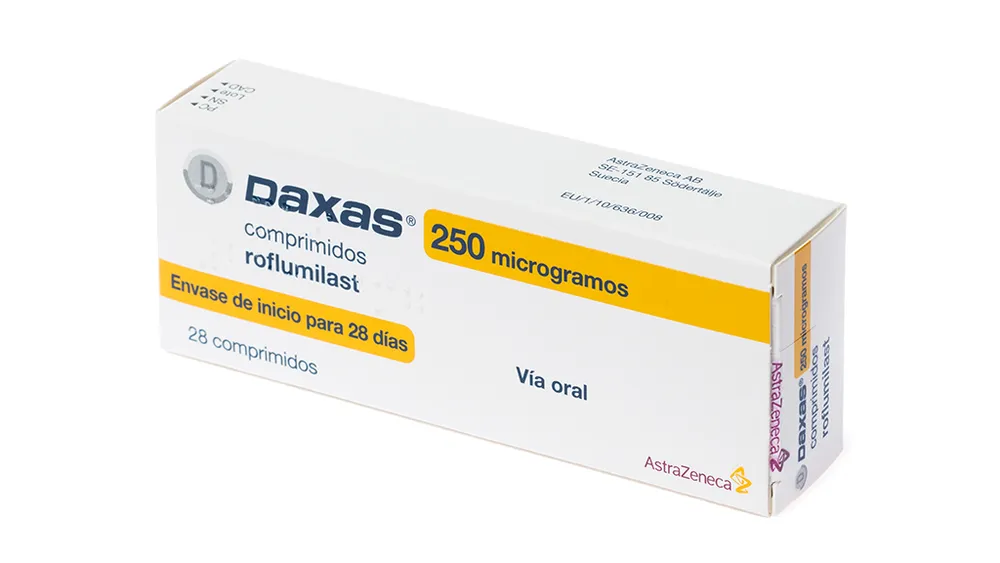
Table of Contents
Package leaflet: Information for the user
Introduction
Package leaflet: Information for the patient
Daxas 250 micrograms tablets
roflumilast
Read the entire leaflet carefully before you start taking this medicine, because it contains important information for you.
- Keep this leaflet as you may need to read it again.
- If you have any questions, ask your doctor or pharmacist.
- This medicine has been prescribed for you only, and you should not give it to other people even if they have the same symptoms as you, because it may harm them.
- If you experience any adverse effects, consult your doctor or pharmacist, even if they are possible adverse effects not listed in this leaflet. See section 4.
Leaflet contents
- What Daxas is and what it is used for
- What you need to know before taking Daxas
- How to take Daxas
- Possible adverse effects
- How to store Daxas
- Contents of the pack and other information
1. What Daxas is and what it is used for
Daxas contains the active substance roflumilast, which is a phosphodiesterase-4 inhibitor anti-inflammatory. Roflumilast reduces the activity of phosphodiesterase-4, a protein naturally found in the body's cells. When the activity of this protein is reduced, inflammation in the lungs decreases. This helps prevent the narrowing of the airways that occurs in chronic obstructive pulmonary disease (COPD). Therefore, Daxas relieves breathing problems.
Daxas is used for the maintenance treatment of severe COPD in adults who have had frequent episodes of worsening COPD symptoms in the past (so-called exacerbations), and who have chronic bronchitis. COPD is a chronic lung disease that results in narrowing of the airways (obstruction) and swelling and irritation of the walls of the small airways in the lungs (inflammation). This leads to symptoms such as cough, wheezing, chest tightness, or difficulty breathing. Daxas should be used in combination with bronchodilators.
2. What you need to know before taking Daxas
Do not take Daxas
- if you are allergic to roflumilast or to any of the other ingredients of this medicine (listed in section 6)
- if you have moderate or severe liver problems.
Warnings and precautions
Talk to your doctor or pharmacist before starting to take Daxas.
Sudden episodes of dyspnea (difficulty breathing)
Daxas is not intended for the treatment of acute episodes of dyspnea (acute bronchospasm). To relieve a sudden episode of dyspnea, it is very important that your doctor provides you with another medicine, which you must always have available to manage such episodes. Daxas will not help you in these situations.
Body weight
You should check your weight periodically. Consult your doctor if, while taking this medicine, you experience unintentional weight loss (not due to diet or an exercise program).
Other diseases
Daxas is not recommended if you have one or more of the following conditions:
- severe immunological diseases such as HIV infection, multiple sclerosis (MS), systemic lupus erythematosus (SLE), or progressive multifocal leukoencephalopathy (PML)
- acute and severe infectious diseases such as acute hepatitis
- cancer (except patients with basal cell carcinoma, a type of slow-growing skin cancer)
- severe heart disease
There is limited experience with Daxas in these conditions. If you are diagnosed with any of these diseases, consult your doctor.
Experience with the use of Daxas in patients with a previous diagnosis of tuberculosis, viral hepatitis, viral herpes, or herpes zoster is also limited. Consult your doctor if you have any of these conditions.
Symptoms you should be aware of
During the first weeks of treatment with Daxas, you may experience diarrhea, nausea, abdominal pain, or headache. If these adverse effects do not resolve within the first few weeks of treatment, consult your doctor.
Daxas is not recommended in patients with a history of depression associated with suicidal thoughts or behavior. You may also experience difficulty sleeping, anxiety, restlessness, or depression. Before starting treatment with Daxas, inform your doctor if you have any of these symptoms or if you are taking any additional medication that could increase the likelihood of these adverse effects. You or your caregivers should immediately inform your doctor of any changes in behavior or mood, or any suicidal thoughts you may have.
Children and adolescents
Do not give this medicine to children or adolescents under 18 years of age.
Other medicines and Daxas
Tell your doctor or pharmacist if you are taking, have recently taken, or might need to take any other medicines, especially the following:
- a medicine containing theophylline (a medicine used to treat respiratory diseases), or
- a medicine used to treat immunological diseases, such as methotrexate, azathioprine, infliximab, etanercept, or long-term oral corticosteroids.
- a medicine containing fluvoxamine (a medicine to treat anxiety and depression), enoxacin (a medicine to treat bacterial infections), or cimetidine (a medicine to treat stomach ulcer or acid reflux).
The effect of Daxas may be reduced if taken together with rifampicin (an antibiotic) or with phenobarbital, carbamazepine, or phenytoin (medicines commonly used to treat epilepsy). Consult your doctor.
Daxas can be used together with other medicines for the treatment of COPD, such as bronchodilators and inhaled or oral corticosteroids. Do not stop taking these medicines or reduce their doses unless instructed by your doctor.
Pregnancy and breastfeeding
If you are pregnant or breastfeeding, think you may be pregnant, or plan to become pregnant, consult your doctor or pharmacist before using this medicine.
You must not become pregnant during treatment with this medicine and should use an effective method of contraception during treatment, as Daxas may be harmful to the fetus.
Driving and using machines
The effect of Daxas on the ability to drive and use machines is negligible or none.
Daxas contains lactose
If your doctor has informed you that you have an intolerance to certain sugars, consult with him before taking this medicine.
3. How to take Daxas
Follow exactly the instructions given by your doctor for taking this medicine. If in doubt, consult your doctor or pharmacist again.
-
During the first 28 days – the recommended initial dose is one 250 microgram roflumilast tablet once daily.
- The initial dose is a low dose used to help your body get used to the medicine before starting the full dose. With this low dose, you will not obtain the full effect of the medicine; therefore, it is important that you switch to taking the full dose (called the “maintenance dose”) after 28 days.
-
After 28 days – the recommended maintenance dose is one 500 microgram tablet once daily.
Take the tablet with water. You may take it with or without food. Take it every day at the same time.
It may take several weeks before Daxas produces its beneficial effect.
If you take more Daxas than you should
If you have taken more tablets than you should, you may experience the following symptoms: headache, nausea, diarrhoea, dizziness, palpitations, confusion, mucus secretion, and low blood pressure. Contact your doctor or pharmacist immediately. If possible, bring the medicine and this leaflet with you.
If you forget to take Daxas
If you forget to take a tablet at your usual time, take it as soon as you remember on the same day. If you have forgotten to take it for a whole day, continue taking your normal dose the next day. Keep taking the medicine at your usual time. Do not take a double dose to make up for a forgotten dose.
If you stop taking Daxas
It is important that you continue taking Daxas for the period indicated by your doctor in order to control lung function, even if your symptoms improve or stop.
If you have any further questions about the use of this medicine, ask your doctor or pharmacist.
4. Possible adverse effects
Like all medicines, this medicine can cause adverse effects, although not everyone experiences them.
You may experience diarrhoea, nausea, stomach pain or headache during the first weeks of treatment with Daxas. If these adverse effects do not resolve after the first few weeks of treatment, consult your doctor.
Some adverse effects may be serious. In clinical studies and post-marketing experience, rare cases of suicidal thoughts and behaviour (including suicide) have been reported. Inform your doctor immediately if you experience any suicidal thoughts. You may also experience insomnia (frequent), anxiety (uncommon), restlessness (rare), panic attacks (rare), or depressed mood (rare).
In uncommon cases, allergic reactions may occur. Allergic reactions may affect the skin and, in rare instances, cause swelling of the eyelids, face, lips and tongue, which may lead to breathing difficulties or a drop in blood pressure and rapid heartbeat. If you experience an allergic reaction, stop taking Daxas immediately and contact your doctor right away or go immediately to the nearest hospital emergency department. Take all your medicines and this leaflet with you and provide full information about your current medication.
Other adverse effects include the following:
Frequent adverse effects (may affect up to 1 in 10 people)
- diarrhoea, nausea, stomach pain
- weight loss, decreased appetite
- headache.
Uncommon adverse effects (may affect up to 1 in 100 people)
- tremor, sensation of spinning (vertigo), dizziness
- awareness of fast or irregular heartbeat (palpitations)
- gastritis, vomiting
- acid reflux from stomach to throat (acid regurgitation), indigestion
- rash
- muscle pain, muscle weakness or cramps
- back pain
- feeling weak or tired; general malaise.
Rare adverse effects (may affect up to 1 in 1,000 people)
- enlargement of breast glands in men
- loss of taste sensation
- respiratory tract infections (excluding pneumonia)
- blood in stools, constipation
- elevated liver and muscle enzymes (seen in blood tests)
- hives (urticaria).
Reporting of adverse effects
If you experience any type of adverse effect, talk to your doctor or pharmacist, even if it is a possible adverse effect not listed in this leaflet. You can also report them directly through the national reporting system detailed in Appendix V. By reporting adverse effects, you can help provide more information on the safety of this medicine.
5. Storage of Daxas
Keep this medicine out of the sight and reach of children.
Do not use this medicine after the expiry date stated on the carton and blister, following “CAD/EXP”. The expiry date refers to the last day of the month indicated.
This medicine does not require any special storage conditions.
Medicines should not be disposed of via wastewater or household waste. Ask your pharmacist how to properly dispose of unused medicines and their packaging. This will help protect the environment.
6. Contents of the pack and other information
Composition of Daxas
The active substance is roflumilast.
Each Daxas 250 microgram tablet contains 250 micrograms of roflumilast. The other components are lactose monohydrate (see section 2, "Daxas contains lactose"), corn starch, povidone, and magnesium stearate.
Appearance of the product and contents of the pack
Daxas 250 microgram tablets are white or off-white, with "D" engraved on one side and "250" on the other.
Each pack contains 28 tablets.
Marketing Authorization Holder
AstraZeneca AB
SE-151 85 Södertälje
Sweden
Manufacturer
Corden Pharma GmbH
Otto-Hahn-Strasse 1
68723 Plankstadt
Germany
Further information on this medicinal product is available upon request by contacting the local representative of the Marketing Authorization Holder:
Belgium/Belgium/Belgium AstraZeneca S.A./N.V. Tel: +32 2 370 48 11 | Lithuania UAB AstraZeneca Lietuva Tel: +370 5 2660550 |
| Luxembourg/Luxembourg AstraZeneca S.A./N.V. Tél/Tel: +32 2 370 48 11 |
Czech Republic AstraZeneca Czech Republic s.r.o. Tel: +420 222 807 111 | Hungary AstraZeneca Kft. Tel.: +36 1 883 6500 |
Denmark AstraZeneca A/S Tlf: +45 43 66 64 62 | Malta Associated Drug Co. Ltd Tel: +356 2277 8000 |
Germany AstraZeneca GmbH Tel: +49 40 809034100 | Netherlands AstraZeneca BV Tel: +31 85 808 9900 |
Estonia AstraZeneca Tel: +372 6549 600 | Norway AstraZeneca AS Tlf: +47 21 00 64 00 |
Greece AstraZeneca A.E. Tel: +30 210 6871500 | Austria AstraZeneca Österreich GmbH Tel: +43 1 711 31 0 |
Spain AstraZeneca Farmacéutica Spain, S.A. Tel: +34 91 301 91 00 | Poland AstraZeneca Pharma Poland Sp. z o.o. Tel.: +48 22 245 73 00 |
France AstraZeneca Tél: +33 1 41 29 40 00 | Portugal AstraZeneca Produtos Farmacêuticos, Lda. Tel: +351 21 434 61 00 |
Croatia AstraZeneca d.o.o. Tel: +385 1 4628 000 | Romania AstraZeneca Pharma SRL Tel: +40 21 317 60 41 |
Ireland AstraZeneca Pharmaceuticals (Ireland) DAC Tel: +353 1609 7100 | Slovenia AstraZeneca UK Limited Tel: +386 1 51 35 600 |
Iceland Vistor Sími: +354 535 7000 | Slovakia AstraZeneca AB, o.z. Tel: +421 2 5737 7777 |
Italy Simesa S.p.A. Tel: +39 02 00704500 | Finland/Suomi AstraZeneca Oy Puh/Tel: +358 10 23 010 |
Cyprus Alaktor Pharmaceutical Ltd Tel: +357 22490305 | Sweden AstraZeneca AB Tel: +46 8 553 26 000 |
Latvia SIA AstraZeneca Latvija Tel: +371 67377100 |

Date of the most recent review of this leaflet
Detailed information on this medicine is available on the website of the European Medicines Agency: http://www.ema.euopa.eu