Daunorubicin 20 mg powder and solvent for solution for injection
Spain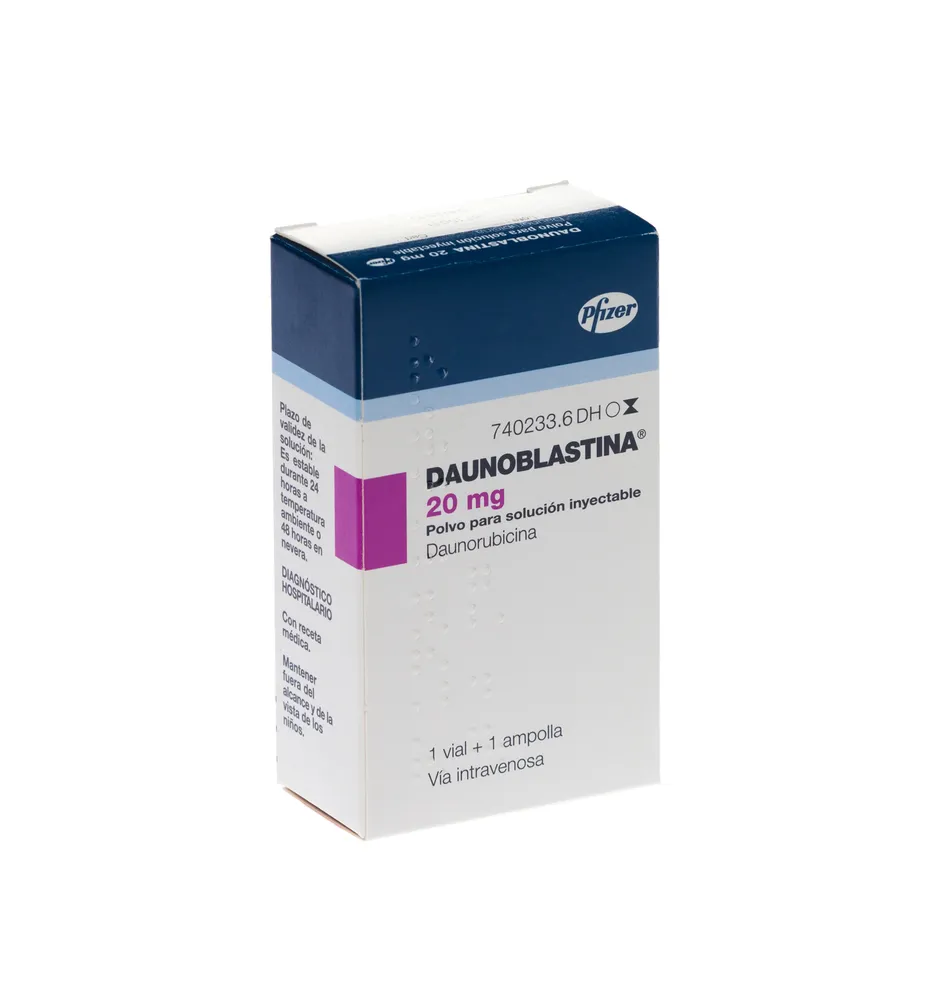
Instructions for Use
Package leaflet: Information for the user
Introduction
Package leaflet: information for the user
Daunoblastina 20 mg powder and solvent for injectable solution
Daunorubicin hydrochloride
Read all of this leaflet carefully before you start using this medicine, because it contains important information for you.
- Keep this leaflet. You may need to read it again.
- If you have any questions, ask your doctor or pharmacist.
- This medicine has been prescribed for you only, and you should not give it to other people, even if they have the same symptoms as you. It may harm them.
- If you experience any adverse reactions, consult your doctor or pharmacist, even if they are adverse reactions not listed in this leaflet. See section 4.
Contents of the leaflet
- What Daunoblastina is and what it is used for
- What you need to know before using Daunoblastina
- How to use Daunoblastina
- Possible adverse reactions
- How to store Daunoblastina
- Contents of the pack and other information
1. What Daunorubicin is and what it is used for
Daunorubicin is an anticancer antibiotic belonging to the anthracycline group and is used in the treatment of various types of cancer. This medicine is administered intravenously. Daunorubicin works by inhibiting the cell cycle, thereby preventing the proliferation of cancer cells.
Adults:
Daunorubicin may be used alone or in combination with other medicines for the treatment of leukemias (cancers of the bone marrow), such as acute myeloid leukemia and acute lymphoblastic leukemia.
Daunorubicin will only be prescribed by a doctor experienced in cancer treatments.
Children:
Daunorubicin, in combination with other medicines, may be used in children with leukemias (blood cancers), such as acute lymphoblastic leukemia and acute myeloid leukemia.
If you have any questions about how daunorubicin works or why this medicine has been prescribed for you, please consult your doctor.
2. What you need to know before using Daunoblastina
Do not use Daunoblastina
- If you are allergic to daunorubicin hydrochloride or to any of the other components of this medicine (listed in section 6), or to other anticancer agents of the same group.
- If you have a persistent disorder of your immune system (impaired ability to fight infections or diseases).
- If you have a serious infection.
- If you have or have had serious liver or kidney problems.
- If you have serious heart problems (heart failure, arrhythmias) or have recently suffered a heart attack.
- If you have received treatment with high doses of daunorubicin or other medicines of the same group.
- If you are pregnant or suspect you might be.
- If you are breastfeeding.
Warnings and precautions
Talk to your doctor or pharmacist before starting Daunoblastina.
-
If you have an uncontrolled viral infection.
-
If you have received, are receiving, or are about to receive radiotherapy, as you may have an increased risk of local reactions. In addition, if you have received radiotherapy to areas near the heart, the toxic effects of the medicine on the heart may be increased.
-
If you have previously received treatment with anticancer medicines and have small mouth ulcers (stomatitis), a decrease in a type of white blood cells (neutropenia), a decrease in platelets (thrombocytopenia), or generalized infections.
-
If during treatment you develop severe bone marrow suppression accompanied by a decrease in white blood cells (leukopenia, neutropenia) and a decrease in platelets (thrombocytopenia).
-
If during treatment you develop anemia.
-
If you have or have had heart problems. Elderly patients and children are more sensitive to the harmful effects of this medicine on the heart.
-
If you have received treatment with other anthracyclines or anthracenediones.
-
If you are being treated with other medicines that can suppress heart contraction or with medicines that are harmful to the heart.
-
If you have or have had liver problems.
- If you have or have had kidney problems.
- If during treatment your blood uric acid levels increase. Since Daunoblastina may increase blood uric acid levels, your doctor may take certain measures to minimize possible complications.
- If you need to be vaccinated while being treated with this medicine, as live or attenuated virus vaccines should not be administered and the response to inactivated or killed vaccines may be reduced.
- If you experience nausea and vomiting. Since Daunoblastina may cause nausea and vomiting, your doctor may administer medication beforehand to prevent them and/or reduce their frequency and severity.
- If you are currently being treated or have been treated with Daunoblastina, you must use effective contraceptive methods.
- If you are taking or have recently taken trastuzumab (a medicine used to treat certain types of cancer). Trastuzumab may take up to 7 months to be eliminated from the body. Since trastuzumab can affect the heart, you must not use Daunoblastina until 7 months after stopping trastuzumab. If Daunoblastina is used before this time, your heart function must be carefully monitored.
If you are in any of the situations described above, consult your doctor before starting Daunoblastina. Your doctor will regularly monitor your condition to ensure that Daunoblastina is having the intended effect.
Daunoblastina may cause complete hair loss (alopecia), including facial hair, underarm, and pubic hair. This adverse effect is usually reversible, with hair regrowing approximately two to three months after treatment ends.
Before starting treatment and while receiving Daunoblastina, your doctor may perform periodic blood tests and assessments of heart, liver, and/or kidney function.
Take special care with daunorubicin
A neurological disorder called SEPR has been reported when daunorubicin is used in combination with other cancer treatments. SEPR may cause symptoms such as headache, seizures, lethargy, confusion, and altered vision. If you experience any of these symptoms, contact your doctor immediately.
Using Daunoblastina with other medicines
Inform your doctor or pharmacist if you are using, have recently used, or might need to use any other medicines. The adverse effects may be increased or the action of other medicines may be altered, such as those used to treat cancer, heart disorders, those that may affect bone marrow and liver function, medicines that alter uric acid excretion, and antiplatelet agents. Certain types of vaccines must not be administered during treatment with Daunoblastina.
Pregnancy, breastfeeding, and fertility
If you are pregnant or breastfeeding, think you might be pregnant, or plan to become pregnant, consult your doctor or pharmacist before using this medicine.
Your doctor will inform you about the potential risks of using Daunoblastina during pregnancy.
Effective contraceptive measures must be used to prevent pregnancy during treatment with Daunoblastina and after treatment ends. This applies to patients of both sexes. Men treated with Daunoblastina should avoid fathering children during treatment and for at least 14 weeks after treatment ends. Women of childbearing age should use effective contraception during treatment with Daunoblastina and for at least 27 weeks after treatment ends. If patients wish to have children after completing treatment, both men and women should discuss genetic counseling and fertility preservation options with their doctor before starting Daunoblastina treatment.
If you are breastfeeding, inform your doctor. You must not use Daunoblastina while breastfeeding or for at least 6 days after the last dose.
Driving and use of machines
Daunoblastina may cause nausea and vomiting, which in some cases may impair your ability to drive or operate machinery.
Daunoblastina contains sodium
This medicine contains less than 1 mmol of sodium (23 mg) per ml of reconstituted solution; essentially “sodium-free”.
3. How to use Daunorubicin
Your doctor will determine the most appropriate dose and duration of treatment according to your condition and response to therapy.
Your doctor will indicate the number of treatment cycles you need.
If you receive more Daunorubicin than you should
Although unlikely, if you were to receive more Daunorubicin than you should, adverse effects of the medicine could occur.
4. Possible adverse effects
Like all medicines, this medicine can cause adverse effects, although not everyone will experience them.
Very common adverse effects (may affect more than 1 in 10 patients) include:
- Infections, which sometimes can be fatal, systemic infection (sepsis/septicemia).
- Impairment of normal bone marrow function, decreased number of red blood cells (anaemia), decreased number of white blood cells (neutropenia and leucopenia), decreased number of platelets (thrombocytopenia), decreased number of granulocytes (granulocytopenia).
- Heart muscle disorder (cardiomyopathy), which may present as: difficulty breathing (dyspnoea), bluish discoloration of the skin (cyanosis), fluid accumulation in the ankles, feet, and legs (peripheral oedema), enlarged liver (hepatomegaly), fluid accumulation in the abdomen (ascites), fluid accumulation in the pleural cavity (pleural effusion), loss of the heart's ability to pump blood (congestive heart failure).
- Bleeding.
- Diarrhoea, inflammation of the oesophagus (oesophagitis), inflammation of the mouth mucosa (mucositis/stomatitis), nausea/vomiting.
- Hair loss (alopecia), skin redness (erythema), skin rash.
- Fever.
- Pain.
- Increased levels of certain blood substances such as bilirubin, aspartate aminotransferase, and alkaline phosphatase.
Common adverse effects (may affect up to 1 in 10 patients) include:
- Abdominal pain, inflammation of the vein where the medicine is administered (phlebitis at the infusion site), changes in electrocardiogram.
Uncommon adverse effects (may affect up to 1 in 100 patients) include:
- Acute myeloid leukaemia, myocardial infarction.
Adverse effects with unknown frequency (cannot be estimated from available data) include:
- Shock due to severe infection (septic shock).
- Myelodysplastic syndrome.
- Severe allergic reaction (anaphylaxis), allergic-type reactions.
- Dehydration, significant increase in blood uric acid (acute hyperuricaemia).
- Inflammation and thickening of heart tissue (endomyocardial fibrosis), chest pain due to insufficient blood supply to the heart (angina pectoris), inflammation of the membrane surrounding the heart (pericarditis), inflammation of the heart muscle (myocarditis), irregular heart rhythm (supraventricular tachyarrhythmias).
- Facial redness (flushing), shock, presence of blood clots in veins (thrombophlebitis), thickening of vein walls (phlebosclerosis).
- Reduced oxygen supply to tissues (hypoxia).
- Colitis.
- Hepatitis, liver failure.
- Skin inflammation due to direct contact with a substance (contact dermatitis), increased sensitivity of irradiated skin areas, itching, increased pigmentation of skin and nails, urticaria.
- Red colour in urine for 1 or 2 days after administration.
- Absence of menstruation (amenorrhoea), absence of sperm in semen (azoospermia).
- Chills, death, very high fever, leakage of the medicine from the vein where it is being administered, possibly causing symptoms such as: immediate local pain/burning sensation, severe inflammation of cells at the administration site (cellulitis), painful skin ulcers, and tissue death (tissue necrosis).
Reporting of adverse effects
If you experience any adverse effect, consult your doctor, pharmacist, or nurse, even if it is a possible adverse effect not listed in this leaflet. You may also report them directly via the Spanish Pharmacovigilance System for Human Medicines: https://www.notificaram.es. By reporting adverse effects, you can help provide more information on the safety of this medicine.
5. Storage of Daunorubicin
Keep this medicine out of the sight and reach of children.
This medicine does not require special storage conditions.
Do not use this medicine after the expiry date stated on the outer packaging and label after EXP. The expiry date refers to the last day of the month indicated.
Do not use this medicine if it appears damaged or if the container has been opened.
Immediate use after reconstitution or vial opening is recommended. If not used immediately, the storage times and conditions are the responsibility of the user.
The storage time for the reconstituted solution should not exceed 24 hours at a temperature not exceeding 30°C, or 48 hours under refrigeration (between 2°C–8°C).
Disposal of unused medicine and all materials used during its handling must be carried out in accordance with local regulations for cytotoxic agents.
6. Contents of the pack and other information
Composition of Daunoblastina
- The active substance is daunorubicin hydrochloride.
- The other components are:
- Vial with powder: mannitol.
- Solvent ampoule containing 10 ml of 0.9% sodium chloride (9 mg/ml): water for injections and sodium chloride.
Appearance of the medicinal product and contents of the pack
The vial contains the lyophilized active substance, a red-orange colored powder. The ampoule contains 10 ml of solvent (0.9% sodium chloride solution).
Marketing Authorization Holder
Pfizer, S.L.
Avda. de Europa, 20 B
Parque Empresarial La Moraleja
28108 Alcobendas (Madrid)
Spain
Manufacturer
Latina Pharma S.p.A.
Via Murillo, 7 - 04013 Sermoneta (LT)
Italy
Date of the most recent revision of this leaflet: April 2022
Detailed and up-to-date information on this medicinal product is available on the website of the Spanish Agency for Medicines and Health Products (AEMPS) http://www.aemps.gob.es/
This page has been machine-translated and may contain inaccuracies. The original data is available in the manufacturing country's language.
Last data check: May 18, 2026 · Data source: CIMA — AEMPS