Dalacin 300 mg hard capsules
Spain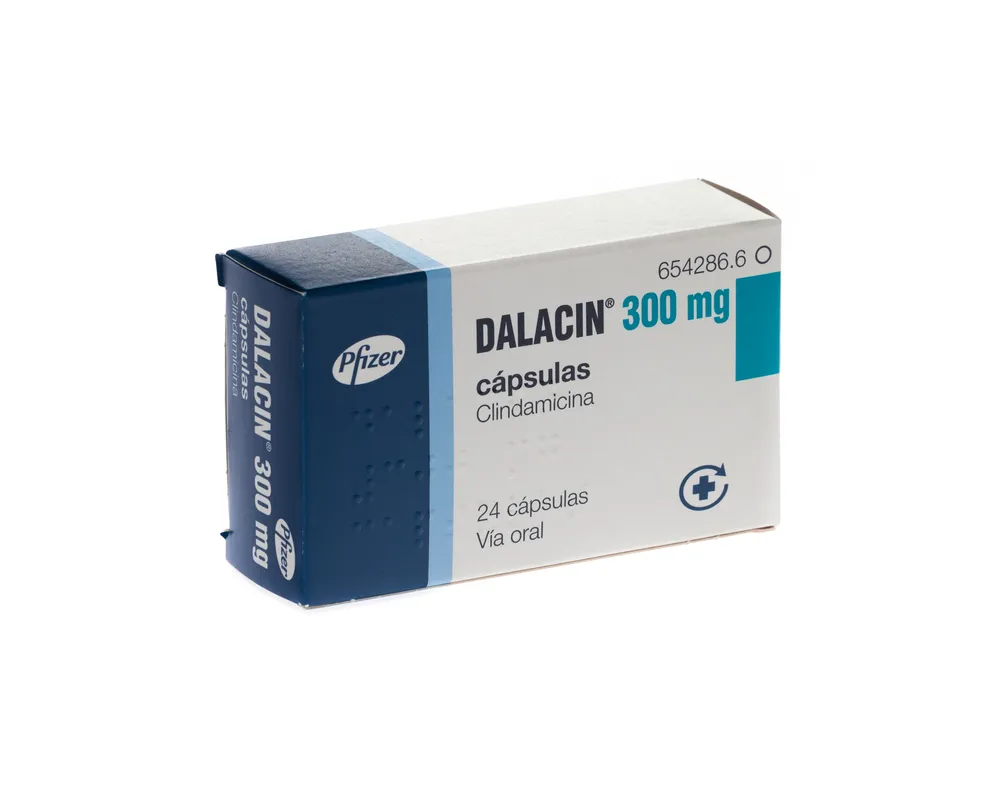
Table of Contents
- Package leaflet: Information for the user
- Introduction
- 1. What Dalacin hard capsules are and what they are used for
- 2. What you need to know before using Dalacin hard capsules
- 3. How to take Dalacin hard capsules
- 4. Possible adverse effects
- 5. Storage of Dalacin hard capsules
- 6. Information for the User
Package leaflet: Information for the user
Introduction
Package leaflet: information for the patient
Dalacin 300 mg hard capsules
Clindamycin
Read the entire leaflet carefully before you start using this medicine because it contains important information for you.
- Keep this leaflet, as you may need to read it again.
- If you have any questions, ask your doctor or pharmacist.
- This medicine has been prescribed for you only and must not be given to other people, even if they have the same symptoms as you, because it could harm them.
- If you experience any adverse effects, consult your doctor or pharmacist, even if they are adverse effects not listed in this leaflet. See section 4.
Leaflet contents:
- What Dalacin hard capsules are and what they are used for
- What you need to know before using Dalacin hard capsules
- How to use Dalacin hard capsules
- Possible adverse effects
- How to store Dalacin hard capsules
- Contents of the pack and other information
1. What Dalacin hard capsules are and what they are used for
This medicine belongs to a group of antibiotics called lincosamides.
Antibiotics are used to treat bacterial infections and are not effective against viral infections such as flu or the common cold.
It is important that you follow the instructions regarding dosage, administration, and duration of treatment as directed by your doctor.
Do not keep or reuse this medicine. If you have any antibiotic left over after completing the treatment, return it to the pharmacy for proper disposal. Medicines must not be disposed of via wastewater or household waste.
It is used to treat bacterial infections in different parts of the body in adults.
Additionally, this medicine is used to treat acute sinusitis (infection of the paranasal sinuses) in children older than 1 month and under 18 years of age.
2. What you need to know before using Dalacin hard capsules
Do not use Dalacin hard capsules
- If you are allergic to clindamycin, lincomycin, or any of the other ingredients of this medicine (listed in section 6).
- If you have previously suffered from antibiotic-associated colitis.
Warnings and precautions
- Allergic reactions or severe skin reactions may occur during treatment. If this happens, treatment with Dalacin must be stopped and appropriate therapy initiated.
- During or after treatment with this medicine, symptoms suggesting antibiotic-associated colitis (such as diarrhoea) may appear. If this occurs, treatment must be discontinued and your doctor will prescribe the most appropriate treatment.
- If you suffer from an inflammatory bowel disease, such as Crohn’s disease or ulcerative colitis, inform your doctor, who will confirm whether you should use this medicine.
- Prolonged use of this medicine may lead to overgrowth of other microorganisms, particularly fungi.
- If you are being treated with neuromuscular blocking agents (used to induce muscle paralysis, such as pancuronium, tubocurarine), inform your doctor, as clindamycin may enhance the effect of these medicines.
- If treatment with Dalacin is prolonged, periodic blood tests and assessments of blood counts, liver and kidney function should be performed.
- Acute kidney disorders may occur. Inform your doctor about any medicines you are currently taking and if you have any kidney problems. If you experience reduced urine output, fluid retention causing swelling of the legs, ankles or feet, shortness of breath or nausea, contact your doctor immediately.
- Due to the risk of oesophageal inflammation (oesophagitis) and oesophageal ulcer, it is important to always take Dalacin capsules as indicated in section 3.
Children and adolescents
This medicine is not suitable for children who are unable to swallow the capsules whole.
The recommended dose in children over 1 month of age is 8 to 25 mg/kg/day, divided into 3 or 4 equal doses; see section 3 for further details.
Use of Dalacin hard capsules with other medicines
Inform your doctor or pharmacist if you are taking, have recently taken, or might take any other medicines, including those obtained without a prescription.
You must inform your doctor if you are taking any of the following medicines:
- Warfarin and similar medicines, which are used to thin the blood and prevent thrombosis. The risk of bleeding may be increased when taking these medicines with Dalacin. Therefore, your doctor may need to perform regular blood tests to monitor your blood clotting status.
- Neuromuscular blocking agents (such as pancuronium, tubocurarine), as their effects may be enhanced by this medicine.
- Oral typhoid vaccine, as it may be inactivated when administered concomitantly with antibacterial agents; Dalacin should not be administered within 3 days before or after vaccination.
- Medicines that induce or inhibit the activity of the CYP3A4 and CYP3A5 isoenzymes, as they may alter the effectiveness of this medicine (e.g. rifampicin).
Taking Dalacin hard capsules with food and drink
The capsules may be taken with food, as food intake does not affect the absorption of Dalacin. It is recommended to take the capsules with a large glass of water to minimize the risk of oesophageal irritation.
Pregnancy, breast-feeding and fertility
Pregnancy
If you are pregnant or breast-feeding, think you may be pregnant or are planning to become pregnant, consult your doctor or pharmacist before using this medicine.
Clindamycin crosses the placental barrier in humans. Clinical studies in pregnant women have not shown an increased frequency of congenital abnormalities when clindamycin is administered systemically during the second and third trimesters. However, there are insufficient and well-controlled studies in pregnant women during the first trimester of pregnancy.
Therefore, clindamycin should not be used during pregnancy unless strictly necessary.
Breast-feeding
Clindamycin is excreted in human milk following oral or intravenous administration. Because of the potential for serious adverse reactions in the nursing infant, such as diarrhoea, blood in stools or rash, the use of clindamycin is contraindicated during breast-feeding.
Driving and using machines
The effect of this medicine on the ability to drive or operate machinery is none or negligible.
Dalacin hard capsules contain lactose
This medicine contains lactose. If your doctor has informed you that you have an intolerance to certain sugars, consult him before taking this medicine.
3. How to take Dalacin hard capsules
Follow exactly the dosing instructions for this medicine provided in this leaflet or as directed by your doctor. If in doubt, consult your doctor or pharmacist.
This medicine is administered orally.
Your doctor will determine the most appropriate dose and duration of treatment for you, depending on your condition and response to treatment.
Adults
The recommended dose in adults is 600 to 1,800 mg per day, divided into 2, 3, or 4 equal doses, depending on the severity, site of infection, and microbial sensitivity. Your doctor will advise you on the appropriate regimen.
The duration of treatment should be determined according to the type of infection and response, and should be as short as possible, generally between 7 and 14 days.
The usual dosage for acute pharyngotonsillitis and certain pneumonias is 300 mg twice daily for 10 days.
Pelvic inflammatory disease: following intravenous treatment administered by a healthcare professional, 450–600 mg of clindamycin orally every 6 hours until completing 10–14 days (total treatment including both intravenous and oral administration).
Pneumonia in patients with HIV infection: 300–450 mg of clindamycin orally every 6 hours for 21 days. This treatment is given in combination therapy with primaquine (15–30 mg/day orally).
Toxoplasmic encephalitis in patients with HIV infection: 600–1,200 mg of clindamycin every 6 hours via intravenous or oral route for 2 weeks.
After this period, 300–600 mg every 6 hours orally for 8–10 weeks. The treatment is administered in combination with pyrimethamine (25–75 mg/day orally) and folinic acid (10–20 mg/day), with higher doses of pyrimethamine.
Use in elderly patients
No dose adjustment is required in elderly patients with normal hepatic and renal function.
Use in patients with renal impairment
No dose adjustment is required in patients with renal impairment.
Use in patients with hepatic impairment
No dose adjustment is required in patients with hepatic impairment.
Use in children
The recommended dose in children over 1 month of age is 8 to 25 mg/kg/day, divided into 3 or 4 equal doses. The clindamycin dose is calculated based on total body weight, regardless of obesity. This medicine is indicated only for children able to swallow capsules. The capsules must be taken whole, which should be taken into account when administering the medicine, as it may not be suitable for providing the exact dose required for treatment in children.
Method of Administration
Dalacin hard capsules should be taken whole with a large glass of water and at least 30 minutes before lying down, to avoid possible esophageal irritation.
If you take more Dalacin hard capsules than you should
In case of overdose, you may experience nausea, vomiting, diarrhea, or allergic reactions.
In case of overdose or accidental ingestion, consult your doctor or pharmacist immediately or call the Toxicology Information Service at 91 562 04 20, indicating the medicine and the amount ingested.
Information for healthcare professionals
In case of overdose, peritoneal dialysis or hemodialysis are not effective in removing the drug. Gastric lavage may be performed. Administration of activated charcoal and appropriate symptomatic treatment is recommended.
If an allergic-type reaction occurs, standard emergency treatment should be applied, including corticosteroids, adrenaline, and antihistamines.
If you forget to take Dalacin
If you miss a dose, take the medicine as soon as possible and continue treatment as prescribed. However, if the next dose is due soon, it is better not to take the missed dose and wait for the next scheduled dose. Do not take a double dose to make up for the missed dose. Continue using Dalacin as directed by your doctor.
If you stop treatment with Dalacin
If you stop treatment with Dalacin before the time recommended by your doctor, symptoms may worsen or recur.
If you have any further questions about the use of this product, ask your doctor or pharmacist.
4. Possible adverse effects
Like all medicines, Dalacin may have adverse effects, although not everyone will experience them.
Immediately inform your doctor if you experience:
- Fluid retention causing swelling in the legs, ankles or feet, difficulty breathing or nausea.
The frequency of adverse effects observed during clinical trials was:
Common: may affect up to 1 in 10 people
- Pseudomembranous colitis.
- Diarrhoea, abdominal pain.
- Abnormalities in liver function tests.
Uncommon: may affect up to 1 in 100 people
- Vomiting, nausea.
- Reddish skin rash with small spots (macules or papules) (maculopapular rash), reddish raised itchy skin lesions (urticaria).
Frequency not known (cannot be estimated from available data)
- Colitis caused by Clostridioides difficile, vaginal infection.
- Decrease in white blood cells (agranulocytosis, neutropenia, leucopenia), decrease in platelets (thrombocytopenia), increase in a type of white blood cells (eosinophilia).
- Allergic-type reactions (anaphylactic shock), allergic reaction (anaphylactoid and anaphylactic reaction), hypersensitivity.
- Disturbance of taste sensation (dysgeusia).
- Oesophageal ulcer*, oesophagitis*.
- Yellowing of the skin and mucous membranes (jaundice).
- Adverse skin reactions, which in some cases may be severe: skin and mucous membrane disease causing massive exfoliation and systemic toxicity (toxic epidermal necrolysis), skin disease causing blisters and painful sores on the skin and mucous membranes (Stevens-Johnson syndrome), drug reaction with eosinophilia and systemic symptoms (multiorgan involvement) (DRESS syndrome), red skin lesions, angioedema (swelling under the skin), skin eruptions with blisters and peeling (exfoliative dermatitis, bullous dermatitis), inflammation of blood vessels in the skin, blisters on mucous membranes (erythema multiforme), itching, generalized skin rash with variable shape, extent and distribution (morbilliform rash), skin reaction characterized by symmetrical, well-defined redness in skin folds, especially in the buttocks, groin and armpits.
*Adverse effects more likely to occur if Dalacin hard capsules are taken while lying down and/or with insufficient water.
Reporting of adverse effects
If you experience any type of adverse effect, consult your doctor or pharmacist, even if they are possible adverse effects not listed in this leaflet. You may also report them directly via the Spanish Pharmacovigilance System for Human Medicinal Products: www.notificaram.es.
By reporting adverse effects, you can help provide more information on the safety of this medicine.
5. Storage of Dalacin hard capsules
Store below 30°C.
Keep in the original packaging.
Keep out of the sight and reach of children.
Do not use this medicine after the expiry date stated on the packaging. The expiry date refers to the last day of the month indicated.
Medicines must not be disposed of via wastewater or household waste. Dispose of unused medicines and their packaging at the SIGRE collection point at your pharmacy. If you are unsure, ask your pharmacist how to properly dispose of unused medicines and their packaging. This will help protect the environment.
6. Information for the User
Composition
- The active substance is clindamycin. Each capsule contains 300 mg of clindamycin (as hydrochloride).
- The other components are: capsule contents (monohydrate lactose, corn starch, talc, and magnesium stearate) and capsule components (gelatin, erythrosine [E127], indigo carmine, indigotine [E132], and titanium dioxide [E171]).
Appearance of the medicinal product and contents of the pack
The medicine is presented as lavender-colored hard capsules printed with “CLIN 300” on the body and the Pfizer logo on the cap, packed in blisters. Each pack contains either 24 or 500 hard capsules.
Marketing Authorization Holder and Manufacturer
Marketing Authorization Holder
Pfizer, S.L.
Avda. de Europa, 20 B.
Parque Empresarial La Moraleja.
28108, Alcobendas (Madrid). Spain.
Manufacturer
Fareva Amboise.
Zone Industrielle, 29 route des Industries.
37530, Pocé-sur-Cisse. France.
Date of the most recent review of this leaflet: January 2026
Detailed and up-to-date information on this medicinal product is available on the website of the Spanish Agency of Medicines and Medical Devices (AEMPS) http://www.aemps.es/