Dalacin 100 mg ovules
Spain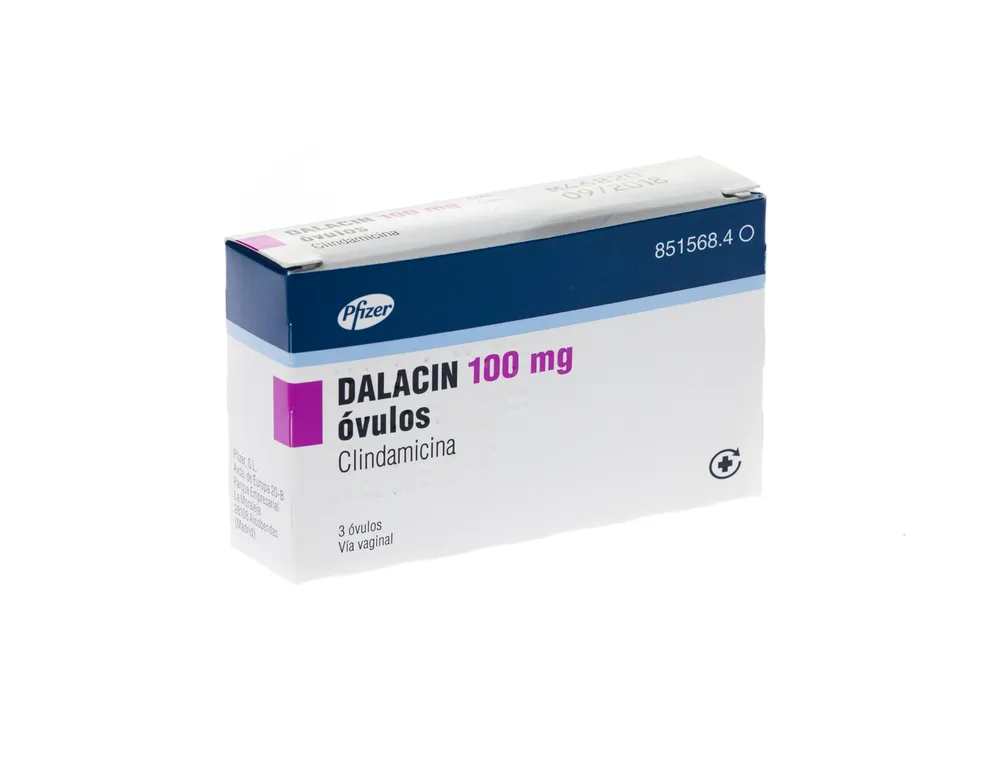
Table of Contents
Package leaflet: Information for the user
Introduction
Package leaflet: information for the user
Dalacin 100 mg pessaries
Clindamycin
Read the entire leaflet carefully before you start taking this medicine, as it contains important information for you.
- Keep this leaflet as you may need to read it again.
- If you have any questions, ask your doctor or pharmacist.
- This medicine has been prescribed for you only, and you should not give it to other people, even if they have the same symptoms as you, because it could harm them.
- If you experience any adverse reactions, consult your doctor or pharmacist, even if they are adverse reactions not listed in this leaflet. See section 4.
Leaflet contents: :
-
What Dalacin is and what it is used for
-
What you need to know before using Dalacin
-
How to use Dalacin
-
Possible side effects
-
How to store Dalacin
-
Contents of the pack and other information
1. What Dalacin is and what it is used for
The name of your medicine is Dalacin 100 mg vaginal ovules. It is referred to as "Dalacin" in this leaflet.
Dalacin is a semi-solid vaginal ovule (vaginal suppository). When inserted into the vagina, it releases a medicine called clindamycin (as phosphate). This medicine belongs to a group known as "antibiotics".
Antibiotics are used to treat bacterial infections and are not effective against viral infections such as flu or the common cold.
It is important that you follow your doctor's instructions regarding dosage, administration, and duration of treatment.
Do not store or reuse this medicine. If you have any antibiotic left over after completing the treatment, return it to the pharmacy for proper disposal. Do not dispose of medicines via wastewater or household waste.
Dalacin is indicated for the treatment of a bacterial infection of the vagina called bacterial vaginosis.
2. What you need to know before using Dalacin
Do not use Dalacin:
- if you are allergic to clindamycin, to another antibiotic called lincomycin, or to any of the other components of this medicine (listed in section 6).
- if you have previously had inflammation of the colon (colitis) after taking antibiotics.
Warnings and precautions
Consult your doctor or pharmacist before starting to use Dalacin:
- if you have diarrhoea or if you usually get diarrhoea when taking antibiotics.
- if you have a history of inflammatory bowel disease such as Crohn's disease or ulcerative colitis.
If you develop severe, persistent or bloody diarrhoea during or after treatment with Dalacin, consult your doctor immediately, as it may be necessary to stop treatment. This could be a sign of intestinal inflammation (pseudomembranous colitis) that may occur following antibiotic treatment.
Please consult your doctor if you are unsure whether you can take this medicine if any of the following apply to you:
- if you have kidney, liver problems or disorders of the immune system.
- if you are under 16 or over 65 years of age.
Dalacin should not be used in girls under 16 years of age.
As with all vaginal infections, sexual intercourse is not recommended during treatment with Dalacin. Dalacin may weaken condoms and diaphragms. Do not rely on condoms or contraceptive diaphragms while using this treatment and for 72 hours after treatment.
The use of other vaginal products such as tampons or douches (vaginal washes) is not recommended during treatment with the ovules.
Use of Dalacin with other medicines
Inform your doctor or pharmacist if you are taking, have recently taken, or might need to take any other medicines.
In particular, consult your doctor if you are taking:
- Muscle relaxants, as Dalacin may increase the effect of these medicines.
Pregnancy, breast-feeding and fertility
If you are pregnant or breast-feeding, think you may be pregnant or are planning to become pregnant, consult your doctor or pharmacist before using this medicine.
The use of Dalacin during the first trimester of pregnancy is not recommended, as there is insufficient evidence regarding its safety.
If you are pregnant, you should only use Dalacin after consulting your doctor, who will decide whether this treatment is appropriate for you.
If you are breast-feeding, your doctor will decide whether Dalacin is suitable for you, as the active substance may pass into breast milk. Although it is unlikely that the infant will ingest a significant amount of active substance through breast milk, if your baby develops bloody diarrhoea or any signs of illness, consult your doctor immediately. You should discontinue breast-feeding if this occurs.
Driving and using machines
This medicine is unlikely to affect your ability to drive or operate machinery.
3. How to use Dalacin
Follow exactly the instructions for administration of this medicine given by your doctor. If in doubt, consult your doctor or pharmacist again.
Do not use this product if the aluminium foil containing the vaginal ovules is torn, opened or not completely sealed.
Take care to avoid the ovule becoming warm, as it may soften or become deformed.
The recommended dose of this medicine is one ovule inserted high into the vagina at bedtime, for 3 consecutive nights. After insertion, the ovule will melt and disappear.
Insertion:
? Remove the ovule from its aluminium foil wrapper.
? Lie on your back with your knees drawn up towards your chest.
? Using the middle finger, insert the ovule as deeply as possible into the vagina without causing discomfort.
Remember to wash your hands after using the ovules.
If you use more Dalacin than you should
Consult your doctor. Do not use any additional ovules until your doctor tells you to do so.
In case of overdose or accidental ingestion, contact your doctor or pharmacist immediately, or call the Toxicology Information Service at telephone number: 91 562 04 20, indicating the medicine and the amount ingested.
If you forget to use Dalacin
If you forget to use an ovule and only a few hours have passed since the scheduled time, use it immediately.
If it is almost time for your next dose, do not use the missed ovule. Wait until your next scheduled dose and apply it then.
Continue using your ovules as normal.
If you swallow Dalacin
If you accidentally eat or swallow the ovule, contact your doctor. The ovules are unlikely to cause you any harm, but your doctor can advise you on what you should do.
If you have any further questions about the use of this medicine, ask your doctor or pharmacist.
4. Possible adverse effects
Like all medicines, this medicine may cause adverse effects, although not everyone will experience them.
Consult your doctor immediately if:
- you have severe, persistent or bloody diarrhoea (which may be associated with stomach pain or fever). This is an uncommon adverse effect that may occur after treatment with antibiotics and could be a sign of serious intestinal inflammation or inflammation of the lining of the large intestine (pseudomembranous colitis).
- you experience a severe allergic reaction or skin reactions. These adverse effects are very rare.
Frequent (may affect up to 1 in 10 people)
- fungal infections, yeast infection
- headache
- stomach pain, diarrhoea, nausea
- itching (in an area different from the site of application)
- vaginal candidiasis, vaginal discomfort, vaginal disorder
Uncommon (may affect up to 1 in 100 people)
- vomiting
- rash
- pain in the upper stomach or back
- fever or chills, general malaise
- pain when urinating, blood in the urine, cloudy or foul-smelling urine, increased frequency or urgency of urination
- vaginal infection, vaginal discharge, irregular menstruation
- pain (at the application site), itching, localized swelling
Reporting of adverse effects
If you experience any type of adverse effect, consult your doctor, pharmacist or nurse, even if it is a possible adverse effect not listed in this leaflet. You may also report them directly via the Spanish Pharmacovigilance System for Human Medicinal Products: https://www.notificaram.es. By reporting adverse effects, you can help provide more information on the safety of this medicine.
5. Storage of Dalacin
Keep this medicine out of the sight and reach of children.
Do not use this medicine after the expiry date stated on the packaging after EXP. The expiry date refers to the last day of the month indicated.
Store below 25°C.
Medicines must not be disposed of via wastewater or household waste. Unused containers and medicines should be returned to the SIGRE collection point at your pharmacy. Ask your pharmacist how to dispose of containers and medicines you no longer need. This will help protect the environment.
6. Contents of the package and other information
Composition of Dalacin
- The active substance is clindamycin (as phosphate). Each ovule contains 100 mg of clindamycin (as clindamycin phosphate).
The other components are solid semisynthetic glycerides.
Nature of the product and pack contents
Dalacin is a white to off-white ovule. It is supplied in aluminum strips containing 3 ovules and packaged in cardboard boxes.
Marketing Authorization Holder:
Holder:
Pfizer, S.L.
Avda. de Europa 20-B.
Parque Empresarial La Moraleja.
28108 (Alcobendas), Madrid
Manufacturer responsible:
Pfizer Service Company BV
Hermeslaan 11
1932 Zaventem
Belgium
This medicinal product is authorized in the Member States of the European Economic Area under the following names:
Ireland | Dalacin vaginal ovule |
Italy | Cleocin |
Germany | Sobelin 100 mg Vaginalzäpfchen |
Spain | Dalacin 100 mg ovules |
Finland, Sweden | Dalacin |
Date of the latest review of this leaflet: 12/2022
Detailed and up-to-date information on this medicinal product is available on the website of the Spanish Agency of Medicines and Medical Devices (AEMPS) http://www.aemps.gob.es.