Dacogen 50 mg powder for concentrate for infusion solution
Spain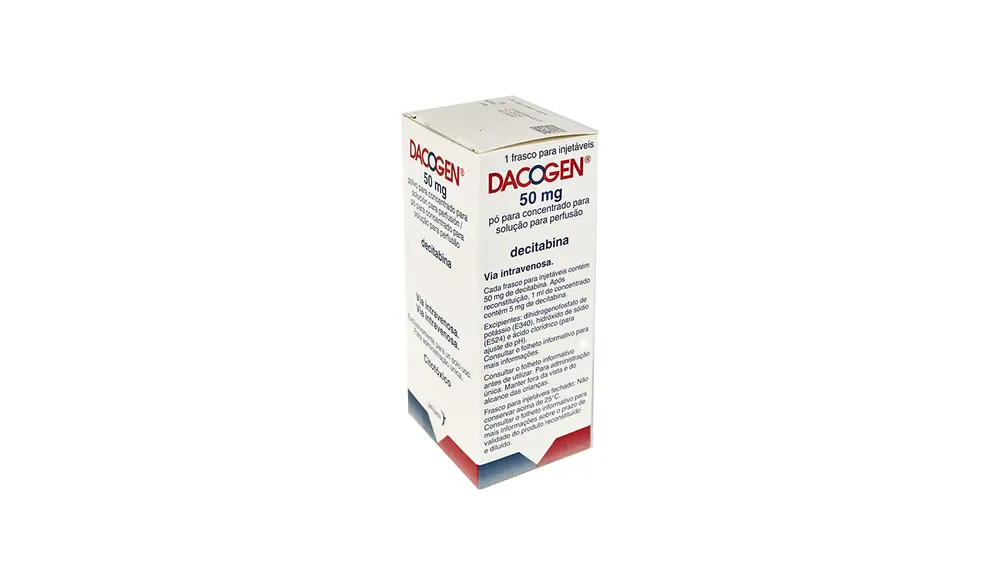
Table of Contents
Package leaflet: Information for the user
Introduction
Package leaflet: Information for the user
Dacogen 50 mg powder for concentrate for solution for infusion
decitabine
Read the entire leaflet carefully before you start using this medicine, because it contains important information for you.
- Keep this leaflet, as you may need to read it again.
- If you have any questions, ask your doctor, pharmacist, or nurse.
- This medicine has been prescribed for you only, and you should not give it to other people, even if they have the same symptoms as you, because it could harm them.
- If you experience any adverse effects, consult your doctor, pharmacist, or nurse, even if they are adverse effects not listed in this leaflet. See section 4.
Contents of the leaflet
- What Dacogen is and what it is used for
- What you need to know before using Dacogen
- How to use Dacogen
- Possible side effects
- How to store Dacogen
- Contents of the pack and other information
1. What Dacogen is and what it is used for
What Dacogen is
Dacogen is an anticancer medicine. It contains the active substance “decitabine”.
What Dacogen is used for
Dacogen is used to treat a type of cancer called “acute myeloid leukaemia” or “AML”. It is a cancer that affects blood cells. Dacogen will be given to you when you are diagnosed with AML for the first time. This medicine is used only in adults.
How Dacogen works
Dacogen works by preventing the growth of cancer cells. It also destroys cancer cells.
If you have any questions about how Dacogen works or why it has been prescribed for you, please consult your doctor or nurse.
2. What you need to know before using Dacogen
Do not use Dacogen:
- if you are allergic to decitabine or to any of the other ingredients of this medicine (listed in section 6);
- if you are breastfeeding.
If you are unsure whether any of the above conditions apply to you, consult your doctor, pharmacist, or nurse before using Dacogen.
Warnings and precautions
Talk to your doctor, pharmacist, or nurse before starting Dacogen if you have:
- low platelet count, red blood cells, or white blood cells;
- an infection;
- liver disease;
- severe kidney disorder;
- heart disorder.
If you are unsure whether any of the above conditions apply to you, consult your doctor, pharmacist, or nurse before using Dacogen.
Tests or monitoring
You will have blood tests before starting treatment with Dacogen and at the beginning of each treatment cycle. These tests are used to check that:
- you have enough blood cells;
- your liver and kidneys are functioning properly.
Ask your doctor about the meaning of your blood test results.
Children and adolescents
Dacogen must not be used in children or adolescents under 18 years of age.
Use of Dacogen with other medicines
Tell your doctor, nurse, or pharmacist if you are taking, have recently taken, or might need to take any other medicines, including those obtained without a prescription and herbal medicines. Dacogen may affect how other medicines work. In addition, some other medicines may affect how Dacogen works.
Pregnancy and breastfeeding
- If you are pregnant or breastfeeding, think you may be pregnant, or plan to become pregnant, speak to your doctor before using this medicine.
- You must not use Dacogen if you are pregnant because it may harm your unborn child. Inform your doctor immediately if you become pregnant during treatment with Dacogen.
- You must not breastfeed while using Dacogen, as it is unknown whether the medicine passes into breast milk.
Male and female fertility and contraception
- Men must not father a child while receiving Dacogen.
- Men should use effective contraception during treatment and for 3 months after stopping treatment.
- Ask your doctor about preserving your sperm before starting treatment.
- Women must use effective contraception during treatment.
- It is unknown when it is safe for women to become pregnant after treatment has been stopped.
- Ask your doctor about freezing your eggs before starting treatment.
Driving and using machines
You may feel tired or weak after using Dacogen. If this happens, do not drive or operate tools or machinery.
Dacogen contains potassium and sodium
- This medicine contains 0.5 mmol of potassium per vial. After reconstitution, it contains less than 1 mmol (39 mg) of potassium, which is essentially “potassium-free”.
- This medicine contains 0.29 mmol (6.67 mg) of sodium (the main component of table/cooking salt) per vial. After reconstitution, it contains between 13.8–138 mg of sodium per dose, equivalent to 0.7–7% of the maximum recommended daily intake of sodium for an adult. Consult your doctor if you are on a low-salt diet.
3. How to use Dacogen
Dacogen will be administered to you by a doctor or nurse trained to give this type of medicine.
Recommended dose
- Your doctor will calculate your dose of Dacogen based on your height and weight (body surface area).
- The dose is 20 mg/m² of body surface area.
- You will receive Dacogen daily for 5 days, followed by 3 weeks without the drug. This is called a "treatment cycle" and will be repeated every 4 weeks. You will usually receive at least 4 treatment cycles.
- Your doctor may delay your dose or modify the total number of cycles, depending on how you respond to treatment.
How Dacogen is administered
The solution is given intravenously (as an infusion) over one hour.
If you are given more Dacogen than you should
This medicine will be administered by your doctor or nurse. It is highly unlikely that you will be given too much (overdose). If this does occur, your doctor will evaluate you and manage any adverse effects appropriately.
If you have missed your Dacogen administration appointment
If you miss an appointment, schedule another one as soon as possible. This is because it is important to follow the dosing schedule to ensure this medicine is as effective as possible.
If you have any further questions about the use of this medicine, consult your doctor or nurse.
4. Possible adverse effects
Like all medicines, this medicine can cause adverse effects, although not everyone will experience them. The following adverse effects may occur with this medicine.
Tell your doctor or nurse immediately if you experience any of the following serious adverse effects:
- Fever: may be a sign of an infection caused by low white blood cell counts (very common).
- Chest pain or difficulty breathing (with or without fever or cough): may be signs of a lung infection called “pneumonia” (very common), inflamed lungs (interstitial lung disease [frequency not known]), or cardiomyopathy (disease of the heart muscle [infrequent]) which may be accompanied by swelling of the ankles, hands, legs, and feet.
- Bleeding: including blood in the stools. May be a sign of bleeding in the stomach or intestines (frequent).
- Difficulty moving, speaking or understanding, or seeing; sudden and severe headache, seizures, numbness or weakness in any part of the body. These may be symptoms of bleeding inside the head (frequent).
- Difficulty breathing, swelling of the lips, itching or skin rash. These may be due to an allergic reaction (hypersensitivity) (frequent).
Consult your doctor or nurse immediately if you experience any of the serious adverse effects listed above.
Other adverse effects of Dacogen are
Very common (may affect more than 1 in 10 patients)
- urinary tract infection
- other infection anywhere in the body, caused by bacteria, viruses, or fungi
- bleeding or bruising more easily – may be signs of a decreased number of blood platelets (thrombocytopenia)
- feeling tired or pale – may be signs of a decreased number of red blood cells (anaemia)
- high blood sugar levels
- headache
- nosebleeds
- diarrhoea
- vomiting
- nausea
- fever
- abnormal liver function
Common (may affect up to 1 in 10 patients)
- bloodstream infection caused by bacteria – may be a sign of low white blood cell count
- nasal pain or runny nose, sinus pain
- mouth or tongue sores
- increased levels of "bilirubin" in the blood
Uncommon (may affect up to 1 in 100 patients)
- decreased number of red blood cells, white blood cells, and platelets (pancytopenia)
- heart muscle disease (cardiomyopathy)
- red, raised, and painful skin lesions, fever, increased white blood cells – may be signs of “Acute Febrile Neutrophilic Dermatosis” or “Sweet’s Syndrome”
Not known (frequency cannot be estimated from available data)
- inflamed intestine (enterocolitis, colitis, and typhlitis), with symptoms of abdominal pain, bloating (intestinal gas), or diarrhoea. Enterocolitis may lead to complications from sepsis (the body's response to infection) and may be associated with fatal outcome.
Reporting of adverse effects
If you experience any type of adverse effect, talk to your doctor, pharmacist, or nurse, even if it is a possible adverse effect not listed in this leaflet. You can also report them directly through the national reporting system included in Appendix V. By reporting adverse effects, you can help provide more information on the safety of this medicine.
5. Storage of Dacogen
- Your doctor, nurse, or pharmacist is responsible for the storage of Dacogen.
- Keep this medicine out of the sight and reach of children.
- Do not use this medicine after the expiry date stated on the carton and vial label following EXP. The expiry date refers to the last day of the month indicated.
- Do not store above 25°C.
- After reconstitution, the concentrate must be further diluted within 15 minutes using refrigerated infusion fluids. The diluted solution may be stored refrigerated at 2°C – 8°C for up to 3 hours, followed by up to 1 hour at room temperature (20°C – 25°C) prior to administration.
- Your doctor, nurse, or pharmacist is responsible for the proper disposal of any unused Dacogen.
6. Contents of the container and other information
Composition of Dacogen
- The active substance is decitabine. Each vial of powder contains 50 mg of decitabine. After reconstitution with 10 ml of water for injections, each ml of concentrate contains 5 mg of decitabine.
- The other components are monopotassium dihydrogen phosphate (E340), sodium hydroxide (E524), and hydrochloric acid (to adjust pH). See section 2.
Appearance of the product and contents of the container
Dacogen is a white or almost white powder for concentrate for solution for infusion. It is supplied in a 20 ml glass vial containing 50 mg of decitabine. Each pack contains 1 vial.
Marketing Authorization Holder
Janssen-Cilag International NV
Turnhoutseweg 30
B-2340 Beerse
Belgium
Manufacturer
Janssen Pharmaceutica NV
Turnhoutseweg 30
B-2340 Beerse
Belgium
Further information on this medicinal product is available upon request by contacting the local representative of the Marketing Authorization Holder:
Belgium/Belgium/Belgium Janssen-Cilag NV Tel/Tel: +32 14 64 94 11 | Lithuania UAB "JOHNSON & JOHNSON" Tel: +370 5 278 68 88 |
Bulgaria „JANSSEN & JOHNSON PHARMACEUTICAL” EOOD Tel: +359 2 489 94 00 | Luxembourg/Luxembourg Janssen-Cilag NV Tél/Tel: +32 14 64 94 11 |
Czech Republic Janssen-Cilag s.r.o. Tel: +420 227 012 227 | Hungary Janssen-Cilag Kft. Tel: +36 1 884 2858 |
Denmark Janssen-Cilag A/S Tlf: +45 4594 8282 | Malta AM MANGION LTD. Tel: +356 2397 6000 |
Germany Janssen-Cilag GmbH Tel: +49 2137 955 955 | Netherlands Janssen-Cilag B.V. Tel: +31 76 711 1111 |
Estonia UAB "JOHNSON & JOHNSON" Estonian branch Tel: +372 617 7410 | Norway Janssen-Cilag AS Tlf: +47 24 12 65 00 |
Greece Janssen-Cilag Pharmaceutical S.A. Tel: +30 210 80 90 000 | Austria Janssen-Cilag Pharma GmbH Tel: +43 1 610 300 |
Spain Janssen-Cilag, S.A. Tel: +34 91 722 81 00 | Poland Janssen-Cilag Polska Sp. z o.o. Tel: +48 22 237 60 00 |
France Janssen-Cilag Tél: 0 800 25 50 75 / +33 1 55 00 40 03 | Portugal Janssen-Cilag Farmacêutica Lda. Tel: +351 214 368 600 |
Croatia Johnson & Johnson S.E. d.o.o. Tel: +385 1 6610 700 | Romania Johnson & Johnson România SRL Tel: +40 21 207 1800 |
Ireland Janssen Sciences Ireland UC Tel: +353 1 800 709 122 | Slovenia Johnson & Johnson d.o.o. Tel: +386 1 401 18 00 |
Iceland Janssen-Cilag AB c/o Vistor hf. Tel: +354 535 7000 | Slovakia Johnson & Johnson s.r.o. Tel: +421 232 408 400 |
Italy Janssen-Cilag SpA Tel: +39 02 2510 1 | Finland/Sweden Janssen-Cilag Oy Puh/Tel: +358 207 531 300 |
Cyprus Varnavas Hadjipanagis Ltd Tel: +357 22 207 700 | Sweden Janssen-Cilag AB Tel: +46 8 626 50 00 |
Latvia UAB "JOHNSON & JOHNSON" Latvian branch Tel: +371 678 93561 | United Kingdom Janssen-Cilag Ltd. Tel: +44 1 494 567 444 |
Date of the most recent review of this summary: MM/YYYY
Detailed information on this medicine is available on the European Medicines Agency website: http://www.ema.europa.eu/.
This information is intended for healthcare professionals only:
- RECONSTITUTION
Skin contact with the solution should be avoided and protective gloves must be worn. Standard procedures for handling cytotoxic drugs should be followed.
The powder must be reconstituted under aseptic conditions with 10 ml of water for injections. After reconstitution, each millilitre contains approximately 5 mg of decitabine at a pH of 6.7 to 7.3. Within 15 minutes of reconstitution, the solution must be further diluted with refrigerated (2°C – 8°C) infusion fluids (9 mg/ml (0.9%) sodium chloride injection solution or 5% glucose injection solution) to achieve a final concentration of 0.15 to 1.0 mg/ml.
For shelf life and storage conditions after reconstitution, see section 5 of the summary of product characteristics.
- ADMINISTRATION
Infuse the reconstituted solution intravenously over 1 hour.
- DISPOSAL
Vials are for single use only, and any unused solution must be discarded.
Disposal of unused medicine and of all materials that have come into contact with it must be carried out in accordance with local regulations.