Cytarabine Pfizer 20 mg/ml solution for injection and infusion
Spain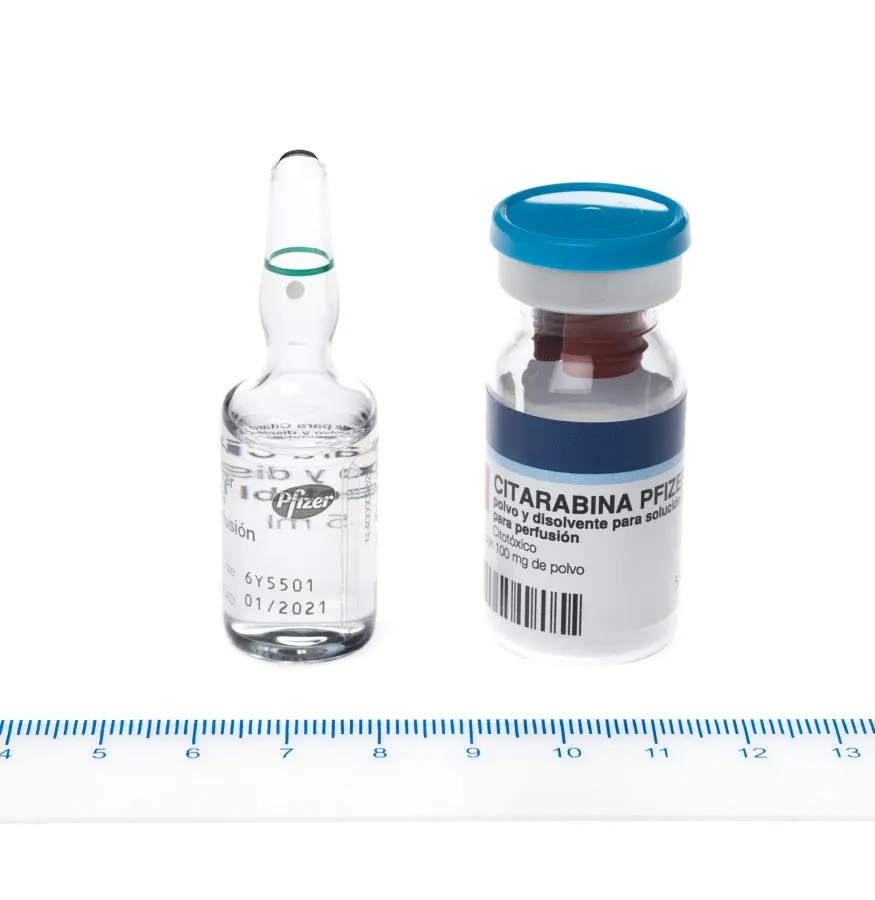
Table of Contents
Patient Information Leaflet
Introduction
Patient Information Leaflet
Cytarabine Pfizer 20 mg/ml solution for injection and infusion
Read all of this leaflet carefully before you start using this medicine, because it contains important information for you.
- Keep this leaflet. You may need to read it again.
- If you have any questions, ask your doctor, pharmacist, or nurse.
- If you get any side effects, talk to your doctor, pharmacist, or nurse. This includes any side effects not listed in this leaflet. See section 4.
Contents of this leaflet
- What Cytarabine Pfizer is and what it is used for
- What you need to know before using Cytarabine Pfizer
- How to use Cytarabine Pfizer
- Possible side effects
- How to store Cytarabine Pfizer
- Contents of the pack and other information
1. What Citarabina Pfizer is and what it is used for
Citarabina Pfizer is used in adults and children. The active substance is cytarabine.
Cytarabine belongs to a group of medicines called cytotoxic agents; these medicines are used to treat acute leukaemias (blood cancer causing an excess of white blood cells in the blood), including prophylaxis and treatment of central nervous system (CNS) involvement (meningeal leukaemia). Cytarabine interferes with the proliferation of cancer cells, which are eventually destroyed.
Cytarabine is also used to treat certain types of chronic leukaemia.
Remission induction involves intensive treatment to reduce the extent of leukaemia. When effective, blood cell balance improves to some degree and your health improves. This period of relative good health is called remission.
Maintenance treatment is a less intensive therapy aimed at keeping remission going for as long as possible. Relatively low doses of cytarabine are used to keep leukaemia under control and prevent its recurrence.
2. What you need to know before using Cytarabine Pfizer
Do not use Cytarabine Pfizer:
- If you are allergic to the active substance or to any of the other components of this medicine (listed in section 6).
- If you are already taking medicines that reduce the bone marrow's ability to produce blood cells.
Warnings and precautions
Talk to your doctor or pharmacist before starting to use Cytarabine Pfizer.
- If your bone marrow is affected, treatment should begin under close medical supervision.
- Cytarabine markedly reduces the production of blood cells in the bone marrow. This may increase susceptibility to infections or bleeding. Blood cell counts may continue to decrease for up to one week after stopping treatment. Your doctor will perform periodic blood tests and examine your bone marrow if necessary.
- If you have or have had liver or kidney problems. During treatment with cytarabine, your liver and kidney function should be monitored. If your liver and/or kidneys are not functioning properly before treatment, cytarabine should only be administered with extreme caution.
- If you have or have had gout, as cytarabine may cause elevated levels of uric acid.
- Severe and sometimes potentially fatal adverse effects may occur in the central nervous system, intestines, or lungs.
- If you are receiving cytarabine intravenously in combination with intrathecal methotrexate, as you may experience serious adverse effects in your nervous system, especially if you are a young patient or adolescent.
- If you need to be vaccinated while undergoing treatment with this medicine, since live or attenuated virus vaccines must not be administered and the response to inactivated or killed vaccines may be reduced.
If you are in any of the situations listed above, consult your doctor before using this medicine.
Children and adolescents
The safety of this medicine has not been established for use in infants.
Other medicines and Cytarabine Pfizer
Tell your doctor or pharmacist if you are taking, have recently taken, or might need to take any other medicines.
- If you are receiving medicines containing 5-fluorocytosine (a medicine used to treat fungal infections).
- If you are taking medicines containing beta-acetyldigoxin, which is used to treat certain heart conditions.
- If you are taking gentamicin (an antibiotic used to treat bacterial infections).
- If you are receiving medicines containing cyclophosphamide, vincristine, and prednisone, which are used in cancer treatment regimens.
- If you are receiving cytarabine intravenously in combination with intrathecal methotrexate.
Pregnancy, breastfeeding, and fertility If you are pregnant or breastfeeding, think you may be pregnant, or are planning to become pregnant, consult your doctor before using this medicine.
Pregnancy
You must not become pregnant while you or your partner are being treated with cytarabine. If you are sexually active, you are advised to use effective contraceptive methods to prevent pregnancy, regardless of your sex. Cytarabine may cause congenital abnormalities, so it is important to inform your doctor if you think you may be pregnant. Both men and women must use effective contraception during treatment and for 6 months after the last dose.
Contraception in women of childbearing potential
Women must always use effective contraceptive methods (contraception) to prevent pregnancy during treatment and for 6 months after the last dose. Discuss with your doctor which contraceptive methods are appropriate for you and your partner.
Contraception in men
Male patients with female partners of childbearing potential must always use highly effective contraceptive methods to prevent pregnancy during treatment and for 3 months after the last dose.
Breastfeeding
Breastfeeding must be discontinued during treatment with Cytarabine Pfizer and for at least one week after the last dose, or the treatment must be discontinued, as this medicine could be harmful to breastfed infants.
Fertility
Due to the potential risk of infertility after treatment, you should consider the possibility of preserving sperm before starting treatment with cytarabine.
Driving and use of machines Cytarabine has a minor or moderate influence on the ability to drive or operate machinery due to adverse reactions (such as altered brain function and dizziness).
Cytarabine Pfizer contains sodium
This medicine contains 2.67 mg of sodium (main component of table/cooking salt) per milliliter. This corresponds to 0.13% of the maximum daily sodium intake recommended for an adult.
This medicine contains 13.35 mg of sodium (main component of table/cooking salt) per 5 ml vial. This corresponds to 0.67% of the maximum daily sodium intake recommended for an adult.
This medicine contains 66.75 mg of sodium (main component of table/cooking salt) per 25 ml vial. This corresponds to 3.34% of the maximum daily sodium intake recommended for an adult.
3. How to use Cytarabine Pfizer
Method and routes of administration
Cytarabine must be administered only under the supervision of a physician experienced in the use of this type of treatment. Consult your doctor or pharmacist if you have any questions.
This medicine may be administered intravenously as a rapid injection (bolus) or by infusion, subcutaneously, or intrathecally.
If in doubt, consult your doctor or nurse again.
Dosage
Your doctor will determine the dose, duration of treatment, and the most appropriate route of administration for you, based on your condition, whether as induction or maintenance therapy, and according to your body weight or body surface area and your response to treatment.
Your doctor will inform you of the number of treatment cycles you require.
During treatment, you will require frequent examinations, including blood tests. Your doctor will advise you how often these are needed and will arrange for regular tests of:
- Blood, to check for low blood cell counts that may require treatment.
- Liver (also via blood tests) to ensure that cytarabine is not adversely affecting its function.
- Kidneys (also via blood tests) to ensure that cytarabine is not adversely affecting its function.
- Blood uric acid levels: cytarabine may increase blood uric acid levels. If your uric acid levels become too high, you may be given another medication.
If you receive more Cytarabine Pfizer than you should
This medicine will be administered in a hospital setting, so it is unlikely that you will receive more cytarabine than intended. However, some of the known serious adverse effects of the medicine may occur, such as mouth ulcers, or a reduction in white blood cells and platelets (which help blood clotting) in the blood. In such cases, you may require antibiotics or blood transfusions. Mouth ulcers can be treated to reduce discomfort during healing.
4. Possible adverse effects
Like all medicines, this medicine can cause adverse effects, although not everyone will experience them.
The adverse effects of cytarabine depend on the dose. The gastrointestinal tract is usually the most affected organ, as well as the blood.
Very common adverse effects (may affect more than 1 in 10 patients) include:
- Infections, systemic infection, pneumonia.
- Reduction in the number of red blood cells, white blood cells, and/or platelets in the blood.
- Bone marrow suppression, i.e., impairment of the immune system with loss of the ability to fight infections or diseases.
- Impairment of normal brain and cerebellar* function, drowsiness*.
- Eye corneal disorder*.
- Fluid accumulation in the lungs*, difficulty breathing*.
- Nausea, vomiting, diarrhea, inflammation or ulcers in the mouth or anus, abdominal pain.
- Liver dysfunction.
- Rash, hair loss.
- Fever, cytarabine syndrome (characterized by muscle and bone pain, sometimes chest pain, fever, conjunctivitis, rash, and malaise, usually appearing 6–12 hours after administration and treated with corticosteroids).
- Changes in the appearance of bone marrow and blood cells.
Common adverse effects (may affect up to 1 in 10 patients) include:
- Inflammation of a portion of the intestine with death of intestinal cells (necrotizing colitis)*.
- Skin ulcers, peeling*.
Adverse effects with unknown frequency (cannot be estimated from available data) include:
-
Severe allergic reaction.
-
Inflammation at the injection site.
-
Localized accumulation of pus in the liver*.
-
Fluid retention of allergic origin.
-
Loss of appetite.
-
Personality change*.
-
Neurotoxicity, nerve inflammation, headache, dizziness, coma*, disturbances in motor and sensory function of the peripheral nervous system* (when administered intrathecally); in children, a rare inflammatory disorder may occur causing damage to the tissue covering the nerves (necrotizing leukoencephalopathy), leg and lower body paralysis (paraplegia), progressive ascending paralysis, progressive toxicity, seizures.
-
Conjunctivitis (eye infection that may be accompanied by rash), hemorrhagic conjunctivitis*, blindness (when administered intrathecally).
-
Inflammation of the tissue covering the heart (pericarditis), slower than normal heart rate or rhythm (sinus bradycardia).
-
Heart disease (cardiomyopathy)*, enlargement of the heart (cardiomegaly)*.
-
Blockage and inflammation of the blood vessel at the injection site (thrombophlebitis).
-
Sore throat, shortness of breath, inflammation of a part of lung tissue*.
-
Esophageal ulcer, esophagitis, gastrointestinal ulcer*, presence of cysts in the intestinal wall*, peritonitis*, death of intestinal cells*, inflammation of the pancreas (pancreatitis).
-
Yellowing of the skin, liver damage*, increased bilirubin levels*.
-
Hives, skin spots, itching.
-
Urinary retention, kidney impairment.
-
Chest pain.
-
Reaction at the injection site.
-
Skin rash on the palms of the hands and soles of the feet.
-
Redness, pain, or swelling of the ears that may occur during or shortly after cytarabine treatment (known as "cytarabine ears" or auricular erythema).
-
Inflammation of the sweat glands, which may sometimes cause painful red skin plaques (known as neutrophilic eccrine hidradenitis).
-
Due to high-dose cytarabine only
Reporting of adverse effects
If you experience any type of adverse effect, consult your doctor, pharmacist, or nurse, even if it is a possible adverse effect not listed in this leaflet. You may also report them directly via the Spanish Pharmacovigilance System for Human Medicines: https://www.notificaram.es. By reporting adverse effects, you can help provide more information on the safety of this medicine.
5. Storage of Cytarabine Pfizer
Keep this medicine out of the sight and reach of children.
Store in the original packaging to protect from light, at a temperature between 15°C and 25°C until use.
Do not use this medicine after the expiry date stated on the carton and label after EXP. The expiry date refers to the last day of the month indicated.
Do not use this medicine if signs of deterioration are observed.
Disposal of unused medicine and all materials used during its handling must be carried out in accordance with local regulations for cytotoxic agents.
6. Contents of the pack and other information
Composition of Cytarabine Pfizer
- The active substance is cytarabine. Each millilitre of solution contains 20 mg of cytarabine.
A 5 ml vial contains 100 mg of cytarabine.
A 25 ml vial contains 500 mg of cytarabine.
- The other components are sodium chloride, hydrochloric acid, sodium hydroxide, and water for injections.
Appearance of Cytarabine Pfizer and contents of the pack
It is presented as a clear, colourless or slightly yellowish solution in transparent glass vials with a rubber stopper and flip-off cap, available in 5 ml and 25 ml sizes.
- 5 ml vial in a pack containing 1 vial.
- 25 ml vial in a pack containing 1 vial.
Only certain pack sizes may be marketed.
Marketing Authorization Holder
Pfizer, S.L.
Avda. de Europa, 20 B
Parque Empresarial La Moraleja
28108 Alcobendas (Madrid)
Spain
Manufacturer
Pfizer Service Company BV
Hermeslaan 11
1932 Zaventem
Belgium
Date of the most recent review of this leaflet: March 2026.
Detailed and up-to-date information on this medicinal product is available on the website of the Spanish Agency for Medicines and Health Products (Agencia Española de Medicamentos y Productos Sanitarios - AEMPS) http://www.aemps.gob.es/
This information is intended for healthcare professionals only
The administration of cytarabine, like all other cytostatic agents, should be performed by personnel experienced in the use of chemotherapy.
Route of administration
The solution may be administered intravenously as a rapid injection (bolus) or by infusion, subcutaneously, or intrathecally. Cytarabine is not active when administered orally. High total doses are better tolerated when given as a bolus rather than by slow infusion, although a clear clinical difference between the two methods has not been demonstrated. When cytarabine is administered intravenously at high doses or intrathecally, solvents containing benzyl alcohol must not be used. A common practice is to dilute with 9 mg/ml sodium chloride solution for injection, free of preservatives, and to use immediately.
The in-use chemical and physical stability of infusion solutions has demonstrated that cytarabine is stable at concentrations between 0.1 mg/ml and 1.0 mg/ml in water for injections; 5% dextrose injectable solution; and 0.9% sodium chloride injectable solution, in PVC infusion bags for up to 4 days at 25°C/60% relative humidity, exposed to ambient light and at 2–8°C protected from light.
From a microbiological standpoint, the medicinal product should be used immediately after dilution. If not used immediately, in-use stability times and conditions are the responsibility of the user and should normally not exceed 24 hours when stored between 2 and 8°C, unless the dilution has been carried out under controlled and validated aseptic conditions.
Intravenous administration
For intravenous administration (by infusion), the recommended diluents are:
- Water for injections
- 5% dextrose injectable solution
- 0.9% sodium chloride injectable solution
The infusion time for each dose ranges between 1 and 3 hours.
As with all parenteral medications, intravenous mixtures should be visually inspected for clarity, particles, precipitates, color changes, and leaks prior to administration, whenever the solution and container permit. Solutions showing cloudiness, particles, precipitates, color changes, or leaks must not be used.