Cuvénax 35 micrograms/puff solution for nasal spray
Spain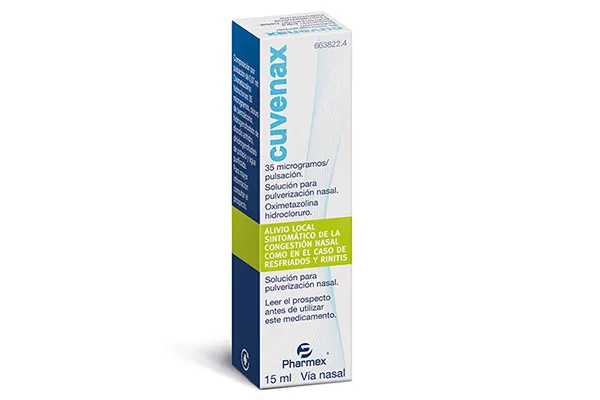
Table of Contents
Package leaflet: Information for the user
Introduction
PACKAGE LEAFLET: INFORMATION FOR THE USER
CUVENAX 35 micrograms/spray nasal spray solution
Oxymetazoline hydrochloride
Read the entire leaflet carefully before starting to use this medicine, because it contains important information for you.
Follow exactly the instructions for administration of the medicine contained in this leaflet or those indicated by your doctor, pharmacist or nurse.
- Keep this leaflet, as you may need to read it again.
- If you need advice or more information, consult your pharmacist.
- If you experience adverse effects, consult your doctor, pharmacist or nurse, even if they are adverse effects not listed in this leaflet. See section 4.
- You should consult a doctor if your condition worsens or if you do not improve after 3 days.
Leaflet contents:
- What Cuvenax is and what it is used for.
- What you need to know before using Cuvenax.
- How to use Cuvenax.
- Possible adverse effects.
- How to store Cuvenax.
- Contents of the pack and other information.
1. What Cuvenax is and what it is used for
This medicine belongs to the group known as sympathomimetics. It is a medicine containing oxymetazoline as the active substance, which is a nasal decongestant. When administered in the nose, it produces nasal decongestion and improves nasal ventilation.
This medicine is indicated for the local symptomatic relief of nasal congestion, such as in colds and rhinitis.
2. What you need to know before using Cuvenax
Do not use Cuvenax
If you are allergic (hypersensitive) to oxymetazoline or to any of the other components of this medicine (listed in section 6).
If you have recently undergone head surgery.
Warnings and precautions
Talk to your doctor, pharmacist, or nurse before using Cuvenax:
If you are being treated with antidepressant medications, phenothiazines (tranquilizers), or methyldopa (to lower blood pressure).
- If you have had or currently have, even if only once, any of the following conditions or symptoms:
- High blood sugar levels (diabetes mellitus)
- High blood pressure (hypertension)
- Any heart or circulatory system disease
- Prostate disease with difficulty urinating (prostatic hypertrophy)
- Thyroid disease (hyperthyroidism)
- If you have ever experienced insomnia or dizziness while taking other sympathomimetic medicines, such as those used to treat heart conditions, hypotension (low blood pressure), or asthma.
In rare cases, oxymetazoline may increase nasal congestion symptoms rather than relieve them; this is because its effects are temporary, and prolonged use may lead to this so-called rebound effect.
Do not exceed the recommended dose indicated in section 3. How to use Cuvenax.
To prevent infection, the medicine must not be shared between individuals, and the applicator should always be cleaned after each use with a clean, damp cloth.
Children and adolescents
Do not use in children under 6 years of age without consulting a doctor.
Use in people aged 65 years and older
Consult your doctor or pharmacist, as elderly individuals may be more sensitive to the effects of this medicine.
Other medicines and Cuvenax
Inform your doctor or pharmacist if you are taking, have recently taken, or might need to take any other medicines.
This medicine must not be used by people who are currently taking, or have taken within the last two weeks, tricyclic antidepressants or monoamine oxidase inhibitors (MAOIs) (medicines used to treat depression), or methyldopa (a medicine to lower blood pressure).
It should also not be used if you are being treated with phenothiazines (tranquilizers) or medicines for asthma.
Use of Cuvenax with food, drinks, and alcohol
Eating food does not affect the effectiveness of this medicine.
Pregnancy and breastfeeding
If you are pregnant or breastfeeding, think you might be pregnant, or are planning to become pregnant, consult your doctor or pharmacist before using this medicine.
This medicine should not be used during pregnancy or breastfeeding.
Consult your doctor or pharmacist before using any medicine.
Driving and using machines
Observe how you react to the medicine, as drowsiness may occur at normal doses. If this happens, do not drive or operate dangerous machinery.
Cuvenax contains benzalkonium chloride
This medicine contains 0.014 mg of benzalkonium chloride per spray.
Benzalkonium chloride may cause irritation or inflammation inside the nose, especially when used over long periods.
3. How to use Cuvenax
Follow exactly the administration instructions contained in this leaflet or those provided by your doctor or pharmacist. If in doubt, consult your doctor or pharmacist.
The recommended dose is:
Adults and children over 6 years of age: Apply 1 spray into each nostril up to 2 times daily, once in the morning and once at night. If necessary, adults may administer a second spray into each nostril at each dose.
Children under 6 years of age: This medicine must not be used in children under 6 years of age.
This medicine is for nasal use.
If this is the first time the product is being used, or if it has not been used for a long time, the spray must be primed. To do this, holding the container away from the body, press the spray pump several times until a fine mist is released.
Before application, clear any existing nasal secretions by blowing your nose thoroughly.
To administer the spray, keep your head upright.
Insert the applicator into the nostril so that it does not completely block the opening. While pressing the applicator, inhale gently to ensure the medicine is evenly distributed throughout the nasal cavity.
To prevent infection, after each use and before closing the container, clean the tip of the applicator with a clean, damp cloth. In addition, each container should be used by only one person.
If symptoms worsen or persist after 3 days of treatment, discontinue treatment and consult your doctor.
If you use more Cuvenax than you should
Excessive or prolonged use may cause headache, tremors, insomnia, excessive sweating, sleep disturbances, palpitations, or nervousness.
In case of overdose or accidental ingestion, contact your doctor or pharmacist immediately or call the Toxicology Information Service at 91.5620420, indicating the medicine and the amount ingested.
If you forget to use Cuvenax
Do not use a double dose to make up for missed doses.
If necessary, resume use as indicated in section 3. How to use Cuvenax.
If you stop using Cuvenax
If you have any further questions about the use of this medicine, ask your doctor or pharmacist.
4. Possible adverse effects
Like all medicines, this medicine can cause adverse effects, although not everyone will experience them.
During the period of use of oxymetazoline, the following adverse effects have been observed, although their frequency could not be established precisely:
The adverse effects that may occur most frequently are:
Burning sensation at the site of application, dryness, itching of the nasal mucosa, or sneezing.
The adverse effects that may occur very rarely are:
Anxiety, restlessness, insomnia, hallucinations, tremors, and sleep disorders in children. Tachycardia, palpitations, increased blood pressure. Headache, nausea, rash (skin redness).
Excessive or prolonged use of this medicine may lead to increased nasal congestion.
Reporting of adverse effects
If you experience any type of adverse effect, consult your doctor or pharmacist, even if it is a possible adverse effect not listed in this leaflet. You can also report them directly through the Spanish Pharmacovigilance System for Human Medicines: www.notificaRAM.es. By reporting adverse effects, you can help provide more information on the safety of this medicine.
5. Storage of Cuvenax
Keep this medicine out of the sight and reach of children.
This medicine does not require any special storage conditions.
Do not use this medicine after the expiry date stated on the packaging after {EXP.}. The expiry date is the last day of the month indicated.
Medicines must not be disposed of via wastewater or household waste. Dispose of unused medicines and their containers at the SIGRE Point at your pharmacy. If you have any doubts, ask your pharmacist how to dispose of medicines and containers that you no longer need. This will help protect the environment.
6. Contents of the package and other information
Composition of CUVENAX
The active substance is: oxymetazoline hydrochloride.
- The other excipients are benzalkonium chloride (0.014 mg per spray), potassium dihydrogen phosphate, anhydrous disodium hydrogen phosphate, purified water.
Each spray contains 35 micrograms of oxymetazoline hydrochloride in 0.07 ml of nasal spray solution.
Appearance of the product and contents of the package
It is a colourless, clear liquid solution.
The container with the dosing pump is white and contains 15 ml of nasal spray solution.
Marketing Authorization Holder:
PHARMEX ADVANCED LABORATORIES, S.L.
Ctra. A-431 Km.19
14720 Almodóvar del Río (Córdoba)
Manufacturer:
PHARMEX ADVANCED LABORATORIES, S.L.
Ctra. A-431 Km.19
14720 Almodóvar del Río (Córdoba)
Spain
This Patient Information Leaflet was approved in August 2009