Custodiol solution for cardioplegia and for organ preservation
Spain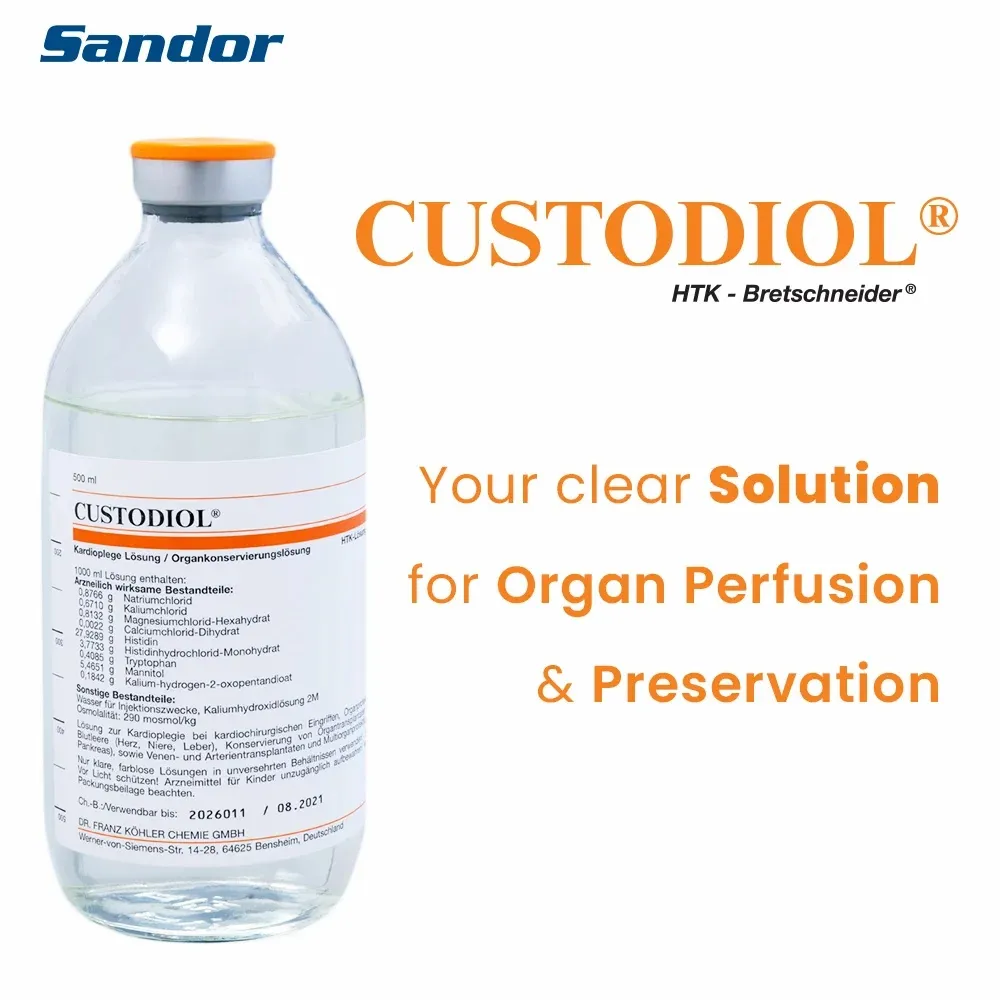
Table of Contents
Package leaflet: Information for the user
Introduction
Package leaflet: information for the patient
Custodiol Solution for cardioplegia and organ preservation
Read the entire leaflet carefully before you start using this medicine, because it contains important information for you.
- Keep this leaflet, as you may need to read it again.
- If you have any questions, consult your doctor.
- If you experience any adverse effects, consult your doctor or nurse, even if they are adverse effects not listed in this leaflet. See section 4.
Leaflet contents
-
What Custodiol is and what it is used for
-
What you need to know before using Custodiol
-
How to use Custodiol
-
Possible side effects
- Storage of Custodiol
-
Contents of the container and other information
1. What Custodiol is and what it is used for
Custodiol is an aqueous solution containing a mixture of electrolytes and amino acids.
Custodiol is used:
- only during cardiac surgical procedures and organ harvesting for transplantation
- for reversible, induced cardiac arrest during open-heart surgery (cardioplegia in cardiac surgery)
- for organ protection during bloodless-field surgical procedures (heart, kidney, liver)
- for organ transplant preservation: cold perfusion and storage (heart, kidney, liver, pancreas)
2. What you need to know before using Custodiol
Custodiol should only be used intraoperatively.
Do not use Custodiol:
- if you are allergic to the active substances or to any of the other components of this medicine (listed in section 6).
Warnings and precautions
Children and adolescents
Only a limited amount of data is available regarding use in children and adolescents.
Use of Custodiol with other medicines
Inform your doctor if you are taking or using, have recently taken or used, or might need to take or use any other medicines.
No interactions are known with the following medicines, which are commonly used during and also frequently before and after surgery:
- certain medicines used to treat heart failure (cardiac glycosides)
- tablets to increase urine production (diuretics)
- medicines used to treat symptoms of angina pectoris (e.g., chest pain or tightness)
- medicines used when oxygen supply to the heart muscle is insufficient (such as nitrates, beta-blockers, or calcium antagonists)
- medicines that reduce blood pressure (such as, e.g., beta-blockers or calcium receptor blockers).
Pregnancy and breastfeeding
If you are pregnant or breastfeeding, think you may be pregnant or are planning to become pregnant, consult your doctor before using this medicine.
Driving and use of machines
Custodiol has no influence on the ability to drive and use machines.
Custodiol contains sodium
Custodiol contains 15.0 mmol of sodium per 1,000 ml, which should be taken into consideration in patients on low-sodium diets.
Custodiol contains 10.0 mmol of potassium per 1,000 ml, which should be taken into consideration in patients with renal insufficiency or on low-potassium diets.
3. How to use Custodiol
The treatment regimen and dosage must be determined by a specialist. Custodiol should only be administered by healthcare professionals, i.e. by a physician or a nurse. Refer to the dosing recommendations in the detailed information for healthcare professionals at the end of this leaflet.
If more Custodiol has been used than prescribed
Transfer of large amounts of Custodiol into the systemic circulation may cause volume overload and electrolyte imbalances (blood levels too low in calcium or sodium or too high in magnesium or potassium). In this case, your doctor will perform periodic blood tests.
Note for the physician: additional information on overdose can be found at the end of this leaflet.
If you have any further questions about the use of this medicine, consult your doctor or nurse.
4. Possible adverse effects
Like all medicines, this medicine can cause adverse effects, although not everyone will experience them.
Adverse effects of unknown frequency (cannot be estimated from available data):
Systemic use of Custodiol may cause a temporary reduction in blood pressure during surgical intervention.
Reporting of adverse effects
If you experience any type of adverse effect, consult your doctor or nurse, even if it is a possible adverse effect not listed in this leaflet. You can also report them directly through the Spanish Pharmacovigilance System for Human Medicinal Products: www.notificaRAM.es
By reporting adverse effects, you can help provide more information on the safety of this medicine.
5. Storage of Custodiol
Store in a refrigerator (between 2 °C and 8 °C).
Keep the vial or plastic bag inside the outer packaging to protect it from light.
Keep this medicine out of the sight and reach of children.
Do not use this medicine after the expiry date stated on the packaging after EXP. The expiry date refers to the last day of the month indicated.
Use only clear, colourless to pale yellow solutions in undamaged containers. For single use only. After opening, use immediately. Discard any unused solution.
Do not use this medicine if the solution has a distinctly yellow colour.
After opening, any unused product should be diluted with water and disposed of via the drain.
6. Contents of the pack and other information
Composition of Custodiol
- The active substances are sodium chloride, potassium chloride, magnesium chloride hexahydrate, histidine, histidine hydrochloride monohydrate, tryptophan, mannitol, calcium chloride dihydrate, α-ketoglutaric acid.
- The other excipients are water for injections and potassium hydroxide (for pH adjustment).
Appearance of the product and contents of the container
Custodiol is a clear solution and is available in the following pack sizes:
Bottles of 500 ml
Bottles of 1,000 ml
Bags of 1,000 ml
Bags of 2,000 ml
Bags of 5,000 ml
10 bottles x 500 ml
6 bottles x 1,000 ml
6 bags x 1,000 ml
4 bags x 2,000 ml
2 bags x 5,000 ml
Only some pack sizes may be commercially available.
Marketing Authorisation Holder and Manufacturer
Marketing Authorisation Holder
DR. FRANZ KÖHLER CHEMIE GMBH
Werner-von-Siemens-Str. 14-28
64625 Bensheim
Germany
Local Representative
Cardiolink S.L.
Córcega 270, 3º-2ª
08008 Barcelona
Spain
Tel: +34 932 370 274
email: [email protected]
Manufacturer
DR. FRANZ KÖHLER CHEMIE GMBH
Werner-von-Siemens-Str. 14-28, 64625 Bensheim
Germany
Tel.: 06251 1083-0 - Fax: 06251 1083-146
www.koehler-chemie.de - [email protected]
This medicinal product is authorised in the European Economic Area member states under the following names:
Austria Organosol Kardioplege Lösung / Organkonservierungslösung
Belgium Perisoc Solution de cardioplégie / preservation d'organe
Spain Custodiol Solución para cardioplejía y para conservación de órganos
France Perisoc Solution de cardioplégie / preservation d'organe
Italy Conasoc
Netherlands Cetomedic Solution for Cardioplegia / bewaaroplossing voor organen
Portugal Custodiol Solução para cardioplegia ou para conservação de órgãos
United Kingdom Custodiol Solution for Cardioplegia / Organ Preservation
Date of the most recent revision of this leaflet: February 2022.
This information is intended for healthcare professionals only:
Overdose
Transfer of large volumes of Custodiol into the systemic circulation may cause volume overload and electrolyte imbalances (hypocalcemia, hyponatremia, hypermagnesemia, hyperkalemia). Periodic monitoring of serum electrolytes is recommended following systemic administration.
Complete inactivation makes the myocardium prone to distension. Therefore, adequate ventricular drainage must be ensured. Recommended perfusion volumes and pressures must not be exceeded. Particular caution is required with hearts of children and infants.
Dosage and method of administration
A. Cardioplegia:
- Perfusion volume:
- Open-heart procedures:
Solution temperature between 6 °C and 10 °C for open-heart procedures.
Perfusion rate is 1 ml/minute/gram of cardiac weight. Normal heart weight corresponds to approximately 0.5% of body weight in an adult, resulting in a total Custodiol volume between 1.5 and 2 liters.
Perfusion pressure (= pressure in the aortic root):
In adults, an initial hydrostatic pressure of 110 to 140 cm (equivalent to 80 to 110 mmHg) is used. The surgeon must ensure proper closure of the aortic valve. After initiation of cardiac arrest, pressure is reduced by half, i.e., to a hydrostatic pressure of 50 to 70 cm (equivalent to 40 to 50 mmHg). In cases of severe coronary stenosis, a higher pressure (approx. 50 mmHg) should be used.
Perfusion time:
Using this dosage and pressure regimen, perfusion time should be 6–8 minutes to achieve homogeneous myocardial equilibrium and must not be shorter under any circumstances.
Perfusion technique:
After aortic cross-clamping and simultaneous left ventricular aspiration, the solution is administered antegrade. Cardioplegia perfusion can be delivered via a roller pump with constant volume or by gravity (after cardiac arrest, the solution bag should be kept 40–50 cm above heart level).
Guidelines for additional cardioplegia perfusions:
If additional cardioplegia perfusions are required, perfusion time should be 1–2 minutes (equivalent to 200–400 ml); perfusion pressure should correspond to the pressure during the last minute of initial coronary cardioplegia perfusion.
In most cases, moderate systemic hypothermia is induced.
Custodiol is usually administered via the aortic root. In cases of aortic insufficiency or thoracic aortic dissection surgery, the solution should be administered via selective coronary perfusion into the coronary ostia.
Due to limited clinical data, a positive benefit-risk ratio for the use of Custodiol in short surgical procedures (<90 minutes) has not yet been confirmed.
Guidelines for retrograde perfusions into the coronary sinus:
Do not exceed a perfusion pressure of 30 mmHg (normally about 250 ml/min) during retrograde perfusions of the same duration as antegrade perfusions (minimum 6–8 minutes).
B. Heart transplantation:
After transverse clamping of the ascending aorta, the heart is perfused for at least 6 minutes. This is performed at a perfusion rate of 1 ml/minute per gram of heart weight, up to a total volume of 3.5 liters or more for adults.
Perfusion pressure (= pressure in the aortic root):
In adults, an initial hydrostatic pressure of 110 to 140 cm (equivalent to 80 to 110 mmHg) is used. The surgeon must ensure proper closure of the aortic valve. After initiation of cardiac arrest, pressure is reduced by half, i.e., to a hydrostatic pressure of 50–70 cm (equivalent to 40–50 mmHg). In cases of severe coronary stenosis, a higher pressure (approx. 50 mmHg) should be used.
Perfusion time:
Using this dosage and pressure regimen, perfusion time should be 6–8 minutes to achieve homogeneous myocardial equilibrium and must not be shorter under any circumstances.
Perfusion technique:
After aortic cross-clamping and simultaneous left ventricular aspiration, the solution is administered antegrade. Cardioplegia perfusion can be delivered via a roller pump with constant volume or by gravity (after cardiac arrest, the solution bag should be kept 40–50 cm above heart level).
If the heart perfused with Custodiol is to be transplanted, it must be stored and transported in cold Custodiol at 2 °C to 4 °C to maintain protection. Reliable protection can thus be achieved for up to five hours.
C. Kidney transplantation
The following general administration guidelines are recommended for the kidney:
Solution temperature: between 5 °C and 8 °C
Perfusion volume:
Perfusion of 1.5 ml of Custodiol per minute per gram of estimated kidney weight (normal adult kidney weight is approximately 150 grams). Including 500 ml of preservation solution, this results in a total volume of approximately 2.5 liters of Custodiol per organ.
Perfusion pressure (renal artery):
Water column of 120 to 140 cm above kidney level, equivalent to approximately 90 to 110 mmHg at the tip of the perfusion catheter in the renal artery.
Perfusion time:
Using this dosage and pressure regimen, perfusion time is 8–10 minutes. This time is necessary to achieve homogeneous equilibrium of the kidney's extracellular space (including interstitium and tubular system) and must not be shorter under any circumstances.
Concomitant measures:
To maximize the protective efficacy of Custodiol in the kidney, it is important to ensure pronounced diuresis prior to the start of perfusion (via medication and/or patient hydration).
Custodiol is administered via the renal artery.
If the kidney perfused with Custodiol is to be transplanted, it should be stored and transported in cold Custodiol at 2 °C to 4 °C to maintain protection. Reliable protection can thus be achieved for up to 48 hours.
D. Liver transplantation
The following general administration guidelines may be recommended for the liver:
Solution temperature: between 5 °C and 8 °C
Perfusion time:
Using this dosage and pressure regimen, perfusion time is 8 minutes (10–15 minutes).
Perfusion volume:
If simultaneous protection of the liver, pancreas, and kidneys is required in a so-called multi-organ donor, a perfusion volume of 150–200 ml of Custodiol solution/kg body weight is needed. With this "global protection," this corresponds to a perfusion volume of cold Custodiol solution of 8–12 liters in patients weighing approximately 70–80 kg.
If only the liver or part of it (e.g., in a living donor) is to be retrieved without other organs, the perfused volume is proportionally reduced.
Perfusion pressure:
Water column 100 cm above liver level.
Concomitant measures:
In an organ donor, blood should be heparinized before the start of perfusion.
Additional measures for transplantation:
Bile ducts should be thoroughly flushed with at least 100 ml of cold Custodiol, in situ or ex situ, usually using a small-caliber catheter.
Subsequently, the surgically removed liver is packed or shipped for transplantation immersed in cold Custodiol. The organ must be completely covered with cold Custodiol. A cold ischemia time <10 hours is recommended.
E. Pancreas
Volume and perfusion time should be adjusted relative to the liver, considering the much smaller size of the pancreas graft. Optimal perfusion depends on thorough cooling and exsanguination of the organ. This can be achieved with approximately 3–4 liters of Custodiol. Over-perfusion and re-flushing of the graft should be avoided.
Previous studies suggest caution should be exercised to avoid excessive flushing of the pancreatic allograft with any preservation solution, as this may cause graft edema and pancreatitis. A clear benefit exists in maintaining cold ischemia time as short as possible. A cold ischemia time <10 hours is recommended.
With larger flush volumes (>5 liters) and prolonged ischemia times (>12 hours), there may be an increased risk of allograft pancreatitis.
Paediatric population:
Limited data are available on use in children and adolescents.
Heart
- Perfusion pressure: in newborns and infants, initial water column of 110–120 cm above heart level (equivalent to 80–90 mmHg); after initiation of cardiac arrest, reduce to water column of 40–50 cm (equivalent to 30–40 mmHg). In patients with severe coronary sclerosis, higher pressures should be maintained for a longer period. The right atrium should be opened and cardioplegia completely aspirated from the bypass circuit to avoid hemodilution.
Perfusion volume depends on the child's age: 50 ml/kg (1st month of life), 30 ml/kg (2nd month–1st year), 20 ml/kg (>1st year), while perfusion time is 4–6 minutes in all cases. For example, an estimated cardiac weight of 50 g would require approximately 350 ml.