Curosurf 240
Spain
Table of Contents
- Package leaflet: Information for the user
- Introduction
- **Porcine Pulmonary Surfactant**
- 1. What Curosurf 240 mg Intratracheal Instillation Suspension is and what it is used for
- 2. What you need to know before starting to use Curosurf 240 mg Endotracheal Pulmonary Instillation Suspension
- 3. How to use Curosurf 240 mg Suspension for endotracheal instillation
- 4. Possible adverse effects
- 5. Storage of Curosurf 240 mg Suspension for Endotracheopulmonary Instillation
- 6. Package contents and additional information
Package leaflet: Information for the user
Introduction
Package leaflet: information for the user
CUROSURF 240 mg
Suspension for endotracheal instillation
Porcine Pulmonary Surfactant
Read this entire leaflet carefully before starting to use this medicine, as it contains important information for you.
- Keep this leaflet, as you may need to read it again.
- If you have any questions, consult your doctor.
- This medicine has been prescribed for you personally and must not be given to other people, even if they have the same symptoms as you, since it could harm them.
- If you experience any adverse effects, consult your doctor, even if they are adverse effects not listed in this leaflet.
Leaflet contents:
- What Curosurf 240 mg Suspension for endotracheal instillation is and what it is used for
- What you need to know before using Curosurf 240 mg Suspension for endotracheal instillation
- How to use Curosurf 240 mg Suspension for endotracheal instillation
- Possible adverse effects
- Storage of Curosurf 240 mg Suspension for endotracheal instillation
- Package contents and additional information
1. What Curosurf 240 mg Intratracheal Instillation Suspension is and what it is used for
Curosurf is used to treat or prevent Respiratory Distress Syndrome (RDS) in newborns. Most newborns are born with a substance in their lungs called "surfactant". This substance coats the lungs and prevents them from sticking together, thus facilitating normal breathing. However, some infants, especially premature babies, do not have enough of this surfactant at birth, which leads to RDS. Curosurf is a natural surfactant that works in the same way as the surfactant naturally produced by newborns, helping the infant to breathe normally until the baby can produce surfactant on its own.
2. What you need to know before starting to use Curosurf 240 mg Endotracheal Pulmonary Instillation Suspension
Do not use Curosurf 240 mg Endotracheal Pulmonary Instillation Suspension
- If you are allergic to porcine pulmonary surfactant or to any of the other components of this medicine (listed in section 6).
Warnings and precautions
The newborn's general condition should be stabilised. Correction of acidosis, hypotension, anaemia, hypoglycaemia and hypothermia is also recommended.
Newborns born after a very prolonged period following membrane rupture (longer than 3 weeks) may not respond optimally.
Surfactant administration may reduce the severity of RDS, but does not completely eliminate mortality and morbidity associated with prematurity, as these infants may have other associated complications. After administration of Curosurf, suppression of cerebral electrical activity, lasting 2–10 minutes, has been observed; its clinical significance is not well known.
The administration of Curosurf has not been studied in preterm newborns with severe hypotension.
Children
This medicine is intended only for preterm infants.
Interaction of Curosurf 240 mg Endotracheal Pulmonary Instillation Suspension with other medicines
Inform your doctor or pharmacist if you are using or have recently used any other medicines, including those obtained without a prescription, homeopathic medicines, herbal remedies, and other health-related products, as it may be necessary to interrupt treatment or adjust the dose of one or more of them.
Nevertheless, no interactions have been observed between Curosurf and the medicines commonly used in neonatal intensive care units.
Pregnancy and breastfeeding
This medicine is intended only for preterm infants.
Driving and use of machines
Not applicable, as this medicine is intended only for preterm infants.
Curosurf 240 mg Endotracheal Pulmonary Instillation Suspension contains sodium
This medicine contains less than 23 mg (1 mmol) of sodium per vial and is therefore considered essentially "sodium-free".
3. How to use Curosurf 240 mg Suspension for endotracheal instillation
Follow exactly the administration instructions for this medicine as given by your doctor. If in doubt, consult your doctor again.
Curosurf must only be administered by trained and experienced personnel in the care, resuscitation, and stabilization of preterm newborns, and only when adequate facilities for ventilation and monitoring of infants with Respiratory Distress Syndrome (RDS) are available.
Curosurf 240 mg Suspension for endotracheal instillation is administered via the endotracheal route.
The recommended dose for treatment is:
- 200 mg/kg (1.25–2.5 ml/kg), administered as a single dose or divided into two doses of 100 mg/kg, the first to be given immediately after diagnosis of RDS and the second after approximately 12 hours.
- If necessary, an additional dose of 100 mg/kg may be administered after a 12-hour interval in newborns who continue to require assisted ventilation and supplemental oxygen. The maximum total dose is 300–400 mg/kg.
The recommended dose for prevention (prophylaxis) is:
- 100–200 mg/kg (1.25–2.5 ml/kg), administered as a single dose as soon as possible after birth (preferably within the first 15 minutes).
- If necessary, an additional dose of 100 mg/kg may be administered 6–12 hours after the first dose and repeated 12 hours later if signs of RDS persist and assisted ventilation is still required. The maximum total dose is 300–400 mg/kg.
If you use more Curosurf 240 mg Suspension for endotracheal instillation than you should
Cases of overdose following administration of Curosurf have not been reported. However, in the unlikely event of accidental overdose, and only if there are clear clinical effects on the newborn's respiration, ventilation, or oxygenation, as much of the suspension as possible should be aspirated and supportive treatment provided, with special attention to fluid and electrolyte balance.
In case of overdose or accidental ingestion, contact your doctor or pharmacist immediately or call the Toxicology Information Service at telephone number 91 562 04 20, indicating the medication and the amount ingested.
If you have any further questions about the use of this product, consult your doctor or pharmacist.
4. Possible adverse effects
Like all medicines, Curosurf 240 mg Suspension for endotracheal instillation may cause adverse effects, although not everybody experiences them.
Such adverse effects include:
- Infections and infestations: sepsis (serious infection)
- Nervous system disorders: intracranial haemorrhage
- Respiratory disorders: presence of air in the pleura (pneumothorax), pulmonary haemorrhage, chronic lung disease (bronchopulmonary dysplasia), breathing difficulty (apnoea), oxygen toxicity (hyperoxia), bluish discoloration of the skin and mucous membranes (cyanosis)
- Cardiac disorders: abnormally slow heart rate (bradycardia)
- Vascular disorders: low blood pressure (hypotension)
- Investigations: reduced oxygen saturation, abnormal electroencephalogram
- Injuries, poisoning and procedural complications: endotracheal intubation complication
Reporting of adverse effects
If you experience any type of adverse effect, consult your doctor or pharmacist, even if it is a possible adverse effect not listed in this leaflet. You may also report them directly through the Spanish Pharmacovigilance System for Human Medicinal Products, https://www.notificaRAM.es. By reporting adverse effects, you can help provide more information on the safety of this medicine.
5. Storage of Curosurf 240 mg Suspension for Endotracheopulmonary Instillation
Store in a refrigerator (2-8°C), protected from light.
Unopened and unused vials of Curosurf that have been kept at room temperature for up to 24 hours may be returned to the refrigerator for later use. Do not transfer between room temperature and refrigerator more than once.
Keep out of the reach and sight of children.
Do not use Curosurf after the expiry date stated on the packaging following EXP. The expiry date refers to the last day of the month indicated.
Medicines must not be disposed of via wastewater or household waste. Dispose of unused medicines and their containers at a SIGRE collection point at your pharmacy. If you have any doubts, ask your pharmacist how to properly dispose of unused medicines and their containers. This will help protect the environment.
6. Package contents and additional information
Composition of Curosurf 240 mg Suspension for endotracheal instillation
- The active substance is porcine lung surfactant. Each single-dose vial contains 240 mg of porcine lung surfactant.
- The other components are sodium chloride, sodium bicarbonate and water for injection.
Appearance of the product and contents of the container
Packaging with one colorless glass vial with a capacity of 5 ml, containing 3 ml of sterile lung surfactant suspension (80 mg/ml) of white to yellowish color; the stopper is made of chlorobutyl rubber and the cap is made of plastic and aluminum.
Marketing Authorization Holder and Manufacturer
Marketing Authorization Holder:
CHIESI ESPAÑA, S.A.U.
Plaça d’Europa, 41-43, Planta 10
08908 L’Hospitalet de Llobregat
Barcelona (Spain)
Manufacturer:
CHIESI FARMACEUTICI, S.p.A.
Via San Leonardo 96 - Via Palermo, 26/A
43122 Parma (Italy)
This summary of product characteristics was approved in October 2016.
Detailed and up-to-date information on this medicine is available on the website of the Spanish Agency of Medicines and Health Products (AEMPS) http://www.aemps.gob.es/.
This information is intended exclusively for physicians or healthcare professionals
Instructions for use
BEFORE using CUROSURF
Aspirate the endotracheal tube before instillation to reduce the risk of obstruction, as changes in ventilation parameters during or immediately after instillation may indicate endotracheal tube blockage due to mucus, especially if pulmonary secretions were abundant before drug administration. If mucus obstruction of the endotracheal tube is suspected and cannot be cleared by aspiration, the endotracheal tube must be replaced immediately.
Method of administration
Warm the vial to room temperature by holding it in the hand for a few minutes.
Gently invert the vial several times for a few minutes, WITHOUT SHAKING, until the suspension appears homogeneous.
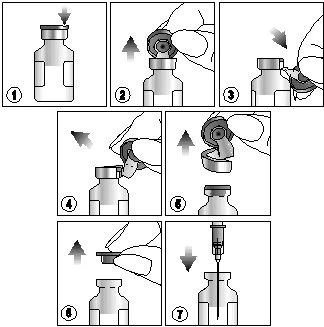
To withdraw the suspension, carefully follow the instructions below:
-
Locate the notch (FLIP UP) on the colored plastic cap.
-
Lift the notch and pull upward.
-
Pull off the plastic cap with the aluminum portion facing downward.
-
and 5) Remove the entire ring by tearing off the aluminum seal.
-
Remove the rubber stopper.
-
Withdraw the contents using a sterile needle and syringe and administer CUROSURF according to the most appropriate method described below.
CUROSURF can be administered in the following different ways:
a. Disconnecting the infant from mechanical ventilation:
Temporarily disconnect the infant from mechanical ventilation and administer 1.25 to 2.5 ml/kg (100–200 mg/kg) of the suspension as a single bolus directly into the lower trachea via the endotracheal tube. Provide manual ventilation with a bag-valve device for approximately one minute, then reconnect the infant to mechanical ventilation under the same conditions as before administration. If additional doses (1.25 ml/kg = 100 mg/kg) are required, they may be administered in the same manner.
b. Without disconnecting the infant from mechanical ventilation:
Administer 1.25 to 2.5 ml/kg (100–200 mg/kg) of the suspension as a single bolus directly into the lower trachea by passing a catheter through the suction port and into the endotracheal tube. If additional doses (1.25 ml/kg = 100 mg/kg) are required, they may be administered in the same manner.
c. A third administration option is via intubation of the newborn to deliver surfactant. The doses are the same as those indicated in sections a. and b. In this case, an intubation-extubation technique is used; after surfactant administration and extubation, nasal CPAP (Continuous Positive Airway Pressure) may be applied.
d. Less Invasive Surfactant Administration (LISA) using a thin catheter
In spontaneously breathing premature infants, Curosurf may also be administered using the Less Invasive Surfactant Administration (LISA) technique with a thin catheter. The doses are the same as those indicated in administration methods a, b, and c. A small-diameter catheter is inserted into the trachea of infants on CPAP, ensuring continuous spontaneous breathing, with direct visualization of the vocal cords by laryngoscopy. Curosurf is instilled as a single bolus over 0.5–3 minutes. After instillation, the catheter is immediately removed. CPAP therapy should be maintained throughout the procedure.
For surfactant administration, a CE-marked thin catheter specifically intended for surfactant administration must be used.
DURING treatment, regardless of the administration method used, the following is recommended:
- Frequent blood gas monitoring after administration, as an immediate increase in PaO₂ or oxygen saturation is typically observed. To maintain adequate blood oxygen levels, periodic blood gas analysis, continuous monitoring of transcutaneous PO₂ or oxygen saturation is recommended.
- Monitoring for signs of infection. Appropriate antibiotic therapy should be initiated at the first signs of neonatal infection.
- Avoid sudden changes in PaO₂ after instillation by promptly adjusting the ventilator settings. Intracranial hemorrhage following CUROSURF instillation has been associated with a reduction in mean arterial blood pressure and early peaks in arterial oxygenation (PaO₂).
AFTER drug administration:
- Do not aspirate tracheal secretions for at least 6 hours, unless there is a life-threatening risk;
- The following adjustments may be necessary:
- Reduction of peak inspiratory pressure (without waiting for blood gas confirmation) if lung expansion improves rapidly;
- Rapid adjustment of the inspired oxygen concentration (to avoid hyperoxia if a rapid increase in arterial oxygen levels occurs).
DISCONTINUE CUROSURF therapy in case of:
- Bradycardia, hypotension, and low oxygen saturation: in these situations, appropriate measures should be taken to normalize heart rate. After stabilization, continue monitoring the neonate's vital signs.
- Reflux: if necessary, increase the peak inspiratory pressure of the ventilator to clear endotracheal tube obstruction.
To complete the picture of complications associated with prematurity, the following disorders may occur, directly related to the severity of the disease and the use of mechanical ventilation required for reoxygenation: pneumothorax, pulmonary interstitial emphysema, and pulmonary hemorrhage.
Finally, prolonged use of high oxygen concentrations and mechanical ventilation are associated with the development of bronchopulmonary dysplasia and retinopathy of prematurity.