Curadona Unidosis 100 mg/ml cutaneous solution
Spain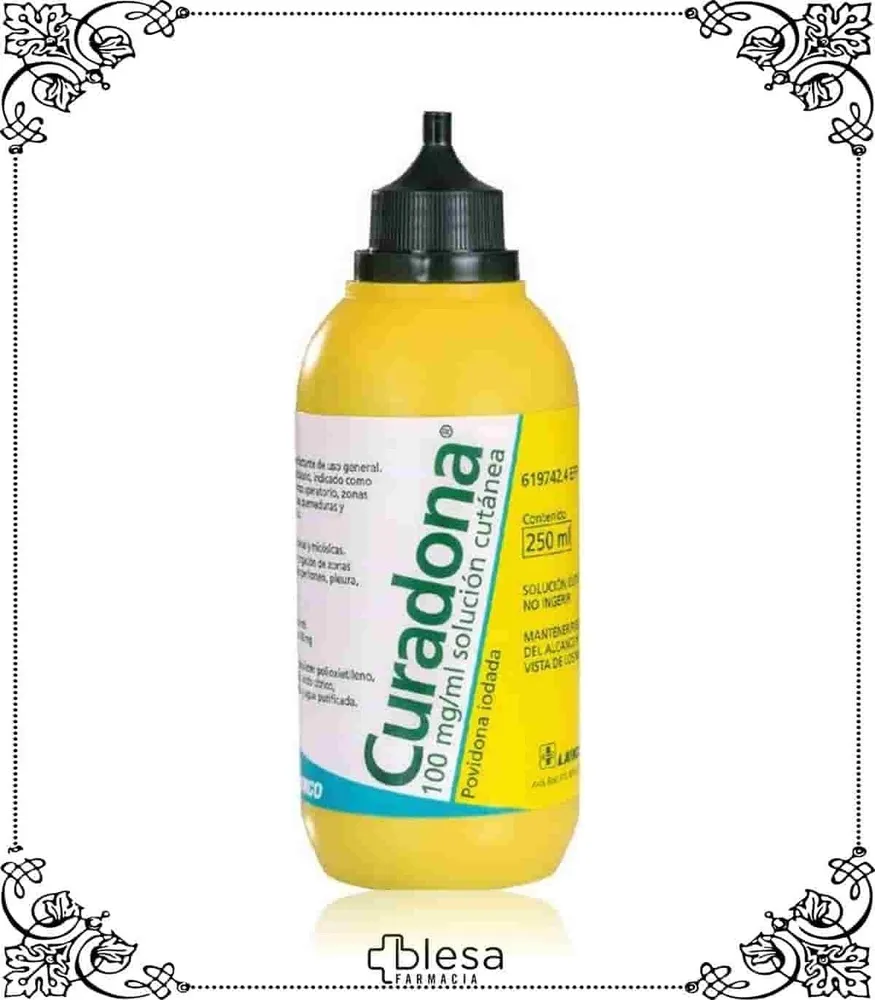
Table of Contents
- Package leaflet: Information for the user
- Introduction
- 1. What Curadona unidosis is and what it is used for
- 2. What you need to know before using Curadona single-dose
- 3. How to use Curadona single-dose
- 4. Possible adverse effects
- 5. Storage of Curadona single-dose units
- 6. Contents of the pack and other information
Package leaflet: Information for the user
Introduction
Package leaflet: information for the user
Curadona unidosis 100 mg/ml cutaneous solution
Povidone iodine
Read this entire leaflet carefully before you start using this medicine, because it contains important information for you.
Follow exactly the instructions for use provided in this leaflet or those given by your doctor or pharmacist.
- Keep this leaflet as you may need to read it again.
- If you need advice or more information, consult your pharmacist.
- If you experience any adverse reactions, consult your doctor or pharmacist, even if they are adverse reactions not listed in this leaflet. See section 4.
- You should consult a doctor if your condition worsens or does not improve after 7 days.
Contents of the leaflet
- What Curadona unidosis is and what it is used for
- What you need to know before using Curadona unidosis
- How to use Curadona unidosis
- Possible adverse effects
- How to store Curadona unidosis
- Contents of the pack and other information
1. What Curadona unidosis is and what it is used for
Povidone iodine, the active substance of this medicine, is an antiseptic and disinfectant (a substance that prevents the growth of microorganisms) containing iodine.
Curadona unidosis is indicated as a general antiseptic for use on:
- Skin (for minor wounds and superficial cuts, mild burns, or abrasions).
- Surgical fields, puncture sites, wounds, burns, and surgical instruments.
- Microbial and fungal dermatitis.
- Irrigation of septic areas of the body (peritoneum, pleura, bones).
You should consult a doctor if your condition worsens or does not improve after 7 days.
2. What you need to know before using Curadona single-dose
Do not use Curadona single-dose
- If you are allergic to povidone-iodine, to other iodine-containing products or medicines, or to any of the other components of this medicine (listed in section 6).
- In newborns (from 0 to 1 month of age).
Warnings and precautions
Talk to your doctor or pharmacist before starting to use Curadona single-dose.
Do not use this medicine for long periods or on large areas of skin without consulting your doctor, especially if:
- you have burns affecting more than 20% of your body surface
- you have large or open wounds
- you suffer from kidney or liver disease
- you have a thyroid disorder
- you are being treated with lithium-containing medicines.
Do not heat the product before applying it.
This medicine is for external use only, on the skin.
Avoid contact with eyes, ears, and other mucous membranes.
Other medicines and Curadona single-dose
Tell your doctor or pharmacist if you are taking, have recently taken, or might need to take any other medicines.
In particular, you should consult your doctor if you are using Curadona single-dose at the same time as:
-
other products containing mercury derivatives, as these react with iodine to form irritating compounds
-
sodium thiosulfate (used for the treatment of fungal infections)
-
lithium (a medicine used to treat certain types of depression).
Interference with diagnostic tests:
This medicine may interfere with thyroid function tests and with tests for detecting occult blood in feces and urine. Therefore, you must inform your doctor that you are using Curadona single-dose before undergoing such tests.
Use in children
Do not administer this medicine to children under 30 months of age without first consulting a doctor.
Pregnancy and breastfeeding
If you are pregnant or breastfeeding, think you may be pregnant, or are planning to become pregnant, consult your doctor or pharmacist before using this medicine.
Pregnant women or those who are breastfeeding should avoid using this medicine, as it may cause transient hypothyroidism (a condition that occurs when thyroid gland activity decreases) in the fetus or breastfed infant.
Driving and using machines
The use of this medicine does not affect your ability to drive and/or operate machinery.
3. How to use Curadona single-dose
Follow exactly the instructions for administering this medicine as described in this leaflet or as directed by your doctor or pharmacist. If in doubt, consult your doctor or pharmacist.
Recommended dose: Apply a small amount directly to the affected area, 2 to 3 times daily.
Method of administration
For topical use only.
Wash and dry the affected area before applying the product.
If symptoms worsen or persist after 7 days, consult your doctor.
If you use more Curadona single-dose than you should
If you have used more Curadona single-dose than recommended, consult your doctor or pharmacist. In case of overdose or accidental ingestion, contact the Toxicology Information Service immediately at telephone number 91 562 04 20, indicating the medicine and the amount ingested.
If an excessive amount of the product is applied and skin irritation occurs, wash the affected area thoroughly with water, discontinue treatment, and if irritation persists, seek medical advice.
In cases of ingestion of large amounts of povidone-iodine, the following may occur: abdominal pain, diarrhea, fever, nausea, vomiting, metabolic acidosis, and hypernatremia (excess sodium in the blood), as well as disturbances in kidney, liver, and thyroid function. Excess iodine may also cause goiter, hypothyroidism, or hyperthyroidism.
In such cases, if the patient is conscious, milk should be administered every 15 minutes to relieve gastric irritation. Additionally, to eliminate any povidone-iodine remaining in the stomach, a starch solution should be administered, prepared by adding 15 mg of corn starch or 15 mg of flour to 500 ml of water. Gastric lavage or induction of vomiting must not be performed if the patient has esophageal damage.
Other supportive measures to maintain vital functions may be employed, such as oxygen administration to support respiration and antihistamines, epinephrine, or corticosteroids for the treatment of anaphylaxis.
If you have any further questions about the use of this medicine, ask your doctor or pharmacist.
4. Possible adverse effects
Like all medicines, this medicine may produce adverse effects, although not everyone will experience them.
During the period of use of povidone iodine, the following adverse effects have been observed, for which the frequency could not be established accurately: occasionally skin disorders such as local irritation, itching, or stinging. In such cases, treatment should be discontinued and the affected area washed with water.
However, adverse effects may become more serious if the product is used for a prolonged period, or if it is applied to large wounds or extensive burns, potentially leading to systemic adverse effects such as mainly metabolic acidosis, hypernatremia (excess sodium in the blood), and disturbances in kidney, liver, and thyroid function (especially in children).
Reporting of adverse effects:
If you experience any type of adverse effect, consult your doctor or pharmacist, even if it is a possible adverse effect not listed in this leaflet. You may also report them directly via the Spanish Pharmacovigilance System for Human Medicines: https://www.notificaram.es. By reporting adverse effects, you can help provide more information on the safety of this medicine.
5. Storage of Curadona single-dose units
No special storage conditions are required.
Keep this medicine out of the sight and reach of children.
Do not use this medicine after the expiry date stated on the packaging after EXP. The expiry date refers to the last day of the month indicated.
Medicines must not be disposed of via wastewater or household waste. Dispose of unused medicines and their containers at a SIGRE collection point at your pharmacy. If you are unsure, please ask your pharmacist how to dispose of unused medicines and their containers. This will help protect the environment.
6. Contents of the pack and other information
Composition of Curadona unidosis
- The active substance is povidone-iodine. Each milliliter of solution contains 100 mg of povidone-iodine.
- The other components (excipients) are: glycerol (E-422), alkyl ether polyoxyethylene, disodium hydrogen phosphate dihydrate, citric acid monohydrate, sodium hydroxide (E-524) and purified water.
Appearance of the product and contents of the pack
Brown-colored solution for cutaneous use, supplied in plastic bottles with dropper and cap.
Available in unit packs containing 5 tubes of 10 ml and 5 tubes of 5 ml, and in clinical packs containing 200 tubes of 10 ml and 200 tubes of 5 ml.
Only certain pack sizes may be marketed.
Marketing Authorization Holder and Manufacturer:
LAINCO, S.A. – Avda. Bizet, 8-12 - 08191 Rubí (Barcelona), Spain
Date of the most recent review of this leaflet: September 2024
Detailed and up-to-date information on this medicinal product is available on the website of the Spanish Agency for Medicines and Health Products (AEMPS) http://www.aemps.gob.es/