Cuprior 150 mg film-coated tablets
Spain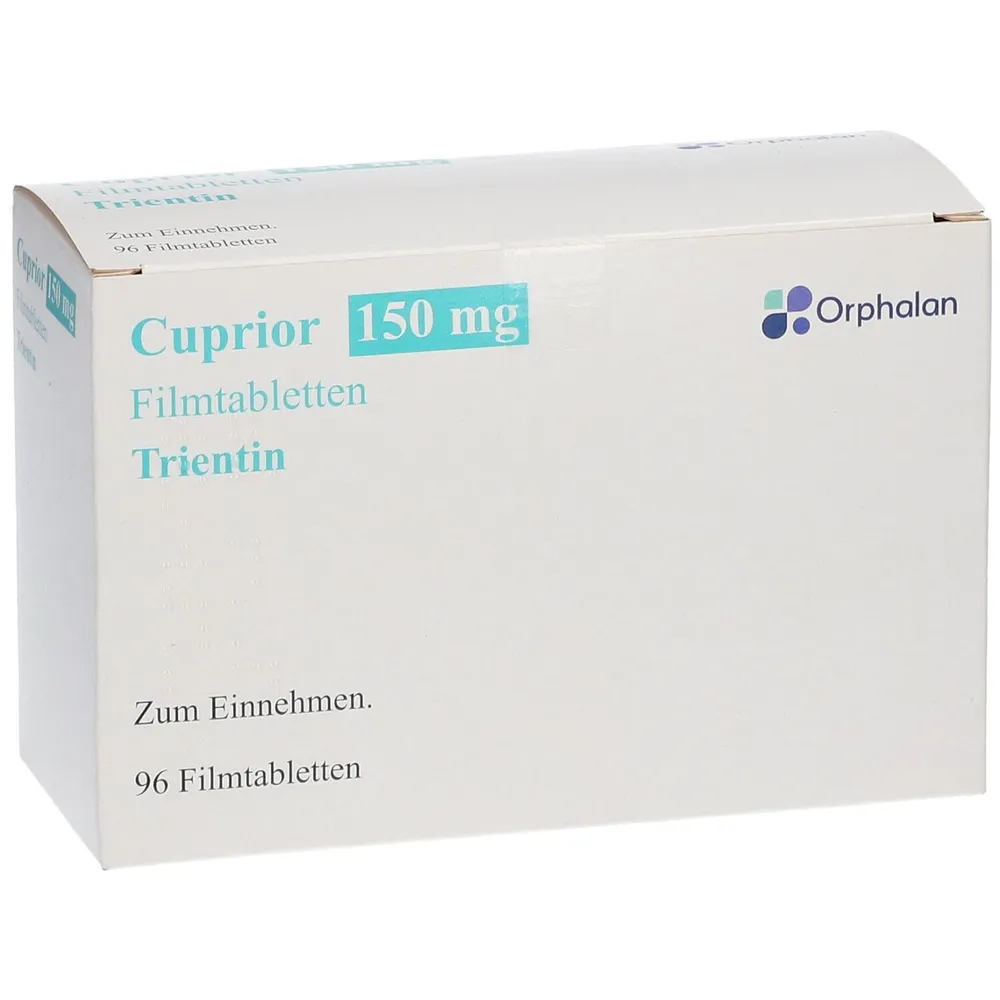
Table of Contents
Package leaflet: Information for the user
Introduction
Package leaflet: information for the patient
Cuprior 150 mg film-coated tablets
trientine
Read the entire leaflet carefully before you start taking this medicine, because it contains important information for you.
- Keep this leaflet, as you may need to read it again.
- If you have any questions, ask your doctor or pharmacist.
- This medicine has been prescribed for you only, and you should not give it to others, even if they have the same symptoms as you, because it could harm them.
- If you experience any adverse effects, consult your doctor or pharmacist, even if they are effects not listed in this leaflet. See section 4.
Leaflet contents
-
What Cuprior is and what it is used for
-
What you need to know before taking Cuprior
-
How to take Cuprior
-
Possible side effects
-
How to store Cuprior
-
Contents of the pack and other information
1. What Cuprior is and what it is used for
Cuprior is a medicine used to treat Wilson's disease and contains the active substance trientine.
Wilson's disease is a hereditary condition in which the body cannot transport copper normally or cannot eliminate copper normally through liver secretion into the intestine. As a result, small amounts of copper ingested with food and drinks accumulate to excessive levels, which may cause liver damage and problems in the nervous system. This medicine works mainly by binding to copper in the body, which can then be excreted in the urine, thereby helping to reduce copper levels. It may also bind to copper in the intestine, thus reducing the amount of copper absorbed by the body.
Cuprior is given to adults, adolescents, and children aged 5 years and older who cannot tolerate another medicine used to treat this disease called penicillamine.
2. What you need to know before starting to take Cuprior
Do not take Cuprior
- if you are allergic to trientine or to any of the other ingredients of this medicine (listed in section 6).
Warnings and precautions
Talk to your doctor or pharmacist before starting to take Cuprior.
If you were previously taking another medicine containing trientine, your doctor may adjust your daily dose, the number of tablets, or the number of daily doses when switching your treatment to Cuprior.
Your symptoms may worsen when you start treatment. If this occurs, you must inform your doctor.
Your doctor will periodically perform blood and urine tests to ensure you are receiving the correct dose of Cuprior to control your symptoms and copper levels.
You must inform your doctor if you experience any adverse effects, as this could indicate that your dose of Cuprior needs to be adjusted up or down.
This medicine may also reduce iron levels in the blood; therefore, your doctor may prescribe iron supplements (see section "Other medicines and Cuprior" below).
If you have kidney problems, your doctor will periodically check that the treatment dose is appropriate and that kidney function is not affected.
The combination of trientine with another medicine containing zinc is not recommended.
Pseudolupus reactions (with symptoms such as persistent skin rash, fever, joint pain, and fatigue) have been reported in some patients who switched to trientine after receiving penicillamine treatment. However, it was not possible to determine whether the reaction was caused by trientine or by previous penicillamine treatment.
Children and adolescents
Your doctor will perform more frequent check-ups to ensure that your copper levels remain at an appropriate level for growth and mental development. This medicine is not recommended for children under 5 years of age.
Other medicines and Cuprior
Inform your doctor if you are taking, have recently taken, or might need to take any other medicines.
In particular, you must inform your doctor if you are already taking iron supplements or if you take remedies for indigestion (medicines that reduce discomfort after eating). If you are taking these medicines, you must take Cuprior at a different time of day, otherwise Cuprior will not be effective. If you are taking iron supplements, ensure that at least two hours elapse between taking Cuprior and taking the iron supplements.
Pregnancy and breastfeeding
If you are pregnant or breastfeeding, think you may be pregnant, or are planning to become pregnant, consult your doctor before using this medicine.
It is very important that you continue treatment to reduce copper levels during pregnancy. You should discuss in detail with your doctor the potential benefits of treatment, while also considering any possible risks. Your doctor will advise you on the most appropriate treatment and dose for your situation.
If you are pregnant and taking Cuprior, you will be monitored throughout your pregnancy to detect any effects on the baby or any changes in your copper levels. After your baby is born, the copper level in the baby's blood will also be monitored.
It is not known whether Cuprior passes into breast milk. It is important that you inform your doctor if you are breastfeeding or intend to breastfeed. Your doctor will help you decide whether it is better to stop breastfeeding or to stop taking Cuprior, taking into account the benefits of breastfeeding for the child and the benefits of Cuprior for the mother. Your doctor will determine the most appropriate treatment and dose for your situation.
Driving and using machines
Cuprior is not expected to affect your ability to drive or use tools or machines.
Cuprior contains sodium
This medicine contains less than 1 mmol of sodium (23 mg) per dose; hence, it is essentially "sodium-free".
3. How to take Cuprior
Follow exactly the instructions for the use of this medicine given by your doctor or pharmacist. If in doubt, consult your doctor or pharmacist again.
Adults
In adults of all ages, the recommended daily dose is 3 to 6 and a half tablets per day (corresponding to a total daily amount between 450 and 975 mg). This total daily dose should be divided into 2 to 4 smaller doses taken throughout the day. Your doctor will tell you how many tablets you should take and how often during the day. Tablets may be split in half if necessary.
Use in children and adolescents (5 to 18 years)
The dose for children and adolescents will usually be lower than the adult dose and will depend on age and body weight.
The usual total daily dose ranges between 225 and 600 mg (from 1 and a half to 4 tablets per day), divided into 2 to 4 smaller doses taken throughout the day. Your doctor will tell you how many tablets to take and how often during the day. Tablets may be split in half if necessary.
Once treatment has started, your doctor may adjust the dose depending on your response to treatment.
Swallow the tablets with water. Take this medicine on an empty stomach, at least one hour before or two hours after meals, and at least one hour apart from other medicines, food, or milk.
If you take iron supplements, take them at least two hours after taking Cuprior.
If you take more Cuprior than you should
Take Cuprior only as prescribed by your doctor. If you think you have taken more Cuprior than prescribed, consult your doctor or pharmacist.
If you take more than you should, you may experience nausea, vomiting, and dizziness.
If you forget to take Cuprior
Do not take a double dose to make up for missed doses. Skip the missed dose and take the next dose at the usual time.
If you have any further questions about the use of this medicine, ask your doctor or pharmacist.
If you stop taking Cuprior
This medicine is intended for long-term treatment. Do not stop treatment unless instructed by your doctor, even if you feel better, as Wilson's disease is a lifelong condition.
If you have any further questions about the use of this medicine, ask your doctor or pharmacist.
4. Possible adverse effects
Like all medicines, this medicine can cause adverse effects, although not everybody gets them.
The following adverse effects have been reported:
Common (may affect up to 1 in 10 people)
- nausea
Uncommon (may affect up to 1 in 100 people)
- skin rash
- redness of the skin (erythema)
- itching
- anemia
Frequency not known (cannot be estimated from available data)
- stomach discomfort and malaise, such as severe stomach pain (duodenitis)
- inflammation of the intestine which may cause, for example, abdominal pain, recurrent diarrhoea, and blood in the stools (colitis)
- decrease in the number of red blood cells due to low iron levels in the blood (iron deficiency)
- urticaria (hives).
Reporting of adverse effects
If you experience any type of adverse effect, consult your doctor or pharmacist, even if it is a possible adverse effect not listed in this leaflet. You may also report them directly through the national reporting system included in Appendix V. By reporting adverse effects, you can help provide more information on the safety of this medicine.
5. Storage of Cuprior
Keep this medicine out of the sight and reach of children.
Do not use this medicine after the expiry date which is stated on the carton and blister after EXP. The expiry date refers to the last day of the month indicated.
This medicine does not require any special storage conditions.
Medicines should not be disposed of via wastewater or household waste. Ask your pharmacist how to dispose of medicines and packaging that you no longer need. This will help protect the environment.
6. Contents of the pack and other information
Composition of Cuprior
- The active substance is trientine. Each film-coated tablet contains trientine tetrahydrochloride equivalent to 150 mg of trientine.
- The other components are:
Tablet core: mannitol, anhydrous colloidal silica, and glyceryl dibehenate.
Tablet coating: polyvinyl alcohol, talc, titanium dioxide (E171), glyceryl monocaprylocaprate (type I), yellow iron oxide (E172), and sodium lauryl sulfate (see section 2 “Cuprior contains sodium”).
Appearance of the medicine and contents of the pack
Cuprior are elongated, yellow, film-coated tablets, 16 x 8 mm, with a groove on each side.
Cuprior is available in blisters of 72 or 96 film-coated tablets.
Only some pack sizes may be marketed.
Marketing Authorization Holder
Orphalan
226 Boulevard Voltaire
75011 Paris
France
Manufacturer
Delpharm Evreux
5 rue du Guesclin
27000 Evreux
France
Date of the most recent revision of this leaflet:
This information can also be found by scanning the QR code below with a mobile phone or on the website QR code http://www.cuprior.com
Other sources of information
Detailed information on this medicine is available on the website of the European Medicines Agency: http://www.ema.europa.eu. Links to other websites on rare diseases and orphan medicinal products are also provided.