Cumbran 1.5 mg tablet EFG
Spain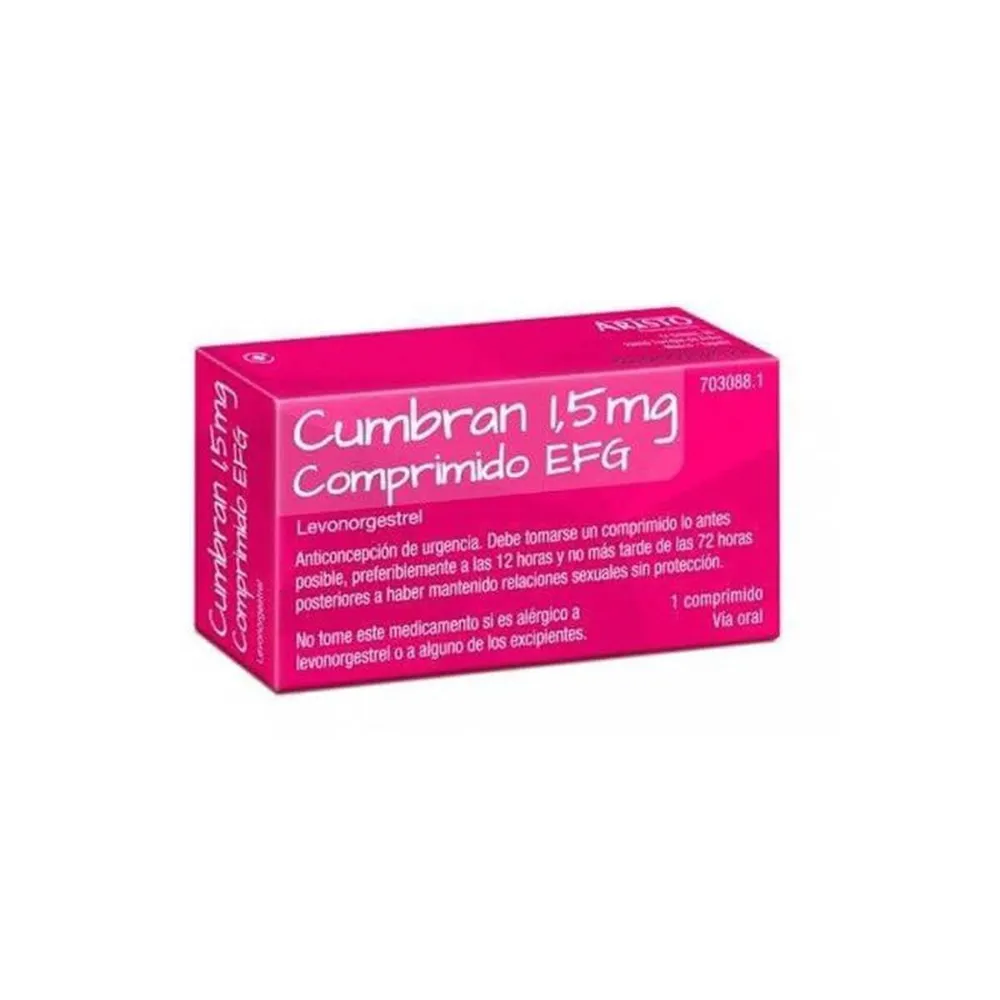
Table of Contents
Package leaflet: Information for the user
Introduction
Package leaflet: information for the user
Cumbran 1.5 mg tablet EFG
Levonorgestrel
Read the entire leaflet carefully before you start using this medicine, as it contains important information for you.
- Keep this leaflet, as you may need to read it again.
- If you have any questions, ask your pharmacist.
- This medicine has been prescribed for you only and must not be given to other people, even if they have the same symptoms as you, since it could harm them.
- If you experience any adverse effects, consult your doctor or pharmacist, even if they are effects not listed in this leaflet. See section 4.
Leaflet contents
-
- What Cumbran is and what it is used for
-
- What you need to know before taking Cumbran
-
- How to take Cumbran
-
- Possible side effects
-
- How to store Cumbran
- Contents of the pack and other information
1. What Cumbran is and what it is used for
Cumbran is an emergency oral contraceptive.
What is emergency contraception?
Emergency contraception is a method of last resort to prevent pregnancy after unprotected sexual intercourse or when a contraceptive method has failed.
When should emergency contraception be used?
You should take Cumbran as soon as possible, preferably within 12 hours and no later than 72 hours (3 days) after unprotected sexual intercourse or contraceptive failure. Levonorgestrel is more effective the sooner it is taken after unprotected intercourse. This medicine can only prevent pregnancy if taken within 72 hours of unprotected sexual intercourse. It will not work if you are already pregnant. If you have unprotected intercourse after taking this medicine, it will not prevent pregnancy.
You should consider using emergency contraception if you suspect you may be at risk of pregnancy due to:
- Having had unprotected sexual intercourse.
- Forgetting to take your regular contraceptive pill on time.
- Your partner’s condom broke, slipped, or came off.
- You suspect that your intrauterine device (IUD) has been displaced.
- The diaphragm you used moved out of place or was removed too early.
- You are concerned that withdrawal (coitus interruptus) or the calendar method (Ogino) may have failed.
- In case of rape.
The precise mechanism of action of levonorgestrel is unknown. It most likely prevents the ovaries from releasing an egg (ovulation). Other mechanisms may also be involved, including prevention of implantation of a fertilized egg into the uterus. It is not effective once implantation has begun.
This tablet is indicated solely for emergency contraception and not as a regular contraceptive method, as it is less effective than the regular oral contraceptive pill (“the pill”).
Cumbran is not indicated for use before the first menstrual period (menarche).
2. What you need to know before taking Cumbran
Do not take Cumbran
If you are allergic to levonorgestrel or to any of the other ingredients of this medicine (listed in section 6).
Warnings and precautions
The use of this medicine is not recommended in the following cases:
- If you have had an ectopic pregnancy (pregnancy outside the uterus).
- If you have had pelvic inflammatory disease (salpingitis).
- If you or a family member have a known risk factor for thrombosis (blood clot formation).
- If you have a severe gastrointestinal disorder affecting the absorption of food and drugs.
- If you suffer from severe liver disease or a serious small intestine disorder, such as Crohn's disease.
A history of tubal (ectopic) pregnancy or previous infection of the fallopian tubes increases the risk of experiencing a (new) ectopic pregnancy. Therefore, if you have previously had a tubal (ectopic) pregnancy or an infection in the fallopian tubes, you should consult your doctor before taking this medicine.
Emergency contraception should be used only as an occasional method and must not replace any regular contraceptive method, because:
- It does not always prevent pregnancy.
- The risk of excessive hormone exposure may disrupt the menstrual cycle.
Emergency contraception does not interrupt an existing pregnancy.
If you have had another unprotected sexual intercourse more than 72 hours ago, conception may already have occurred. Therefore, treatment with levonorgestrel after the second sexual intercourse may not be effective in preventing pregnancy.
In all women, emergency contraception should be taken as soon as possible after unprotected sex. There is some evidence that levonorgestrel may be less effective with increasing weight or body mass index (BMI), but these data were limited and inconclusive. Therefore, levonorgestrel is recommended for all women, regardless of their weight or BMI.
You are advised to consult a healthcare professional if you have concerns about any issues related to emergency contraception.
Repeated administration of levonorgestrel within the same menstrual cycle is not recommended, as it may disrupt the cycle.
This medicine is not as effective as regular contraceptive methods (the pill or condoms). Your doctor may advise you on long-term contraceptive methods that are more effective in preventing pregnancy.
After using this medicine, it is essential to rule out a possible pregnancy by taking a pregnancy test:
- When the next menstrual period is delayed by more than five days
- In case of abnormal bleeding, even around the expected time of the period
If you do not use condoms during sexual intercourse (or if they break or slip off), you may have contracted a sexually transmitted infection (STI) or HIV virus. The use of emergency contraceptive pills does not protect against sexually transmitted infections or HIV infection and cannot replace the necessary measures and precautions that should be taken when there is a risk of disease transmission (see "Additional information" later in this leaflet).
Psychiatric disorders:
Some women using hormonal contraceptives such as Cumbran have reported depression or a depressed mood. Depression can be severe and may sometimes lead to suicidal thoughts. If you experience mood changes or depressive symptoms, contact a doctor for medical advice as soon as possible.
Other medicines and Cumbran
Inform your doctor or pharmacist if you are taking, have recently taken, or might need to take any other medicines, including medicines obtained without a prescription or herbal medicines.
Some medicines may prevent Cumbran from working effectively. If you have taken any of the following medicines within the last 4 weeks, Cumbran may be less suitable for you. Your doctor may prescribe another type of emergency contraception (non-hormonal), namely a copper intrauterine device (Cu-IUD). If this is not an option for you or if you cannot see your doctor quickly, a double dose of Cumbran may be taken:
- Barbiturates and other medicines used to treat epilepsy (e.g. phenobarbital, phenytoin, primidone, and carbamazepine)
- Medicines used to treat HIV (ritonavir, efavirenz)
- Medicines used to treat tuberculosis (rifabutin, rifampicin)
- A medicine used to treat fungal infections (griseofulvin)
- Herbal medicines containing St John's wort (Hypericum perforatum).
This medicine should not be used in combination with emergency contraceptives containing ulipristal acetate.
Consult your doctor or pharmacist if you need further information about the correct dosage for you.
Consult your doctor as soon as possible after taking the tablets, to receive advice on reliable methods of regular contraception and to avoid pregnancy (see also section 3, "How to take Cumbran" for more information).
Cumbran may also affect the proper functioning of other medicines.
- A medicine called cyclosporine (which suppresses the immune system).
Pregnancy and breastfeeding
If you are pregnant:
If you are pregnant, this medicine will not cause abortion of an ongoing pregnancy.
If you take this medicine and become pregnant, studies conducted to date have not shown any risk of birth defects for the fetus. However, you should not take this medicine if you are pregnant. If you become pregnant after taking levonorgestrel, you should consult your doctor. Your doctor may check whether you have an ectopic pregnancy (if the fetus develops outside the uterus). This is especially important if you experience severe abdominal pain after taking this medicine, if you have previously had an ectopic pregnancy or surgery on the fallopian tubes, or if you have had pelvic inflammatory disease.
If you are breastfeeding:
Breastfeeding is possible, but since levonorgestrel is excreted in breast milk, you should breastfeed your baby immediately before taking this medicine and suspend breastfeeding for at least 8 hours after administration of levonorgestrel.
If you are pregnant or breastfeeding, think you may be pregnant, or plan to become pregnant, consult your doctor or pharmacist before using this medicine.
Driving and using machines
After taking levonorgestrel, some women report fatigue and dizziness (see section 4, "Possible side effects"): do not drive or operate machinery if you experience these symptoms.
No studies have been conducted on the effects of levonorgestrel on the ability to drive and use machines.
This medicine contains lactose.
If your doctor has informed you that you have an intolerance to certain sugars, consult with them before taking this medicine.
3. How to take Cumbran
Follow exactly the administration instructions for this medicine as described in this leaflet or as directed by your doctor or pharmacist. If in doubt, consult your doctor or pharmacist again.
This medicine is administered orally. The tablet should be swallowed with a glass of water and must not be chewed.
You may take Cumbran at any time during your menstrual cycle, except if you are already pregnant or think you may be pregnant.
Take the tablet as soon as possible, preferably within 12 hours, and no later than 72 hours (3 days) after having had unprotected sexual intercourse.
Do not delay taking the tablet. The medicine is more effective the sooner it is taken after unprotected sexual intercourse. It can only prevent pregnancy if taken within 72 hours after unprotected sexual intercourse.
If you vomit within three hours of taking the tablet, you should take another tablet.
Contact your doctor if more than 72 hours have passed since the unprotected sexual intercourse.
If you are taking any of the medicines that may reduce the effectiveness of Cumbran (see section “Other medicines and Cumbran”) or if you have taken any of these medicines in the past 4 weeks, Cumbran may be less effective for you. Your doctor may prescribe another type of emergency contraception (non-hormonal), namely a copper intrauterine device (Cu-IUD). If this is not an option for you or if you cannot see your doctor promptly, you may take a double dose of Cumbran (i.e., 2 tablets taken at the same time).
After taking levonorgestrel, use a barrier contraceptive method (condom, diaphragm) until your next menstrual period begins. If you have further unprotected sexual intercourse after taking this medicine (even during the same menstrual cycle), the tablets will not provide any contraceptive effect, and there is a risk you could become pregnant. If you are using a regular contraceptive method such as oral contraceptives, you may continue taking them as usual.
If you are taking oral contraceptives (“the pill”), after taking levonorgestrel, simply continue taking your pill as you normally do. If you do not experience any menstrual bleeding during the next pill-free interval, you should take a pregnancy test to rule out pregnancy. Your doctor may recommend effective long-term contraceptive methods to prevent pregnancy.
If you continue using a regular hormonal contraceptive method such as the pill and do not have any bleeding during the pill-free interval, contact your doctor to confirm you are not pregnant.
Your next menstrual period after taking Cumbran
After taking this medicine, your menstrual period will usually be normal and occur on the expected date, although sometimes it may occur a few days earlier or later. If your period is delayed by more than five days, is unusually light or heavy, or if for any other reason you suspect you may be pregnant, take a pregnancy test. If you become pregnant despite taking this medicine, it is important that you consult your doctor.
If you take more Cumbran than you should
Cases of acute poisoning or serious adverse effects after taking excessive doses of levonorgestrel at once have not been reported. However, you may experience nausea, vomiting, or vaginal bleeding. Consult your doctor or pharmacist for advice.
In case of overdose or accidental ingestion, contact your doctor or pharmacist immediately or call the Toxicology Information Service at telephone number: 91 562 04 20, indicating the medicine and the amount ingested.
4. Possible adverse effects
Like all medicines, this medicine can cause adverse effects, although not everybody will experience them.
The frequency of occurrence of the possible adverse effects listed below is defined as follows:
Very common (may affect more than 1 in 10 people)
Common (affect between 1 and 10 in every 100 people)
Very rare (affect less than 1 in 10,000 people)
Not known (frequency cannot be estimated from the available data).
The following adverse effects have been observed:
Very common adverse effects:
- Dizziness, headache
- Nausea, abdominal pain
- Breast tenderness on palpation, delayed menstrual period, very heavy menstrual periods, bleeding
- Fatigue
Common adverse effects:
- Diarrhea
- Vomiting
Frequency not known:
- Post-marketing cases of thromboembolic events (blood clots) have been reported.
- Skin hypersensitivity may occur after taking this medicine.
If you experience any adverse effects, consult your doctor or pharmacist, even if they are adverse effects not listed in this leaflet.
Reporting of adverse effects
If you experience any type of adverse effect, consult your doctor or pharmacist, even if they are possible adverse effects not listed in this leaflet. You may also report them directly through the Spanish Pharmacovigilance System for Human Medicinal Products: www.notificaRAM.es. By reporting adverse effects, you can help provide more information on the safety of this medicine.
5. Storage of Cumbran
Keep this medicine out of the sight and reach of children.
No special storage conditions are required.
Do not use this medicine after the expiry date stated on the carton after “EXP”. The expiry date refers to the last day of the month indicated.
Do not use this medicine if you notice any visible signs of deterioration; in such case, return the medicine to your pharmacist.
Medicines must not be disposed of via wastewater or household waste. Ask your pharmacist how to dispose of medicines and packaging that you no longer need. Dispose of unused medicines and packaging at a Sigre collection point. This helps protect the environment.
6. Package contents and other information
Composition of Cumbran
The active substance is levonorgestrel.
The other components (excipients) are monohydrate lactose, povidone (E-1201), corn starch, anhydrous colloidal silica (E-551), and magnesium stearate (E-572).
Levonorgestrel belongs to a class of medicines called emergency contraceptives.
Appearance of the product and contents of the pack
Round, white or almost white, uncoated tablets, flat, with the imprint “145” on one side and smooth on the other.
Each pack contains one 1.5 mg levonorgestrel tablet.
Marketing Authorization Holder and Manufacturer
Marketing Authorization Holder
Aristo Pharma Iberia, S.L
C/ Solana, 26
28850, Torrejón de Ardoz
Madrid, Spain
Manufacturer
Accord Healthcare Limited
Sage House,
319 Pinner Road,
North Harrow,
Middlesex - HA1 4HF
United Kingdom
or
Aristo Pharma GmbH
Wallenroder Straße 8-10,
13435, Berlin
Germany
or
Laboratorios Medicamentos Internacionales S.A.
C/Solana 26
28850-Torrejón de Ardoz (Madrid)
Spain
Date of the most recent review of this leaflet: February 2019
Detailed and up-to-date information on this medicine is available on the website of the Spanish Agency of Medicines and Health Products (AEMPS) http://www.aemps.es/
Additional information
The menstrual cycle
The menstrual cycle is the period between two menstrual periods. Normally, the cycle lasts 28 days, but it may vary from woman to woman. Menstrual periods occur when a woman is not pregnant.
Fertilization
Midway through each cycle, an egg is released from one of the two ovaries (this process is now called "ovulation"). Ovulation typically occurs in the middle of the cycle, but it may happen at any other time.
After sexual intercourse, the man's sperm travels toward the released egg and fertilizes it (i.e., a sperm fuses with the egg, forming an embryo). A few days later, the fertilized egg implants into the uterus and pregnancy begins.
Contraceptives
Contraceptive methods serve, among other things, to prevent:
Ovulation: by using the contraceptive pill.
Fertilization (fusion of a sperm with an egg): by using a condom.
Implantation of a fertilized egg into the uterus: by using an intrauterine device (IUD).
Emergency contraception
Emergency contraception works by inhibiting ovulation or by preventing the implantation of a fertilized egg after sexual intercourse. It is not effective if implantation has already begun.
When a woman has sexual intercourse without using a contraceptive method, pregnancy cannot be ruled out. If you use this medicine but do not use any regular contraceptive method, it is strongly recommended that you seek medical advice or visit a public health service. You will be informed about the contraceptive method most suitable for you.
Warning about the risk of contracting a sexually transmitted infection
If you have had unprotected sexual intercourse, you are at risk of contracting a sexually transmitted infection (STI), especially if you do not know your partner's sexual history or if you have sexual relations with multiple partners. If you have any questions, consult your doctor, pharmacist, or family planning service.
GLOSSARY
- Ectopic pregnancy: a pregnancy that develops outside the uterus, usually in the fallopian tubes. Symptoms include persistent abdominal pain, amenorrhea, vaginal bleeding, or signs of pregnancy (nausea, breast tenderness). If you experience any of these symptoms, consult your doctor immediately.
Salpingitis: infection of the fallopian tubes. Symptoms include abdominal pain, fever, and heavy vaginal discharge.