Cuitvar 0.5 mg + 1 mg film-coated tablets EFG
Spain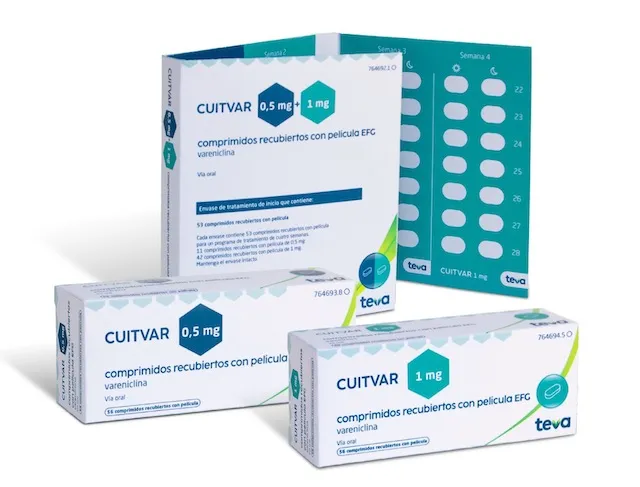
Table of Contents
Patient Information Leaflet
Introduction
Package leaflet: Information for the patient
Cuitvar 0.5 mg + 1 mg film-coated tablets EFG
varenicline
Read the entire leaflet carefully before you start taking this medicine, as it contains important information for you.
- Keep this leaflet, as you may need to read it again.
- If you have any questions, ask your doctor or pharmacist.
- This medicine has been prescribed for you only and must not be given to other people, even if they have the same symptoms as you, because it could harm them.
- If you experience any adverse effects, consult your doctor or pharmacist, even if these effects are not listed in this leaflet. See section 4.
Leaflet contents
- What Cuitvar is and what it is used for
- What you need to know before taking Cuitvar
- How to take Cuitvar
- Possible side effects
- How to store Cuitvar
- Contents of the pack and other information
1. What Cuitvar is and what it is used for
Cuitvar contains the active substance varenicline. Varenicline is a medicine used
in adults to help them stop smoking.
Varenicline can help relieve the craving and withdrawal symptoms associated with quitting smoking.
Varenicline may also reduce the pleasure derived from cigarettes if you smoke during treatment.
2. What you need to know before taking Cuitvar
Do not take Cuitvar
- If you are allergic to varenicline or to any of the other ingredients of this medicine (listed in section 6).
Warnings and precautions
Consult your doctor or pharmacist before starting to take Cuitvar.
Cases of depression, suicidal ideation and behavior, and suicide attempts have been reported in patients receiving varenicline. If you are taking varenicline and experience agitation, depressed mood, changes in behavior that concern you or your family, or develop suicidal thoughts or behavior, you must stop taking varenicline and contact your doctor immediately for treatment evaluation.
Effects of quitting smoking
Changes in your body resulting from quitting smoking, with or without treatment with varenicline, may alter the action of other medicines. Therefore, in some cases, a dose adjustment may be necessary. See further details below under "Other medicines and Cuitvar."
Quitting smoking, with or without treatment, has been associated in some individuals with an increased risk of changes in thinking or behavior, feelings of depression and anxiety, and may be associated with worsening of a psychiatric disorder. If you have a history of psychiatric disorder, discuss this with your doctor.
Cardiac symptoms
Worsening or new onset of heart or blood vessel (cardiovascular) problems has been reported, primarily in individuals who already had cardiovascular conditions. Inform your doctor if you experience any change in symptoms during treatment with varenicline. If you experience symptoms of a heart attack or stroke, seek emergency medical help immediately.
Seizures
Before starting treatment with varenicline, inform your doctor if you have had seizures or have epilepsy. Some people have experienced seizures during treatment with varenicline.
Hypersensitivity reactions
Stop taking varenicline and contact your doctor immediately if you develop any of the following signs or symptoms that may indicate a severe allergic reaction: swelling of the face, lips, tongue, gums, throat or body, or difficulty breathing, wheezing.
Skin reactions
Cases of potentially life-threatening skin rash (Stevens-Johnson syndrome and erythema multiforme) have been reported with the use of varenicline. If you develop a rash, blisters, or skin peeling, you must stop taking varenicline and seek urgent medical attention.
Children and adolescents
The use of varenicline is not recommended in pediatric patients, as efficacy has not been demonstrated.
Other medicines and Cuitvar
Inform your doctor or pharmacist if you are taking, have recently taken, or might need to take any other medicine.
In some cases, as a result of quitting smoking, with or without varenicline, a dose adjustment of other medicines may be necessary. Examples include theophylline (a medicine used to treat respiratory problems), warfarin (a medicine to reduce blood clotting), and insulin (a medicine used to treat diabetes). If you have any doubts, consult your doctor or pharmacist.
If you have severe renal impairment, you should avoid taking cimetidine (a medicine for gastric problems) at the same time as varenicline, as this may lead to increased blood levels of varenicline.
Use of Cuitvar with other smoking cessation therapies
Consult your doctor before using varenicline in combination with other smoking cessation therapies.
Taking Cuitvar with alcohol
There have been some reports of increased intoxicating effects of alcohol in patients taking varenicline. However, it is unknown whether varenicline increases the effects of alcohol.
Pregnancy and breastfeeding
If you are pregnant or breastfeeding, think you may be pregnant, or are planning to become pregnant, consult your doctor or pharmacist before using this medicine.
It is preferable to avoid using varenicline during pregnancy. Consult your doctor if you are planning a pregnancy.
Although not studied, varenicline may pass into human breast milk. You should consult your doctor or pharmacist before taking varenicline.
Driving and using machines
Varenicline may be associated with dizziness, somnolence, and transient loss of consciousness. You should not drive, operate complex machinery, or engage in any other potentially hazardous activities until you know whether this medicine affects your ability to perform such activities.
3. How to take Cuitvar
Follow exactly the instructions for administering this medicine as given by your doctor. If in doubt, consult your doctor or pharmacist again.
You are more likely to stop smoking if you are motivated to do so. Your doctor or pharmacist may provide you with advice, support, and additional information to help ensure your attempt to quit smoking is successful.
Normally, before starting your treatment with varenicline, you should choose a date during the second week of treatment (between day 8 and day 14) on which you will stop smoking. If you do not wish or are unable to set a quit date within those 2 weeks, you may choose your quit date within the following 5 weeks after starting treatment. You should write this date on the pack as a reminder.
Cuitvar is available as white tablets (0.5 mg) and light blue tablets (1 mg). You will start with the white tablets and normally progress to the light blue ones. See the table below for the usual administration instructions to follow starting from Day 1.
Week 1 | Dosage |
Day 1 - 3 | From day 1 to day 3, you must take one white film-coated tablet of Cuitvar 0.5 mg once daily. |
Day 4 - 7 | From day 4 to day 7, you must take one white film-coated tablet of Cuitvar 0.5 mg twice daily, once in the morning and once in the afternoon, approximately at the same time each day. |
Week 2 | |
Day 8 – 14 | From day 8 to day 14, take one light blue film-coated tablet of Cuitvar 1 mg twice daily, once in the morning and once in the evening, approximately at the same time each day. |
Weeks 3 - 12 | |
Day 15 - End of treatment | From day 15 until the end of treatment, take one light blue film-coated Cuitvar 1 mg tablet twice daily, once in the morning and once in the evening, approximately at the same time each day. |
If you have stopped smoking after 12 weeks of treatment, your doctor may recommend an additional 12 weeks of treatment with varenicline 1 mg film-coated tablets twice daily to help you remain abstinent.
If you are unable or unwilling to quit smoking immediately, you should reduce your tobacco consumption during the first 12 weeks of treatment and stop smoking completely by the end of this treatment period. You should then continue taking varenicline 1 mg film-coated tablets twice daily for another 12 weeks, for a total of 24 weeks of treatment.
If you experience adverse effects that you cannot tolerate, your doctor may decide to temporarily or permanently reduce your dose to 0.5 mg twice daily.
If you have kidney problems, you should consult your doctor before taking varenicline. You may require a lower dose.
Cuitvar is administered orally.
The tablets should be swallowed whole with water and may be taken with or without food.
If you take more Cuitvar than you should
If you have accidentally taken more varenicline than prescribed by your doctor, contact your doctor immediately, go to the nearest hospital, or call the Toxicology Information Service at telephone number 91 562 04 20, stating the medication and the amount taken. Bring your tablet pack with you.
If you forget to take Cuitvar
Do not take a double dose to make up for missed doses. It is important to take varenicline regularly at the same time each day. If you forget to take a dose, take it as soon as possible. However, if there are 3–4 hours or less until your next scheduled dose, do not take the missed tablet.
If you stop taking Cuitvar
Clinical trials have shown that taking all doses of your medication at the correct times and for the recommended treatment period described above increases your chances of successfully quitting smoking. Therefore, unless your doctor instructs you otherwise, it is important to continue taking varenicline as directed in the table above.
In smoking cessation therapy, the risk of relapse may be high in the period immediately following the end of treatment. Temporarily, after stopping varenicline, you may experience increased irritability, craving to smoke, depression, and/or sleep disturbances. Your doctor may decide to gradually reduce your dose of varenicline at the end of treatment.
If you have any further questions about the use of this medicine, ask your doctor or pharmacist.
4. Possible adverse effects
Like all medicines, this medicine can cause adverse effects, although not everyone will experience them.
Stopping smoking, with or without treatment, may produce various symptoms. These may include mood changes (such as feeling depressed, irritable, frustrated, or anxious), insomnia, difficulty concentrating, slowed heart rate, and increased appetite or weight gain.
You should be aware of the possible occurrence of serious neuropsychiatric symptoms, such as agitation, depressed mood, or changes in behavior during an attempt to quit smoking with or without varenicline, and you should contact a doctor or pharmacist if you experience these symptoms.
Serious adverse effects have occurred rarely or very rarely in people trying to stop smoking with varenicline: seizures, stroke, heart attack, suicidal thoughts, loss of touch with reality, and inability to think or judge clearly (psychosis), as well as changes in thinking or behavior (such as aggressive or abnormal behavior). Serious skin reactions have also been reported, including erythema multiforme (a type of rash) and Stevens-Johnson syndrome (a serious illness causing blisters on the skin, mouth, and around the eyes and genitals), and serious allergic reactions including angioedema (swelling of the face, mouth, or throat).
Very common adverse effects: may affect more than 1 in 10 people
- Inflammation of the nose and throat, abnormal dreams, difficulty sleeping, headache
- Nausea
Common adverse effects: may affect up to 1 in 10 people
- Chest infection, inflammation of the sinuses
- Weight gain, decreased appetite, increased appetite
- Drowsiness, dizziness, changes in taste sensation
- Difficulty breathing, cough
- Stomach acid reflux, vomiting, constipation, diarrhea, bloating sensation, abdominal pain, toothache, indigestion, flatulence, dry mouth
- Skin rash, itching
- Joint pain, myalgia, back pain
- Chest pain, fatigue
Uncommon adverse effects: may affect up to 1 in 100 people
- Fungal infection, viral infection
- Feeling of panic, difficulty thinking, restlessness, mood changes, depression, anxiety, hallucinations, changes in sex drive
- Seizures, tremor, feeling of lethargy, reduced sensitivity to touch
- Conjunctivitis, eye pain
- Ringing in the ears
- Angina, rapid heartbeat, palpitations, increased heart rate
- Increased blood pressure, hot flushes
- Inflammation of the nose, sinuses, and throat, nasal congestion, throat and chest congestion, hoarseness, hay fever, sore throat, congested sinuses, excess nasal mucus with cough, rhinorrhea
- Red blood in stools, irritated stomach, change in bowel habits, belching, mouth ulcers, gum pain
- Skin redness, acne, increased sweating, night sweats
- Muscle spasms, chest wall pain
- Abnormally frequent urination, nocturnal urination
- Increased menstrual flow
- Chest discomfort, flu-like illness, fever, feeling of weakness or malaise
- High blood sugar levels
- Heart attack
- Suicidal thoughts
- Changes in thinking or behavior (such as aggression)
Rare adverse effects: may affect up to 1 in 1,000 people
- Excessive thirst
- Malaise or feeling of unhappiness, slowed thinking
- Stroke
- Increased muscle tension, speech difficulties, coordination difficulties, decreased sense of taste, changes in sleep pattern
- Vision disturbances, discoloration of the eyeball, dilated pupils, light sensitivity, myopia, watery eyes
- Irregular heartbeat or changes in heart rhythm
- Sore throat, snoring
- Blood in vomit, abnormal stools, coated tongue
- Numb joints, rib pain
- Glucose in urine, increased volume and frequency of urination
- Vaginal discharge, changes in sexual ability
- Feeling cold, cyst
- Diabetes
- Sleepwalking
- Loss of touch with reality and inability to think or judge clearly (psychosis)
- Abnormal behavior
- Serious skin reactions including erythema multiforme (a type of rash) and Stevens-Johnson syndrome (a serious illness causing blisters on the skin, mouth, and around the eyes and genitals)
- Serious allergic reactions including angioedema (swelling of the face, mouth, or throat)
Frequency not known
- Transient loss of consciousness
Reporting of adverse effects
If you experience any adverse effect, consult your doctor or pharmacist, even if it is a possible adverse effect not listed in this leaflet. You may also report them directly via the Spanish Pharmacovigilance System for Human Medicines: https://www.notificaram.es. By reporting adverse effects, you can help provide more information on the safety of this medicine.
5. Storage of Cuitvar
Keep this medicine out of the sight and reach of children.
Do not use this medicine after the expiry date stated on the outer packaging, blister, or label of the bottle after EXP. The expiry date refers to the last day of the month indicated.
This medicine does not require any special storage conditions.
Medicines must not be disposed of via wastewater or household waste. Dispose of unused medicines and their containers at the SIGRE collection point at your pharmacy. Ask your pharmacist how to dispose of medicines and containers you no longer need. This way, you will help protect the environment.
6. Contents of the pack and other information
Composition of Cuitvar
-
The active substance is varenicline.
-
Each 0.5 mg film-coated tablet contains 0.5 mg of varenicline (as citrate).
-
Each 1 mg film-coated tablet contains 1 mg of varenicline (as citrate).
-
The other components are:
Tablet core: microcrystalline cellulose, pregelatinized starch (from corn), propyl gallate, magnesium stearate and anhydrous citric acid.
Coating – Cuitvar 0.5 mg film-coated tablets EFG: hypromellose (E-464) and titanium dioxide (E-171).
Coating – Cuitvar 1 mg film-coated tablets EFG: hypromellose (E-464), titanium dioxide (E-171) and indigo carmine, FD&C Blue No. 2 (E-132).
Appearance of the product and contents of the pack
-
Cuitvar 0.5 mg film-coated tablets EFG are white, film-coated, capsule-shaped tablets, printed with “0.5” on one side.
-
Cuitvar 1 mg film-coated tablets EFG are light blue, film-coated, capsule-shaped tablets, printed with “1.0” on one side.
Cuitvar 0.5 mg + 1 mg film-coated tablets EFG are available in the following pack sizes:
Treatment starter packs:
PVC/PE/PVdC//Al blister:
Pack of 25 film-coated tablets:
Each pack contains 25 film-coated tablets for a two-week treatment regimen, consisting of 11 film-coated tablets of 0.5 mg and 14 film-coated tablets of 1 mg.
Pack of 53 film-coated tablets:
Each pack contains 53 film-coated tablets for a four-week treatment regimen, consisting of 11 film-coated tablets of 0.5 mg and 42 film-coated tablets of 1 mg.
Pack of 165 film-coated tablets:
Each pack contains 165 film-coated tablets for an eight-week treatment regimen, consisting of 11 film-coated tablets of 0.5 mg and 154 film-coated tablets of 1 mg.
Single-dose precut PVC/PE/PVdC//Al blister:
Pack of 165 x 1 film-coated tablets:
Each pack contains 165 x 1 film-coated tablets for an eight-week treatment regimen, consisting of 11 x 1 film-coated tablets of 0.5 mg and 154 x 1 film-coated tablets of 1 mg.
Only certain pack sizes may be commercially available.
Marketing Authorization Holder and Manufacturer
Marketing Authorization Holder
Teva B.V.
Swensweg 5,
2031GA Haarlem,
The Netherlands
Manufacturer
Delorbis Pharmaceuticals Ltd.
17 Athinon Str., Ergates Industrial Area
2643 Ergates, Lefkosia
Cyprus
or
Pharmadox Healthcare Ltd.
KW20A Kordin Industrial Park,
Paola, PLA 3000,
Malta
For further information about this medicinal product, please contact the local representative of the Marketing Authorization Holder:
Teva Pharma, S.L.U.
C/ Anabel Segura, 11, Edificio Albatros B, 1st floor
28108, Alcobendas, Madrid (Spain)
Date of the most recent review of this leaflet: February 2024
Other sources of information
You can access detailed and up-to-date information on this medicinal product by scanning with your mobile phone (smartphone) the QR code included on the outer packaging. You may also access this information at the following internet address: https://cima.aemps.es/cima/dochtml/p/89489/P_89489.html.