Crysvita 30 mg solution for injection
Spain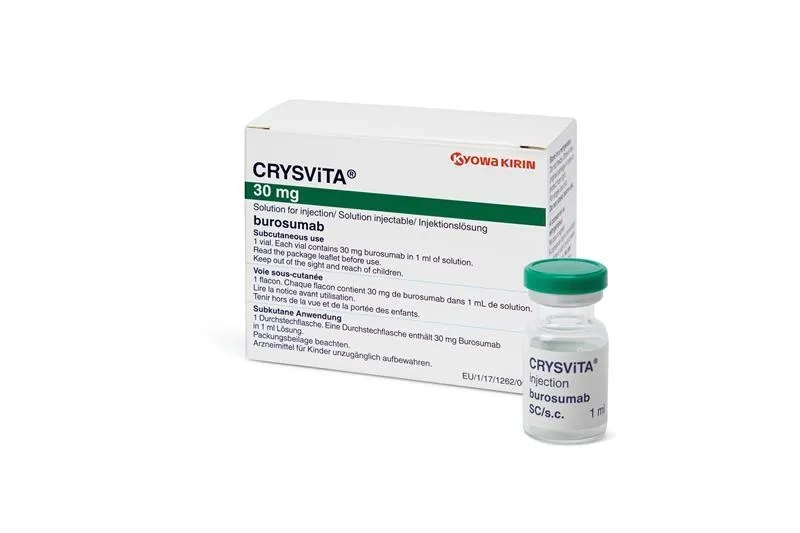
Table of Contents
Package leaflet: Information for the user
Introduction
Package leaflet: information for the user
CRYSVITA 10 mg solution for injection
CRYSVITA 20 mg solution for injection
CRYSVITA 30 mg solution for injection
burosumab
Read the entire leaflet carefully before you start using this medicine, because it contains important information for you.
- Keep this leaflet, as you may need to read it again.
- If you have any questions, ask your doctor, pharmacist or nurse.
- This medicine has been prescribed for you only, and you must not give it to other people, even if they have the same symptoms as you, because it may harm them.
- If you experience any adverse reactions, consult your doctor, even if they are adverse reactions not listed in this leaflet. See section 4.
Contents of the leaflet
- What CRYSVITA is and what it is used for
- What you need to know before using CRYSVITA
- How to use CRYSVITA
- Possible side effects
- How to store CRYSVITA
- Contents of the pack and other information
1. What CRYSVITA is and what it is used for
What CRYSVITA is
CRYSVITA contains the active substance burosumab. It is a type of medicine called a human monoclonal antibody.
What CRYSVITA is used for
CRYSVITA is used to treat X-linked hypophosphataemia (XLH). It is used in children and adolescents aged 1 to 17 years, and in adults.
CRYSVITA is used to treat tumour-induced osteomalacia (TIO) when the tumour causing it cannot be successfully removed or located, in children and adolescents aged 1 to 17 years and in adults.
What is X-linked hypophosphataemia (XLH)
X-linked hypophosphataemia is a genetic disease.
-
People with XLH have higher levels of a hormone called fibroblast growth factor 23 (FGF23).
-
FGF23 reduces the amount of phosphate in the blood.
-
Low phosphate levels can:
-
cause bones not to harden properly and, in children and adolescents, result in impaired growth;
-
cause bone and joint pain and stiffness.
What is tumour-induced osteomalacia (TIO)
- People with TIO have higher levels of a hormone called FGF23 produced by certain types of tumours.
- FGF23 reduces the amount of phosphate in the blood.
- Low phosphate levels can cause softening of the bones, muscle weakness, fatigue, bone pain, and fractures.
How CRYSVITA works
CRYSVITA binds to FGF23 in the blood, preventing FGF23 from acting and thereby increasing phosphate levels in the blood to reach normal phosphate levels.
2. What you need to know before using CRYSVITA
Do not use CRYSVITA
- if you are allergic to burosumab or to any of the other ingredients of this medicine (listed in section 6);
- if you are taking phosphate supplements or certain vitamin D supplements (containing so-called active vitamin D [e.g., calcitriol]);
- if you already have high levels of phosphate in the blood (hyperphosphatemia);
- if you have severe kidney disease or renal failure.
Allergic reactions
Stop using CRYSVITA and contact your doctor immediately if you experience any of the following side effects, as they could be signs of an allergic reaction:
- rash and itching all over the body;
- severe swelling of the eyelids, mouth or lips (angioedema);
- difficulty breathing;
- rapid heartbeat;
- sweating.
Do not use CRYSVITA if any of the above apply to you. If you are unsure, consult your doctor before starting to use CRYSVITA.
Warnings and precautions
Skin reactions
You may experience skin reactions at the injection site; see section 4 for more information. If these reactions are severe, inform your doctor.
Tests and monitoring
Your doctor will check phosphate and calcium levels in your blood and urine, and may also perform a kidney ultrasound before and during treatment to reduce the risk of hyperphosphatemia (too much phosphate in the blood), hypercalcemia (too much calcium in the blood), and ectopic mineralization (calcium buildup in tissues such as the kidneys). Your doctor will also monitor your serum parathyroid hormone levels before and during treatment to reduce the risk of hyperparathyroidism (too much parathyroid hormone in the blood).
Children under 1 year of age
CRYSVITA should not be given to children under 1 year of age, as the safety and effects of this medicine have not been studied in this age group.
Keeping a record
If you are injecting the medicine yourself or giving it to your child, you must record the date of administration, the name of the medicine, and the batch number (shown on the packaging after "Batch") and keep this information in a safe place. If in doubt, consult your doctor, nurse, or pharmacist.
Other medicines and CRYSVITA
Inform your doctor if you are taking, have recently taken, or might need to take any other medicines.
Do not use CRYSVITA and inform your doctor if you are taking:
- phosphate supplements;
- certain vitamin D supplements (containing so-called active vitamin D [e.g., calcitriol]). Some vitamin D supplements may still be used or started, and your doctor will advise you which ones.
Consult your doctor before starting CRYSVITA:
- if you are taking medicines that act on the body similarly to calcium (calcimimetics). Your doctor may want to monitor your calcium levels more closely.
- if you are a patient with TIO and are about to receive treatment for the underlying tumor (i.e., radiotherapy or surgical removal). In this case, treatment with CRYSVITA will not begin until after tumor treatment and only if serum phosphate levels are low.
- if you have conditions related to the parathyroid glands.
Pregnancy and breastfeeding
If you are pregnant or breastfeeding, think you may be pregnant, or plan to become pregnant, consult your doctor or pharmacist before using this medicine, as it is unknown whether CRYSVITA will affect the baby.
The use of CRYSVITA during pregnancy is not recommended.
If you are of childbearing potential, you must use an effective method of contraception while using CRYSVITA and for at least 14 weeks after the last dose. Discuss this with your doctor.
Monoclonal antibodies such as CRYSVITA are known to pass into breast milk during the first few days after birth, but CRYSVITA may be used after this initial period. Talk to your doctor about using CRYSVITA while breastfeeding to decide whether it is better to stop breastfeeding or stop using CRYSVITA.
Driving, cycling, and using machines
You or your child may experience dizziness while using CRYSVITA. If this occurs, it would be dangerous to perform activities such as driving, using tools or machinery, cycling, horseback riding, or climbing trees.
CRYSVITA contains sorbitol
This medicine contains 45.91 mg of sorbitol per vial, equivalent to 45.91 mg/mL. Sorbitol is a source of fructose. If your doctor has told you that you (or your child) have an intolerance to certain sugars, or if you (or your child) have been diagnosed with hereditary fructose intolerance (HFI), a rare genetic disorder that prevents the breakdown of fructose, speak with your doctor before receiving (or giving your child) this medicine.
CRYSVITA contains polysorbate
This medicine contains 0.5 mg of polysorbate 80 per vial, equivalent to 0.5 mg/mL. Polysorbates may cause allergic reactions. Inform your doctor if you or your child has any known allergies.
3. How to use CRYSVITA
CRYSVITA should be administered by subcutaneous injection (under the skin) in the upper arm, abdomen, buttock, or thigh. A healthcare professional will administer this medicine to you or your child. Alternatively, your doctor may recommend that you inject it yourself or administer it to your child. A healthcare professional will show you how to do this. The first self-injection after starting treatment or after any dose adjustment must be performed in the presence of a healthcare professional. A detailed section titled "Instructions for use" is included at the end of this leaflet. Always follow these instructions carefully when administering the CRYSVITA injection to yourself or your child.
Always follow exactly the instructions provided by your doctor, nurse, or pharmacist for using this medicine. If in doubt, consult your doctor, nurse, or pharmacist again.
How much CRYSVITA you need
The dose is determined based on body weight. Your doctor will calculate the correct dose for you.
Dosing for XLH and TIO
Your dose of CRYSVITA must be injected:
- every two weeks in children and adolescents aged 1 to 17 years;
- every four weeks in adults.
Your doctor will perform checks to ensure you are receiving the correct dose and may adjust the dose or frequency of administration if necessary.
Maximum dose for patients with XLH
The maximum dose you will receive for the treatment of XLH is 90 mg.
Maximum dose for patients with TIO
The maximum dose you will receive for the treatment of TIO:
- for children aged 1 to 12 years is 90 mg;
- for adolescents aged 13 to 17 years and adults is 180 mg.
Patients with TIO
If you are a patient with TIO who requires treatment of the underlying tumour (i.e., radiotherapy or surgical removal), your doctor will suspend treatment with CRYSVITA. After completion of tumour treatment, your doctor will monitor your phosphate levels and restart CRYSVITA treatment if serum phosphate levels are low.
If you are given more CRYSVITA than you should
If you think you have been given too much CRYSVITA, inform your doctor immediately.
If you miss a dose of CRYSVITA
If you miss a dose, consult your doctor immediately. The missed dose should be administered as soon as possible, and your doctor will reschedule future doses accordingly.
If you have any further questions about the use of this medicine, ask your doctor.
4. Possible adverse effects
Like all medicines, this medicine can cause adverse effects, although not everyone experiences them.
Adverse effects in children and adolescents with XLH
Very common (may affect more than 1 in 10 children and adolescents)
-
Dental abscess (infection)
-
Cough
-
Headache
-
Dizziness
-
Vomiting
-
Nausea
-
Diarrhea
-
Constipation
-
Dental caries
-
Rash
-
Muscle pain (myalgia) and pain in hands and feet
-
Reactions at the injection site, which may include:
-
redness or rash
-
pain or itching
-
swelling
-
bleeding or bruising
These injection site reactions are usually mild and occur within 1 day after injection, typically resolving within 1 to 3 days.
- Fever
- Low levels of vitamin D in the blood
Common (may affect up to 1 in 10 children and adolescents)
- Urticaria
- Increased parathyroid hormone in the blood
Uncommon (may affect up to 1 in 100 children and adolescents)
- High levels of calcium in the blood
Frequency not known (cannot be estimated from available data)
- High levels of calcium in the urine
- Increased phosphate or high levels of parathyroid hormone in the blood
Adverse effects in children and adolescents with TIO
Adverse effects in children and adolescents are not known, as clinical studies have not been conducted.
Adverse effects in adults with XLH and TIO
Very common (may affect more than 1 in 10 adults)
- Dental abscess (infection)
- Headache
- Dizziness
- Restless legs syndrome (irresistible urge to move the legs to relieve uncomfortable, painful, or strange sensations in the legs, especially before sleeping or during the night)
- Constipation
- Back pain
- Muscle spasm
- Reactions at the injection site, which may include pain or swelling
- Low levels of vitamin D in the blood
Common (may affect up to 1 in 10 adults)
- Elevated levels or high levels of parathyroid hormone in the blood
- High levels of calcium in the blood or urine
- Rash
- Urticaria
- Increased phosphate in the blood
Reporting of adverse effects
If you experience any type of adverse effect, consult your doctor or nurse, even if it is a possible adverse effect not listed in this leaflet. You may also report them directly through the national reporting system listed in Appendix V. By reporting adverse effects, you can help provide more information on the safety of this medicine.
5. Storage of CRYSVITA
Keep CRYSVITA out of the sight and reach of children.
Do not use CRYSVITA after the expiry date stated on the carton and label after EXP. The expiry date refers to the last day of the month indicated.
Store in a refrigerator (between 2 ºC and 8 ºC). Do not freeze.
Keep the vial in the outer carton to protect it from light.
Do not use CRYSVITA if visible particles are present.
Medicines must not be disposed of via wastewater or household waste. Doing so helps protect the environment.
If you are self-injecting, refer to step 5 of the "Instructions for Use" at the end of this leaflet for instructions on the disposal of unused medicines and materials. If you have any doubts about how to dispose of medicines you no longer need, ask your healthcare professional or pharmacist.
6. Contents of the pack and other information
Composition of CRYSVITA
The active substance is burosumab. Each vial contains 10, 20 or 30 mg of burosumab.
The other components are L-histidine, D-sorbitol (E 420), polysorbate 80 (E 433), L-methionine, 10 % hydrochloric acid and water for injections. (See "CRYSVITA contains sorbitol" in section 2 for more information.)
Appearance of the product and contents of the pack
CRYSVITA is presented as a transparent to slightly opalescent solution, colourless to pale brown-yellow, in a small glass vial. Each pack contains 1 vial.
Marketing Authorisation Holder
Kyowa Kirin Holdings B.V.
Bloemlaan 2
2132 NP Hoofddorp
The Netherlands
Manufacturer
allphamed PHARBIL Arzneimittel GmbH
Hildebrandstr. 10-12
37081 Göttingen
Germany
Kyowa Kirin Holdings B.V.
Bloemlaan 2
2132 NP Hoofddorp
The Netherlands
Kyowa Kirin Services Ltd. Dutch Branch
Bloemlaan 2
Hoofddorp 2132 NP
The Netherlands
Date of the most recent revision of this leaflet:
Other sources of information
Detailed information on this medicine is available on the European Medicines Agency website: https://www.ema.europa.eu. Links to other websites on rare diseases and orphan medicines are also available.
INSTRUCTIONS FOR USE
Please read these instructions carefully before using CRYSVITA:
-
Inject yourself or your child only if instructed to do so by your doctor.
-
Injection should only be given after you have received training on the injection technique. The first self-injection after starting treatment or after any dose adjustment must be performed in the presence of a healthcare professional.
-
Follow exactly the administration instructions for this medicine provided by your doctor, pharmacist or nurse (healthcare professional). If in doubt, consult your healthcare professional again.
-
Your doctor will prescribe the correct dose for you. Your dose is measured in milligrams (mg). CRYSVITA is available in vials of three different concentrations: 10 mg, 20 mg and 30 mg. Each vial is for single use only. Always use a new vial of CRYSVITA for each injection; see step 5 for instructions on how to dispose of used vials and other materials.
-
Your healthcare professional will tell you how much CRYSVITA to administer to yourself or your child. You or your child may receive more than one vial to achieve the correct dose.
-
If your healthcare professional indicates that more than one injection is required to administer the required dose, repeat steps 2 to 5 below for each injection. Use new materials and a different injection site for each injection.
-
Use only the syringe and needles provided or prescribed by your healthcare professional to administer the injection.
-
Always use the large needle to withdraw the liquid and remember to switch to the small needle to inject the liquid.
-
Using an incorrect syringe or needle may lead to a dosing error or make the injection more painful.
-
When administering CRYSVITA to a young child, it may be helpful to have another person present to comfort the child.
-
Do not use CRYSVITA if you are allergic to any of the components of this medicine. Stop using CRYSVITA and contact your healthcare professional immediately if you experience any allergic reaction during or after the injection. See section 2 of the leaflet for more information.
Step 1. Gather and inspect the materials
Remove from the refrigerator the CRYSVITA vials you need.
Check the concentration on the label of each vial.
Ensure you have the correct number of vials to match the dose in mg recommended by your healthcare professional.
If you are unsure, ask your healthcare professional.
Allow the vials to reach room temperature for 30 minutes. Do not heat the vials in any other way, for example with warm water or in a microwave oven. Do not expose the vials to direct sunlight.
Record the date of administration, the name of the medicine and the batch number (shown on the packaging, after "Batch") and keep this information in a safe place.
Check the expiry date (shown after "Exp") on the vial label. Inspect the liquid in the vial. Do not shake.
Do not use the vial if:
- it is past the expiry date;
- there is a change in colour, the solution is cloudy or contains particles. The liquid in CRYSVITA should be transparent to slightly opalescent and colourless to pale brown-yellow.
| Place all the materials you will need on a clean, flat surface. For each injection, you will need:
Contact your healthcare provider if you do not have these materials. |
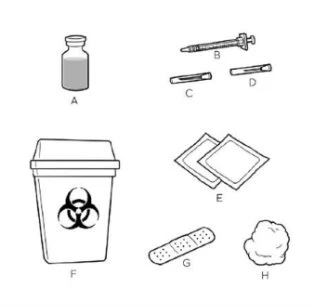
Your healthcare professional will explain the use of the different needles.
The large needle is used to withdraw CRYSVITA from the vial.
The small needle is used to inject CRYSVITA.
If you are unsure, ask your healthcare professional before use.
Do not use any materials that are missing parts or are damaged in any way.
Do not remove the needle caps until you are ready to use them.
Wash your hands thoroughly with soap and water before proceeding to step 2.
Step 2. Withdraw CRYSVITA and prepare the injection
Remove the closure cap from the vial so that the rubber stopper is exposed.
Clean the rubber stopper with an alcohol wipe and allow it to dry. Do not touch the rubber stopper after cleaning it.
| Select the large needle and remove it from its sterile packaging, but do not remove the cap covering the needle. To attach the needle to the syringe, hold the large needle by its protective cap in one hand and the syringe by the barrel in the other. Depending on the materials you have been given:
Do not touch the needle itself or the end of the syringe where the needle attaches. |
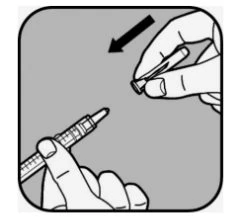
Once the needle is securely attached, hold the syringe by the barrel with the needle pointing upward.
Remove the needle cap by pulling it off.
Do not discard the needle cap.
Do not touch the needle or allow it to come into contact with any surface once the cap has been removed.
Do not use the syringe if it is dropped after removing the cap or if the needle appears damaged.
| Your healthcare professional will tell you how much liquid you should inject. Usually, it will be 1 ml for each injection. Your healthcare professional will tell you which mark to use if you need to inject less than 1 ml. Always use the mark corresponding to your dose. If you are unsure, ask your healthcare professional before use. Pull the syringe plunger until the end of the plunger aligns with the mark corresponding to your dose. This fills the syringe with air. |
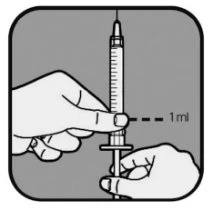
| Keep the vial on a flat surface. Slowly insert the large needle through the rubber stopper and into the vial. Do not let the tip of the needle touch the liquid in the vial. If the tip of the needle touches the liquid, slowly pull the needle back until it no longer touches the liquid. Slowly push the plunger in the syringe. This pushes the air from the syringe into the vial. |
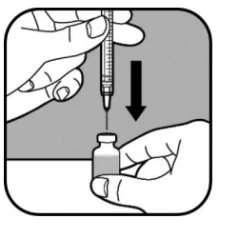
| Keep the needle in the vial and turn it upside down. Make sure the tip of the needle is at the bottom of the liquid. |
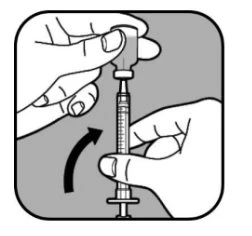
| Pull the plunger slowly to fill the syringe until the end of the plunger aligns with the mark corresponding to your dose. Keep the needle tip in the liquid at all times. |
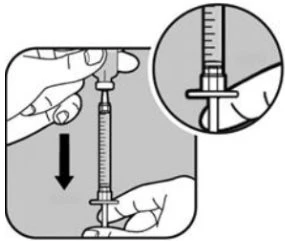
| Check for air bubbles in the liquid in the syringe. If you see bubbles,
Check the dose again using the markings on the syringe. If necessary, withdraw a little more liquid to align it with the mark corresponding to your dose. Check again for air bubbles and repeat the process if needed. |
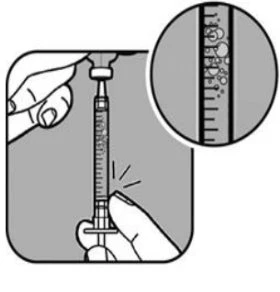
When there are no bubbles in the syringe, remove the syringe and needle directly from the vial by pulling downward.
| Remove the large needle from the syringe.
|
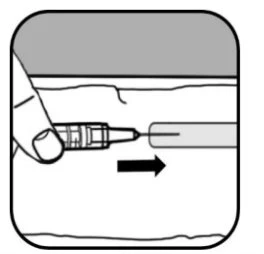
Select the small needle and remove it from the sterile packaging, but do not remove the cap covering the needle.
To attach the small needle to the syringe, hold the needle by its protective cap in one hand and the syringe by the barrel in the other.
Depending on the materials you have been given:
- you will need to push the needle down and turn it clockwise into the syringe until it is tight;
- or push the needle down until it is securely attached.
Do not touch the needle itself or the end of the syringe where the needle attaches.
Step 3. Prepare the injection site
| The injection should be administered into the fatty layer just beneath the skin. You will need to choose the injection site. If you are giving the injection to yourself, suitable areas are:
If you are giving the injection to another person, suitable areas are:
Do not administer the injection in:
|
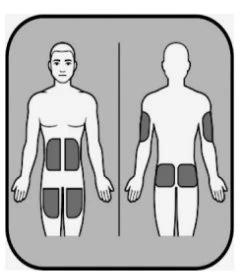
If you are administering more than one injection, use a different site for each injection. Clean each injection site with a new alcohol wipe and allow the skin to dry.
CRYSVITA should be injected into clean, dry skin.
Step 4. Administer the CRYSVITA injection
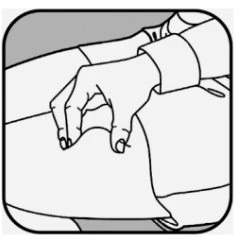
| Remove the small needle cap by pulling it off. Pinch the skin firmly using your thumb and other fingers, creating an area about 5 cm wide. Hold the syringe between the thumb and index finger of your dominant hand. The needle should be inserted into the skin at an angle of 45º or 90º. Your healthcare professional will tell you which angle to use. |
|
|
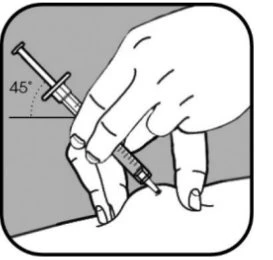
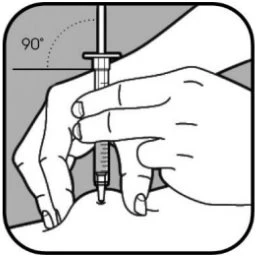
Use a quick dart-like motion to insert the needle into the pinched skin.
Do not push the plunger when inserting the needle.
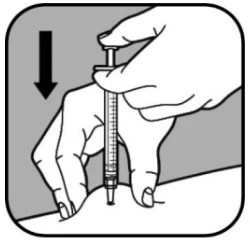
| When the needle is inserted, do not move it. Continue pinching the skin. Slowly push the syringe plunger for up to 30 seconds, until the syringe is empty. |
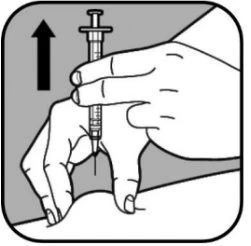
| After administering the full dose, remove the syringe by gently pulling it outward. Release the pinched skin. Press the injection site with a cotton ball or gauze for a few seconds to stop bleeding. Apply a bandage if necessary. Do not rub the injection site. To avoid injury, do not recap the small needle. Place the uncovered needle into the sharps container. |
Step 5. After each injection
Dispose of used needles, caps, and syringes into the sharps container. Vials should be discarded according to local guidelines.
Do not throw needles or syringes into the household trash.
Do not save vials containing leftover medication for future use, and do not give them to other people.
When your sharps container is nearly full, follow local guidelines to request a new container and dispose of the full one properly.
Reminder: If you are administering more than one injection, repeat steps 2 to 5 for each injection.
Use new supplies for each injection.
Record the date of the injection and all injection sites used, so that you use different sites for the next injection.
A video demonstrating how to prepare and administer the injection can be found at the following link: www.myinject.eu.