Cotellic 20 mg film-coated tablets
Spain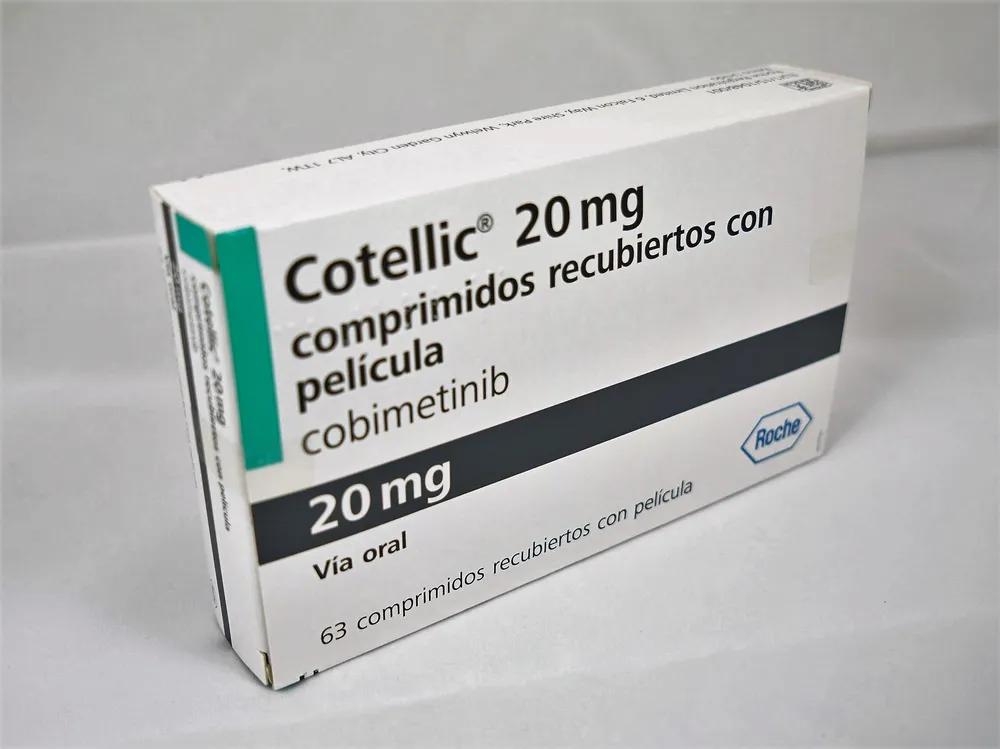
Table of Contents
Package Leaflet: Information for the User
Introduction
Package Leaflet: Information for the Patient
Cotellic 20 mg Film-coated Tablets
cobimetinib
Read this entire leaflet carefully before you start taking this medicine, as it contains important information for you.
- Keep this leaflet, as you may need to read it again.
- If you have any questions, ask your doctor, pharmacist, or nurse.
- This medicine has been prescribed for you only, and you should not give it to others, even if they have the same symptoms as you, because it may harm them.
- If you experience any adverse effects, consult your doctor, pharmacist, or nurse, even if these effects are not listed in this leaflet. See section 4.
Leaflet Contents
- What Cotellic is and what it is used for
- What you need to know before taking Cotellic
- How to take Cotellic
- Possible adverse effects
- How to store Cotellic
- Contents of the pack and other information
1. What Cotellic is and what it is used for
What Cotellic is
Cotellic is an anticancer medicine that contains the active substance cobimetinib.
What Cotellic is used for
Cotellic is used to treat adult patients with a type of skin cancer called melanoma that has spread to other parts of the body or cannot be removed by surgery.
- It is used in combination with another anticancer medicine called vemurafenib.
- It can only be used in patients whose cancer has a specific change (mutation) in a protein called "BRAF". Before starting treatment, your doctor will perform a test for this mutation. This change may cause the melanoma to develop.
How Cotellic works
Cotellic acts on a protein called "MEK", which plays an important role in controlling the growth of cancer cells. When Cotellic is used in combination with vemurafenib (which acts on the altered "BRAF" protein), it slows down or stops the growth of your cancer even further.
2. What you need to know before starting Cotellic
Do not take Cotellic:
- if you are allergic to cobimetinib or to any of the other ingredients of this medicine (listed in section 6).
If you have any doubts, consult your doctor, pharmacist, or nurse before taking Cotellic.
Warnings and precautions
Talk to your doctor, pharmacist, or nurse before starting Cotellic if you have:
- Bleeding
Cotellic may cause serious bleeding, especially in the brain or stomach (see also “Serious bleeding” in section 4). Immediately inform your doctor if you experience any unusual bleeding or any of the following symptoms: headaches, dizziness, feeling weak, blood in the stool or black stools, or vomiting blood.
- Vision problems
Cotellic may cause vision problems (see also “Vision problems” in section 4). Immediately inform your doctor if you experience blurred vision, distorted vision, partial vision loss, or any other changes in vision during treatment. Your doctor should examine your eyes if you develop new or worsening vision problems while taking Cotellic.
- Heart problems
Cotellic may reduce the amount of blood pumped by your heart (see also “Heart problems” in section 4). Your doctor should perform tests before and during treatment with Cotellic to ensure your heart is pumping blood properly. Immediately inform your doctor if you feel your heart beating rapidly, fluttering, or irregularly, or if you experience dizziness, fainting, shortness of breath, fatigue, or swelling in your legs.
- Liver problems
Cotellic may increase levels of certain liver enzymes in the blood during treatment. Your doctor will perform blood tests to monitor these levels and check how well your liver is functioning.
- Muscle problems
Cotellic may increase levels of creatine phosphokinase, an enzyme found mainly in muscle, heart, and brain. This may be a sign of muscle damage (rhabdomyolysis) (see also “Muscle problems” in section 4). Your doctor will perform blood tests to monitor this. Immediately inform your doctor if you experience any of the following symptoms: muscle pain, muscle spasms, weakness, or dark or reddish urine.
- Diarrhea
Immediately inform your doctor if you develop diarrhea. Severe diarrhea may lead to loss of body fluids (dehydration). Follow your doctor’s instructions on how to prevent or treat diarrhea.
Children and adolescents
The use of Cotellic is not recommended in children and adolescents. The efficacy and safety of Cotellic have not been established in patients under 18 years of age.
Other medicines and Cotellic
Inform your doctor or pharmacist if you are taking, have recently taken, or might need to take any other medicines. This is because Cotellic may affect how other medicines work. Likewise, other medicines may affect how Cotellic works.
Consult your doctor before taking Cotellic if you are taking:
Medication | Indication of the medication |
Itraconazole, clarithromycin, erythromycin, telithromycin, voriconazole, rifampicin, posaconazole, fluconazole, miconazole | for certain fungal or bacterial infections |
Ritonavir, cobicistat, lopinavir, delavirdine, amprenavir, fosamprenavir | for HIV infections |
telaprevir | for hepatitis C |
nefazodone | for depression |
amiodarone | for irregular heart rhythm |
diltiazem, verapamil | for high blood pressure |
imatinib | for cancer |
carbamazepine, phenytoin | for seizures (fits) |
St. John's Wort | herbal medicine used to treat depression. It is available over-the-counter. |
Use of Cotellic with food and beverages
Avoid taking Cotellic with grapefruit juice. The reason is that it may increase the amount of Cotellic in your blood.
Pregnancy and breastfeeding
If you are pregnant or breastfeeding, think you might be pregnant, or are planning to become pregnant, consult your doctor or pharmacist before using this medicine.
- Cotellic is not recommended during pregnancy. Although the effects of Cotellic have not been studied in pregnant women, it may cause permanent harm or congenital defects in the fetus.
- If you become pregnant while being treated with Cotellic or within 3 months after your last dose, inform your doctor immediately.
- It is unknown whether Cotellic passes into breast milk. If you are breastfeeding, your doctor will advise you on the benefits and risks of taking Cotellic.
Contraceptive methods
Women of childbearing potential must use two effective contraceptive methods, such as a condom or another barrier method (with spermicide, if possible), during treatment and for at least 3 months after the end of treatment. Consult your doctor about the most suitable contraceptive method for you.
Driving and use of machines
Cotellic may affect your ability to drive or operate machinery. Avoid driving or operating machinery if you have any vision problems or other symptoms that could impair your ability, e.g., if you feel dizzy or tired. Consult your doctor if you are unsure.
Cotellic contains lactose and sodium
Cotellic tablets contain lactose (a type of sugar). If your doctor has informed you of an intolerance to certain sugars, consult with him before taking this medicine.
This medicine contains less than 1 mmol of sodium (23 mg1mmol) per tablet; hence, it is essentially “sodium-free”.
3. How to take Cotellic
Follow exactly the instructions for administering this medicine as given by your doctor or pharmacist. If you are unsure, consult your doctor or pharmacist again.
How much to take
The recommended dose is 3 tablets (a total of 60 mg) once daily.
- Take the tablets every day for 21 days (this is called a "treatment period").
- After 21 days, do not take any Cotellic tablets for 7 days. During this 7-day break from Cotellic treatment, you must continue taking vemurafenib as directed by your doctor.
- Start your next 21-day treatment period with Cotellic after the 7-day break.
- If you experience any adverse effects, your doctor may consider reducing the dose, temporarily interrupting, or permanently discontinuing treatment. Always follow your doctor's exact instructions for taking Cotellic.
How to take the medicine
- Swallow the tablets whole with water.
- Cotellic may be taken with or without food.
If you feel nauseous
If you feel nauseous (vomit) after taking Cotellic, do not take an additional dose of Cotellic that day. Continue taking Cotellic as usual the next day.
If you take more Cotellic than you should
If you take more Cotellic than you should, inform your doctor immediately. Take the medicine packaging and this leaflet with you.
If you forget to take Cotellic
- If there are more than 12 hours until your next dose, take the missed dose as soon as you remember.
- If there are less than 12 hours until your next dose, skip the missed dose and continue taking Cotellic according to your regular schedule.
- Do not take a double dose to make up for a missed dose.
If you stop taking Cotellic
It is important to take Cotellic for the duration prescribed by your doctor.
If you have any further questions about the use of this medicine, ask your doctor, pharmacist, or nurse.
4. Possible adverse effects
Like all medicines, this medicine may cause adverse effects, although not everyone experiences them. If you experience any adverse effect, your doctor may consider reducing the dose, temporarily interrupting treatment, or permanently discontinuing treatment.
Also refer to the vemurafenib package leaflet, which is used in combination with Cotellic.
Serious adverse effects
Inform your doctor immediately if you experience any of the following adverse effects or if any of these worsen during treatment.
Severe bleeding (common: may affect up to 1 in 10 people)
Cotellic may cause severe bleeding, especially in the brain or stomach.
Depending on the site of bleeding, symptoms may include:
- headaches, dizziness or weakness
- vomiting blood
- abdominal pain
- red or black stools
Vision problems (very common: may affect more than 1 in 10 people)
Cotellic may cause vision problems. Some of these vision problems may lead to "serous retinopathy" (fluid accumulation under the retina of the eye). Symptoms of serous retinopathy include:
- blurred vision
- distorted vision
- partial vision loss
- any other changes in vision
Heart problems (common: may affect up to 1 in 10 people)
Cotellic may reduce the amount of blood pumped by the heart. Symptoms may include:
- feeling dizzy
- feeling faint
- shortness of breath
- feeling tired
- feeling a racing, pounding, or irregular heartbeat
- swelling in the legs
Muscle problems (uncommon: may affect up to 1 in 100 people)
Cotellic may increase the level of an enzyme in your blood (creatine phosphokinase), which is found in muscles. This may be a sign of muscle damage (rhabdomyolysis). Symptoms may include:
- muscle pain
- muscle spasms and weakness
- dark or red-colored urine
Diarrhoea (very common: may affect more than 1 in 10 people)
Inform your doctor immediately if you have diarrhoea and follow your doctor's instructions on what to do to help prevent or treat diarrhoea.
Other adverse effects
Inform your doctor, pharmacist, or nurse if you experience any of the following adverse effects:
Very common (may affect more than 1 in 10 people)
- increased skin sensitivity to sunlight
- skin rash
- feeling sick (nausea)
- fever
- chills
- increased liver enzymes (shown in blood tests)
- changes in blood test results related to creatine phosphokinase, an enzyme found mainly in the heart, brain, and skeletal muscle
- vomiting
- skin rash with flat discolored areas or acne-like bumps
- high blood pressure
- anaemia (low red blood cell count in blood)
- bleeding
- abnormal thickening of the skin
- swelling, usually in the legs (peripheral oedema)
- itching or dry skin
- mouth pain or mouth ulcers, inflammation of mucous membranes (stomatitis)
Common (may affect up to 1 in 10 people)
- certain types of skin cancer such as basal cell carcinoma, cutaneous squamous cell carcinoma, and keratoacanthoma
- dehydration, a condition in which your body does not have as much fluid as it should
- decreased levels of phosphate and sodium (shown in blood tests)
- increased blood sugar levels (shown in blood tests)
- increased level of a liver pigment (called bilirubin) in the blood. Symptoms include yellowing of the skin and eyes
- lung inflammation that may cause difficulty breathing and may be fatal (called "pneumonitis")
Reporting of adverse effects
If you experience any adverse effect, talk to your doctor, pharmacist, or nurse, even if it is a possible adverse effect not listed in this leaflet. You can also report them directly through the national reporting system listed in Appendix V. By reporting adverse effects, you can help provide more information on the safety of this medicine.
5. Storage of Cotellic
- Keep this medicine out of the sight and reach of children.
- Do not use this medicine after the expiry date which is stated on the blister and carton after EXP. The expiry date is the last day of the month indicated.
- This medicine does not require any special storage conditions.
- Medicines should not be disposed of via wastewater or household waste. Ask your pharmacist how to dispose of medicines and packaging that you no longer need. This will help protect the environment.
6. Contents of the pack and other information
Composition of Cotellic
- The active substance is cobimetinib. Each film-coated tablet contains cobimetinib hemifumarate equivalent to 20 mg of cobimetinib.
- The other components are (see Section 2, “Cotellic contains lactose and sodium”):
- Tablet core: lactose monohydrate, microcrystalline cellulose (E460), sodium croscarmellose (E468) and magnesium stearate (E470b).
- Coating: polyvinyl alcohol, titanium dioxide (E171), macrogol 3350 and talc (E553b).
Appearance of Cotellic and pack sizes
Cotellic film-coated tablets are white, round and have the inscription "COB" engraved on one side. One pack size is available: 63 tablets (3 blisters of 21 tablets each).
Marketing Authorization Holder
Roche Registration GmbH
Emil-Barell-Strasse 1
79639 Grenzach-Wyhlen
Germany
Manufacturer
Roche Pharma AG
Emil-Barell-Strasse 1
79639
Grenzach-Wyhlen
Germany
For more information about this medicinal product, you may contact the local representative of the Marketing Authorization Holder:
Belgium/Belgium/Belgium Luxembourg/Luxembourg N.V. Roche S.A. Belgium/Belgium/Belgium Tel/Tel: +32 (0) 2 525 82 11 | Latvia Roche Latvija SIA Tel: +371 - 6 7039831 |
| Lithuania UAB “Roche Lietuva” Tel: +370 5 2546799 |
Czech Republic Roche s. r. o. Tel: +420 - 2 20382111 | Hungary Roche (Hungary) Kft. Tel: +36 – 1 279 4500 |
Denmark Roche Pharmaceuticals A/S Tlf: +45 - 36 39 99 99 | Netherlands Roche Nederland B.V. Tel: +31 (0) 348 438050 |
Germany Roche Pharma AG Tel: +49 (0) 7624 140 | Norway Roche Norge AS Tlf: +47 - 22 78 90 00 |
Estonia Roche Eesti OÜ Tel: + 372 - 6 177 380 | Austria Roche Austria GmbH Tel: +43 (0) 1 27739 |
Greece, Cyprus Roche (Hellas) A.E. Greece Tel: +30 210 61 66 100 | Poland Roche Polska Sp.z o.o. Tel: +48 - 22 345 18 88 |
Spain Roche Farma S.A. Tel: +34 - 91 324 81 00 | Portugal Roche Farmacêutica Química, Lda Tel: +351 - 21 425 70 00 |
France Roche Tél: +33 (0)1 47 61 40 00 | Romania Roche România S.R.L. Tel: +40 21 206 47 01 |
Croatia Roche d.o.o Tel: +385 1 4722 333 | Slovenia Roche farmacevtska družba d.o.o. Tel: +386 - 1 360 26 00 |
Ireland, Malta Roche Products (Ireland) Ltd. Ireland/Ireland Tel: +353 (0) 1 469 0700 | Slovakia Roche Slovensko, s.r.o. Tel: +421 - 2 52638201 |
Iceland Roche Pharmaceuticals A/S c/o Icepharma hf Sími: +354 540 8000 | Finland/Finland Roche Oy Puh/Tel: +358 (0) 10 554 500 |
Italy Roche S.p.A. Tel: +39 - 039 2471 | Sweden Roche AB Tel: +46 (0) 8 726 1200 |

Date of the most recent review of this leaflet:
Detailed information on this medicine is available on the website of the European Medicines Agency: http://www.ema.europa.eu.